

 Well-Behaved Women Seldom Make History is a book authored by Laurel Thatcher Ulrich. This has become a well-known phrase used by most feminists to imply a meaning of disobedience or stance against the patriarchal structure of society. Often in error, the credit of the invention of this phrase is attributed Eleanor Roosevelt and Marilyn Monroe. Their image, and especially the image of Monroe, will often appear with the slogan on merchandise as a means of marketing and raising revenue. Ironically, reinvention or reuse is prevalent in history when it comes to tradition or ritual for the same reason – monetary gain. This practice is common and the benefit of reinventing or reinterpreting an old tradition is an automatic connection to the past giving continuity, which, according to Eric Hobsbaum, instills strong “binding social practice,” (p. 10) including loyalty and duty in the members of the group. This is especially effective in manipulating the poor and uneducated who usually display strict obedience and blind acceptance of tradition. The Bengali reinvented tradition of satî is an example of this. Continue reading “Well-Behaved Women Seldom Make History, But Obedient Ones are Rewarded in Heaven: An Examination of the Re-Invention of the Bengali Tradition of Sati By Michele Stopera Freyhauf”
Category: Ethics
Getting Tenure, Part I: It Took a Village by Grace Yia-Hei Kao

“[T]he many sacrifices made for my career have not been borne by me alone….Here are some of the ‘villagers’ to whom I owe a debt of gratitude.”
On December 1, 2011, the full professors at Claremont School of Theology unanimously recommended two of my colleagues and me for tenure. Provided that the Board of Trustees approves their recommendation and two extremes never come to pass (either “financial exigency” compels my institution to start laying off people willy-nilly or I do something professionally or morally egregious enough to be dismissed “for cause”), I now have a job for life! :) Continue reading “Getting Tenure, Part I: It Took a Village by Grace Yia-Hei Kao”
A Reflection of What Influences and Controls My Ideologies: An Examination Of Althusser’s Ideological State Apparatus By Michele Stopera Freyhauf
Michele Stopera Freyhauf: Feminist scholar, activist, and graduate student in religion and biblical studies at John Carroll University, Michele is the student representative on the Board for Eastern Great Lakes Biblical Society (EGLBS) and author of several articles including “Hagia Sophia: Political and Religious Symbolism in Stones and Spolia.” Her research interests involve Feminism, Sexuality, the influence of Goddess imagery, Myth, and Rhetoric especially in the Old Testament, Ancient Egypt and Early Christianity. She also focuses her research in feminism, migration studies, and genocide as it relates to women, especially in the Middle East and Latin America.
Exploring the new world of historiography this semester has been an adventure. In my studies, I came across an interesting person named Louis Pierre Althusser. He is considered a structuralist Marxist and in 1970, he wrote an essay titled Ideology and Ideological State Apparatuses (Notes towards an Investigation). The basis of his argument explores how various institutions control the working class. We have our ideas taken from or given to us because we were essentially molded by various institutions that are being controlled by an agency of power, like government or church. Someone has told us what it is to be moral and ingrained that definition. Someone has influenced our idea of what it means once you graduate from high school then college. Someone else has defined the benchmark for wealth and happiness or when we have enough “stuff.” Ideologically we are controlled by so many outside factors. It is this point that I want to reflect an explore as a Feminist, a mother, a graduate student, and part of the proverbial 99%. Continue reading “A Reflection of What Influences and Controls My Ideologies: An Examination Of Althusser’s Ideological State Apparatus By Michele Stopera Freyhauf”
Privileged Feminist By Xochitl Alvizo
 I have the privilege of having radical lesbian feminism ‘work’ for me. I can’t explain why it does – but it does – it just works for me. I am not of the same generation as most feminists who experienced and awakened to radical feminism during the women’s movement of the 70s and 80s in the United States. I am not white nor was I middle-class when I encountered it (though I probably am middle class now). But nonetheless, as I encountered radical lesbian feminist writing, and eventually some of the women who wrote them, it spoke to me in the depths of my being and rattled my very core. Radical lesbian feminism liberated me and birthed me into a whole new way of Be-ing…and that is a privilege I must not take for granted and must hold loosely. Continue reading “Privileged Feminist By Xochitl Alvizo”
Should Our Children and Grandchildren Live Better Than Us? And Whatever Happened to Our Dreams? By Carol P. Christ
 Carol P. Christ is a founding mother in the study of women and religion, feminist theology, women’s spirituality, and the Goddess movement. She teaches in the Women’s Spirituality program at CIIS and through Ariadne Institute offers Goddess Pilgrimages to Crete. Her books include She Who Changes and Rebirth of the Goddess and the widely used anthologies Womanspirit Rising and Weaving the Visions.
Last Sunday on Meet the Press Tom Brokaw spoke about the breakdown of what he felt had been a common consensus about American life. He said that Americans are questioning the American dream which tells us that “our children and grandchildren will live better than us.” He found it disturbing that people now feel their children will not be better off than they were. The poor no longer see a way out of poverty and the middle class fear that their children will be unemployed for long periods in their lives, burdened with college debt, and unable to afford mortgages and college educations for their children. I have heard this idea expressed many times in the recent economic crisis, including by progressive journalist Adrianna Huffington.
What Brokaw and others do not mention is that a few generations ago, this American dream was the hope that one’s children would not live in poverty. Now, for the middle class if this dream means anything, it means having a bigger house, more cars, $2000 suits, botox and plastic surgery, expensive vacations, weddings costing tens of thousands of dollars, store-bought Halloween costumes, and so many Christmas presents that children step on their new toys to get to the tree for more packages. What Brokaw and others did not address is whether the desire for your children to have “more” than you had, once your family is out of poverty is a valid, good, or sustainable desire to have. Of course we should all hope that our children and children’s children will find employment and not live in poverty, but an endless upward spiral cannot be sustained and there is no evidence that it makes anyone any happier. Continue reading “Should Our Children and Grandchildren Live Better Than Us? And Whatever Happened to Our Dreams? By Carol P. Christ”
Mistaken “Miss Representation”: Women in the Media and Necessary Comprehensive Conversations By Jaji Crocker
 This post is written in conjunction with the Feminist Ethics Course Dialogue project sponsored by Claremont School of Theology in the Claremont Lincoln University Consortium, Claremont Graduate University, and directed by Grace Yia-Hei Kao.
Jaji Crocker received her MFA in Creative Writing from Northwestern University, and is now pursuing a dual degree at Claremont Graduate University, studying for her PhD in English and MA in Religion. Her research interests and approach are innately interdisciplinary as she explores the evolution of the ethics buttressing and changing religious philosophies and practices in North America and the Middle East, as well as the evolution of the theological imagination and feminist influences in post WWII American literature. Jaji continues to write fiction and teach creative writing.
Last week, a program graced the Oprah Winfrey Network (OWN) entitled “Miss Representation.” The piece discussed the damaging influence of the media on the psyches and behaviors of girls and women in North America, pointing to the media’s hypersexualized representation of women, emphasizing women’s bodies and clothing rather than their intellect and voice. The message being, a woman’s message – the words she speaks – doesn’t matter; it is trivial and cute and even, sometimes, dangerous. Continue reading “Mistaken “Miss Representation”: Women in the Media and Necessary Comprehensive Conversations By Jaji Crocker”
The Misbegotten Male: Male Sex-Selection & Female Abortion By Cynthia Garrity Bond
 I turned away and, despite myself, the tears came, tears
Of weakness and disappointment; for what woman
wants a girl for her first-born? They took the child from
me. Kali said: “Never mind. There will be many later
On. You have plenty of time”
To our modern sensibility, the ancient Greeks understanding of procreation is as far reaching as say Nordstrom’s may be to any dollar store. To the Greeks, men’s testicles had a particular function or job to fulfill: the left one produced girls with the right one producing boys. For Aristotle, if you were willing to “man-up” and take the pain, tie off your left testicle during intercourse in order to insure the birth of a son. In this formula, if something were to go wrong, even though you followed the correct game plan and a girl was born instead of the hope for son, something obviously went wrong at conception, thus the term “The Misbegotten Male,”i.e. a daughter, as the misbegotten. Continue reading “The Misbegotten Male: Male Sex-Selection & Female Abortion By Cynthia Garrity Bond”
Infantilizing Women, Sexualizing Girls By Grace Yia-Hei Kao
Playing Safe: BDSM & The Ethics of Justice and Care By Angelina Duell
 This post is written in conjunction with the Feminist Ethics Course Dialogue project sponsored by Claremont School of Theology in the Claremont Lincoln University Consortium, Claremont Graduate University, and directed by Grace Yia-Hei Kao.
Angelina Duell is a 3rd year Masters of Divinity candidate whose focus is Religious Education. Her hope is to become the Director of Religious Education at a Catholic parish and to develop curriculum that emphasizes developing the skill sets to find your own answers rather than providing dogmatic answers. She also loves horror movies and baking.
It is Wednesday night and I am alone in the house. It’s dark; the only light is from my computer screen. A bead of sweat rolls from my brow as I delicately tap the keys of my keyboard until two words stare back at me, “BDSM feminism.” With bated breath, I press enter.
Just kidding. Continue reading “Playing Safe: BDSM & The Ethics of Justice and Care By Angelina Duell”
Hearing Each Other to Speech in the Academy By Xochitl Alvizo
 Sometimes when I write, especially when I am writing an academic paper but even when I am writing for this blog, I imagine that I am writing it to my feminist peer-group. I am part of a group of four feminist women who have intentionally decided to stay involved in our religious traditions. We are Unitarian Universalist, American Baptist, Presbyterian, and Disciples of Christ, and we started our peer-group in order to enCourage, support, and inspire each other as we participate in our churches with our full feminism selves. We get together regularly and we listen deeply to each other, we celebrate, we cry, we mourn, we rage, we laugh, and, of course, we eat together. On many occasions we have each expressed that we are better versions of ourselves because we are part of each others lives.
One of the reasons it is easier for me to write to my peer-group instead of my academic audience is because I know that my peer-group is invested in my empowerment, my liberation, and my continual be-coming – they understand that my well-being contributes to theirs, and vice versa. Thus, when I write for them, I do not fear; I trust that my peer-group will truly hear me and encourage me, and that when they raise questions and point out weaknesses in my writing, they do so not in an attempt to tear down my work but in order to strengthen it and build on it.
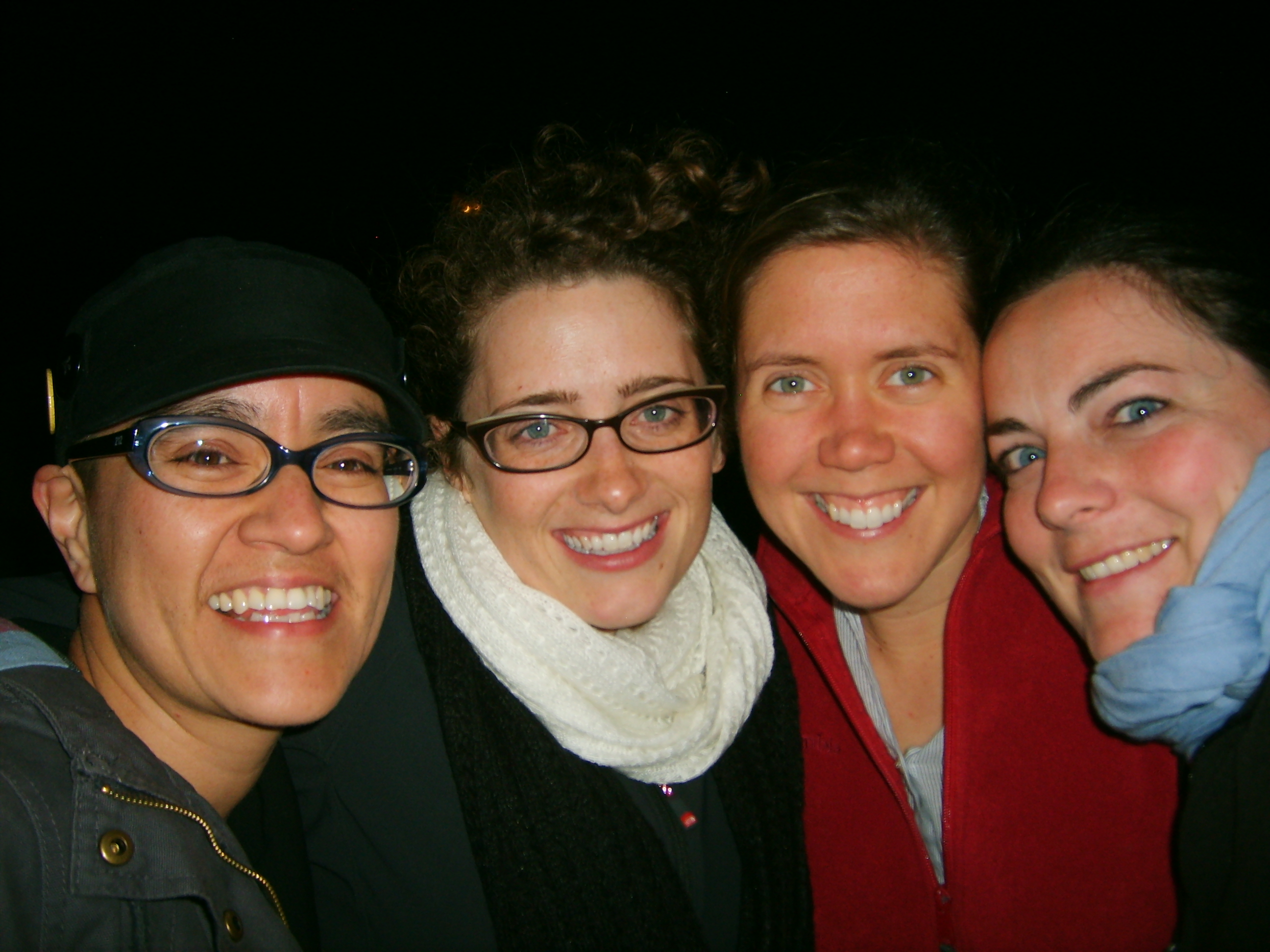
My peer-group, while being able to point out the blind spots and shortcomings on my work, never fail to recognize, honor, and express appreciation for my contribution as well. They hear me to speech and understand the importance of that for bringing out my academic best. Continue reading “Hearing Each Other to Speech in the Academy By Xochitl Alvizo”
 Feminism and Religion