We’ve just entered November, the beginning of winter, the season of darkness. Twenty-odd years ago, I led a group of students through the Wheel of the Year in a class I called Practicing the Presence of the Goddess. (I also wrote a book with the same title.
At Imbolc (February 1), we held a divination party at Louise’s house. At Beltane (May 1), we met at Rose’s house, painted our faces, created wreaths of fresh flowers to embody our summer wishes, and then carried our wreaths of flowers through the streets of Huntington Beach to the ocean, where we cast them into the tide. At Lammas (August 1), we harvested our gardens and cooked a feast in my kitchen.
“As I sat there, my heart overflowed with joy at the sight of the bright circle…for I know not where to look for so much character, culture, and so much love of truth and beauty, in any other circle of women and girls” – unidentified woman from Margaret Fuller’s “Conversations” (1)
In the early 19th century, the five women of Fuller’s book — Margaret Fuller, Elizabeth Palmer Peabody, Mary Moody Emerson, Sophia Peabody Hawthorne, and Lydia Jackson Emerson — built many of the foundations of both American feminism and the philosophical movement known as transcendentalism, among many other American “firsts.” Yet, they are almost unknown to most people today.
Daania and I met while outdoors on a walking trail. At first, we crossed paths and echoed to one another “have a great day.” But sometimes we paced our journeys together, engaged in conversation, and got to know one another. Daania does not celebrate Christmas. I do. We both celebrate the forces that move us with love and truth.
One day, Daania and I moved with swift steps because the weather outside was frigid. The frosty air did not keep us from talking. Even though heavy scarves were double wrapped around our mouths and ears, we proved skilled at interpreting our muffled chit-chat.
I looked for my friend, Pamela’s email the morning after she died. Every morning I have looked forward to her email from the day before — the last one sent at 4:37 on the Tuesday afternoon before Thanksgiving. Did she ever see my response sent at 6 AM the next morning – my wish for her to know joy this Thanksgiving, my sending much love? The bulk of it was full of mundanities. How differently might I have written it had I known it would be the last she would see? Our ongoing call and response email conversation — now without response, forever without response.
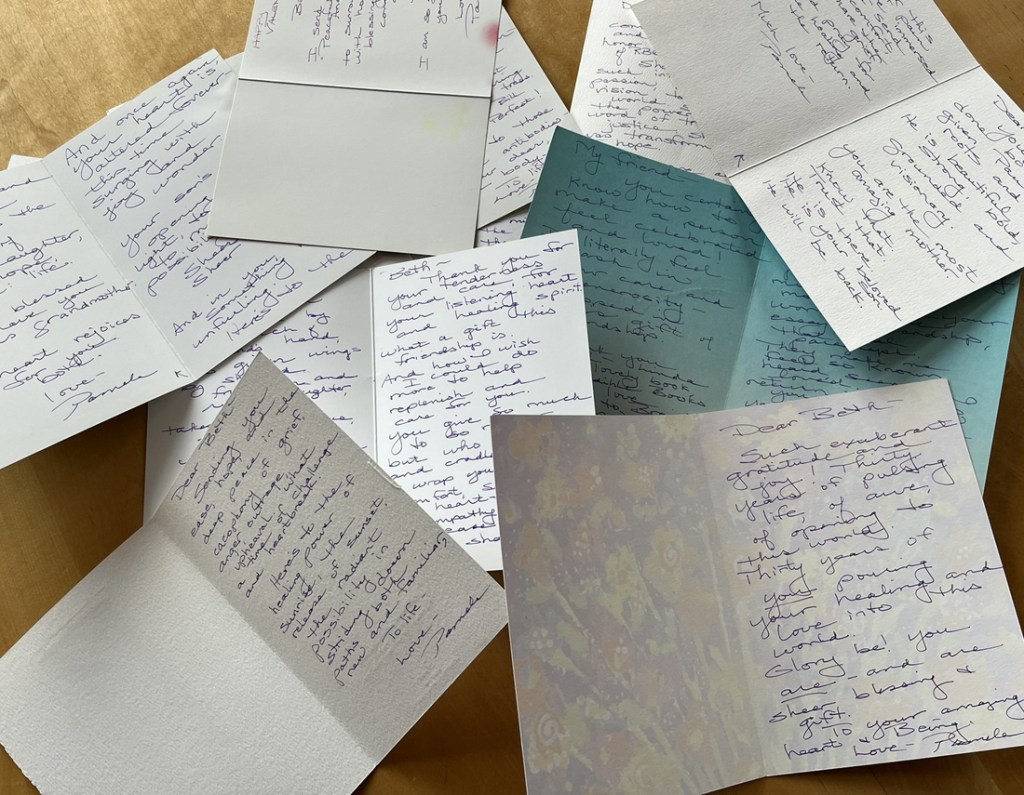
Ours was a friendship of words — words in the cards she has given me over the years, in her detailed responses to my blog posts, in the thousands of emails passed between us over several years. I’ve saved them all. They were too precious ever to delete. How we both loved words — their poetry, their capacity to communicate, convey, confound, console, comfort. I eagerly anticipated her words every day. For years I have entrusted my daily thoughts, worries, joys, activities, hopes, and the occasional dream to her tender care, always knowing her response would be a mirror, reflecting me back to myself, she reflecting on all I had written – giving witness and testimony, always with the deepest of care and affirmation. As Adrienne Rich wrote in the poem we both loved — “Phantasia for Elvira Shatayev” – I have never seen/my own forces so taken up and shared/and given back. Yes, this – the immensity, the intensity, the profound reciprocity of our sharing.
This was originally posted on April 20, 2015 and was updated by Carol on August 23, 2019
In recent weeks Judith Plaskow and I have been revising the manuscript of our new book Goddess and God in the World in preparation for sending it to the publisher. Yes, we have a publisher. We signed a contract with Fortress Press a short time ago. The book should be out in 2016.
We have been hard—and I mean very hard—at work revising the four chapters in the book that are jointly written. The versions have been going back and forth and forth and back as we revision what we want to say and revise each other’s revisions of the drafts we have. We both want the final manuscript to say things just right and it is very hard not to make one more set of (alleged) improvements.
In the process we have realized that while we often disagree on words and wording, we have come to think alike on a wide variety of issues to the point that it becomes hard to say who had the ideas first. In addition we have both become so familiar with each other’s positions that we can each easily articulate both sides of our dialogue on the issues on which we disagree.
On August 26, 1970, I borrowed an old VW bug from my mentor and summer employer Michael Novak to drive from Oyster Bay, Long Island to New York City to take part in the Women’s Strike for Equality march down Fifth Avenue. Some 50,000 women attended the march and another 50,000 took part in sister actions around the United States. The march celebrated the 50th anniversary of the passage of the Women’s Suffrage Amendment that gave women the right to vote. The ERA was on our minds, but it was not the only issue on the feminist agenda. We believed that all the walls created by patriarchy would come tumbling down, and soon!
On Winter Solstice, I hosted a Return of the Sun event at the local healing arts center where I do my Circles. We had offerings and presentations all night long. It was the first time I have ever done anything that large or public, so it was a stretch for me.
At the end of the night, a friend said, ‘Oh my, I needed this. Let’s do it once a month.’
And I thought, ‘yea, right.’
And then I thought, ‘Yea. Right.’
I’ve already started thinking about ways we could do it better and things we could change.
I feel a bit like when I first started hosting Circles nine years ago. I’m tired and judging whether or not it was worth the stress and effort.
But this time around I know it’s worth the stress and effort.
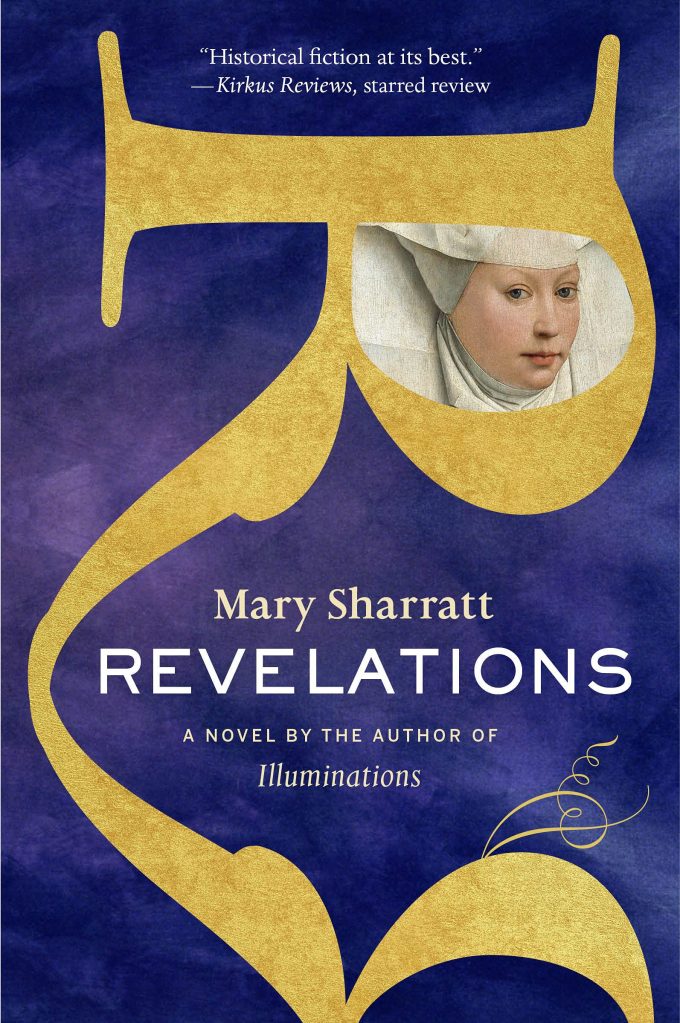
My novel Revelations, based on the intertwined lives of female mystics Margery Kempe and Julian of Norwich, will be released in paperback on April 19. You can order HERE.
“All shall be well, and all shall be well, and all manner of things shall be well.”
These words of Julian of Norwich, taken from her masterpiece of visionary theology, Revelations of Divine Love, seem almost tone deaf against our current backdrop of war and the ongoing pandemic. In a world like ours, with war criminals like Putin calling the shots, it’s so tempting to fall into either hardened cynicism or hopeless despair.
But Julian of Norwich was no naïve simpleton. Although an anchoress who had taken vows as a fully cognizant adult to wall herself into a cell built on to the back of Saint Julian’s Church in Norwich, England, she wasn’t living in some airy-fairy cloistered bubble. Her own age was riven by plague, war, and religious intolerance, which saw the burning of many perceived witches and heretics. Saint Julian’s Church (she took the name of the church, not the other way around) was located in a rough part of town near the river and the stinking tannery district where prostituted women and girls plied their trade.
Far from walling herself off from the world’s woes, Dame Julian had a window in her anchorage wall facing out into the street. Anyone might seek her counsel. She was famous throughout Britain for her sage advice. One of the many who poured her soul out to Julian was a desperate housewife and mother of fourteen children, who had finally plucked up the courage to walk away from an abusive marriage. This woman was none other than Margery Kempe, the heroine of my novel.
Margery had been experiencing sensual, visceral images of the divine for over twenty years. Now she had reached a crossroads in her life. She wanted to walk the mystic’s path and travel as a pilgrim to Jerusalem and Rome. But her choice to leave her family and travel the world as a solo woman was even more controversial and downright dangerous in her age than in ours.
It would have been so easy for a spiritual counselor to parrot the voice of conventional wisdom and tell Margery that her dream of pilgrimage was a self-indulgent folly and that her true calling was to serve her children as a conventional wife and mother.
Instead, Julian did something unheard of. She empowered Margery to trust herself, to trust the voice of spiritual wisdom within her own heart. She told Margery to set all her trust in the divine and not to worry too much what the world thought of her choice–if some people disliked Margery, perhaps that meant Margery was doing something right.
Julian didn’t promise Margery–or us, the readers of Revelations of Divine Love–an easy ride. In one of her searing visions, Julian received the message, “You shall not be overcome.” She wrote in her book, “Our Lord did not say, ‘You shall not be tormented, or troubled, or grieved’ but ‘You shall not be overcome.'”
Julian received her divine revelations around the age of thirty when she was deathly ill and thought she was going to die. Instead, she survived and dedicated the rest of her life to being a living witness to the exquisite divine love she had experienced.
We don’t have to be anchoresses or travel to Jerusalem to experience this deep love and wisdom. The deepest pilgrimage of all is the journey into the depths of our own hearts where divine love dwells eternally, in each one of us, regardless of our faith or spirituality. The sacred inside us can never taken from us.
The heart will always be there for us and it is only from the heart that we can bring peace and justice to our fractured world. By bringing our information-overloaded brains inline with the deep wisdom of the heart. By bringing our speech inline with the heart. By bringing all our deeds inline with the heart.
May we all be witnesses to the Divine Love within us.
“All shall be well and all shall be well, and all manner of things shall be well.”
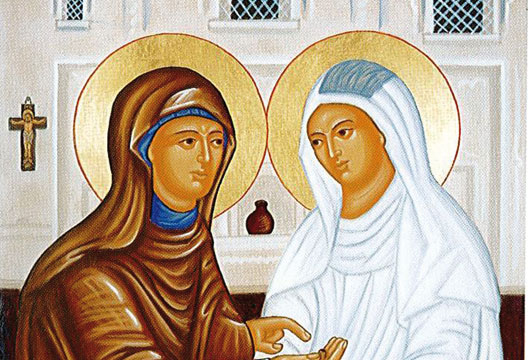
Julian of Norwich (left in her Benedictine habit) counsels Margery Kempe, who dressed all in white to mark her vocation as a mystic and pilgrim.
Mary Sharratt is committed to telling women’s stories. Please check out her acclaimed novel Illuminations, drawn from the dramatic life of Hildegard von Bingen, and her new novelRevelations, about the mystical pilgrim Margery Kempe and her friendship with Julian of Norwich. Visit her website.
, elders are people who have illuminated my path, inspired me to see my own potential. To open my eyes, all my senses, even those I did not know I had. Elders show bravery and model for us how to be strong.
What is an Elder?
The word elder comes from an Old English word which also meant ancestor or chief. A lot can change in a thousand years and many of us no longer honor older people or seek out them out for advice.
In my experience, elders are people who have illuminated my path, inspired me to see my own potential. To open my eyes, all my senses, even those I did not know I had. Elders show bravery and model for us how to be strong.
My first wise woman teachings came from my family. My mother, and her mother, taught me to be myself, to love being outdoors and the importance of having a garden. Feeling the joy of flowers, cooking with fresh herbs, planting a tree to honor the dead. These are a few ancient traditions of my ancestors that have survived even in a modernized and urban setting.
As I rediscover my connection with the earth, my eco-consciousness inspires me to transform. As I go back to nature, I re-awaken my ancient cellular memories of living in harmony with the earth. I feel called to dance barefoot, play drums, make offerings, bathe in moonlight, harvest with my own hands. As I move forward on a path which is both new and old, it is my beloved elders who have shown me how to find my way.
What is an Elder?
The word elder comes from an Old English word which also meant ancestor or chief. A lot can change in a thousand years and many of us no longer honor older people or seek out them out for advice.
In my experience, elders are people who have illuminated my path, inspired me to see my own potential. To open my eyes, all my senses, even those I did not know I had. Elders show bravery and model for us how to be strong.
My first wise woman teachings came from my family. My mother, and her mother, taught me to be myself, to love being outdoors and the importance of having a garden. Feeling the joy of flowers, cooking with fresh herbs, planting a tree to honor the dead. These are a few ancient traditions of my ancestors that have survived even in a modernized and urban setting.
We’ve just entered November, the beginning of winter, the season of darkness. Twenty-odd years ago, I led a group of students through the Wheel of the Year in a class I called Practicing the Presence of the Goddess. (I also wrote a book with the same title.




 Feminism and Religion