“thea-logy begins in experience” – Rebirth of the Goddess
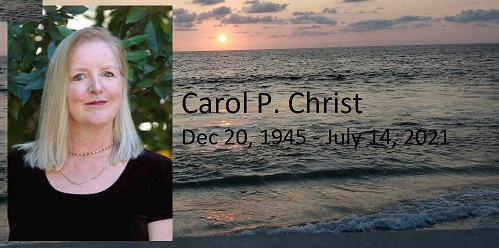
It is hard to believe that Carol P. Christ – Karolina as she dubbed herself in her beloved Greece—has been gone for a year. She remains such a vivid presence in my life—in all of our lives. I think of her and draw strength from those thoughts daily, the way so many women say they think of and feel close to their deceased mothers. For Karolina was indeed a mother to me—a nurturing spiritual mother who initiated me into the ways of the Goddess she adored and, whom she so beautifully defined as “the power of intelligent love that is the ground of all being.”
I first met Karolina in June of 1995 on a bare hotel rooftop in Athens. I had just flown there from New Orleans to join the Ariadne Institute’s Goddess Pilgrimage Tour, a leap of faith inspired by my reading the previous year of Weaving the Visions: Patterns in Feminist Spirituality, a pioneering anthology edited by Carol and her long-time friend and collaborator, Judith Plaskow. That book, along with Carol’s Diving Deep and Surfacing and Judith’s Standing Again at Sinai had spoken to me more deeply than anything I had ever read before. I had grown up in a Middle Eastern Orthodox Jewish family. drawn to spirituality, I had never able to find a place for myself in the deeply patriarchal structures of synagogue or even family rituals … Carol and Judith offered me a way in, and I wanted immediately to embark on the paths they were clearing. I wanted to meet them, to know them, to learn from them, to share with them. Boldly, I decided to join the Pilgrimage, signing up for my first trip overseas trip, the most costly vacation I had ever granted myself. How could I have known that it would transform my life and bless me with a miraculous, deep friendship?
This blog was originally posted on December 1, 2014
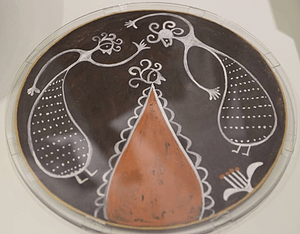
The image from an ancient Cretan bowl (c.1700 BCE) from the Sacred Center of Phaistos pictured here has often been interpreted as an early depiction of Persephone’s descent or rising. But are clues from later Greek mythology pointing in the right direction in this case?
Recently, my colleague Mika Scott posted the Phaistos bowl image on our Goddess Pilgrimage Facebook site in conjunction with the bee pendant from Mallia. This juxtaposition led me to think again about the importance of bees and pollination in agricultural societies and to offer an alternative reading of the symbolism on the bowl.
I’m on a mission to write women back into history, because, to a large extent, women have been written out of history. Their lives and deeds have become lost to us. To uncover their buried stories, we must act as detectives, studying the sparse clues that have been handed down to us. We must learn to read between the lines and fill in the blanks. My writer’s journey is about reclaiming the lost heroines of history and giving voice to that lost motherline.
Many of my novels address spiritual themes. As a spiritual person, I’m very interested in women’s experience of the sacred. As well as being written out of history, we women, for the past five-thousand years of patriarchy, have been side-lined and marginalized by every established religion in the world. Even in alternative spiritual movements, male teachers and leaders have abused their authority over their female students and followers.
But in every age, there have been women who have heroically rebelled against this patriarchal stranglehold to claim their authentic spiritual experience. Often it has involved looking within rather than without for spiritual guidance. Many of these women have been mystics.
What is a mystic?
The American Dictionary states that mysticism is the belief that it is possible to directly receive truth or achieve communication with the divine through prayer and contemplation. In other words, according to my personal definition, you don’t need a priest or other authority figure. The divine mysteries are within your own heart.
Some of the most famous mystics of the Western spiritual tradition have been women who plunged deep within their souls for spiritual guidance and emerged with ecstatic, prophetic, and radical insights.
Many of us imagine female mystics as cloistered women, like Hildegard of Bingen, but what would it be like to be a married woman with children and experience divine visions when you’re in the middle of making dinner or doing the laundry?
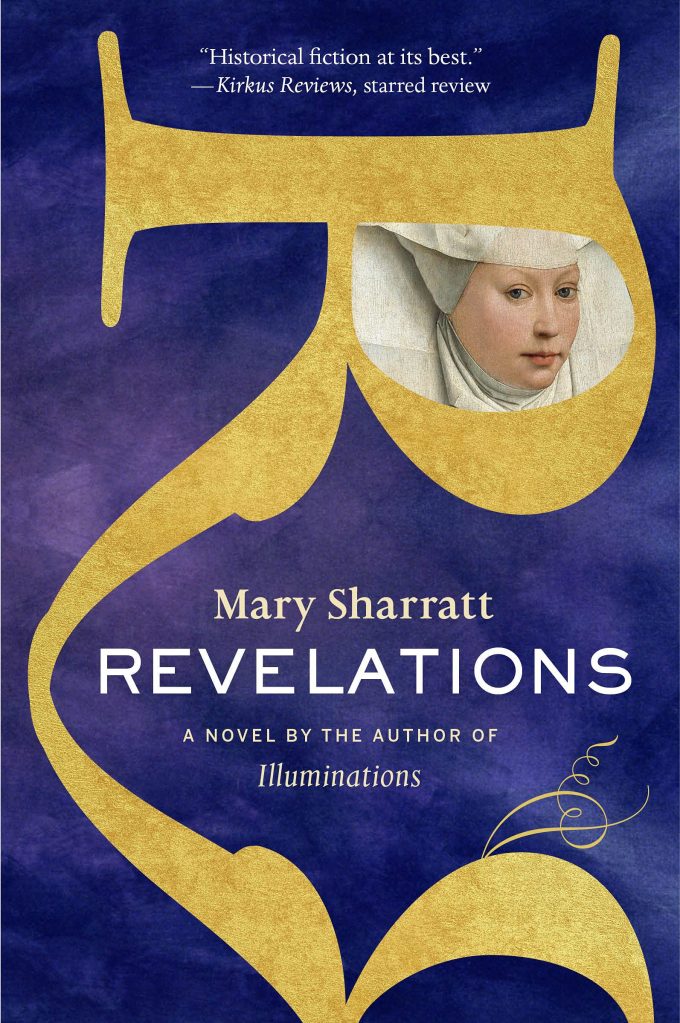
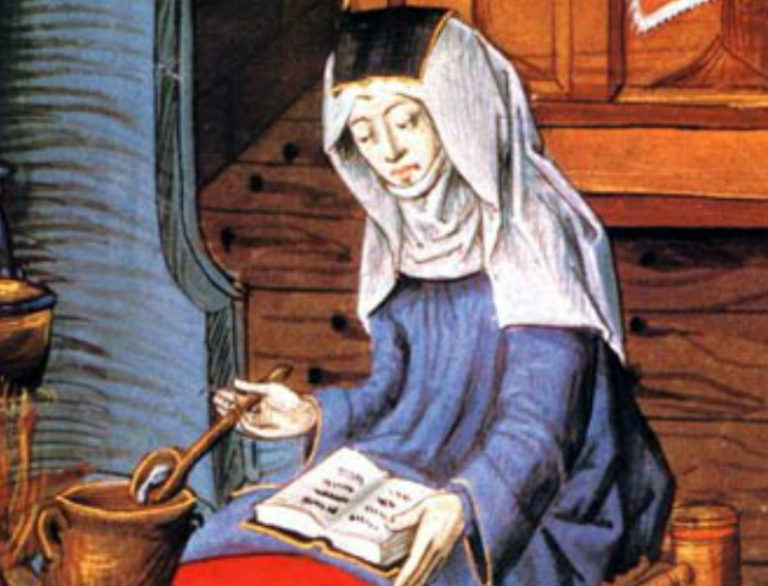
One of the most eccentric mystics of the late Middle Ages was a desperate housewife and failed businesswoman from Norfolk, England, named Margery Kempe (c. 1373 – after 1438). She is the heroine of my novel Revelations.
She ran a brewery and then a horse mill to grind grain, but both businesses failed. Around the age of 40, Margery had reached her breaking point. She was done. The mother of fourteen children, she feared that another pregnancy might kill her, but she couldn’t trust her husband to leave her alone, because canon law upheld his right to sexual congress without her consent. More than anything, Margery wanted to literally walk away from her marriage and go on pilgrimage to Jerusalem.
Since divorce wasn’t an option, she traveled to nearby Norwich to seek spiritual counsel from the anchoress Julian of Norwich, one of the greatest mystics of all time. Margery confessed to Julian that she had been haunted by visceral, body-seizing spiritual visions for the past twenty years. In my novel, Julian, recognizing Margery as a fellow mystic, made a confession of her own. She had written a secret book of her mystical visions, entitled Revelations of Divine Love, the first book in English written by a woman. In an age where heretics were burned at the stake, this was a dangerous text, describing an unconditionally loving God who appeared as Mother and threatened the established Church’s insistence on eternal damnation. Nearing the end of her life, Julian entrusted the book to Margery, who hid the manuscript in a secret compartment in her pilgrim’s staff.
With Julian’s blessing, Margery set off on the adventure of a lifetime to spread Julian’s radical, female vision of the Divine. Her travels took her to Rome, Jerusalem, and Santiago de Compostela. When she returned to England, she was arrested and tried for heresy several times and came close to being burned at the stake. The authorities couldn’t seem to handle this independent woman who traveled on her own and who dared to preach to other women in public. She preserved her story for posterity in The Book of Margery Kempe, the first autobiography written in English.
Margery offers inspiration for those of us who seek to live as mystics and contemplatives in the full stream of worldly life.
Mary Sharratt is committed to telling women’s stories. Please check out her acclaimed novel Illuminations, drawn from the dramatic life of Hildegard von Bingen, and her new novelRevelations, about the mystical pilgrim Margery Kempe and her friendship with Julian of Norwich. Visit her website.
Editor’s Note: A more formal memorial to Catholic Feminist Theologian Rosemary Radford Ruether was posted here at Feminism and Religion at the time of her passing. Now we are delighted to share these memories of her by two scholars, Theresa A Yugar and Janice L. Poss, who knew her well, especially in her last months. Therese’s reflection is below and Janice’s will appear tomorrow. As Janice notes in her post, “More than any deep theological concept, doctrinal exegesis, or other hyper-scholarly thought, she taught me simply by being who she was – a woman – and she gave me the ultimate gift, the gift of herself.” Through these posts, Theresa and Janice pass on some of Rosemary’s wise and caring gifts to our FAR readers.Part 1 was posted yesterday.You can read it here.
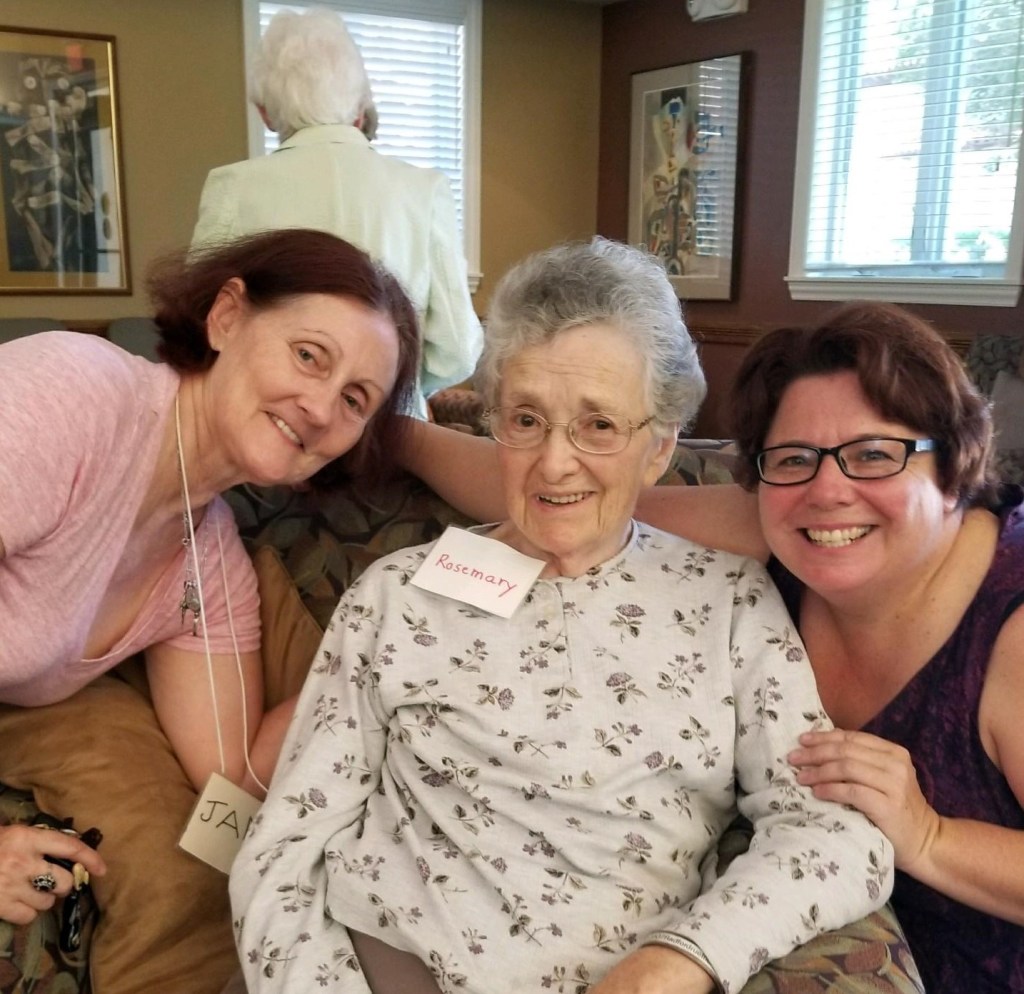
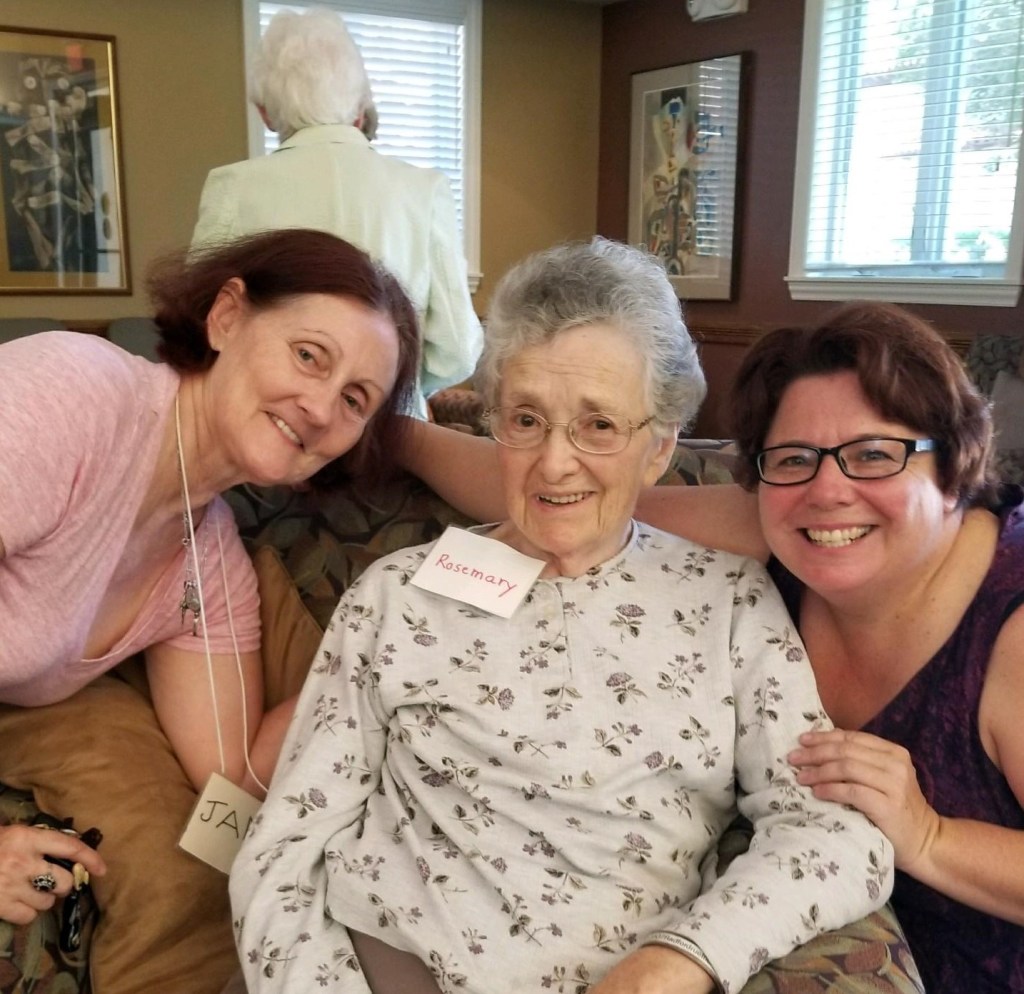
Janice, Theresa with Rosemary
Almost five years ago, Rosemary Radford Ruether suffered a devastating stroke that left her partially paralyzed and no longer able to speak or write, activities that were integral to her life as a writer, teacher, activist, and scholar. During her difficult last years Janice and I learned new ways of engaging her that were academically stimulating and fulfilling for her. We became advocates for her during her disability as she had been an advocate for us. Thus, out of pain grew blessings.
Janice and I dedicate and share with you these two short reflections that reflect our struggle to find our way without her. We know there will be many more reflections composed and shared by others whom she mentored, influenced and touched. Now—in the midst of our grief and sadness at her loss—we offer our personal memories of how she enriched our lives every day until she passed from our midst at 2pm, on Saturday, May 21, 2022.
Editor’s Note: A more formal memorial to Catholic Feminist Theologian Rosemary Radford Ruether was posted here at Feminism and Religion at the time of her passing. Now we are delighted to share these memories of her by two scholars, Theresa A Yugar and Janice L. Poss, who knew her well, especially in her last months. Therese’s reflection was posted yesterday and Janice’s is below. As Janice notes in her post, “More than any deep theological concept, doctrinal exegesis, or other hyper-scholarly thought, she taught me simply by being who she was – a woman – and she gave me the ultimate gift, the gift of herself.” Through these posts, Theresa and Janice pass on some of Rosemary’s wise and caring gifts to our FAR readers.
Janice L. Poss, Rosemary and Theresa A. Yuger
She’s gone, but not forgotten. She is there, presence felt. The Spirit, as they say, works in mysterious ways. I knew about Rosemary for several years after attending two presentations on feminist topics that she gave at Loyola Marymount University in 2005 and 2008. In 2006, I also recall hearing about her while organizing the first Roman Catholic Women Priests (RCWP) Mass in Los Angeles. Once I entered Claremont Graduate University as a Ph.D. student I heard quite a bit about her because my colleague and friend, Theresa Yugar, mentored me through orientation until she graduated. Occasionally I would see Theresa and Rosemary at Pilgrim Place when I attended Women Church Services. Although Rosemary was still teaching one class a semester, I could never attend because I was working full-time.
I recently completed a chapter for a book on Latinx theologies; it’s the second edition of the Wiley-Blackwell Companion to Latino/a Theology, edited by Orlando O. Espín, but this time with the slightly changed title of Companion to Latinoax Theology—aiming to be more inclusive in its umbrella term. The project has 35 contributors and covers everything from interreligious dialogue and care for creation, to race, racism and latinoax cultures, as well as chapters on such subjects as Christology, the bible, and ecclesiology. My particular chapter was about the intersection of gender, feminisms, and Latinoax theologies—not surprising. But what I loved in the process was a particular emphasis that emerged—decoloniality, like a thread woven throughout the chapter as it evolved; and this I now see as a necessity for Christian theologies. Let me explain.
Moderator’s Note: This was originally posted on September 19, 2016
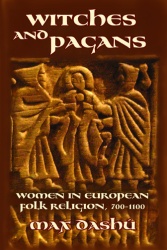
Max Dashu’s Witches and Pagans: Women in European Folk Religion 700-1000challenges the assumption that Europe was fully Christianized within a few short centuries as traditional historians tell us. Most of us were taught not only that Europe became Christian very rapidly, but also that Europeans were more than willing to adopt a new religion that was “superior” to “paganism” in every way. Careful readers of Dashu’s important new work will be challenged to revise their views. When the full 15 volumes of the projected series are in print, historians may be forced to hang their heads in shame. This of course assumes that scholars will read Dashu’s work. More likely they will ignore or dismiss it, but sooner or later–I dare to hope–the truth will out.
History has been written by the victors—in the case of Europe by elite Christian men. These men may have wanted to believe that their views were widely held, but Dashu suggests that they were not. Combing artistic and archaeological records, Dashu finds (to give one example) that images of Mother Earth nursing a snake are far from uncommon and can even be found as illustrations in Christian documents and on Christian monuments. Clerics rage against people—particularly women–who continue to visit holy wells and sacred trees and to practice divination and healing rituals invoking pagan powers. To paraphrase Shakespeare: “Methinks the cleric doth protest too much.” Were these things not happening and happening often, there would have been no need to condemn them. Using these clues, Dashu provides intriguing new readings of the Poetic Edda and Norse sagas.
Yet another of my great feminist and spiritual teachers has died. Rosemary Radford Ruether, ecofeminist Catholic theologian, died on May 21st. Her work challenged my thinking and gave me new understandings and perspectives. She was a prolific writer, authoring hundreds of articles and 36 books, and was the quintessential scholar and historian of world religions and ecofeminist thought and theologies. A scholar of the scholastics, she examined the three strains of Western thought: the Hebraic tradition; Platonic-Gnostic; and Pauline-Augustinian in all their complexities to develop an understanding of the nature of Western thought and its implications for the domination of women, nature, and colonized others. As she described her own approach, she drew out the contradictions and complexities in these theologies, careful “to see both negative and positive aspects . . . and to be skeptical of exclusivist views on either side.”[i] Her thought and writing was ever-expanding, and always striving “to see the dominant system of patriarchy, including its racism, classism, and colonialism, in critical perspective,” and to put herself “in places where in solidarity with its victims, I can see it from its underside.”[ii]To this end, she brought together the ecofeminist theologies of women from around the globe, particularly the global south.[iii] Her thought also grew to include critiques of militarism and corporate globalization. Needless to say, I cannot begin to encompass all of her contributions here. So I will focus on the ways her thought has most deeply influenced and inspired my own, as well as my students’.
I’m on a mission to write women back into history, because, to a large extent, women have been written out of history. Their lives and deeds have become lost to us. To uncover their buried stories, we must act as detectives, studying the sparse clues that have been handed down to us. We must learn to read between the lines and fill in the blanks. My writer’s journey is about reclaiming the lost heroines of history. My quest is to give voice to the ancestral memory of that lost motherline.
My novels address spiritual themes. As a spiritual person, I’m very interested in women’s experience of the sacred. As well as being written out of history, we women, for the past five-thousand years of patriarchy, have been side-lined and marginalized by every established religion in the world. Even in alternative spiritual movements, male teachers and leaders have abused their authority over their female students and followers.
But in every age, there have been women who have heroically rebelled against this patriarchal stranglehold to claim their authentic spiritual experience. Often it has involved looking within rather than without for spiritual guidance.
One of these women was Hildegard of Bingen, the heroine of my novel Illuminations. Born in the lush green Rhineland in present day Germany, Hildegard (who lived from 1098–1179) was a Benedictine abbess and one of the most accomplished people of her time. She founded two monastic communities for women, composed an entire corpus of sacred music, and wrote nine books on subjects as diverse as theology, cosmology, botany, medicine, linguistics, and human sexuality, an intellectual outpouring that was unprecedented for a 12th-century woman. Her prophecies earned her the title Sybil of the Rhine.
Hildegard’s vision of Sapientia, Divine Wisdom.
An outspoken critic of Church corruption, she courted controversy. Though women were forbidden to preach, Hildegard embarked on four preaching tours in which she delivered apocalyptic sermons warning her male superiors in the Church that they must reform their evil ways or suffer divine wrath. But she had to pay the price for being so outspoken. Late in her life, she and her nuns were the subject of an interdict (a collective excommunication) that was lifted only a few months before her death. Hildegard nearly died an outcast, her fate hauntingly similar to that of many canceled women in our contemporary cancel culture.
Hildegard’s theology of the Feminine Divine has made her a pivotal figure in feminist spirituality.
A key concept in her philosophy is Viriditas, or greening power, her revelation of the animating life force manifest in the natural world that infuses all creation with moisture and vitality. To her, the divine was manifest in every leaf and blade of grass. Just as a ray of sunlight is the sun, Hildegard believed that a flower or a stone was God, though not the whole of God. Creation revealed the face of the invisible creator. Hildegard celebrated the sacred in nature, something highly relevant for us in this age of climate change and the destruction of natural habitats.
I, the fiery life of divine essence, am aflame beyond the beauty of the meadows, I gleam in the waters, and I burn in the sun, moon and stars . . . . I awaken everything to life. Hildegard von Bingen, Liber Divinorum (Book of Divine Works)
Hildegard’s philosophy of Viriditas went hand in hand with her celebration of the Feminine Divine. Although the established Church of her day could not have been more male-dominated, Hildegard called God Mother, and said that she could only bear to look upon divinity in her visions if God appeared to her in feminine form. Her visions revealed God as a cosmic egg, nurturing all of life like a womb. Masculine imagery of the creator tends to focus on God’s transcendence, but Hildegard’s revelations of the Feminine Divine celebrated immanence, of God being present in all things, in every aspect of this greening, burgeoning, blessed world.
According to Barbara Newman’s book Sister of Wisdom: St. Hildegard’s Theology of the Feminine, Hildegard’s Sapientia, or Divine Wisdom, creates the cosmos by existing within it.
O power of wisdom! You encompassed the cosmos, Encircling and embracing all in one living orbit With your three wings: One soars on high, One distills the earth’s essence, And the third hovers everywhere. Hildegard von Bingen, O virtus sapientiae
This might be read as an ecstatic hymn to Sophia, the great Cosmic Mother.
Mary Sharratt is committed to telling women’s stories. Please check out her acclaimed novel Illuminations, drawn from the dramatic life of Hildegard von Bingen, and her new novelRevelations, about the mystical pilgrim Margery Kempe and her friendship with Julian of Norwich. Visit her website.
In recent conversations around abortion rights—spurred by a leaked draft of a Supreme Court decision that would overturn Roe v. Wade—everyone has opinions. The financially comfortable, often-white, often-evangelical women in my circles have opinions. And these opinions often involve the lives and choices of materially poor women and women of color.
In her recent book The Trouble with White Women: A Counterhistory of Feminism, Rutgers University professor Kyla Schuller profiles seven pairs of feminist activists over the last two hundred years. Each pair includes one woman who operated from a framework of white feminism—a framework that, according to Schuller, “consistently…wins more rights and opportunities for white women through further dispossessing the most marginalized.” And each pair includes a woman who embodied intersectional feminism—a feminism that “expose[s] sexism to be a powerful structure of systemic inequality and attempt[s] to untangle its deep threads with other forms of domination, while also building new practices of care, coalition, faith, and solidarity.”[1] This is not just history but a live tension in the present day.






 Feminism and Religion