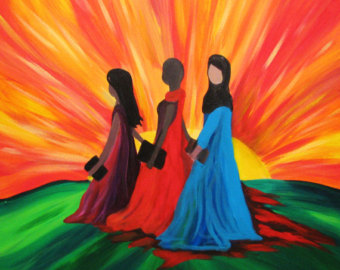
Can You Imagine a Society of Peace? by Carol P. Christ

Carol Molivos by Andrea Sarris 2As war and the fruits of war, including hatred and the desire for vengeance, threaten our human community, I take this opportunity republish a vision of a Society of Peace. If we cannot imagine a Society of Peace, we will never be able to create one. Can you imagine that:
As a child, you would not have to fight with your sisters or brothers for your father’s or your mother’s attention. You would not have one mother but many as you would be raised in a large extended family. Both girls and boys would be equally loved and cherished by their mothers and grandmothers and by their uncles and great-uncles. Both girls and boys would know that they would always have a place in the maternal clan. As a boy or a girl you would never have to “separate from” or “reject” your mother in order to “prove yourself as an individual” or in order to “grow up.” You could grow up without severing the bond with the ones who first loved you and first cared for you.

You would be raised in a large family with sisters and brothers and cousins, all of whom you would consider your siblings. You would never feel lonely. You would not be taught to compete with your siblings. You would never be hit by or hit others, because violent behaviors would not be considered appropriate in families. Continue reading “Can You Imagine a Society of Peace? by Carol P. Christ”

Was Mother Kalawati a Feminist? (Part 2) by Vibha Shetiya

VibahContinued from Part 1.

After leaving her home and her children in order to take refuge with her guru, in no time, Rukmabai won over hearts. Her guru, Siddharood Swami “with his divine sight” discerned that Rukmabai was no ordinary being. In fact, just before his death, upon realizing that his principle disciple had attained moksha (liberation from the cycle of death and rebirth), he left to her his mission of guiding others to salvation, directing his followers to now address her as Mother Kalawati.

And so it came to be that at the tender age of twenty-one, Rukmabai had a large following herself, and as an intense devotee of Krishna, she almost became synonymous with the god. As many like to point out, she had already internalized the attitude of non-attachment, whether towards individuals, possessions or food or drink; she was already enlightened.

Her disciples were both male and female, although she dedicated herself to the well-being of women. But while directing minds towards god, Kalawati Aai – a high class and high caste woman – also dedicated herself to uplifting the poor and backward Bohari community of Belgaum, Karnataka. It is said that the men used to wile away their time drinking and gambling leaving the womenfolk to run the household. Because of Kalawati Aai’s intervention, some order was brought to their lives; the men stopped drinking, which in turn put an end to the physical abuse they had heaped upon their wives, as well as the neglect their children had faced, who earlier had no choice but to turn to vagrancy. Stability in the homes through prayer and piety – in other words channeling their minds away from vice and towards god – in turn saw not just an economic change but also a change in the lives of these women and children, for the better.

But – and this is interesting – her message to women was not one of directing energy towards god in search of inner peace or salvation, but towards the family, of being a virtuous wife and mother. In fact, she urged women to put aside “just one hour a day of your life to the service of god”; the rest of the time should be aimed towards serving the family. And her advice to women unhappy on account of their domestic life would always be to look deep within themselves to remedy the situation, rather than to blame their husbands. Moreover, at no point should a woman ever neglect her duties towards family on account of her own well-being for that would be tantamount to selfishness. I find this most interesting because she herself broke norms in order to serve a personal calling. Continue reading “Was Mother Kalawati a Feminist? (Part 2) by Vibha Shetiya”

On the Syrian Refugee Crisis: Unity not Fear by Gina Messina-Dysert

Gina Messina-Dysert profileIn the midst of the Syrian refugee crisis, our humanity is being tested and we are not fairing so well.  Twenty-six US senators have called to refuse entry for refugees in their states, presidential candidate and governor of my home state of Ohio, John Kasich included.

Speaker of the House Paul Ryan who claims to be deeply committed to Catholic social teaching, argues that we must “pause” in responding to Syrian refugees so there can be greater scrutiny.

Presidential candidate Mike Huckabee has also continued his deplorable speech and xenophobia saying “How come they never end up in the neighborhood where the limousine liberal lives? …Behind gated communities and with armed security around. Mrs. Clinton, you have suggested we take in 65,000 refugees. How many can we bring to your neighborhood in Chappaqua?” Continue reading “On the Syrian Refugee Crisis: Unity not Fear by Gina Messina-Dysert”

Friendships That Save Lives: For Rita M. Gross 1943-2015, by Carol P. Christ

Carol Eftalou - Michael HonnegerWhen Rita Gross visited me in Lesbos two summers ago, we spent many long hours discussing our lives and work. Rita and I met at the Conference of Women Theologians at Alverno College in June, 1971 when we were young women. We did not know it then, but our lives would continue to be intertwined through our common interests, first in the Women and Religion section of the American Academy of Religion, and then through our work on Goddesses and feminist theology.

When we met, Rita was a convert to Judaism working on her dissertation on Australian Aboriginal women’s religious lives, and I was a Christian about to begin a dissertation on Elie Wiesel’s stories that would lead me to express my own anger at God. Continue reading “Friendships That Save Lives: For Rita M. Gross 1943-2015, by Carol P. Christ”

Truth in Storytelling by Elise M. Edwards

“[ShakespElise Edwardseare] was an alright writer.  I did not always understand him, but some things he said were beautiful and he made some things so clear the way he explained people.  But one thing he was wrong about.  That ‘To be or not to be?’  is not the first question. ‘What is the truth?’ – that is the question!  Then ‘To be or not to be?’  is the second question.”

-from “Feeling for Life “ in Some Soul to Keep by J. California Cooper

This past weekend, I taught a lesson for an adult church group about Christian imagination in the short stories of J. California Cooper. The quote above comes from one of her stories. I was invited to teach a lesson as part of a series on exploring God through literature. It was a delight to participate for several reasons.

Continue reading “Truth in Storytelling by Elise M. Edwards”

Buddhism and Feminism: Is Female Rebirth an Obstacle? by Rita M. Gross

rita1Feminist foremother in the field of women and religion and Buddhist feminist theologian Rita Gross died on November 11, 2015 in her beautiful home in Eau Claire, Wisconsin, surrounded by symbols of Buddhist art and the loving presence of her cats. Rita suffered a massive stroke in late October, and in accord with her wishes to refuse extraordinary care, she was provided with hospice care in her home, which kept her comfortable as she died. Those who were with her said that she entered into an advanced meditative state in her last days.

In gratitude for her life and work, FAR republishes her reflections on the Buddhist notion that female rebirth is an obstacle.

Buddhist teachings recommend appreciating obstacles because they are helpful to our practice.  Without obstacles we would never develop profound understanding or compassion.  Buddhists have also frequently claimed that female rebirth is an obstacle.  If obstacles are of great benefit, shouldn’t women, who encounter more obstacles than  men, rise to the top of the hierarchy of  revered Buddhist teachers? But that has not happened.

Is this obstacle actually of benefit to women, as teachings on the helpfulness of obstacles would suggest? After practicing Buddhism for almost forty years, I have come to appreciate how much the many obstacles I faced over the years have taught me.  For a woman of my generation (born 1943), none has been greater than the limitations placed on me as a woman, both by Western culture and by Buddhism.   Continue reading “Buddhism and Feminism: Is Female Rebirth an Obstacle? by Rita M. Gross”

DO RELIGIONS HAVE AN “ESSENTIAL” “CENTRAL” CORE THAT IS–OR IS NOT–SEXIST? by Carol P. Christ

Carol Eftalou - Michael HonnegerThough often asked, this is the wrong question.  Every statement about the “essential” or “central” teaching of any religion is based on a prior interpretation rooted in a particular standpoint. Thus, the idea that there is a “central” or “essential” core in any religion is not a matter of fact, but rather a matter of interpretation.

In discussions of religions, we often make global statements about our own and other religious traditions, such as: “Christianity is patriarchal to its core,” or alternatively, “The core teaching of Christianity is to love God with all your heart and your neighbor as yourself.” Or: “The true Islam teaches that God is love,” or alternatively, “Islam always teaches the subordination of women.”

These sorts of claims are made from time to time here on Feminism and Religion too. Every global statement that a particular religion “is” or “ is not” oppressive, calls someone to assert the opposite in the comments. I believe that statements about the “true” nature of any religion should should always be qualified. Continue reading “DO RELIGIONS HAVE AN “ESSENTIAL” “CENTRAL” CORE THAT IS–OR IS NOT–SEXIST? by Carol P. Christ”

CROSSING THE SEA OF DEATH by Carol P. Christ

carol p. christ photo michael bakasI am washing wet clothes cast off by refugees who crossed the Sea of Death, the new name for the channel only 4 nautical miles wide that separates Turkey and Lesbos. A tiny pink long-sleeved shirt with a boat neck, for a girl, size 3 months. The channel was relatively safe in the spring and summer, even though people were pushed into black rubber dinghies wearing illegal life jackets that would not float. A pair of leggings with feet, grey with pink, orange, brown, white, and blue polka-dots, to be worn over diapers. North winds have made the journey treacherous.

I am not on the front lines, pulling wet children alive and dead from the sea. I think my heart would break. Tiny black stretch pants with nylon sequined bows at the knees, size 2 years. My friends were in the harbor when an overcrowded fishing boat collapsed, throwing 300 people into the sea. Two pairs of children’s underpants, one navy blue, the other turquoise. They pulled babies from the waves and tried to revive them. Small stone-washed blue jeans decorated with rhinestones, for a little girl. They were wet and cold. Their clothing was removed. They were wrapped in blankets. Red knitted leggings with black hearts and white reindeer. Some survived after spitting out the sea’s water. Blue leggings with feet, blue with white and beige stripes, for a boy. The newly donated ambulances do not carry oxygen. Continue reading “CROSSING THE SEA OF DEATH by Carol P. Christ”

Holy Women Icons: Arts and Spirituality on Retreat by Angela Yarber

angelaI’ve noticed some growing trends in feminist spirituality. Recently, I’ve encountered several feminists who have attended virtual retreats from the comfort of their homes. I’ve also been overwhelmed by the number of clergy, scholars, and feminists who have begun coloring. Psychologists claim that coloring can soften stress, relieve anxiety, and be source of playful meditation for adults in an otherwise chaotic world. Similarly, doctors have long pointed to the emotional and physical importance of meditation, spirituality, or prayer in remaining balanced, relieving stress and anxiety. As feminists dwelling in a cisheteropatriarchal world, the need for such balance is even more important. It is these noticings that have led me to write this post.

A fabulous church that cares deeply about inclusion, social justice, and the arts is hosting an exhibition of my Holy Women Icons with a folk feminist twist for the month of October and throughout the month, I’m leading several retreats. While planning these retreats, I couldn’t help but think of the Feminism and Religion community. We are spread throughout the world, offering encouragement and challenge online every day. We have different struggles, spiritual paths, and backgrounds, but we gather on this blog to reconcile two seemingly paradoxical parts of our beings: feminism and religion. I have yet to develop these thoughts fully and I’d like to rely on you to share your input and ideas in the comments section about how we can “retreat” together virtually. With this in mind, I’d like share a bit about the Holy Women Icons Arts and Spirituality retreat I’m leading and invite you to participate at home. The entire retreat takes about 3 hours, or you can break it into 4 sections for shorter periods of time. So, if you’d like, play some music to set the mood, light a candle, and get out some paper, scissors, writing utensils, and crayons/markers, and let’s “retreat” together…

Continue reading “Holy Women Icons: Arts and Spirituality on Retreat by Angela Yarber”

Reform? Progress? By Elise M. Edwards

Elise EdwardsIn my class yesterday (a survey of Christian thought and practices), I was lecturing about monastic life in the Middle Ages. Among other points, I mentioned that medieval religious orders provided settings where women could be educated and assume leadership roles (primarily among other women), thinking of Hildegard of Bingen (1098-1179) who was the Abbess of a monastic community in Rupertsberg. Other women medieval writers who developed influential writings, like Mechtild of Magdeburg (ca. 1210-1282) and Catherine of Siena (1347-80), belonged to tertiaries or third orders, which were monastic community for laypersons. This part of the lesson emphasized that monastic reforms around the 12th century opened religious orders more extensively to women and laity.

Still speaking of medieval reforms, I displayed a picture of Francis of Assisi on the screen at the front of the room. I mentioned that Francis was concerned about the poor and the animals and that he has inspired some contemporary Christians, including the current pope who took Francis as his name. We talked about how both St. Francis and Pope Francis are seen as reformers.

Because earlier in my lesson I’d made a point of speaking of women’s experience, when I spoke about the Pope’s name as a possible sign of renewal or reform, Gina Messina-Dysert’s question “What about the women?” came to mind. In her recent post, she responded to the Pope’s exclusion of many issues that concern women in his address to the US Catholic Bishops. Like Gina, I applaud many of the Pope’s reforms but I am confused about how rarely he is criticized for maintaining the long-held Catholic view that disallows women to be ordained as priests.

Let me provide an example: During the Pope’s visit to the US, one of my students described Pope Francis as “very liberal.” When I interjected that he has not supported the ordination of women, the student laughed and said the pope would be accused of heresy for supporting that! While that may be true, my more immediate concern was that in a classroom of students who are mostly supportive of women in ministry, the Catholic restrictions on the priesthood were seen as a part of the tradition not worth challenging. Why is it that preserving male leadership is excused as a part of the tradition while preserving exclusive marriage practices is something to be challenged? They are interrelated.

As we know from blogs and social media sites, many people who support LGBTQ rights were upset over news stories about the Pope meeting with Kim Davis, the county clerk who was jailed for refusing to issue marriage licenses to same-sex couples. Certainly such a meeting is disturbing to same-sex marriage advocates. But is it surprising? At least one womanist ethicist I know, Eboni Marshall Turman, pointed out in a Facebook discussion that the church has long since been public in its support of male privilege and heteronormativity. My intent is not to single out Catholicism for sexist practices. When recently asked about women’s ordination and leadership in Baptist churches in my own town of Waco Texas, I had to admit that even though ordination of women is permissible and practiced in many of the churches, the number of churches that have called women to the position of senior pastor is shockingly few.

My point is this: When we find teachings in particular religious traditions that justify the exclusion of one group, we should expect to find justifications for excluding other groups, too. In the same discussion I referenced above, Eboni Marshall Turman said, ”Oppressions are compounded and intersectional. If they come for me, it is just a matter of time before they come for you. This is basic theological ethics.”

The experiences of varied groups are not the same; our oppressions and marginalizations also differ. But practices of exclusion are constructed on the same logic that values some persons (the in-group) more than others (the outsiders). Therefore, feminists have a responsibility to advance the well-being and interests of other groups (besides women) who are being marginalized.

Another reason for this advocacy is that many women are included in other marginalized groups. To ignore the intersectionality of oppression is to deny its pervasiveness and the realities of women’s lives. This is why feminists of color are often critical of white feminism. (The recent debate over the photo shoot for the movie Suffragette is a new instance of a persistent critique of white or mainstream feminism. See Rebecca Carroll’s piece on “Suffragette’s Publicity Campaign and the Politics of Erasure”).

To counter the limitations of our own experiences and be consistent in our pursuit of equality, feminists should intentionally cultivate practices of solidarity and coalition-building in our work. I, like everyone else, am often unable to see the inconsistencies in my own practices and teachings without others’ experiences to expand my view. This is one reason I value this Feminism and Religion community. Thank you for the wisdom and practices you offer from your own religious traditions and your own experiences of marginalization. You make me a better feminist through your writings and comments.

Perhaps working together, we can bring about religious reforms that our descendants will recognize in the centuries to come.

Elise M. Edwards, PhD is a Lecturer in Christian Ethics at Baylor University and a graduate of Claremont Graduate University. She is also a registered architect in the State of Florida. Her interdisciplinary work examines issues of civic engagement and how beliefs and commitments are expressed publicly. As a black feminist, she primarily focuses on cultural expressions by, for, and about women and marginalized communities. Follow her on twitter, google+ or academia.edu.