From the Archives: Medusa and Athena: Ancient Allies in Healing Women’s Trauma by Laura Shannon

This blog was originally posted on June 24, 2017

Rather than being a bleeding image of female disempowerment, Medusa may be read as…one of the most ancient European symbols of women’s spiritual abilities… [and] an empowering image of feminine potential.’

–Patricia Monaghan, O Mother Sun! (1994:244)

The name Medusa means ‘sovereign female wisdom,’ ‘guardian / protrectress,’ ‘the one who knows’ or ‘the one who rules.’ It derives from the same Indo-European root as the Sanskrit Medha and the Greek Metis, meaning ‘wisdom’ and ‘intelligence.’ (1) Metis, ‘the clever one’, is Athena’s mother. Corretti identifies Athena, Metis, and Medusa as aspects of an ancient triple Goddess corresponding respectively to the new, full, and dark phases of the moon. (2) All three are Goddesses of wisdom, protection, and healing.
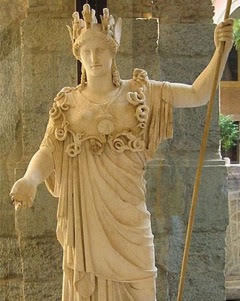
Athena with Gorgoneion in her heart. 5th C BCE.

Athena and Medusa are particularly linked: indeed, one may have been an aspect of the other, ‘two indissociable aspects of the same sacred power.’ (3) Their many common elements include snakes, wings, a formidable appearance, fierce eyes and powerful gaze. The serpent, like the Goddess, has been cast as an embodiment of evil in patriarchal retellings; yet as Merlin Stone points out, serpents were ‘generally linked to wisdom and prophetic counsel’, associated with ‘the female deity’ and ‘entwined about accounts of oracular revelation…throughout the Near and Middle East.’ (4) According to Ovid, the poisonous vipers of the Sahara ‘arose from spilt drops of Medusa’s blood.’ (5) Although this is presented as a further sign of Medusa’s horrifying character, the original Berber inhabitants of North Africa – where Herodotus reports that the Medusa myth began – viewed snakes as bringers of luck and portents of joy. (6)

Continue reading “From the Archives: Medusa and Athena: Ancient Allies in Healing Women’s Trauma by Laura Shannon”
From the Archives: The Quality of Mercy by Barbara Ardinger

This was originally posts on October 4, 2020. You can see the original comments here.

The quality of mercy is not strained;
It droppeth as the gentle rain from heaven
Upon the place beneath. It is twice blest;
It blesseth him that gives and him that takes…

This speech (Act IV, scene 1) from The Merchant of Venice, given by Portia in disguise as a boy lawyer (and Bassanio doesn’t even recognize her!), may be one of Shakespeare’s most famous. In the play, as we know, Shylock, a Jewish moneylender, and Antonio, a merchant waiting for his ships to come in, make a bargain, one part of which is that if Antonio doesn’t pay on time, Shylock gets to collect one pound of his flesh. Antonio’s ships don’t come in, the case is taken before the Duke of Venice, and Portia appears in disguise to solve the legal issues. She goes immediately to Shylock and speaks this speech to him.

Continue reading “From the Archives: The Quality of Mercy by Barbara Ardinger”

Carol P. Christ’s Legacy: Please Keep It in Your Pants by Carol P. Christ

This blog was originally posted on November 6. 2017. You can read the original comments here.

Trigger warning: this post describes sexual abuse

Last week while responding to a comment on my blog, I suddenly remembered a series of incidents in which men I did not know exposed themselves to me in public places. The first time occurred at a park around dusk during an outing with a group of girls. I was about 11, I may have wandered away from the group, or I may have been with others. What I remember is seeing a man with his pants down sitting on a park bench, possibly the first time I ever saw an adult man’s penis. I told or we told, but the man was not reported by the adults. Fast forward to the beautiful gardens of the Palace Schoenbrunn in Vienna where I was confronted by a penis while lost in thought when I was 19. I ran, but said nothing. In my 20s at the early showing of movies in New York City men would sit next to me and jerk off into paper bags. I learned to move whenever a man was near me in the theater, but I never told the ticket seller. A few years later, I crossed paths with a man who had his penis out on my favorite walk in the hills of Alum Rock Park in San Jose. I never walked carefree in that park again. When I was looking for the cave of the Furies on the Acropolis Hill in Athens, a man followed me waving his penis. I told the guard, but when the police came, he was gone. I arrived home in distress. My boyfriend said I was over-reacting. I learned to stay clear of men in cars on the streets of Athens at night after seeing things I did not want to see more than once in their hands. I coded this behavior as part of the background of my life. There was a man who from the basement apartment a few doors up from the Cycladic Museum pressed his erect penis against the window. I told the guard at the museum who said, “We have called the police more than once, but he always cries, and they let him go.” On a trail I had walked many times with my dogs near Lafionas in Lesbos, coming around a bend, I encountered a young farmer, who as soon as he saw me, pulled out his penis and urinated against a fence. That was the last time I walked the trail. We are supposed to learn to consider this behavior as well, if not normal, anyway, not such a big deal. After all, I wasn’t hurt, or was I?

Continue reading “Carol P. Christ’s Legacy: Please Keep It in Your Pants by Carol P. Christ”

white femininity: whitemalegod’s secret weapon By Christena Cleveland, PhD

For the first several weeks of my walking pilgrimage, I debated whether to visit the famous Black Madonna of Orcival. It wasn’t the walking distance that deterred me; She lived in a gorgeous Romanesque cathedral nestled in a charming medieval mountain town only fifteen miles away. Rather, I was hesitant to visit Her because I knew that, after a thousand years of being Black, She had undergone a mid-twentieth-century “renovation and restoration” process that whitened Her skin. I knew from photos that Her once gorgeous melanated skin was now a ghastly beige-ish pink. The incredible Black Madonna of Orcival now appears to be a white woman.

Continue reading “white femininity: whitemalegod’s secret weapon By Christena Cleveland, PhD”

From the Archives: Rape is Not a Political Platform – Rape is a Violent Crime! By Michele Stopera Freyhauf

Moderator’s note: This marvelous FAR site has been running for 10 years and has had more than 3,600 posts in that time. There are so many treasures that have been posted in this decade. They tend to get lost in the archives. We are beginning this column so that we can revisit some of these gems. Today’s blogpost was originally posted August 23, 2012. You can visit it here to see the original comments.

Just when you think you have heard it all, here we go again – another politician with “open mouth-insert foot” syndrome.  Discussing his zero-tolerance policy for abortion, Missouri Representative Todd Akin made the following statement last Sunday about pregnancies that result from rape:

“from what I understand from doctors, that’s really rare.  If it’s a legitimate rape, the female body has ways to try to shut that whole thing down.  But let’s assume that maybe that didn’t work or something.  I think there should be some punishment, but the punishment ought to be on the rapist and not attacking the child.”

Continue reading “From the Archives: Rape is Not a Political Platform – Rape is a Violent Crime! By Michele Stopera Freyhauf”

The Lady of Saint Serin by Sara Wright

I just learned about Jen Taylor who is a singer and songwriter and a woman who embraces the goddess. Her philosophical work focuses on re-wilding the body/mind – returning us to our source.

Jen Taylor writes:

“Statue-Menhirs are sandstone standing stones that were carved about 5000 years ago. They are also known as slabs or anthropomorphic steles (my italics). They are the earliest life-size representation of human beings known to date, appearing across Africa and Eurasia, engraved or carved in low-relief on both sides. Over 100 menhirs were found in the area of Southern Aveyron, France alone. 

Continue reading “The Lady of Saint Serin by Sara Wright”

From the Archives: The Feminist Toolbox by Marie Cartier

This blog was originally posted on April 4, 2012. There were a significant number of comments which you can read here.

Photo of Marie Cartier by Lenn Keller

This spring I am teaching “Feminist Ethics” at California State University Northridge. For the students’ midterm and final we are doing an innovative project that we want to share with the “Feminism and Religion” blogging community. My students have been asked to find a problem in the public world, or their private world, that they wish to interact with and provide a solution for. The solution can solve the problem or a piece of the problem. They must deconstruct the problem and then construct the solution for the midterm. For their final they actually must *do* the solution.

In creating their solution, they must address and use the tools in what I call “the Feminist Ethical Toolbox.” These tools are ones we have been extracting from the class readings (so far we have read the anthologies Feminist Theological Ethics, and Feminist Ethics and Social Policy, and Carol Gilligan’s philosophical treatise on the patriarchy, In The Deepening Darkness, and the students have been using the toolbox and its accumulated (and accumulating) tools throughout the class, in their own lives, and interacting with the toolbox in the reading response journals in terms of looking at wider world issues.

Continue reading “From the Archives: The Feminist Toolbox by Marie Cartier”

Scars Of The Body by Mary Gelfand

Despite the distances involved, throughout my adulthood, I regularly visited my parents.  As their home was small, I often found myself seated at the kitchen table with my mother while my father watched TV in the adjacent living room. During those visits, it was not unusual for my mother to come and stand behind me and begin working her fingers into my thick dark hair. 

I knew why she did this—she was looking for my scars, hidden under the abundance of my hair but still visible to those with patience. Two scars are hidden by my hair.  When I was three, I received a glancing blow from a horse’s hoof which cut my scalp causing it to bleed profusely. When I was six, I fell out of a tree in our back yard and cut my scalp again. Maternal fingers remembered where those scars should be, and Mom would weave her fingers through my hair until she found each scar.  Then she would lovingly stroke each spot several times and return to her seat.  Even at the time it seemed like she was offering a blessings to my wounds.

Continue reading “Scars Of The Body by Mary Gelfand”

Eden, Eve and a Tale of Seeds by Janet Maika’i Rudolph

Last month I wrote about the Garden of Eden. You can read it here:

In that post, I described how Eden is essentially a garden of treasures. What are those treasures? I believe that they are seeds, the most prolific and creative element for spreading life here on Earth. Below is my own fantastical story about the Garden and how the seeds came to reside there.

Sinuous and serpentine, Hawwah, Hayyat, Eve emerged from Apsû, carrying within her seeds, fertilized eggs, and all the fruitfulness and abundance therein. 

Continue reading “Eden, Eve and a Tale of Seeds by Janet Maika’i Rudolph”

Carol P. Christ’s Legacy: Who Is Gender Queer?

Moderator’s Note: Carol Christ died from cancer in July, 2021. Her work continues through her non-profit foundation, the Ariadne Institute for the Study of Myth and Ritual and the Goddess Pilgrimage to Crete. This blog was originally posted March 2, 2015. You can read its original comments here. It is being paired with an archive post tomorrow from Dr. John Erickson who responded to Carol with his own blogpost.

“It seems to me that calling oneself queer can be a way of affirming the parts (or all) of oneself that do not fit into the heteronormative paradigm. In my case, though I am white and straight, I am too tall, too smart, too assertive, too strong, too bold, too flashy, too unwilling to be controlled by men to fit the heteronormative paradigm of woman as in every way a little less than man–not as tall, not as smart, not disagreeing too much, not putting herself forward too much, not taking too many risks, not standing out in a crowd, and at least letting men think they are in charge. From this perspective, a whole lot of women are queer.”*

Continue reading “Carol P. Christ’s Legacy: Who Is Gender Queer?”