From the Archives: Artio, Celtic Goddess of Wild Life, Transformation and Abundance by Judith Shaw

This blog was originally posted August 26, 2015. You can read the original comments here.

Artio, Celtic Goddess of Wild Life, Transformation, and Abundance, is one of the more obscure goddesses in the Celtic pantheon.  She is often shown with baskets of plenty and surrounded by animals.  Artio is frequently depicted as a bear. Her name comes from the old Celtic word for bear, arth(e), which the Romans Latinized to artos.

Artio arrived in western Europe with the Helvetii a Celtic tribe who migrated to Switzerland around 450 BC.  They worshiped Her as the “She-Bear”.

But Her origins could be even older than that.  Some feel that the bear is the oldest European deity as bones and skulls of bears have been found lovingly arranged on niches found in caves across Europe.  In 1840 in Ireland, during the restoration of Armagh Cathedral, ancient, small stone carvings of bears were found.

Continue reading “From the Archives: Artio, Celtic Goddess of Wild Life, Transformation and Abundance by Judith Shaw”

I’m Not “Fit” to Judge Another Woman’s “Fit”ness by Liz Cooledge Jenkins

In recent conversations around abortion rights—spurred by a leaked draft of a Supreme Court decision that would overturn Roe v. Wade—everyone has opinions. The financially comfortable, often-white, often-evangelical women in my circles have opinions. And these opinions often involve the lives and choices of materially poor women and women of color.

            In her recent book The Trouble with White Women: A Counterhistory of Feminism, Rutgers University professor Kyla Schuller profiles seven pairs of feminist activists over the last two hundred years. Each pair includes one woman who operated from a framework of white feminism—a framework that, according to Schuller, “consistently…wins more rights and opportunities for white women through further dispossessing the most marginalized.” And each pair includes a woman who embodied intersectional feminism—a feminism that “expose[s] sexism to be a powerful structure of systemic inequality and attempt[s] to untangle its deep threads with other forms of domination, while also building new practices of care, coalition, faith, and solidarity.”[1] This is not just history but a live tension in the present day.

Continue reading “I’m Not “Fit” to Judge Another Woman’s “Fit”ness by Liz Cooledge Jenkins”

photo essay, part 2: bans off our bodies rally by Marie Cartier

photos from bans off our bodies rally, long beach ca may 14, 2022

all photos by: marie cartier

BIO: Marie Cartier is a teacher, poet, writer, healer, artist, and scholar. She holds a BA in Communications from the University of New Hampshire; an MA in English/Poetry from Colorado State University; an MFA in Theatre Arts (Playwriting) from UCLA; an MFA in Film and TV (Screenwriting) from UCLA; an MFA in Visual Art (Painting/Sculpture) from Claremont Graduate University; and a Ph.D. in Religion with an emphasis on Women and Religion from Claremont Graduate University.

Moderator’s note: This is the 2nd of the two part series. Part 1 was posted yesterday.

Continue reading “photo essay, part 2: bans off our bodies rally by Marie Cartier”

photo essay, part 1: bans off our bodies rally by Marie Cartier

photos from bans off our bodies rally, long beach ca may 14, 2022

all photos by: marie cartier

BIO: Marie Cartier is a teacher, poet, writer, healer, artist, and scholar. She holds a BA in Communications from the University of New Hampshire; an MA in English/Poetry from Colorado State University; an MFA in Theatre Arts (Playwriting) from UCLA; an MFA in Film and TV (Screenwriting) from UCLA; an MFA in Visual Art (Painting/Sculpture) from Claremont Graduate University; and a Ph.D. in Religion with an emphasis on Women and Religion from Claremont Graduate University.

moderator’s note: There are so many powerful photos that they will be posted in two parts, today and tomorrow.

Continue reading “photo essay, part 1: bans off our bodies rally by Marie Cartier”

Hearing Grief by Xochitl Alvizo

I was writing this blog post on the same day that Rosemary Radford Ruether died, receiving the news during my writing process. The timing of that still has me feeling something I cannot yet express…

One of the most meaningful concepts I learned very early on from my education in feminist theology was “hearing to speech,” from Nelle Morton. I have written about this before, sharing that at times when I have struggled with my academic writing, I try to imagine that I am writing to my peer group, which helps open the path because not only are they a trusted circle of friends that I know loves me deeply, but they are friends who hear me into speech (and in that way, to writing, as well).

Nelle Morton coined this feminist principle of “hearing to speech.” [1] Morton’s new understanding of hearing and speaking came to her while she was with a group of women who gathered to tell their stories. As one woman shared her story – a story which at times reached points of excruciating pain – no one moved or interrupted, everyone seemed to be holding their breath. At the end, when the woman finally finished, she said, “You heard me. You heard me all the way – I have the strange feeling you heard me before I started. You heard me to my own story.”

Continue reading “Hearing Grief by Xochitl Alvizo”

Rosemary Radford Ruether, 1936-2022

Rosemary Radford Ruether, 1936-2022
Catholic Feminist Theologian

Pioneering Catholic feminist theologian Rosemary Radford Ruether,  accompanied by her daughters Mimi and Becky, died peacefully on Saturday, May 21, 2022 at 3 PM PDT in Pomona, California after a long illness. Arrangements are pending with more information to follow.

Dr. Ruether was a scholar activist par excellence. She was respected and beloved by students, colleagues, and collaborators around the world for her work on ecofeminist and liberation theologies, anti-racism, Middle East complexities, women-church, and many other topics.

Continue reading “Rosemary Radford Ruether, 1936-2022”

From the Archives: Abortion–the topic that won’t go away–or even morph

This was originally posted on March 12, 2014. It was Esther’s first FAR post.

Recently, I got involved in a conversation about abortion.  It happened on Facebook when a relative posted that her heart hurts when she considers her “sweet baby girl” and how the law (Roe v. Wade, 1973) in the United States gave her the choice as to “whether [or not] I would have her killed.”  She’s sincere.  Many of her friends “liked” her post and, with few exceptions, commented in agreement.  I was one of the exceptions.

March celebrates Women’s History Month–a month to remember the accomplishments of our foremothers, noting their work helping to secure for us (their progeny) certain rights, most notably the right to vote (Elizabeth Cady Stanton, 1815-1902) and reproductive rights (Margaret Sanger, 1879-1966).  Support for abortion nowadays almost always falls under the rubric of “women’s reproductive rights.”  So when we hear, “It’s my body and I’ll decide what I’ll do with my own body,” the speaker is giving voice to what many consider to be a fundamental right–the right to be autonomous and exercise free agency over one’s own person.

Continue reading “From the Archives: Abortion–the topic that won’t go away–or even morph”

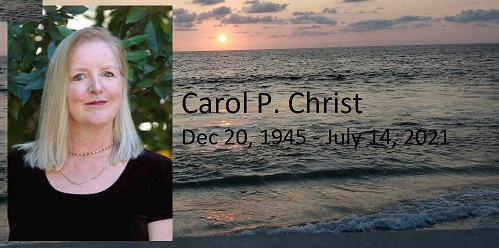
Carol P. Christ’s Legacy: Is This How Patriarchy Began?

This was originally post on June 19, 2017

In my widely read blog and academic essay offering a new definition of patriarchy, I argued that patriarchy is a system of male dominance that arose at the intersection of the control of female sexuality, private property, and war. In it, bracketed the question of how patriarchy began. Today I want to share some thoughts provoked by a short paragraph in Harald Haarmann’s ground-breaking Roots of Ancient Greek Civilization. Haarmann briefly mentions (but does not discuss) the hypothesis that patriarchy arose among the steppe pastoralists as a result of conflicts over grazing lands. As these conflicts became increasingly violent, patriarchal warriors assumed clan leadership in order to protect animal herds, grazing lands, and the women and children of the clan.

On the recent Goddess Pilgrimage to Crete, while we were driving through sparsely populated grazing land, my friend Cristina remarked that the shepherds on foot wearing traditional clothing that she had seen several decades earlier had been replaced by men in shirts and jeans, driving farm trucks. Her nostalgic reverie was interrupted by our young Cretan bus driver who said, “You would not want to be alone with one of those men, not now and certainly not then.”

Continue reading “Carol P. Christ’s Legacy: Is This How Patriarchy Began?”

Bread and Circuses and Mother’s Day

According to Juvenal, politicians in ancient Rome discovered they could get the downtrodden masses to abdicate their rights and accept shocking degrees of oppression merely by giving them enough bread to eat and circuses to distract them.

Meanwhile, in our modern age, we have this thing called Mother’s Day. Never mind how overworked and burned out many mothers are, balancing fulltime employment with the lioness’s share of childcare and housework. Never mind that the possible overturning of the Roe vs. Wade would outlaw abortion and force a whole generation of women and girls in the United States to become mothers against their will.

We’re supposed to dismiss all of the above from our pretty heads because, for ONE DAY A YEAR, we celebrate motherhood with a proliferation of sentimental greeting cards, hothouse flowers, and overpriced restaurant meals served by waitresses who are themselves overworked, burned out mothers.

I think we need to call out hypocrisy here.

A culture that truly honored motherhood would do a lot more than offer one day of saccharine appeasement. It would provide paid parental leave for both parents and urge fathers to put in equal time in parenting and housework. It would provide excellent subsidized childcare, following the Scandinavian model, along with a shorter working week, creating an even playing field for women and men to pursue their careers while still having downtime with their families. A culture that truly celebrated motherhood would insure that motherhood was a freely-elected CHOICE and provide sex education, birth control, and abortion with no discussion or handwringing.

Motherhood in a culture that is toxic to mothers and to women in general can be a fraught experience. Generations of unspoken pain, repression, and deep-lying trauma get passed down from mothers to daughters. Some women I know have made the decision not to have children in order to end this long chain of hurt. Just imagine if every woman refused to reproduce until we could dismantle the chains of patriarchal oppression.

Mother’s Day can be a contentious holiday for both mothers and daughters, especially those who have suffered abuse, neglect, or trauma.

An older friend of mine is haunted by the beatings her mother gave her back in the day when the kind of physical punishment we would now view as child abuse was considered acceptable. Her mother even used to joke about these incidents at family gatherings, as if it were some amusing anecdote, and she seemed to remain steadfastly oblivious to her daughter’s deep pain and trauma. One can only wonder what was going on inside the mother. Did her repressed anger or her own unhealed trauma move her to smack the hell out of her little girl? Had she herself been beaten, shamed for her tears, and ordered to laugh it off?

As the saying goes, hurt people hurt people. I would go further by saying that hurt mothers hurt their daughters.

This is the crux of how patriarchy divides and conquers women. How it trains mothers to cut their daughters down to size, just as they were cut down.

The greatest gift we can give mothers on Mother’s Day, or on ANY day, is our own healing and strength, co-creating a world where every woman, whether she is a mother or not, is respected and whole. Where hurt mothers can be healed and heard, without passing the pain down to the next generation. Where the whole insidious cycle of abuse can end once and for all and we can live inside our power.

Mary Sharratt is committed to telling women’s stories. Please check out her acclaimed novel Illuminations, drawn from the dramatic life of Hildegard von Bingen, and her new novel Revelationsabout the mystical pilgrim Margery Kempe and her friendship with Julian of Norwich. Visit her website.

Legacy of Carol P. Christ: What Does Mother’s Day Mean in a Patriarchal and Matricidal Culture?

This was originally posted on May 9, 2016

When we seek immortality or spiritual “rebirth,” are we not saying that there is something wrong with the “birth” that was given to us through the body of our mothers? In She Who Changes and in “Reading Plato’s Allegory of the Cave as Matricide and Theacide,” I asserted that our culture is “matricidal” because it is based on the assumption that life in the body in this world “just isn’t good enough.”

What is so wrong with the life that our mothers gave us that we must reject it in the name of a “higher” spiritual life? The answer of course death.

Can we love life without accepting death?

Can we love our mothers if we do not accept a life that ends in death?

Jesus was said to have encouraged his disciples to leave their wives and families in order to follow him.  When he was told that his mother and brothers were outside and waiting to speak to him, he is said to have said:

“Who is my mother, and who are my brothers?” And stretching out his hand toward his disciples, he said, “Here are my mother and my brothers!  For whoever does the will of my Father in heaven is my brother, and sister, and mother. (Matt. 12:48-50)

Continue reading “Legacy of Carol P. Christ: What Does Mother’s Day Mean in a Patriarchal and Matricidal Culture?”