Eden, Eve and a Tale of Seeds by Janet Maika’i Rudolph

Last month I wrote about the Garden of Eden. You can read it here:

In that post, I described how Eden is essentially a garden of treasures. What are those treasures? I believe that they are seeds, the most prolific and creative element for spreading life here on Earth. Below is my own fantastical story about the Garden and how the seeds came to reside there.

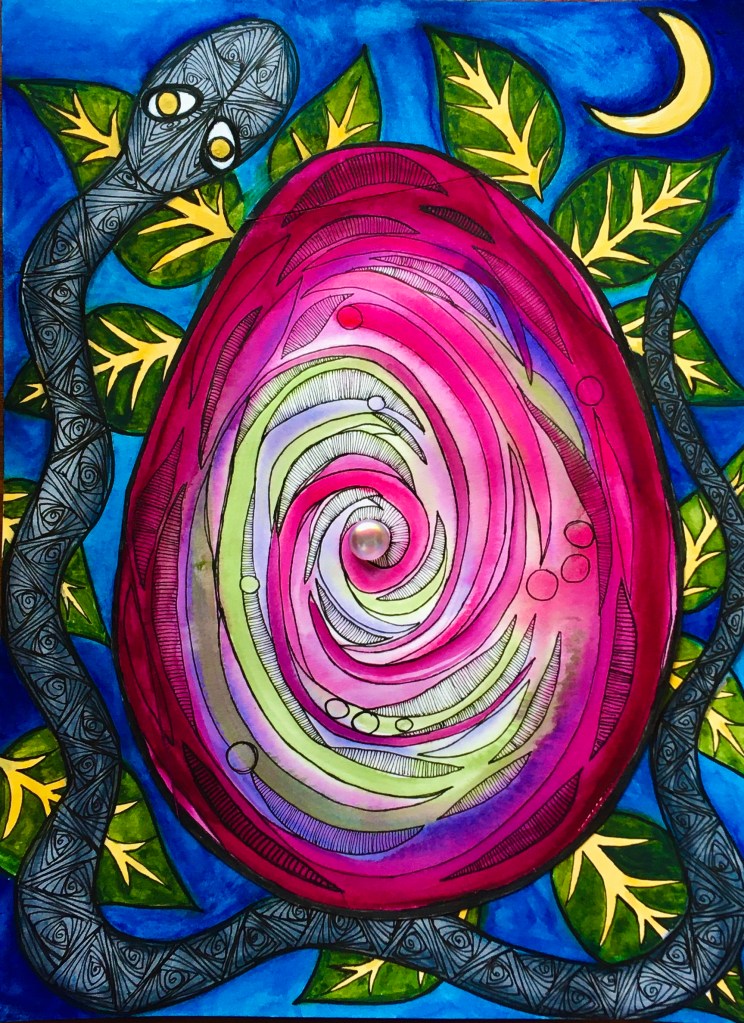
Sinuous and serpentine, Hawwah, Hayyat, Eve emerged from Apsû, carrying within her seeds, fertilized eggs, and all the fruitfulness and abundance therein. 

Continue reading “Eden, Eve and a Tale of Seeds by Janet Maika’i Rudolph”

Carol P. Christ’s Legacy: Who Is Gender Queer?

Moderator’s Note: Carol Christ died from cancer in July, 2021. Her work continues through her non-profit foundation, the Ariadne Institute for the Study of Myth and Ritual and the Goddess Pilgrimage to Crete. This blog was originally posted March 2, 2015. You can read its original comments here. It is being paired with an archive post tomorrow from Dr. John Erickson who responded to Carol with his own blogpost.

“It seems to me that calling oneself queer can be a way of affirming the parts (or all) of oneself that do not fit into the heteronormative paradigm. In my case, though I am white and straight, I am too tall, too smart, too assertive, too strong, too bold, too flashy, too unwilling to be controlled by men to fit the heteronormative paradigm of woman as in every way a little less than man–not as tall, not as smart, not disagreeing too much, not putting herself forward too much, not taking too many risks, not standing out in a crowd, and at least letting men think they are in charge. From this perspective, a whole lot of women are queer.”*

Continue reading “Carol P. Christ’s Legacy: Who Is Gender Queer?”

My Goddessy by Dale Allen

I am passionate about sharing the image, essence and energy of the sacred feminine.  Having presented this material to thousands of men and women at universities, conferences, corporations, expos and theaters across the US, Canada, from Kauai to Dubai, to the Parliament of the World’s Religions, and twice to the UN Commission on the Status of Women, I have humbly witnessed its healing effect.  (I return to UNCSW on March 21, and welcome you to join this free online event, which you can find here.

When I first encountered the word, “Goddess,” I didn’t like it.  Using it felt strange, and I wondered why I should bother.  The word “Goddess” felt uncomfortable and unnecessary.

Continue reading “My Goddessy by Dale Allen”

On The Baby and The Bathwater by Liz Cooledge Jenkins

It wasn’t until seminary—and even then, only sporadically—that I learned that many of the foundational figures in Western Christianity held some incredibly sexist attitudes. Somehow, in all my years of attending church, hearing sermons, participating in (and leading) Bible study groups, reading Christian books, and working in ministry, I had missed this historical reality. I just hadn’t thought about it. And the (mostly white male) Christian leaders who shaped my own faith apparently hadn’t thought about it, either. That, or they didn’t think it was important enough to talk about. Or they intentionally tried to keep it on the down low. Or some combination of these things.

In seminary, when influential theologians’ sexist views came up in class, inevitably someone would say—in a wise-sounding tone—“Well, we don’t want to throw out the baby with the bathwater, do we?”

Continue reading “On The Baby and The Bathwater by Liz Cooledge Jenkins”

Carol P. Christ’s Legacy: The Keepers and the Roman Catholic Church featuring Jean Hargadon Wehner

Moderator’s Note: Jean Hargadon Wehner, who is referenced and quoted by Carol in this post will be available to respond in the comments section. Feel free to ask her any questions. Jean has a new book out about her experiences. The link is at the bottom of the post.

Carol’s work continues through her non-profit foundation, the Ariadne Institute for the Study of Myth and Ritual and the Goddess Pilgrimage to Crete. This blog was originally posted July 10, 2017. You can read it along with its original comments here.

He told me his “come” was a sacrament… He made the sign of the cross with it on my breasts. Jean Hargadon Wehner in The Keepers

I sat glued to my television last weekend watching seven episodes of The Keepers one after the other. Out of all the horrific information in this Netflix documentary, these words stick in my mind. Jean Hargadon Wehner said Father A. Joseph Maskell told her that she was sinner after she confessed to him that her uncle had molested her. Father Maskell explained that her case was so severe that ordinary absolution might not work. Thus, he told her, she must participate in ritual sex with him in order to purify her soul. Jean Hargadon was too young and naive to question his authority. She only knew that she dreaded hearing her name called out on the school loudspeaker with instructions to report to Father Maskell’s office.

Continue reading “Carol P. Christ’s Legacy: The Keepers and the Roman Catholic Church featuring Jean Hargadon Wehner”

Abortion Rights (?) by Esther Nelson

Slowly, yet systematically, women, men, and everybody else along the gender continuum, are losing access to a timely, legal, and safe abortion. This is not breaking news. Pushback in the United States against abortion “rights” has been happening in various state legislatures for decades.  These days we find ourselves more and more constricted as laws across the country reflect a tightening of accessibility to what some people refer to as a “scourge” in the land.

My first-ever blog post on FAR (March 2014) wrestled with the subject of abortion.  In that essay (one that’s still relevant), I suggest we broaden our thinking about a subject that has polarized Americans. Is abortion (a) right?  Is it wrong? The two sides have become entrenched.


Continue reading “Abortion Rights (?) by Esther Nelson”

‘A Wolf in Sheep’s Clothing’ by Sara Wright

The Power of Dreams to Forecast Future Events

I have been a dreamer all my life and within the last six weeks I have had a number of dreams that both frightened and baffled me. How is it possible I ask myself that after 40 years of dream jounraling and being trained as analyst that I am still that stupid?

Part of the answer is that I don’t pay close enough attention to warnings when I can’t make sense of them. For example, when these dreams began someone I didn’t know had contacted me out of the blue and insinuated himself into my life by praising someone I love. The very next night I had a dream that told me that a man was coming to harm me.

Continue reading “‘A Wolf in Sheep’s Clothing’ by Sara Wright”

Behold! The Treasures of Eden by Janet Maika’i Rudolph

The place and purpose of the Garden of Eden is a topic of endless fascination and interpretation. This blogpost looks at two biblical passages and the word eden itself to see what we can learn about its meanings. At its most basic, Eden is a garden of treasure and delight.

As I’ve written before, the written form of Ancient Hebrew words comes from the hieroglyphic tradition of Egypt. The pictures of the letters form a picture puzzle or rebus. The word roots are generally two or three letters. I use script called Semitic Early for my baseline of study.

Continue reading “Behold! The Treasures of Eden by Janet Maika’i Rudolph”

From the Archives: Women’s Bodies and the Bible by Janet Maika’i Rudolph

Moderator’s note: This marvelous FAR site has been running for 10 years and has had more than 3,600 posts in that time. There are so many treasures that have been posted in this decade that they tend to get lost in the archives. We are beginning this column so that we can all revisit some of these gems. Today’s blogpost was originally posted May 20, 2019. You can click here to see the original comments.

Trigger Alert:  The bible on its face is quite violent to women.

Amidst the ugliness that is American politics in general and abortion politics specifically, I began to look for guidance to understand what is happening. I ended up pulling out two books that I read long ago. The first is Woe to the Women-The Bible Tells Me So by Annie Laurie Gaylor. Gaylor, in turn, was inspired by the work of Elizabeth Cady Stanton in her The Women’s Bible which was originally published in two parts (1895 and 1898).

I had forgotten how inspired I have been by both books. Together, they motivated me to begin looking at how the bible is a foundational paradigm of our culture. I started researching how translations have been altered from original meanings. I have already written a few blogs about how the representations of Eve have been changed to strip Her of the roots of Her original power. Take a look here and here.

Continue reading “From the Archives: Women’s Bodies and the Bible by Janet Maika’i Rudolph”

Why It Matters That Simone Biles Won Times Athlete of the Year Award by Janet Maika’i Rudolph

I remember my first feeling’s of disappointment when Simone Biles pulled out of so many events at the 2021 Olympics. But then I quickly realized that here I was falling for the patriarchal lines that are so much a part of our reality that they become unconscious. Simone Biles taught me. Winning isn’t about slaying your foes (although someone who watches politics here in the US would think so). When Biles withdrew, there were many angry tweets and letters that she wasn’t living up to her promises. Let’s review that. She has been called the GOAT (Greatest Of All Time) of her sport. She is the most decorated gymnast in history. She is only 24. What promise has she broken? To whom? And who are we (meaning the public) to even determine what her promise is?

Continue reading “Why It Matters That Simone Biles Won Times Athlete of the Year Award by Janet Maika’i Rudolph”