How the Outdoors Got on Us by Barbara Ardinger

Barbara ArdingerI read some wonderful posts last spring and summer about the beauties of the outdoors. One that especially inspired me was by Molly MeadeIf you missed Molly’s description of how she goes out to the “priestess rocks,” read it now.

But as much as I admire people who like to spend time outdoors in gardens or the wilderness or national parks or anywhere else without kitchens and bathrooms…well, I just don’t like to get the outdoors on me. Most Pagans I know like to camp and hold grand outdoor rituals. Not me. I get lost. I trip over tree roots and get allergic in some large gardens. I don’t like to climb or hike and I stay away from the beach because it’s got all that icky, dirty sand all over it. Although I send money to the Wilderness Society and Friends of the Earth, the wilderness does not need my footprints in it.

So here’s another of my weird little stories. This one’s a fable I wrote several years ago for a friend who was holding regular ceremonies at Joshua Tree National Park in the SoCal desert. (I went to some of those ceremonies. My friends were very proud of me.)

Continue reading “How the Outdoors Got on Us by Barbara Ardinger”

Wisdom Fiction (Part 2) by Elise M. Edwards

Elise Edwards“There are years that ask questions and years that answer.” from Their Eyes Were Watching God by Zora Neale Hurston

In my previous two posts, I’ve discussed the wisdom that can be found in black women’s literature. Continuing this series, I’m sharing a statement from the most well-known novel written by Zora Neale Hurston. Hurston was an American novelist, folklorist, anthropologist, and cultural critic whose work was first published in the 1920s-1940s. Their Eyes Were Watching God was published in 1937 and has since been reissued and adapted into film.

“There are years that ask questions and years that answer.” This quote is one that has circled around my mind every New Year and every birthday for many years. These times of year are when I’m likely to reflect on the previous year and wonder what has come from it.

Continue reading “Wisdom Fiction (Part 2) by Elise M. Edwards”

Lucy Pick’s Pilgrimage by Mary Sharratt

mary sharrattIn medieval Europe, religious devotion provided an alternate narrative for women’s lives in a male-dominated culture. Defiant women who stood up for themselves in the face of rape, incest, and murder were hailed as virgin martyrs. Religious vocations, such as becoming a nun or a beguine, provided a viable and esteemed alternative to forced marriage.

Even women who were married with children could escape their domestic entanglements and conjugal duties by taking an oath of celibacy as 15th century English mystic Margery Kempe did, leaving behind her husband and 14 children to go on pilgrimage to Santiago de Compostela, Rome, and Jerusalem. Her Book of Margery Kempe, the tale of her travels, reads like a kind of late medieval Eat, Pray, Love and is the first autobiography written in the English language.

Though it might seem surprising to us today, women of the European Middle Ages possessed more rights and freedoms than their descendants in the Renaissance, Early Modern, and Victorian ages. Women worked as craftspeople and artisans and were members of the guilds, alongside men. Monarchs such as Eleanor of Aquitaine were global power brokers while religious leaders such as Hildegard von Bingen devoted their lives to intellectual and artistic pursuits, composing music and writing weighty philosophical and theological books that are still being discussed today.

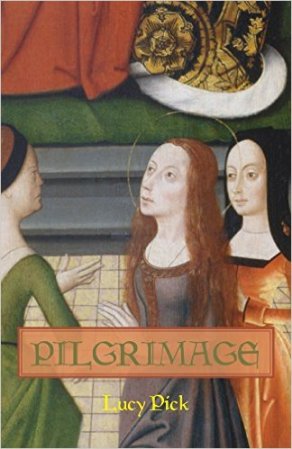
lucy pick pilgrimageThe cover of academic historian Lucy Pick’s novel Pilgrimage shows details from a painted altarpiece dedicated to Saint Godeleva. A victim of forced marriage who was strangled by order of her husband, this legendary saint was a patron of abused wives. Lucy Pick’s novel concerns the saint’s daughter, the blind Gebirga of Gistel in Flanders. What would it be like to be the daughter of a martyred saint whose miracles cured everyone except you?

Considered unmarriageable due to her blindness, Gebirga rejects life as a nun in an abbey dedicated to her sainted mother. Instead, in a bid for freedom, she embarks on a pilgrimage to Santiago de Compostela in faraway Iberia, an epic journey for that time. She serves as the companion to a highly strung teenage noblewoman and is charged with delivering the girl to the Spanish king she is contracted to marry. During their travels, Gebirga must use all her intelligence and resourcefulness to protect herself and her young charge from the considerable dangers and political intrigues they face on their way. Though they encounter hardship and heartbreak, this is a pilgrimage of miracles, healing, and redemption.

Lucy Pick, the Director of Undergraduate Studies and Senior Lecturer at the University of Chicago’s Divinity School, has infused her novel with impeccable research into the lives of medieval women. This novel is a medievalist’s delight and fans of the late Margaret Frazer will devour this book.

Mary Sharratt’s book Illuminations: A Novel of Hildegard von Bingen, won the 2013 Nautilus Gold Award, Better Books for a Better World. Her forthcoming novel, The Dark Lady’s Mask: A Novel of Shakespeare’s Muse, tells the tale of the groundbreaking Renaissance women poet Aemilia Bassano Lanier and will be published by Houghton Mifflin Harcourt in April 2016. Visit Mary’s website.


Wisdom Fiction (Part 1) by Elise M. Edwards

Elise Edwards“I was born in a strange little country town that may be like all other country towns, but I do not know. It was the world I was born to. The world is such a place that you need special things to understand it. I do not think I am a fool, but I do not understand life. It is like I am always standing in the dark somewhere. It could be on the edge of a cliff by a deep ravine… Or on a flat piece of all the land in the world… and I would not know. I would not know whether to step stand still. Either one could be a danger… When I am alone. Some lives are like that. Depending on the kindness of everybody.”

-from “Feeling for Life “ in Some Soul to Keep by J. California Cooper

In my previous post, I wrote about the truths we learn from black women’s literary tradition and from listening to the stories of those we too often ignore. Continuing that reflection over the next few months, I’d like to share some of the lessons from J. California Cooper’s short stories. The quote above is taken from the opening paragraph of one of her works.

Continue reading “Wisdom Fiction (Part 1) by Elise M. Edwards”

No Man Can Spin Gold (Part 2) by Barbara Ardinger

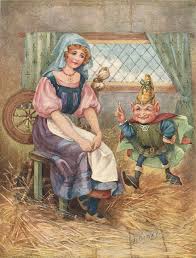
RumpelstiltzskinPerdita was in a panic. She looked this way and that, but all she saw was a towering pile of straw. She sat down to breathe deeply and think deeply. While she was breathing and thinking, the little man held is peaked green hat in his hands and marched anticlockwise around the room, whistling a jolly marching song she’d never heard before. He marched around the room three times.

Finally Perdita said to herself, Who knows what can happen in a year? That’s a long time. I can promise anything now. And then, well, I know I’ll be able to think of something to do. I’ll study all year! Aloud she said, “Kind Sir, you are miraculous, for no man can spin gold, and yet—here you are, spinning gold! You can have what you ask for.

And so the little man smiled a smile that showed all his teeth and sat down at the wheel and—whirr, whirr, whirr—the whole roomful of straw was soon spun into the finest gold thread imaginable, twice as fine as the finest silk thread the merchants sold at the harvest festival.

As soon as the Queen arrived back at her palace the next day, her Nephew introduced his betrothed to her. The Queen was much older than Perdita thought she would be, and she was as wise as she was old. She took Perdita into her private chamber and asked her several questions. She learned more about Perdita than the girl realized, also about her mother and stepfather and young traveling scholars. Nevertheless, the Queen gave her royal blessing to the marriage, for she wanted her Nephew to be married to someone with a quick mind, good manners, and some ambition so the land would be well cared for after her death.

The wedding took place on the day following the summer solstice, and guests were invited from lands all around. Perdita’s mother and stepfather were invited, too, and they were both given new clothes to wear. The stepfather tried to have a private conversation with the Queen, but the major-domo led him into the map room and showed him some extremely dependable treasure maps.

After the wedding banquet of roast peacock and candied goldfish and artichoke hearts and rosewater dumplings, the Queen and Perdita’s mother walked together in the gardens and talked of many things. Pretty soon, after the stepfather had memorized several of the treasure maps and borrowed enough money to rent a ship and set off to claim his treasure, the mother was invited to move into the palace, where her healing and domestic arts would be appreciated.

A year and a day later, Perdita gave birth to a daughter who was the most beautiful baby in the whole land. The royal birth was celebrated with fireworks and parades and festivals and rituals in the temples that lasted three whole days without pause. Perdita’s mother was appointed chief nursemaid and immediately hired a wet nurse who had the creamiest milk in the whole land.

On the third night after the baby’s blessing and naming day, Perdita was alone in her chamber, brushing her long, curly hair, when she heard a noise behind her.

“Well then. I have come for the baby.”

“What?” Perdita pretended not to recognize the little man. “And just who are you? And what are you doing in my private chamber? Get out immediately or I shall call the guards.”

“You know who I am. You know why I’m here.”

“Yes, yes, I confess it. I do.” She allowed a tear to roll down her cheek. “Oh, but please don’t take my baby. I have never loved anyone before, and I love this baby more than anything I have ever possessed. Here—take my jewelry. All of it. Take my jeweled toys. Take the tapestries from the walls. Take my richly embroidered clothes. Take my royal robes. Take my golden coronet. Take these books I’ve read. Take anything you want, but please, Kind Sir, oh, please don’t take my daughter.”

“We made a bargain. I have spun the gold for you. No man can spin gold, but I can, and I spun for three nights. Because of my spinning, you are now the heiress of the throne of this land. You must keep your part of the bargain.”

“No, no!” Perdita cried, glad that the baby was in her mother’s watchful care. “I cannot give up my daughter! She is more precious to me than gold.” And Perdita began to cry, to really cry, and her crying was so heart-rending that the little man finally began to take pity on her.

Continue reading “No Man Can Spin Gold (Part 2) by Barbara Ardinger”

No Man Can Spin Gold (Part 1) by Barbara Ardinger

PerditaIn a land not too far away there once lived a widow who was so poor and who worked so hard day and night to make a bare living that she had almost no time to teach her daughter the things a girl needs to know to be a proper wife. The girl, whose name was Perdita, had learned how to do a few useful things around the house, but when she laid the fire she always mixed green wood with the dry, when she made the soup she always forgot the salt and pepper, and when she swept she inevitably forgot to sweep under the bed. When she sewed she always pricked her fingers and left little red spots on the fabric, and when she spun she always made huge knots and horrible tangles in the new thread. Although she wasn’t very good at these important homely tasks, she had somehow learned to read and study numbers and she had even learned about Panglossian optimism. Her parents had no idea how this learning had come to her, unless it had something to do with the scholars who regularly passed through the town and with whom Perdita spent a lot of time. In her own opinion, the girl more than made up for her lack of useful skills with her brilliant mind and quick tongue…not to mention her beauty.

One day, although her mother had ordered her to finish the washing and hang the clothes in the sun to dry, Perdita left them soaking in the tub and went out and about with her mother’s second husband. On the road they happened to meet the Queen’s eldest Nephew. Now since the Queen had borne no daughters and was now too old to do so, everyone knew that one of her Nephews would inherit the throne when she died. As soon as he spotted the young man, Perdita’s stepfather saw an opportunity.

“Here’s your opportunity,” he murmured to the girl. “Do what you can to attract this fellow. If you do, things will go well for you and your mother.”

Perdita saw an opportunity, too. An opportunity to raise herself socially and find a life that was not so filled with laundry and other mind-numbing hard work. So she tossed her curls and swung her hips, she gazed up at the Royal Nephew, and soon she had his attention, for this young nobleman was interested in the things that have always interested the upper-class men. During their ensuing conversation, Perdita said coyly, “I may have a poor mother, but I’m quite clever, you know. I can read and write. I can cook and clean. I can sew and spin.

“I’m interested in girls who can do useful things,” said the Queen’s Nephew. “Are you good at all things you do?”

“Oh, yes, I am very, very good,” the girl replied demurely. “I have a great many talents.”

“And,” said her mother’s second husband, “some of this girls talents no one has uncovered yet.”

“I see,” said the young man with a wink. “And may I learn what your hidden talents are, my dear?”

“Why,” said Perdita with a pretty blush, “why I can…I can

“She can spin straw into gold,” said the stepfather. Who do you know who can do that?”

“No one at all.” The Royal Nephew took Perdita’s hand. “It’s well known that no man can spin straw into gold.

And she works very fast,” said the stepfather. “See how soft her hands are! Her fingers are as nimble as my own. Even though we’re not even related by blood, I have taught her all she knows!”

“Indeed,” the Royal Nephew said, “nimble…” And after he thought for a moment, he added, “My dear, would you like to come to my Aunt’s palace with me and show me—show us your talents?”

So with an unnecessary push from her stepfather, Perdita, who was sure she would be moving into the best of all possible worlds, went to the palace with the Queen’s Nephew. But the Queen was not there, for she was visiting one of her Sister Queens in a nearby land. When the Royal Nephew asked Perdita to show him how she spun straw into gold, she batted her eyelashes at him and, remembering what she’d seen other girls do, shrugged her linen bodice just a little bit off one shoulder. A little while later, when the Royal Nephew asked again about spinning straw into gold, she shrugged her bodice a little bit off her other shoulder. When he asked a third time about spinning straw into gold, however, she finally understood that he expected a reply.

She had to think fast. “Oh,” she said disingenuously, “oh, I only do it at night, when the moon is full, and I can never do it if anyone is watching. I can spin straw into gold only when I am left absolutely alone with my work.” She was feeling quite sure that the Royal Nephew would never leave her alone, especially with her soft linen bodice falling off both shoulders.

But Perdita hadn’t noticed that the moon was full that very night, and when the Royal Nephew offered to let her stay in the palace, she was loath to refuse the invitation. I’ll think of a way out of this predicament, she said to herself. I always do, for I’m very clever.

The young nobleman was keenly interested in gold, as nobles always are, and so he ordered a room at the far, far end of the farthest corridor to be filled one third full with straw. Then he got his aunt’s best spinning wheel and put that in the room, too.
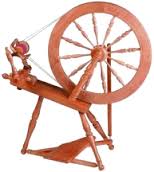
Spinning wheel“Here is a fine and private room,” he said to Perdita, “and I guarantee that no one will disturb you. Just spend the night here and show me how you can spin straw into gold, and I’ll give you a lovely reward in the morning.” And he winked at her.

What could the girl do? She watched the Royal Nephew close the door. She heard the key turn in the lock. She began to walk about the room. At last she sat down beside the wheel. But she didn’t have the least idea about how to spin straw into gold, for she couldn’t even spin flax into decent linen thread without getting huge knots and horrible tangles in it. She began to cry. “I’m lost!” she wailed. No one is here to advise me. No scholar I’ve ever met has considered this situation. No man can spin straw into gold, but I can’t, either. Oh, woe is me.”

“Well now.”

Suddenly she heard a voice, and when she peeked between her fingers, she saw a little man wearing a peaked green hat and a long brown jacket and wide brown trousers. He had a long white beard and big strong hands.

“Good evening,” he said. “Why are you crying?”

“I’m supposed to spin straw into gold, but I don’t know how.”

Continue reading “No Man Can Spin Gold (Part 1) by Barbara Ardinger”

Truth in Storytelling by Elise M. Edwards

“[ShakespElise Edwardseare] was an alright writer.  I did not always understand him, but some things he said were beautiful and he made some things so clear the way he explained people.  But one thing he was wrong about.  That ‘To be or not to be?’  is not the first question. ‘What is the truth?’ – that is the question!  Then ‘To be or not to be?’  is the second question.”

-from “Feeling for Life “ in Some Soul to Keep by J. California Cooper

This past weekend, I taught a lesson for an adult church group about Christian imagination in the short stories of J. California Cooper. The quote above comes from one of her stories. I was invited to teach a lesson as part of a series on exploring God through literature. It was a delight to participate for several reasons.

Continue reading “Truth in Storytelling by Elise M. Edwards”

Another Excerpt from That Christmas Morning Feeling by Marie Cartier

MarieCartierforKCETa-thumb-300x448-72405Author’s Note:  This post continues to serialize excerpts from my novel, That Christmas Morning Feeling. Please see last month’s post for the initial entry.

****************

Book Number Seventeen

Look, I’m not the one. I don’t have an investment here. This is not about me. But, I think that when you think you can actually do some good in the world you should do it. I mean what if you have this whole body of knowledge. And you say nothing. Is that morally acceptable? I think not. I’m sure everyone has thought it. You are going along in your life, and you stop suddenly. The color of the trees, sparkle on the water, but maybe not so wow world, you are cool stuff. Maybe just the mundane world, maybe even the curve of the paint on the wall, even paint drying as the saying goes, could be enough to catch you up and you realize – life. Life’s here. Right now. And it needs me. Do I love it, or do I not? And if you do, if you love, love it – just life. Then you have to do something about it, to make it better. Like if it was your kid, you couldn’t just sit by – right? Well, you could. People do, God knows.

Or he doesn’t. You’d think he would do something, or she. Guess it doesn’t work that way. Maybe it’s true what they said in the church last Sunday. I’ve been thinking about it… even though I was only half listening. Personally I usually hate being there, big waste of time. But it is a waste of time, and in some ways that’s a good thing…just a predictable waste of time, nothing dramatic happening –that’s a new way to look at Church. I guess. Have to remember that.

Maybe God is in “the least of us.” That would be me. And it is up to us to decide what God does, how God acts, or rather to act like God. Then we can get God to change things. Otherwise God is just an idea…without a body. Not much you can do on planet Earth in that state. We have to figure out we are not really in Oz, like Dorothy, no mystical wizard to help us…just some fabulous dream shoes and a great idea about home, and no place like it, whatever she’s rattling at the end… and then going there to do something about it. She can’t do it from Oz. Too bad, but true. She has to wake up there in the middle of the black and white world and get out of bed, presumably without the fabulous shoes. So she just has to get out of bed and get on with it. At least I hope she gets out of bed; we never really saw that part.

We are really here, so we can do something about the here and now.

So no one is talking Incest. No one I personally know of course, since I talk it. That is not because Incest is not happening as an event. It’s just not a newsworthy concept, really. Because it isn’t a concept is it…? It’s an event, as in, “This happened to me.” But it is not a language that is spoken on planet Earth. No language here, except Incest, could transform that event that happens into a concept that’s newsworthy… not that I know of. And no one is taking language labs in Incest. So no one can write about it in the newspapers, etc., etc. It’s obviously a vicious cycle.

Continue reading “Another Excerpt from That Christmas Morning Feeling by Marie Cartier”

Not a Woman of the Cloth- an excerpt from Murder at the Rummage Sale by Elizabeth Cunningham

Elizabeth Cunningham headshot jpegWhen I finished writing The Maeve Chronicles, I returned to a mystery novel, abandoned thirty years earlier. I was finally ready to write about the small town Episcopal Church where I grew up in the 1950s and 60s and to explore the points of view of characters based on my late parents. When I began seeing through my mother’s eyes, the intensity of her suppressed fury took me by storm. Trapped in the role of minister’s wife, Anne Bradley strikes me as an embryonic feminist. In the scene below, Anne is hanging up laundry when she is approached by a pesky parishioner who makes a veiled reference to the death of Anne’s son.

*********

“Hello there, Mrs. Bradley,” Mildred Thomson said, adding some obligatory remarks about the weather. “I was hoping to find Father, I mean *Mr. Bradley in today. Do you know when he might be back?”

Anne did not. In fact, she realized she did not even know where he was. Hospital calls? A diocesan meeting? Surely she would have remembered if he’d gone all the way to New York. He had probably told her, and she had probably not listened. He was not there most of the time, or if he was, he was not available, not to her or the children. He stayed in his study in the parish house where no doubt Mrs. Thomson had hoped to ambush him.

“I’m afraid I don’t, Mrs. Thomson,” said Anne, feeling for her cigarettes in her apron pocket. Hell’s bells. She must have left them in the back hall on the shelf above the washer.

Anne turned back to the clothesline. Three children meant a lot of laundry, though in the summer the load was a little lighter, shorts and short sleeves, not so many filthy elbows and knees. There were always Gerald’s shirts. Short or long-sleeved, they had to be ironed, something she could not even contemplate till the cool of the evening.

“Did you have an appointment with him?” Anne asked, hoping the question did not sound too much like a reproof.

“No, no,” Mrs. Thomson said vaguely. “I just happened by. I suppose I ought to make an appointment. I never did with Father Roberts. He never minded my popping in.”

That was definitely a reproach. Anne felt almost sorry for her husband, almost. But it was part of his job to listen to parishioners maunder on, as much as holding services on Sunday and galvanizing his congregation to do good works in the community.

“Mrs. Bradley, may I ask you a personal question?”

Could she say no, Anne wondered? Or at least, excuse me while I get a cigarette? But Mrs. Thomson took her hesitation for consent.

“Do you ever struggle with your prayer life?”

Anne bit back a bitter laugh. She could hear it in her head, a sound a dog might make, something between a yelp and a snarl.

“I suppose you don’t,” Mrs. Thomson said wistfully.

Continue reading “Not a Woman of the Cloth- an excerpt from Murder at the Rummage Sale by Elizabeth Cunningham”

From Her Lips by Barbara Ardinger

Barbara Ardinger

There was an old woman who lived in a shoe,
She had so many children she didn’t know what to do.
She gave them some broth without any bread;
She whipped them all soundly and put them to bed.

Look! Here she comes. Like most old women, she has a lot to say. Let’s listen in:

“Well, that’s what an old nursery rhyme says. But I’m that old woman, and I can tell you for sure that the only thing ‘true’ about that rhyme is that I’m old. I’m older than anyone I know. Oh, I see you there, eavesdropping. That’s okay. You’re welcome here.

Old woman...shoeYou know what? I’ve been called many names by the (mostly) men who make up those rhymes and stories. I’ve been the old witch in the candy house who serves pie to children and then serves the children in the pie. (But did that German guy who wrote that opera about me ever say who eats those pies?) I’ve been the thirteenth old woman at the christening who wasn’t invited and brings a curse that’s as big as the blessings from the first twelve. I’ve been the evil, wicked, mean stepmother.

Continue reading “From Her Lips by Barbara Ardinger”