The Naming of Our Mother-Lines by Cynthia Garrity-Bond

I am Cynthia, daughter of Pauline, daughter of Ellen, daughter of Mary. I first spoke this litany of names at a retreat given by Carol Christ.  As we entered the chapel, each woman was given a rose to place in the center of the circle after she recited her own mother line.  Simple but incredibly powerful, a beautiful reminder of our matriarchal inheritance.

The reflection of this ritual is all the more rich because today is my birthday. Especially since my mother’s death in 1990, March 9 is a day of reflection on our complicated mother-daughter relationship with all its highs and lows that marked our lives.  But what I really miss from her are the stories told around the kitchen table, starting with the uniqueness of each of our births.  With each one, the hope and expectation of both parents was for a daughter.  Not until the fourth birth did their plea to St. Jude, patron saint of lost causes (and our family’s most depended on saint), bring forth their highly anticipated girl. Continue reading “The Naming of Our Mother-Lines by Cynthia Garrity-Bond”

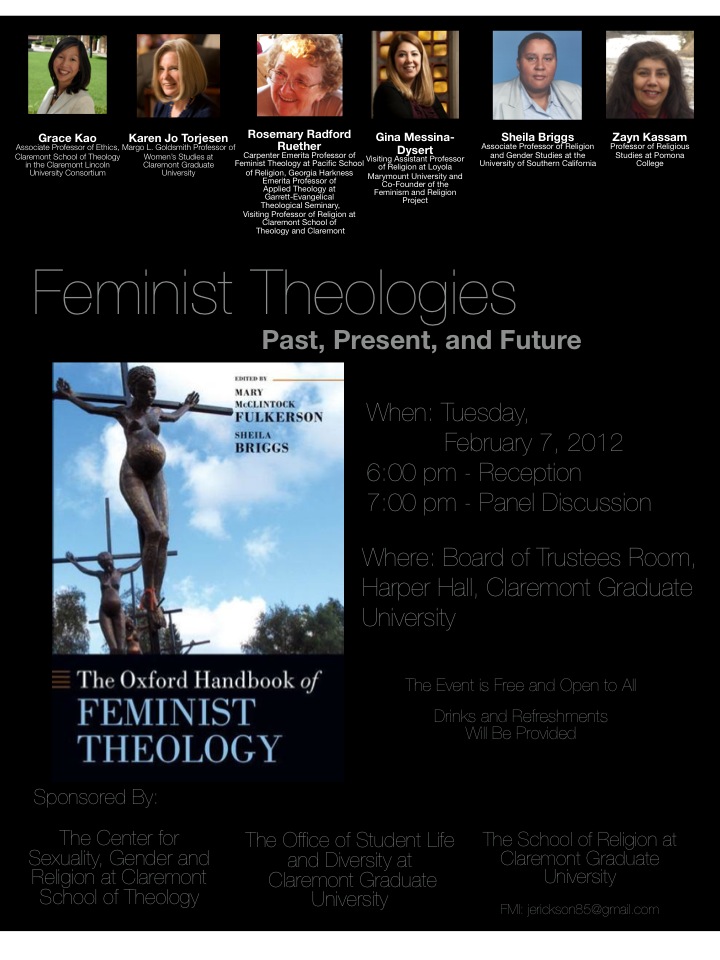
Feminist Theologies: Past, Present, and Future

On February 7, 2012, a panel discussion focused on the past, present, and future of feminist theologies took place at Claremont Graduate University to celebrate the release of TheOxford Handbook on Feminist Theology.  The panel was organized by John Erickson, moderated by Grace Kao, and featured Karen Torjesen, Rosemary Radford Ruether, Gina Messina-Dysert, Zayne Kassam, and Sheila Briggs as presenters.  What resulted was a terrific discussion about women, religion, and feminist theologies.  Many were in attendance and participated in the panel; for those who were unable to attend, here is a video of the presentations from that evening.  We look forward to you sharing your thoughts and comments about the past, present, and future of feminist theologies.

REMEMBERING MERLIN STONE, 1931-2011 by Carol P. Christ

“In the beginning…God was a woman.  Do you remember?”  Feminst foremother and author of these words Merlin Stone died in Feburary last year.

I can still remember reading the hardback copy of When God Was a Woman while lying on the bed in my bedroom overlooking the river in New York City early in 1977.  The fact that I remember this viscerally underscores the impact that When God Was a Woman had on my mind and my body.  Stone’s words had the quality of revelation:  “In the beginning…God was a woman. Do you remember?”  As I type this phrase more than thirty-five  years after first reading it, my body again reacts with chills of recognition of a knowledge that was stolen from me, a knowledge that I remembered in my body, a knowledge that re-membered my body.  My copy of When God was a Woman is copiously underlined in red and blue ink, testimony to many readings.

Though I could then and can now criticize details in the book, the amassing of information and the comprehensive perspective When God Was a Woman provided was news to me when I first read it.  Despite having earned a Ph.D. in Religious Studies from Yale, I did not “know” that Goddesses were worshipped at the very dawn of religion.  I had not heard of the theories of Indo-European invasions of warlike patriarchal peoples into areas already settled by peaceful matrilineal, matrifocal cultures in Europe and India.  I had written my undergraduate thesis on the prophets, studying their words in the original Hebrew, but I did not understand that their constant references to the Hebrew people “whoring” after “idols” and worshipping “on every high hill and under every green tree” referred to the fact that many of the Hebrew people were choosing to worship Goddesses in sacred places in nature.  Nor did I understand that the Genesis story which I had studied and taught took the sacred symbols of Goddess religion– the snake, the tree and the fruit of the tree, the female body—and turned them upside down.  Continue reading “REMEMBERING MERLIN STONE, 1931-2011 by Carol P. Christ”

Feminism and the Emerging Church By Xochitl Alvizo

What is emerging in the emerging church will not be faithful, liberative, or just if it continues to perpetuate the erasure of women’s herstory. 

There has been on ongoing conversation among Christian identified people for about 20-30 years now. It originally started in the U.K. and Australia before making its impact in the U.S.  It has its roots in evangelical Christianity but has since extended more broadly to Christians of all stripes including Catholic ones. This conversation is often referred to as the Emerging Church, the emerging church movement, or, as preferred by many, the Emerging Conversation. Phyllis Tickle has written a book, The Great Emergence, suggesting that this movement represents a much larger historical transformation of Christianity that occurs about every 500 years prompting a kind of house cleaning and rummage sale of the church. Continue reading “Feminism and the Emerging Church By Xochitl Alvizo”

Feminist Theologies: Past, Present, and Future by Gina Messina-Dysert

I had the great honor to be a part of the Feminist Theologies: Past, Present, and Future panel on February 7, 2012 to celebrate The Oxford Handbook of Feminist Theology.  I presented with some feminist foremothers who have had a tremendous impact on me and my feminist ideals.  To say it was a wonderful experience would be a complete understatement.

Below is the talk I shared at the conference.  It focuses on my personal experience with feminist theology, the Feminism and Religion project, and how digital print will shape the future of feminist theology.  A very special thanks to John Erickson for organizing this important event.

It is truly a pleasure to be here today to celebrate the publication of The Oxford Handbook of Feminist Theology.  Certainly a foundational text that will be instrumental in moving the field of feminist theology forward by connecting feminists from different cultural and geographical backgrounds to discuss women and religion in a globalized world. Continue reading “Feminist Theologies: Past, Present, and Future by Gina Messina-Dysert”

RE-SOULING ON SHABBAT BY IVY HELMAN

I attended a service at Congregation Shalom in Chelmsford, MA two Fridays ago.  During the service, Rabbi Shoshana Perry spent a few minutes addressing the last word of a Hebrew prayer found in the Reform siddur, Mishkan T’filah.  It was translated in the siddur as “God rested” but the Hebrew word used was vayinafash, which comes from the word nefesh, or soul.  The prayer emphasizes on the seventh day that God did not rest as much as God took time out to re-soul.  Rabbi Perry believes that our Shabbat should be spent doing things that help us also re-soul.

Initially, I spent quite a long time considering why God would need to re-soul and what exactly God would do to re-soul.  When I realized the futility of trying to sort that out, I moved a little closer to home: what do I do on Shabbat to re-soul?  I was quite overwhelmed trying to answer this question as well.

Traditionally, Shabbat is about study, rest, prayer and family among other things.  In fact, many Jews avoid creative processes like writing, cooking, painting, driving and working because God rested from creative work on the seventh day.  (Incidentally, our creativity is also how we are considered to be made in the image of God).  Part of the reason this idea struck me so deeply is because I often find painting, cooking and writing rejuvenating. Continue reading “RE-SOULING ON SHABBAT BY IVY HELMAN”

The Feast Day of St. Brigid by Carol P. Christ

May we remember Brigid on her day in the fullness of her connection to bountiful and life-giving earth by setting a bowl of milk on an altar or special place in the garden on her holy day.  Who knows, a snake just might come to drink from it.

The Christian Feast Day of St. Brigid of Kildare, one of the two patron saints of Ireland, is held on February 1, the pre-Christian holiday known as Imbloc.  It is well known that St. Brigid has the same name as a pre-Christian Goddess of Ireland, variously known as Brighid (pronounced “Breed”), Brigid, Brigit, Bride, or Bridie.  The name Brigid is from the Celtic “Brig” meaning “High One” or “Exalted One.”  Brigid like other Irish Goddesses was originally associated with a Mountain Mother, protectress of the people who lived within sight of her and of the flocks nurtured on her slopes.

Imbloc marked the day that cows and ewes give birth and begin to produce milk.  It was also said to be the day when hibernating snakes (like groundhogs) first come out of their holes.  In northern countries, Imbloc signals the beginning of the ending of winter.  The days have begun to lengthen perceptibly after the winter solstice when the sun stands still and it seems that winter will never end.  At Imbloc spring is not yet in full blossom.  But if hibernating snakes come out of their holes, it is a sure sign that the processes of transformation will continue and warmer days will not be far off.  As Marija Gimbutas says, “The awakening of the snakes meant the awakening of all of nature, the beginning of the life of the new year.”   Continue reading “The Feast Day of St. Brigid by Carol P. Christ”

Body, Nature, Ancestors by Carol P. Christ

Some years ago, womanist theologian Karen Baker–Fletcher asked about ancestors following a lecture I gave on the body and nature.  I have since come to realize that ancestors are a missing link between the two:  we cannot speak adequately of embodiment and interdependence in the web of life without recognizing the ancestors whose lives made ours possible.  Our mothers quite literally gave us our bodies.  All of our ancestors gave us their genes.  Care and callousness with origins going back longer than conscious memory was imprinted on the psyches of our parents and grandparents and transmitted to us.  All of our ancestors give us connections to place.  While many black people in America can recite oral histories that begin with slavery in the United States, I come from a family where stories of origin for the most part were not valued or told.  Both of my father’s parents lost their fathers when they were very young, and my father, who was raised Catholic at a time when Catholics were discriminated against, preferred to think of our family as “American now.”  Like the hero of the film Lost in America, most members of my family dreamed of “melting right into that pot.” In the process we lost stories we need to help us to understand ourselves and the complex realities that “becoming American” involved.   Continue reading “Body, Nature, Ancestors by Carol P. Christ”

A Next Wave of Scholarship By Kwok Pui Lan

I came to the United States in 1984 to begin my doctoral studies at Harvard Divinity School. It was an exciting time to do feminist theology and religious studies. Womanist ethics just began to emerge, as Dr. Katie Geneva Cannon has just completed a dissertation on the subject at Union Theological Seminary in 1983. I count it as a blessing that she was teaching at the Episcopal Divinity School, just on the other side of the Cambridge Common.

The mid-1980s saw the paradigm shifts in feminist studies in religion, as womanist, mujerista/Latina, Asian and Asian American women began to articulate their own theological understanding. If Womanspirit Rising (1979) was a reference text for our field, which contained essays by white women, we had the first reader by radical women of color, This Bridge Called Our Back(1981).

We began to discuss multiple oppressions and multiple identities, and the need to integrate race, class, and gender into our analyses. We challenged white women who have universalized their middle-class, white experience as if women were all the same. Continue reading “A Next Wave of Scholarship By Kwok Pui Lan”

Home for the Holidays By Carol P. Christ

Yesterday I was watching an episode of Grey’s Anatomy in which George’s father said to him, “you’re not like us, you’re a surgeon.”  “And,” George’s father added, “you don’t like to do the things we like to do.”  It is not easy not being like your family and not liking the things they like.  When my mother was alive, she was the glue that held us together.  Since then, my sheer presence in the lives of my father and my brothers and their families is disruptive.  No matter that I try not to make waves, I make them all the same.  I do keep my mouth shut about politics and religion and feminism.  Even so, the last time I was home for the holidays my father asked me to stay in a hotel because having me in the house made him nervous and uncomfortable.  To be fair, how would you feel if your daughter was 6 feet tall and you weren’t, she had a PhD and you didn’t, and even if she didn’t open her mouth at all, you knew that she didn’t agree with your political views or your everyday assumption that men make the final decisions on all important matters?  Or if you were my brother who does not have a college education and who feels that women and minorities and gays have taken something from him? Or if you were my Mormon brother who is trying to keep his three daughters on the straight and narrow and not on the path chosen by their aunt?  On the last Christmas day I spent at my brother’s house, I did not mention any of the obvious things, but it was hard to hide being astonished by the number of presents and the amount of money spent on them, and I simply could not force myself to watch football.   Continue reading “Home for the Holidays By Carol P. Christ”