As the creator of the divine feminine app, an online platform to find circles, events and resources to which an average of three women a day have found their way to for the past decade, I have been privy to quite a few opinions.
A large majority of the 12,000 women who have registered on the app are Circle hosts, course creators, retreat organizers, book authors, singers, product sellers and others that ‘She’ has tapped on the shoulder.
And I hear quite a lot.
‘Be careful about her.’ ‘Do you know what she did?’ ‘I would watch your back.’
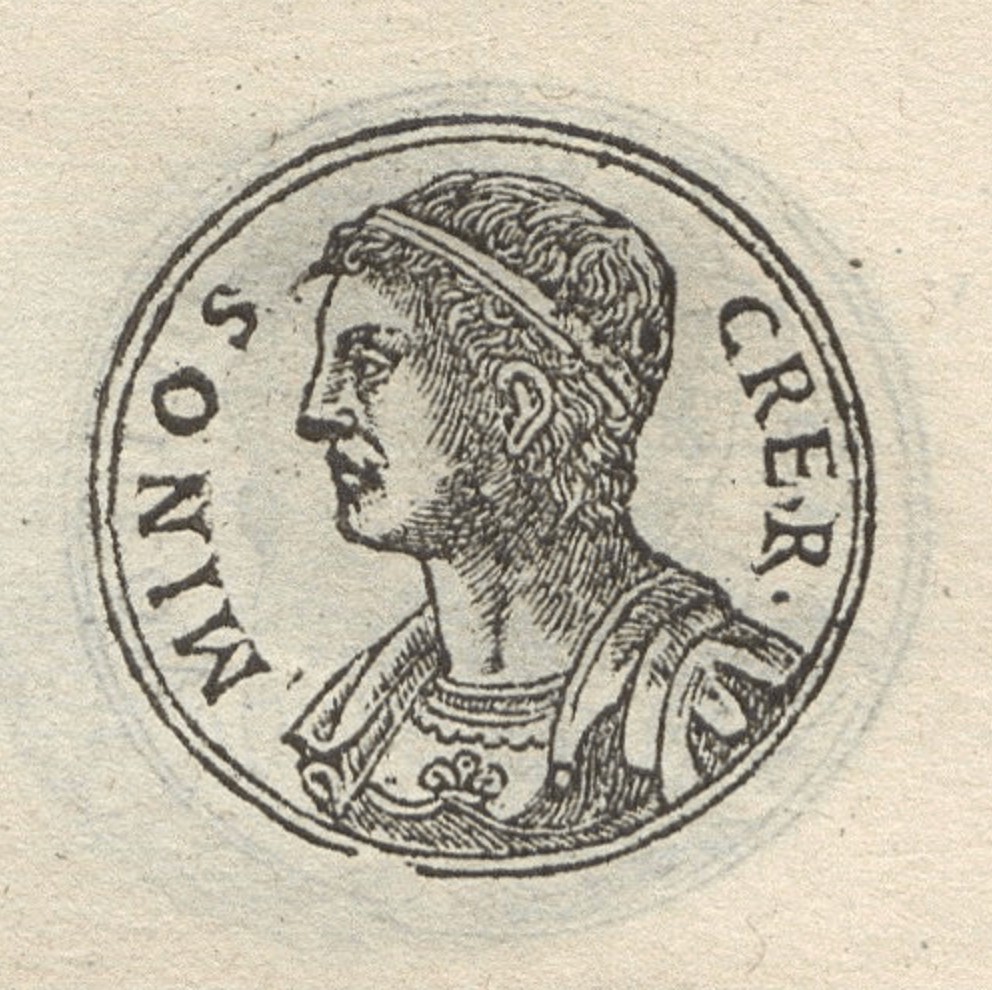
Portrait of Minos, king of Crete, from the Promptuarium Iconum Insigniorum
As the Ancient Greek myth is told, Ariadne’s father, Minos, is a powerful brute. The offspring of rape by the God Zeus of the Phoenician Princess, Europa, Minos’ violent origins reflect his development as a man, ruler, and father. He conquers and plunders while harboring secrets and wreaking havoc on his family. In the mythic world he is the definition of a victorious king. In today’s world, we call Minos a narcissist.
Half divine and half mortal, Minos moves between sacred and profane spaces to his advantage. He gains his throne as King of Crete with the support of the Sea God, Poseidon. When given a giant white bull as a congratulatory gift, Minos chooses not to sacrifice the bull as he promises Poseidon, but to keep it for himself. It is this choice that reveals Minos’ shadow narcissism. To Minos, the bull is his greatness, not a symbol of it. In a rage, Poseidon punishes Minos for his choice by cursing his wife, Pasiphaë, to become enraptured with the magic bull. While Minos is away from Crete conquering other lands and other women (he fathered several children outside his marriage), Pasiphaë under possession of Poseidon’s spell, convinces the inventor, Daedalus, to build a contraption to lure the bull into her. Ariadne’s half-brother, the Minotaur, is born out of this union.
this we were, this is how we tried to love, and these are the forces they had ranged against us, and these are the forces we had ranged within us, within us and against us, against us and within us.
Adrienne Rich
Last week a colleague of mine forwarded the sad news that Anita Caspary, IHM [The Sisters of the Immaculate Heart of Mary], had died at the rich age of 95. This was the same day (October 5) that Steve Jobs passed away from his battle with pancreatic cancer. The tension between the two figures was not lost on me. The death of Jobs, an icon of ingenuity and leadership, wonderful husband and father, is mourned throughout the world. The life and legacy of Anita Caspary will be remembered and mourned as well, but by comparison, on a much smaller scale. That’s unfortunate, because the life and legacy of Caspary as an instrument for change in the lives of Catholic women in general, and Women Religious in particular is what legends are made of.
As an IHM sister, Caspary was teacher, poet, author, and president of Immaculate Heart College (1958-1963), but is best known in her role as Mother General Sister Humiliata (1963-1973) of the IHM’s. In Witness to Integrity, Caspary dramatically chronicles the painful struggles and controversies between the IHM sisters and Cardinal Archbishop of Los Angeles, James Francis McIntyre, in which 600 IHM Los Angeles nuns were released from their canonical vows in 1970. Released because of their self-determination in remaining at the center of their religious fidelity and thought by putting into practice The Second Vatican Council’s Decree on Up-to-Date Renewal of Religious life, or Perfectae Caritatis. Addressed to priest and religious, this decree sanctioned the exodus from the middle ages for the sisters by insisting they join the modern world in both dress and discernment of vocation that best utilized each sister’s talents. In an exert put forth from the 1967 Decrees of the Ninth Chapter, the IHM community clarify their position for renewal:
Those of us on the paths of the Divine Feminine can go to great lengths to approach Her. We might read and study hard-to-find books, invest time and money to visit temples and museums, and seek out Goddesses-related power spots around the world. We might acquire ceremonial jewelry and devotional artworks, attend conferences, track down Goddesses-inspired music, and apprentice with teachers from spiritual traditions that may be far removed from our own heritage. We might invest in supplies and training to craft devotional music, art, sculpture, and apparel, and create or attend performances, healings, and rituals honoring the Feminine Sacred.
Yet there is one important ritual activity that we routinely forget and ignore, one that we know was key to Goddess worship whenever we have written prayers, from Demeter to Inanna, Isis to Freyja, Hekate to Sarasvati. This time-honored practice is simple to learn, costs nothing to use, and quickly, safely, and legally creates an altered state of mind that brilliantly and efficiently connects us with our spirits, the natural world, the Divine Feminine, and each other. And furthermore, this ancient sacred craft is not limited to indigenous or ancient cultures but is already part of the familiar heritage of anyone who speaks English, so there is no danger of cultural appropriation in using it.
Hundreds (it felt like thousands) of wings descended around the stone table I was sitting on at dawn. Transfixed by this sight that seemed to be occurring within as well as without I could barely comprehend the thousands of soft coos that floated through the air. Celestial music filled my ears. Was this really happening I wondered even as the birds clustered round my feet? I’d loved doves as a child, had drawn thousands of them. In Medieval paintings white doves descended upon Mary as Grace. The child believed. Doves were like no other birds the child was sure…
The buildings and churches of Assisi all had doves cooing from rooftops distracting me from outdoor lectures. I was attending a Jungian conference in Assisi Italy and every morning found me wandering the narrow streets or climbing Saint Francis’s mountain to pick wildflowers and sweet herbs. I had no idea until approaching Assisi that the golden sunflowers that stretched across the horizon almost blinding me that I would spend one week of my life in two worlds. One as a member of a professional conference, the other submerged in experiences that lifted me out of ordinary reality. The time with the doves was just one of many experiences of Mary, Saint Francis and Old Women (who approached me in the streets) that lifted me out of the life I knew.
What I felt and sensed was stronger than any rational thought, so experiential reality held me fast and even at the time these experiences were occurring I hoped this reality would never let me go.
The image of the Goddess as Maiden, Mother, Crone is widespread in contemporary Goddess Spirituality. The Triple Goddess honors three ages of women, in contrast to the wider culture that: affirms young women as sex objects while shaming them as sluts; celebrates mothers on Mother’s Day, while providing few legal and economic protections for mothers; and ignores older women.
Though Goddess feminists have created rituals for menstruation and birth, I suspect that a greater number of rituals have celebrated “croning.” The reasons for this are twofold. One is that women have time and space to reflect on the meaning of life in middle age. The other is that aging women are not honored and respected in the wider culture–creating a need for rituals that do just that. Many women I know have spoken of the empowerment they felt in their croning rituals.
On the other hand, many women I know have not been particularly interested in a croning ritual.
The Dinner Party by Judy Chicago: Donald Woodman, Wikimedia Commons
Knitting and other forms of needlework made a resurgence when Second Wave feminism reclaimed traditional “women’s work” as a form of feminist expression, promoting crafting as a tool of feminist empowerment. The most prominent example of this was Judy Chicago’s 1979 The Dinner Party that celebrated prominent female historical and mythical figures. A massive artwork, it consists of 539 quilted triangle pieces from all over the world, embroidered place banners, and ceramic plates arranged on a large triangular table.
Women form the vast majority of those engaged in knitting resistance,[i] and beyond the reclamation of women’s domestic arts, craftivism provides women a voice that is often usurped and talked over in masculine political spaces. As one of the participants in a resistance knitting circle that was studied by feminist scholars stated, “’Because politics is still very sexist and configured for men . . . I think women don’t get very far . . . I think craftivism is . . . something that’s accessible to women . . . and is an alternative form of expression.”[ii]
“All the women knitted. . . . So much was closing around the women who sat knitting, knitting, that they their very selves were closing in around a structure yet unbuilt, where they were to sit knitting, knitting, counting dropping heads.”[i] – A Tale of Two Cities
So does Charles Dickens tell the tale of perhaps the most infamous resistance knitter, the character of Madame DeFarge in his A Tale of Two Cities. Using a different pattern of knots for each letter of the alphabet, Madame DeFarge uses her knitting to encode the names of spies and traitors to be beheaded by guillotine in the French Revolution’s Reign of Terror.
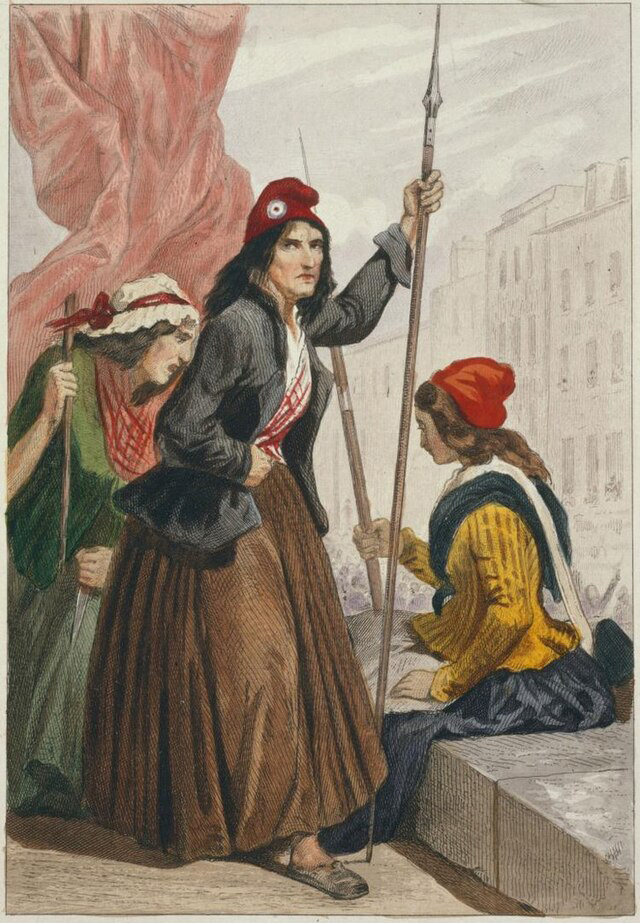
Tricoteuse
Her character is based on the true story of the tricoteuse – the women who notoriously knitted while sitting next to the guillotine. They undoubtedly took up this public position because just a few months before the Reign of Terror began they were banned from government proceedings and prohibited from forming any political assembly. Initially praised for their role in the resistance after successfully forcing Louis XVI to acquiesce to their demands following their march on the palace at Versailles protesting rising food prices, they had become too much of a threat to the aristocrats. It is said they were knitting liberty hats.
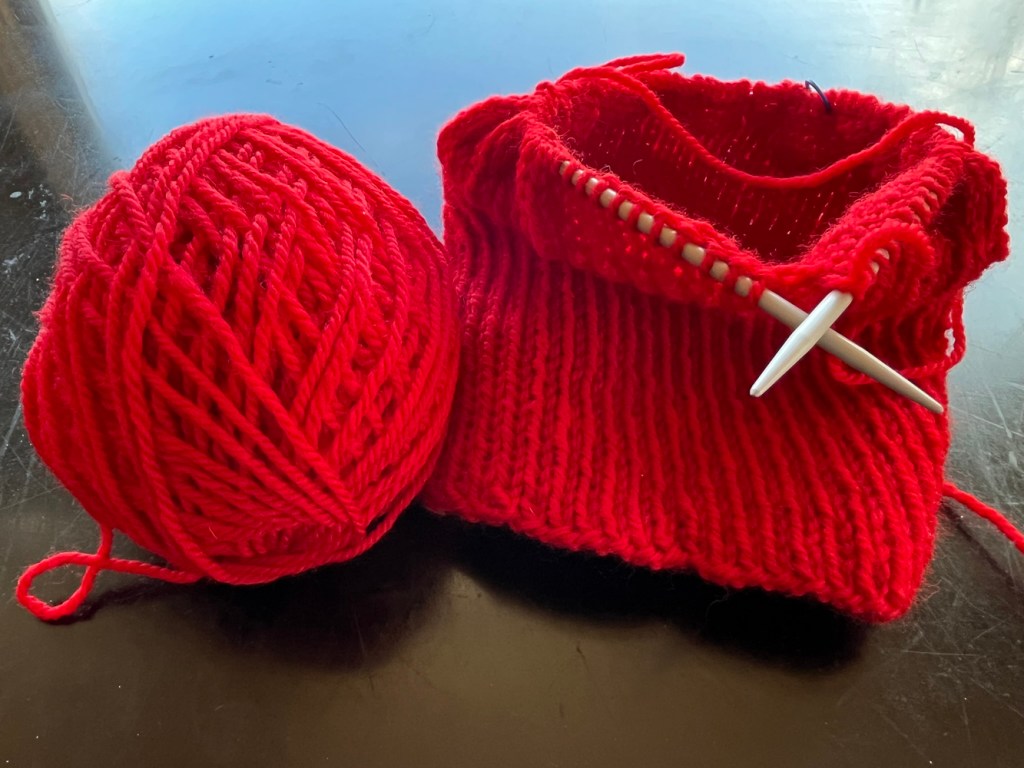
Fast forward to today. Begun with a simple “Melt the Ice” pattern designed by Paul Neary from the yarn shop in Minneapolis, Needle & Skein, women and men all over the world are once again knitting liberty hats. The red pointed hats are modeled after the nisselue — or “Santa hat”– that Norwegian women knit as a symbol of resistance to the Nazis who were occupying Norway during WW II. Needle & Skein made the pattern available for $5, with proceeds going to support rent and food assistance to those unable to leave their homes due to ICE’s ongoing presence in the Twin Cities. As of March 5th, they had already raised $705,000.
That the movement has become worldwide is extremely moving to those of us in Minnesota. It lets us know we are not alone. It has become a sisterhood of sorts, with a continual round of Facebook messages like this one from Elisabet Engström, “I am knitting the Melt the Ice hat right now. . . . It feels so good to be a part this. I live in Sweden. Happy knitting to all of you.” Another writes from Ibaraki, Japan, that has a cultural exchange program with Minneapolis, that she is knitting MTI hats “in solidarity and support.”[ii] I particularly loved this one, “I changed the pattern a bit, but I’m loving the resistance and how much it’s already earned for donation. I’m 82 and can no longer march, but I can do this.”[iii]
These days, at every protest I attend and just walking around town, I see people, mostly women, wearing the red Melt the Ice hats. There’s something particularly fortifying about wearing one’s convictions so visibly in solidarity with others doing the same. On the 84th anniversary of the Naz’s banning the wearing of the nisselue hats, people all around the world wore the red MTI hats they had inspired, proudly displaying their resistance to the occupation forces of ICE that have terrorized cities and immigrant communities throughout the US.
I first engaged in knitting resistance in 2009 when students in my course, “Women, Peace, and War” participated in CodePink’s Mother’s Day action against war, displaying a banner on the White House fence with the words, “We will not raise our children to kill another mother’s child.” CodePink sent out requests for 4X4 knit squares in pink yarn, and so we began to knit. Many of the students already knew how to knit. We taught those who did not. Most class sessions we were all busily knitting while discussing the readings on women’s roles in war and peace, and by the due date sent in a few dozen squares. It was a wonderful exercise in activist engagement that also brought us together as a community in the classroom and with other anti-war feminist activists throughout the country.
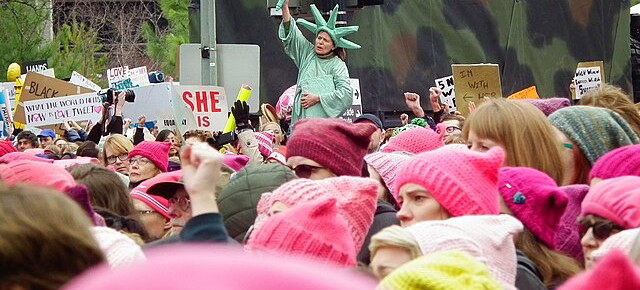
Many people first engaged in knitting resistance when Kat Coyle of Ravelry – the social group for knitters and crocheters – created a pattern for the “pussy hat”[iv] – a symbol of resistance to Donald Trump worn in the first Women’s March following his inauguration in 2017. The streets in Washington, DC and other cities across the country were filled with pink pussy hats.
Women’s March on Washington in 2017
These are just a few of the hundreds of ways knitting and other crafts have been used in resistance to oppression, tyranny, violence, and war. In 2003, Betsy Good coined “craftivism” – a combination of “craft” and “activism” – to describe this worldwide movement.[v] As one craftivist described it, craftivism is “a strategy for non-violent activism in the mode of do-it-yourself citizenship or do-it-together citizenship’.”[vi] Craftivist and author Sarah Corbette wrote, “To be a craftivist is not just to be someone who likes craft: it is to be someone who hones their craft to question injustice, encourage peace and show ways to achieve a better world for everybody involved.”[vii]
Craftivism includes all forms of fiber and needle arts – from knitting and crocheting to embroidery and quilting and more – from the use of quilts encoded with messages about the underground railroad and its resurgence as a medium for resistance during the Civil Rights movement to the AIDS memorial quilt,[viii] from suffragists’ embroidered banners for votes for women to the embroidered arpilleras of women in Chile to document human rights abuses during Pinochet’s regime. But the craft that is currently engaging so many is knitting. Knitting has featured prominently in anti-war resistance, such as the aforementioned CodePink banner. During WWI and II, knitting was central to resistance workers who knit secret messages into scarves and mittens and sweaters, using knit and purl stitches to represent dots and dashes in Morse Code, or dropping stitches in strategic places to represent German train activity. Women knit themselves into webs during anti-nuclear protests at Greenham Common in the 1980s and decorated the perimeter fence around the air base with ribbons and knit items. The British “Cast Off Knitting Club” knit grenade purses to protest the Iraq War and in the US Starhawk and fellow protestors created a yarn web around the Pentagon.
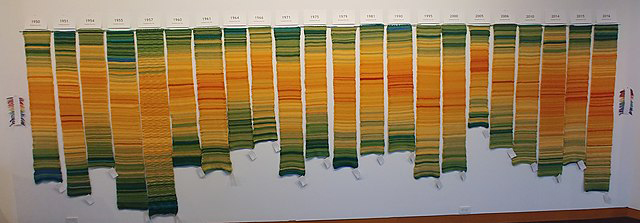
The Tempestry Project
Knitting has been used as a form of protest for countless other causes as well. Suffragists in the US knit, sewed, and embroidered banners with declarations of women’s right to vote. The “Tempestry” project was begun in 2016 in response to concerns that the incoming Trump administration would minimize climate data. Participants knit ‘temperature scarves’ with specific color-coding to record climate change data in various places in the US.[ix] The “Liberty Crochet Mural” – consisting of 40 individual crocheted squares assembled into a 17ft x 11ft yarn mural — celebrates women’s reproductive autonomy and freedom to choose. In the “Welcome Blanket” project — a response to the first Trump administration’s proposed 2,000-mile wall along the United States–Mexico border, Los Angeles artist Jayne Zweiman and dozens of other fiber artists knit, sewed, crocheted, and wove 3,500,640 yards of blankets to welcome immigrants.[x] And the Minnesota MTI hat is not the only anti-ICE knitting project. In Portland, Tracy Wright formed “Knitters Against Fascism,” which designed and promoted the Portland frog hat and conducts “knit-ins” outside the Portland ICE facility.[xi]
MTI hat in production
In Part II, more on knitting resistance and feminism, gentle protest, and community building – tomorrow
Laware, Margaret L. “Circling the Missiles and Staining Them Red: Feminist Rhetorical Invention and Strategies of Resistance at the Women’s Peace Camp at Greenham Common.” NWSAJournal, Vol. 16, No. 3 (Autumn, 2004), pp. 18-41.
[iv] The “pussy hat” was inspired as a protest against Trump’s infamous statement in a 2005 tape, “When you’re a star, they let you do it. Grab them by the pussy. You can do anything.”
[v] The term “craftivism” is usually attributed to Betsy Greer, but she actually coined the term when after she mentioned a connection between craft and activism, “Buzz,” one of the women in her knitting circle, said, “You could call it craftivism.” Greer then posted it on her online journal in 2000, and in 2003 bought domain named craftivism.com, which has become a worldwide network of craftivists.
[viii] Evidence suggests that quilt patterns such as the “Log Cabin” or “Flying Geese” may have been used in the Underground Railroad to provide coded messages to guide enslaved people to freedom. Women in the Civil Rights movement organized quilting circles as a form of resistance. The quilts made during the Civil Rights movement were often sold to raise funds for the movement. The AIDS memorial quilt originated in San Francisco in 1985 to memorialize those lost to AIDS. Gert McMullin, the ‘mother’ of the quilt, sewed the first stitch and since then 50,000 panels have been added, honoring more than 110,000 individuals. Weighing 54, it is thought to be the largest community art project ever created. It has raised more than $3 million dollars for AIDS services. Other famous resistance quilts include The Border Wall Quilt Project, a collection of 8” x 16” quilt pieces expressing concern about the border wall and the Broken Treaty quilts, created by Gina Adams, with texts taken from treaties to demonstrate the broken promises and injustices to indigenous peoples.
[x] The project quickly exceeded its goal and aims to encircle the globe in 36,521 handmade pieces. 8,000 have been collected so far. To learn more or participate, see Welcome Blanket.
[xi] The proceeds from the sale of the pattern have raised $500 for local food shelves.
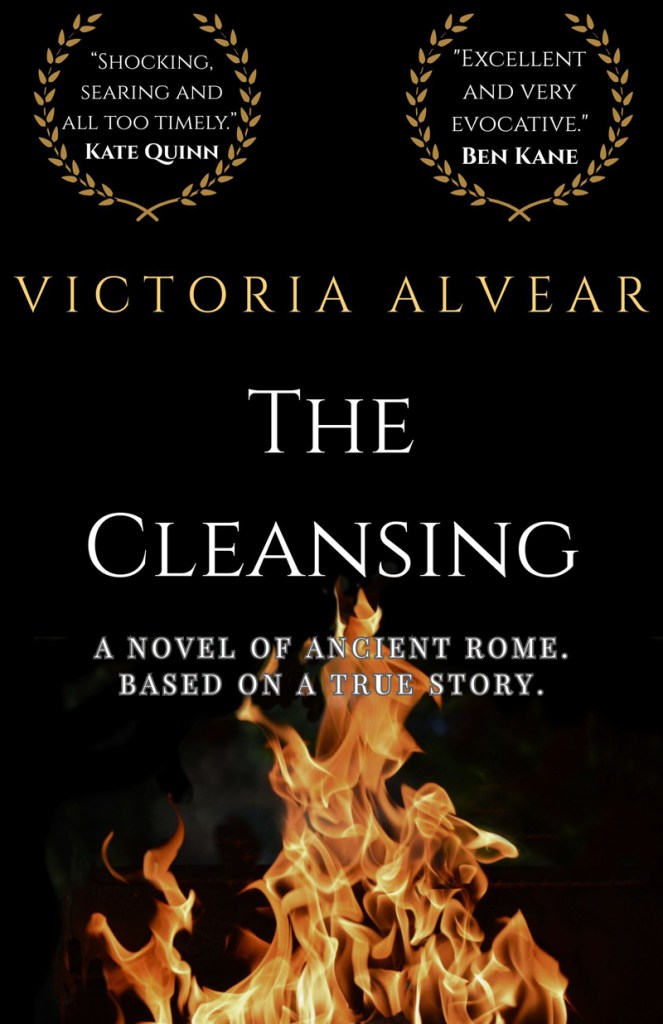
Published by Hypatia Press, The Cleansing deconstructs the roots of religious-based misogyny and purity culture through the real story of a Vestal Virgin accused of breaking her vow of chastity. Midwest Book Review called the novel, “Original, exceptional, deftly crafted and a simply riveting read from cover to cover.”
Writing a novel about the persecution of a Vestal Virgin priestess in ancient Rome really brought home for me just how deep the religious roots of misogyny and purity culture go. In my novel, The CleansingI focused on the true story of a Vestal accused of having sex and being blamed for the massacre of 50,000 men in one battle.
Two hundred years before Christianity, Rome’s religious leaders claimed only a “crime” of that magnitude—of one of their sacred virgins breaking their vows—could have “disgusted” the gods enough to cause them to turn their backs on Rome. The Vestal faced a death sentence—being buried alive—for this so-called “crime.”
Meanwhile, the general who made a massive strategic error in battle, the man responsible for marching tens of thousands of soldiers into a trap, walked away scot-free.
It seemed unbelievable to me that they truly believed a woman’s sexual conduct could have that much influence and power. And yet they did, as evidenced by the fact that the Romans buried alive two dozen Vestal Virgin priestesses (that we know of) during Rome’s existence. When a tragedy occurred—war, famine, pestilence—the head priest of Rome, the pontifex Maximus, and the Collegium of priests often claimed that one or more of their six Vestal priestesses “had” to have had sex to explain away the tragedy.
This blogpost is included as part of FAR’s co-operation with other organizations to highlight and amplify each other’s voices. Paul Robear is President and Executive Director of The Cuyamungue Institute (CUYA). CUYA is the international home of Ritual Postures and a global leader in transformative experiences rooted in ancient traditions — offering workshops, research, and online learning that open pathways to expanded states of consciousness. CUYA, The Felicitas D. Goodman Institute is an independent, 501c3 not-for-profit educational organization committed to the study of “ASC” Altered States of Consciousness as a natural extension of the human experience.
Finding Coherence in Shared Presence
Why have human beings always gathered in circles?
I have often wondered why I am instinctively drawn to them; my body seems to recognize a quiet stability before my mind can explain it.
The circle itself generates a kind of collective coherence.
Long before there were formal doctrines or institutions, there were fires, drums, breath, and bodies moving together in a circle. Across cultures and continents, people entered rhythm — through chant, movement, and synchronized breath. While these practices were often interpreted through religious frameworks, something more fundamental was occurring beneath the symbolism.
In a circle, every face can be seen, every movement sensed. Nothing approaches from behind. The body registers this orientation as safety.
Ritual, then, may be one of humanity’s oldest technologies for collective coherence.





 Feminism and Religion