Creating Spaces for Grieving and Receiving by Anjeanette LeBoeuf

By now, all aspects of life have been altered or halted. The world as we know it has become radically different as we attempt to get a handle on this disease and stop the rising number of deaths each day. We are enduring trauma on a global and individual level. Trauma carries a myriad of emotions; anger and grief sometimes being the prominent two.  And with the rising uncertainty paired with the increasing amount of trauma and grief we are all experiencing, we need to find ways to talk about our feelings, share, and move forward.

Continue reading “Creating Spaces for Grieving and Receiving by Anjeanette LeBoeuf”

Dolphin – Friendly Guide, Ambassador of Peace and Play by Judith Shaw

judith shaw photoAnyone who has seen dolphins frolicking in the sea, understands the allure of these mysterious creatures who live in the water and yet are not fish. Highly intelligent and communicative, Dolphin inspires a sense of joy in our hearts. Often seen leaping and swimming beside boats, stories of rescue and friendship abound. Continue reading “Dolphin – Friendly Guide, Ambassador of Peace and Play by Judith Shaw”

Self-calming with Syllable Counting and Rhyme Finding by Elizabeth Cunningham

In times of stress, I like to count syllables. It soothes me the way the click of knitting needles might soothe others. Finding rhymes is also calming. Below are poems in forms that require syllable count and/or rhyme, the last three written recently. I hope you are all sheltering well.

Villanelle: 10 syllables to a line. A, B rhyme scheme, with repetition of the 1st and 3rd lines.


noon

I have come to love the silence of noon
the cars have all gone wherever they go
I can hear the bees hum their tuneless tune

the noon of the day is the sun’s full moon
listen, the air is still, the wind lies low
I have come to love the silence of noon

the chainsaws silent, no wood to be hewn
no scratching the dirt, it’s too hot to hoe
I can hear the bees hum their tuneless tune

each shadow cast, now drawn close, is a rune
thickets conceal spotted fawns and a doe
I have come to love the silence of noon

this refuge from noise, a sweet daily boon
a full body blessing, crown to tiptoe
I can hear the bees hum their tuneless tune

each noon is a moment, passing so soon
the wild meadow flowers before we mow
I have come to love the silence of noon
I can hear the bees hum their tuneless tune Continue reading “Self-calming with Syllable Counting and Rhyme Finding by Elizabeth Cunningham”

Monotheism and the Shema: Lessons on Oneness and Unity by Ivy Helman

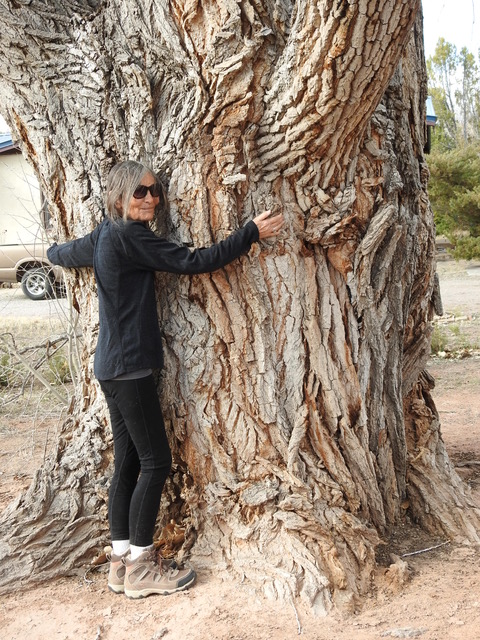
ivy tree huggingIn my last blog post, I explained what we lost when the Israelites became monotheists.  That post looked at the move to monotheism from a more historical, feminist perspective.  In this post, I want to understand monotheism from a more modern, feminist lens.  Using the Shema as a starting point for modern Jewish monotheistic thinking, my question is: how do we honor the deity based on who we understand that deity to be?  In my opinion, Jewish monotheism requires we honor G-d by moving away from one-sided gendered depictions of the deity and think about how we act in light of the interconnectedness of life.

Judaism highlights the Shema as the description of the divine.  It reads, “Hear, O Israel! The L-rd is Our G-d, The L-rd is One!,” (Deut. 6:4).  The key aspect of this verse is twofold. First, we have a relationship with the deity hence the description of the deity as “our,” and, second, this deity is one. 

Oneness used to imply that no other deities count, and perhaps also that no other deities literally exist.  For example, if one were to read the Torah, one would understand the deity differently.  On the one hand, the deity is one of many possible deities one could worship. On the other, it is quite clear that no matter what the deity is called, there is one specific deity that chose to help the Israelites.  In the Torah, the divine is always referred to as he, using only masculine pronouns for the deity. In addition, he is often called king, lord, and master. G-d is depicted as powerful, wrathful, jealous, and even scary.   Continue reading “Monotheism and the Shema: Lessons on Oneness and Unity by Ivy Helman”

Corona: Reclaiming Sovereignty in a Culture of Addiction by Eirini Delaki

The moment we live right now is one of its kind in the history of humanity. There´s an expansive wave of uncertainty, fear of death, panic and, at the same time, an expansive wave of creativity, hope, compassion and unity. We´ve never been so isolated from each other and yet so close…

I believe that there´s a great opportunity in what is happening right now. The opportunity that the fear of death will awake us in realizing that we’ve already been living our lives “infected” by all sorts of habits that were taking life away from us.

There´s a symbolic frequency in the word Corona, like in Corona virus, that holds the key to transformation through this experience. Corona means crown. It also refers to the aura of plasma that surrounds the sun and other stars. When a baby is born, we call that “crowning”, since its head comes out first, if all goes well. This pandemia is a radical wake up call to recuperate our sovereignty, to shine, to be reborn into our authenticity. The seventh chakra, that is the vortex of our energy system, situated at the top of our head, is called Crown Chakra. When that vortex is balanced, we experience unity, the knowledge that there´s an intrinsic law underlying all of existence, serenity, joy, and deep peace about life, beyond intellectual knowledge. Continue reading “Corona: Reclaiming Sovereignty in a Culture of Addiction by Eirini Delaki”

Fierce Grace in Frightening Times by Mary Sharratt


The Covid 19 pandemic had turned our lives upside down on a global scale. What we as a collective could not possibly have anticipated ever happening to privileged Western people has become our new normal as we are forced into lockdown and social isolation.

Ironically, apart from travel plans being canceled, my day-to-day life hasn’t changed that much. As a freelance writer, I’ve always worked from home and my workload and deadlines remain unchanged. In fact, many freelancers and remote workers feel pressured into greater productivity now that they are “stuck at home” with few other diversions. To me, this pressure to carry on business as usual amid a news stream of ever increasing infection and deaths feels sickeningly schizoid. Jocelyn K. Glei, in her brilliant podcast series Hurry Slowly, discusses this phenomenon of productivity shame. Continue reading “Fierce Grace in Frightening Times by Mary Sharratt”

“Tree of Life” Dream by Sara Wright

Full Seed Moon 3/9/20

I see a beautiful fruit tree that is in full bloom with delicate pink blossoms and a man comes and attacks it violently – Oh, all the blossoms fall away, drifting tears cover the ground. Before this the little tree had bloomed “forever,” but man brought death to the blossoming tree and to the tree of life itself.

Little interpretation is necessary to understand this dream on a collective level. The Tree Holocaust is upon us. The Anthropocene is destroying more forests every second.  Billions of trees. The lungs of the earth. The Beings that gift us with rain. We have less than three percent of intact forest left on this planet.

“Man” represents the age of the Anthropocene – each one of us – male or female. Every human being on this earth is complicit in tree obliteration and the terrifying violence associated with this slaughter. It’s important to note that the tree is weeping. (My sense is that the tree isn’t just weeping for being murdered but that s/he is weeping for those who would annihilate her/him). Continue reading ““Tree of Life” Dream by Sara Wright”

Coronavirus: The Villain Is Not Mother Nature: It Is Ourselves by  Carol P. Christ

Over the past few weeks of lockdown in Greece, I have asked myself numerous times: if we can shut down the world economy because of a virus, why don’t we shut everything down until we end war or find real solutions to global climate change? In my mind the horrors of war are much worse than the horrors of disease and dying and the threat and reality of global extinctions pose a much greater threat to humanity (not to mention nature) than the Coronavirus.

Why is it that we are willing to take extreme measures to defeat the Coronavirus but we are not willing to take extreme measures to end war or to stop global climate change? A thought keeps creeping into the back of my mind: the fight against disease and death is (understood to be) a fight against Mother Nature and (sadly) we are well used to fighting against Her. If we recognized that human beings have brought the Coronavirus upon ourselves, we would have to face up to our responsibility for it. Continue reading “Coronavirus: The Villain Is Not Mother Nature: It Is Ourselves by  Carol P. Christ”

“Not If But When” by Barbara Ardinger

As I’m writing this early in March, the CDC has recently said of the outbreak of the coronavirus (Covid-19) that it’s a question of “not if but when” the epidemic will strike the U.S. As we know, it started in China, where it was underreported. Some U.S. cities are setting up quarantine centers, the Faux New Channel is now proclaiming conspiracy theories about the origin of the virus, and Mr. Trump has appointed Mr. Pence to be Coronavirus Czar. Which would be fine if either man believed in science.

We’ve seen epidemics and pandemics before—the post-World War I Spanish Flu, HIV/AIDS, Ebola, SARS, the avian and swine flus, and many more. This new disease as already killed people on six continents. My purpose here is to briefly review two books in which a pandemic is a major plot driver. You know those books you read and keep and go back to again and again? Two of my go-to novels are Station Eleven (2014) by Emily St. John Mandel and Doomsday Book (1992) by Connie Willis. Continue reading ““Not If But When” by Barbara Ardinger”

The Time My Kids Broke Me Out of Jail by Trelawney Grenfell-Muir

When I was a child, I liked and hated the game Monopoly. It was interesting and exciting, but it was also cutthroat, ruthless, competitive, and often seemed to involve cheating by the banker. My vague memories are mostly hurt feelings and distrust. So when my younger daughter Z pulled my ancient Monopoly set up from the basement and asked me to teach her how to play, I agreed with reluctance and trepidation.

My older daughter E noticed us playing after an hour or so and asked to join. Of course, E played at a significant disadvantage since she joined late. My trepidation increased. E was paying lots of rent but collecting hardly anything. The hurt feelings and distrust would erupt soon. I played grimly on, trying to act relaxed and cheerful as my dread mounted.

At one point, I couldn’t afford to pay rent to Z, so I mortgaged some properties. My daughters were horrified. “No, Mummy!” they kept repeating, “you don’t have to do that! We will give you some money!!” But, see, that’s not how The Game works, so I kept refusing their money. “It’ll be fine, honest!” I said, confused and unsure how to handle their anxious concern. I tried to be Nonanxious Presence Parent, modeling that I don’t mind losing The Game. They were equally confused. Why wouldn’t I accept their help? We played on. Continue reading “The Time My Kids Broke Me Out of Jail by Trelawney Grenfell-Muir”