Writing Women Back into Jewish History: Interview with Michelle Cameron by Mary Sharratt


My friend Michelle Cameron’s powerful new novel, Beyond the Ghetto Gates, is a deep dive into women’s history that I thoroughly enjoyed.

This is a passionately compelling saga of an ancient way of life on the threshold of radical change. Young Mirelle longs to dedicate her life to running her aging father’s workshop, but her rabbi forbids her on account of her sex. Chafing against the constraints of both her gender and the suffocating strictures of the Ancona Ghetto, Mirelle sees no way forward but dutiful arranged marriage. Yet Napoleon’s armies, sweeping across Europe, threaten to change her way of life forever.
I learned so much from reading Michelle’s novel and from my conversation with her below. I hope my readers are likewise compelled! Reading is our great solace in this time of lockdown.


Mary Sharratt:  Michelle, tell us about your new novel, Beyond the Ghetto Gates.

Michelle Cameron: Beyond the Ghetto Gates is a historical novel set during Napoleon Bonaparte’s Italian campaign (1796-97). When French troops occupy the port city of Ancona, freeing the city’s Jews from their repressive ghetto, two very different cultures collide. Mirelle, a young Jewish maiden, must choose between her duty – an arranged marriage to a wealthy Jewish merchant – and her love for a dashing French Catholic soldier. In the meantime, Francesca, a devout Catholic, must decide if she will honor her marriage vows to an abusive and murderous husband. Beyond the Ghetto Gates depicts how the Jews and Catholics of Ancona wrestle with ancient traditions, prejudices, and the challenges of a rapidly changing world.


MS.: How does your faith inspire your fiction?

MC: People often ask if I’m religious, because my historical novels focus on Jewish characters, issues of antisemitism, and the deep conflict between religious tradition and assimilation. I believe it’s precisely because I am a non-observant Jew with deep roots in my ancestral traditions and culture that I can wrestle with these issues in ways that a more religious writer could not. I’ve felt the attraction of being part of “the norm,” much as my characters do, that tug-of-war between religious identity versus being accepted in a secularized society, which is a constant theme in my fiction.


MS: What is the most surprising fact you’ve gleaned from your research into women in Jewish history?

MC: That Jewish women could divorce if their husbands fail in their marital duties. These are spelled out in the marriage contracts (ketubot) that Mirelle’s father creates:

Be my wife according to the law of Moses and Israel. I will work, honor, feed, and support you in the custom of Jewish men, who work, honor, feed, and support their wives faithfully. I will give you the settlement of ______ as well as your food, clothing, necessities of life, and conjugal needs, according to the universal custom.

The shocker here is “and conjugal needs.” Once, when speaking about my previous novel, The Fruit of Her Hands, I was questioned on the pleasure that Shira’s rabbi husband gave her in bed. There’s a common misconception that intercourse is a duty whose sole purpose is procreation. Luckily for me, the group included the rabbi’s wife, who explained that men are actually taught in the Talmud how to satisfy their wives sexually.

But since observant women are discouraged from studying Talmud, men who aren’t adequate to the task aren’t always condemned for their failures. But the fact remains that men are supposed to make the act pleasurable for both parties – and that they can be divorced if they don’t do so.

MS: How do you hope your work might inspire your readers to gain new insights about history and faith?

MC: I hope that, by learning about the cultural underpinnings and the historical struggles of my Jewish characters, my novels might promote greater understanding between all faiths.

MS: What is the one question you never get asked in interviews, but wish you did?

MC: Did you always want to write Jewish historical fiction?

In fact, I did not. My first book, In the Shadow of the Globe, a verse novel about William Shakespeare’s life and loves, was actually the type of book I thought I’d be writing. But then I discovered that I could trace my roots back to my 13th Century rabbi ancestor – Meir of Rothenberg – and realized his life story was the stuff of a novel. Writing that book set me on this path. It helps that I had a much more thorough grounding in Jewish history than most, because I lived in Israel during my high school years.


MS: What are you working on now? Will you continue to explore themes of women and Jewish history?

MC: I’m working on the second book in the series – which takes Napoleon and his troops on a bizarre expedition to Egypt and Israel. Many of the same characters from Beyond the Ghetto Gates will be part of this novel. So yes, I’ll be continuing to explore these themes.


MS: How would you like readers to connect with you?

MC: Via my website. This includes my various social media links, as well as a contact page, allowing readers to write me directly.


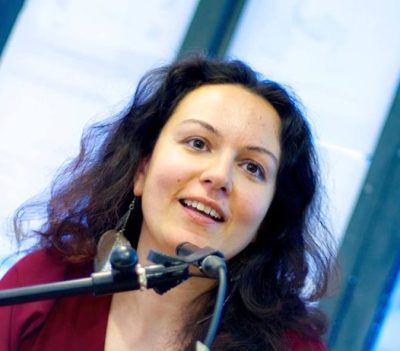
Author, Michelle Cameron


Mary Sharratt is on a mission to write women back into history. Her most recent novel Ecstasy is about the composer Alma Schindler Mahler. If you enjoyed this article, sign up for Mary’s newsletter or visit her website.


The Messy, Wild Mystery that’s Stronger than Wrong by Trelawney Grenfell-Muir

I am an annoying feminist. I annoy pretty much everyone about it, because I’m never NOT applying a feminist lens to every aspect of life: science (looking at you, Larry Summers), politics (Joe Biden is a rapist), art (objectification is NOT empowerment), culture (make-up is a prison), and, of course religion. I’m perhaps most annoying of all when it comes to religion. I annoy Christians by raving about Christ The Cosmic Vagina, and I annoy secularists by raving about feminist Jesus. I especially annoy my church friends and colleagues by refusing to use the (male) word “God” to talk about the Infinite Divine Mystery, much less male pronouns or oppressive symbols such as Lord, King, or Kingdom.

Yep, I’ve been cheerfully annoying the hell out of everyone for decades, drawing vagina art during male-centric worship services, changing lyrics on the fly, slipping female words and symbols into prayers and startling whomever sits near me… I am a feminist. Not the fun kind. Continue reading “The Messy, Wild Mystery that’s Stronger than Wrong by Trelawney Grenfell-Muir”

Community Immunity by Natalie Weaver and Nathan

My eleven-year-old son, Nathan, a fifth grader, is doing his best to deal with changes the coronavirus pandemic has brought to his life.  Before this time, Nathan’s biggest daily worries have been keeping his school papers organized and staying on top of his sometimes rigorous homework assignments. Nathan has ADHD, which poses certain challenges to his learning and behaviors, making some tasks that have many intermediary steps nearly intolerable for him.  Nathan’s learning is complicated by the fact that, while it has always been apparent that his learning style was different, his teachers and family (including me) have not always had the skills or patience to see Nathan’s exceptional gifts and insights from Nathan’s own point of view.  

While his ADHD is a challenge, Nathan has a more ominous, lurking, daily concern.  Nathan has a life-threatening allergy that has made him keenly aware that every visit to a strange house, every meal at a restaurant, every bakery product, every school treat, every friend’s birthday party, and even touching a doorknob or library book could mean a painful and terrifying hospital experience. Since his allergy was first discovered, Nathan has been keenly aware of dust, germs, and particles.  He washes his hands to a fault, both as a result of ADHD compulsive behaviors and his deep awareness of his vulnerability to invisible, yet deadly particle foes.  Nathan’s allergies also give him extremely sensitive skin, predisposed to eczema, severe rashes, dryness, and splitting, so gloves, soaps, and sanitizers are at once necessities and risks to the largest organ in Nathan’s body. Continue reading “Community Immunity by Natalie Weaver and Nathan”

La Llorona and the Dark Green Religion of Hope by Sara Wright

Picture of Sara Wright standing outside in natureI recently returned to Maine after what can only be called a harrowing journey from the Southwest. Grateful to feel beloved earth under my feet, I walk along the pine strewn woodland paths to keep myself sane. My animals have been ill, my neighbor was hospitalized briefly, other neighbors deliberately destroyed my garden wall crushing a baby balsam, and used this property as their personal ski slope, the threat of the C/virus looms – there are no words to describe this kind of exhaustion. As a PTSD survivor all my senses are on permanent scream. The simplest task has become monumental. And I am only one of so many…

Each day I attempt to feel gratitude for what is good in my life.

Momentary peace is found in the Dark Green Religion of Hope that I experience walking under every balsam, lichen, wet leaf, deciduous tree, listening to chickadees, phoebes, juncos, and finches, meandering along the swollen brook – Just to see clear mountain waters rushing to the sea reminds me that Nature’s rhythms are my own, and that most of the time I am not breathing with her – unless I take these walks. Somewhere along the way over these last weeks I have lost access to my body (PTSD). Continue reading “La Llorona and the Dark Green Religion of Hope by Sara Wright”

Visions of the Goddess: A White Horse by Carol P. Christ

Imagine my surprise when, a few days ago, I looked out my window to see a dappled horse munching on flowers in the field across the street from my house. In the next days I got used to her being there. I would look for her in the mornings and at odd times during the day. Sometimes she was visible and sometimes she was not. When I could see her, I would open the window and call out, “Hello, white horse, you are very beautiful.” Once or twice she turned her head to look at me and seemed to respond, “Thank you for noticing.”

Many hundreds of years ago, Sappho must have had a similar vision in a field near a grove of trees where she and her students waited for the Goddess to appear, for she wrote: “In meadows where horses have grown sleek among spring flowers, dill scents the air.“ These lines are part of a longer poem addressed to Aphrodite that begins: “Leave Crete and come to us.” In this place, “incense smokes on the altar,” there is a stream, there are apple trees and rose bushes and horses in a field of flowers. Continue reading “Visions of the Goddess: A White Horse by Carol P. Christ”

Going With the Wind by Barbara Ardinger

The wind changed during the night. Even as they slept, the Witch and the Ladies of the Magic Mirror felt it and stirred in their beds. Kahlil the raven, who was sitting on the roof, felt it, too, and as he looked down the highway, he spotted the travelers. “What’re those folks doing on the road?”

The travelers were walking along the highway built only a few years ago by the people of the country towns who had fled from El Presidente’s capital city. They were coming toward the Witch’s house, too many for the raven to easily count: women, men, and children dressed in dark clothing that was stylish a hundred years ago.

The sun began to rise. The travelers came closer. The Witch and the Ladies got up, got dressed, and stood on the porch to wait for them. At the direction of the stout woman who was leading them, smaller groups broke off and turned toward other houses in the small town. The stout woman led her people to the Witch’s front porch. The wind changed again—and look! The travelers were no longer wearing dignified attire. Cloth caps instead of bowler hats on the men’s heads, headscarves on the women, scraps wrapped around the children. “They’re laborers,” said one of the Ladies. “Migrants.” Another Lady nodded. “And they obviously need our help. They need to be fed.” “They need jobs,” said the Witch. “How can we help them?” Continue reading “Going With the Wind by Barbara Ardinger”

Trauma Healing in Collective Crisis by Laura Shannon

My previous post on this site, Trauma Healing through Communal Dance, on February 1, told of a traumatic event and its lingering effects, including insomnia, brain fog, nightmares, tearfulness, migraines, anxiety, and fear. Now I’m hearing reports of similar symptoms from virtually all of my friends who are affected by the trauma of the coronavirus pandemic.

Three months ago, Greek communal dance helped me recover from my traumatised state. Now, nobody has access to communal practices like circle dance to help us get through it.

So how do we heal when we all need healing? When we don’t have access to the things which would normally help us heal?

Circle Dance with Laura Shannon, Germany 2008 (photo: Beate Frey)

There is a lot of talk right now about strategies, small and large, which can keep us sane in this crazy time. Many speak of the ‘silver linings’ we can find in this enforced retreat, and I have found a few myself. But I have also heard from people who aren’t in a safe place, or who just aren’t coping well.

Even if you are blessed with a peaceful home, access to nature, and continuing income, not everyone is made for isolation. The lockdown can be particularly hard on extroverts. And many people may find that high stress levels in this time of separation, loss, and uncertainty awaken old ghosts of unhealed trauma.

My earlier blog named some of the therapeutic aspects of communal circle dance, including connection with others, shared movement synchrony, realignment with ‘my self, my body, my place between heaven and earth, and my home in the human community.’

Armenian Candle Dance with Laura Shannon, Findhorn 2015 (photo: Hugo Klip)

As I wrote in Medusa and Athena: Ancient Allies in Healing Women’s Trauma, “Past trauma can be transformed through ‘physical experiences that directly contradict the helplessness, rage and collapse that are part of trauma’ and which foster a renewed sense of self-mastery. Because trauma tends to be experienced in ‘isolated fragments’, treatment particularly needs to engage the entire organism, ‘body, mind, and brain’.”

So, dancing is perfect. Circle dance, particularly, is my ideal method of trauma healing. But how can we dance without a circle?

A lot of us are dancing on platforms including Skype and Zoom, but the slight time lag with this technology means that true synchrony is impossible; everyone’s movement appears slightly off the beat. Nevertheless, I love seeing cherished faces, talking together, and dancing despite the distance.

My favourite way to dance ‘in circle’ is without any online technology, simply connecting in heart and spirit. Since the start of the lockdown, my network of dance students, friends, and colleagues in different countries have been ‘meeting’ at set times twice daily, and it is deeply moving to join together in this way. We light a candle for loved ones, health workers, key workers, and anyone who is unwell or needs extra support at this difficult time. Then we each dance the same sequence of circle dances, plus our personal favourites. Knowing that my friends are all dancing in their own homes, and that we are all thinking of each other at the same time, is very precious.

Candle (photo: Laura Shannon)

If you too are separated from your loved ones, you can choose a time every day to stop what you are doing so you can think of one another, with no need for online technology. You don’t have to dance; just put on your favourite music and know you are connected.

Doing things you love can also provide an antidote to trauma – cooking favourite foods, lovingly repotting houseplants, or embarking on a fun creative project – anything you enjoy can connect you to your own power and experience of mastery as a source of healing. With my housemates here in Canterbury, we created a beautiful Easter feast – twice, first for Western and then for Orthodox Easter – with photos of our missing loved ones on the table. It was such a simple act, but nourishing on so many levels.

Time in nature connects us with the flow of life force which is in each of us. As we walk outdoors, feeling the earth below and the sky above, we can remember when we have come through challenges in the past, and let those memories reassure us that we will come through this now too. It was the same earth under our feet then, and it’s the same sky around us now and so it will be in the future when all of this is behind us.

Trees (photo: public domain)

Sometimes a larger crisis, like this pandemic, can put things in perspective, and bring us closer to forgiveness and healing. To support this inner process, I have found the Hawaiian indigenous practice of ho’oponopono to be very powerful. Hawaiian scholar and educator Mary Kawena Pukui describes it as a practice of forgiveness and reconciliation, for family members to ‘make right’ broken relations and prevent problems from erupting.

What can we do to foster forgiveness, move beyond blame, and focus on what we have in common? One recent story on the Karuna website tells how rival gangs in South Africa are now cooperating to deliver food to the vulnerable in their community. Amazing!

There is always something we can do, for ourselves and for others. And let’s not forget the larger context: life as we knew it has hit the pause button, and we have a chance to make some different choices in preparation for when we once again press ‘play’. Maybe we will find that all of us – and all of humanity – are suddenly dancing to a more beautiful tune.


Laura Shannon has been researching and teaching traditional women’s ritual dances since 1987, and is considered one of the ‘grandmothers’ of the worldwide Sacred / Circle Dance movement. She trained in Intercultural Studies (1986) and Dance Movement Therapy (1990), and is currently pursuing postgraduate studies in Myth, Cosmology, and the Sacred at Canterbury Christ Church University in England. Her primary research in Balkan and Greek villages seeks out songs, dances, rituals and textile patterns which descend from the Goddess cultures of Neolithic Old Europe, and which embody an ancient worldview of sustainability, community, and reverence for the earth. In 2018 Laura was chosen as an Honorary Lifetime Member of the Sacred Dance Guild in recognition of her ‘significant and lasting contribution to dance as a sacred art’. Her articles and essays on women’s ritual dances have appeared in numerous publications, including Re-Enchanting the AcademyDancing on the Earth: Women’s Stories of Healing Through DanceShe Rises! Vol. 2Inanna’s AscentRevisioning Medusa, and Spiritual Herstories – Call of the Soul in Dance Research. Laura is also Founding Director of the non-profit Athena Institute for Women’s Dance and Culture. She lives in Canterbury, Greece, and the Findhorn community in Scotland.

Links:

Answering the Call by Joyce Zonana

All along, I’ve believed that Malicroix had something important to offer English-speaking readers: an embrace of solitude, a profound connection with nature, a bold exploration of dream-states. And right now it seems to resonate with our current moment of introspection and reassessment of priorities.

202002_Zonana_JoyceVery early in Henri Bosco’s 1948 novel Malicroix, a young man, Martial de Mégremut, living placidly amid fruitful orchards in a tame Provençal village, receives a letter informing him he has inherited “some marshland, a few livestock, a ramshackle house” from a reclusive great-uncle, Cornélius de Malicroix. Against his family’s strenuous objections–with alarm they speak of “marshes, mosquitoes, miasmas”–Mégremut resolves to travel alone to the remote Camargue to claim his “wild” Malicroix inheritance. The house is on an island, and to reach it Mégremut must cross a rough river, at night, in a frail wooden boat piloted by a taciturn old man who meets him at dusk in the middle of a vast plain.

So begins a deeply internal quest narrative, an initiatory journey that forces Mégremut to come to terms with himself and with the elements–earth, water, wind, and fire–that are ever-present, sometimes terrifyingly so, on the island. For once he arrives, he learns that he must remain there alone for a full three months if he wishes to obtain the inheritance. Torn about whether to stay or leave, he finds that the decision to stay is made of its “own accord,” unconsciously.

Continue reading “Answering the Call by Joyce Zonana”

Redemptive Forgetfulness by Marcia Mount Shoop

MMS Headshot 2015Have you forgotten yet? Have you forgotten what it felt like to go about your life pre-pandemic?

My brain has switched to a different filter system. If I watch a movie or see an image from the pre-pandemic world, the first thing I notice is that people are standing too close to each other. Or I notice that they are touching each other. People are supposed to be in proximity to each other only in the boxes of Zoom or in the confines of their home or in a hospital where the staff has on protective equipment. That pandemic filter overlays itself onto everything now, even memories.

It’s hard to access the joy of greeting someone with a hug or handshake, because those things are something we must tell our bodies not to do. We have to resist that urge. We have to rewire our impulses. There are tiny threads of shared trauma in it all—how will we ever feel like we can be together again and not be afraid? Continue reading “Redemptive Forgetfulness by Marcia Mount Shoop”

Designing with the Goddess in Mind: A Meditation on Greek Spring Fountains by Carol P. Christ

During the past week I have been thinking about Greek spring fountains while designing a water fountain for my new apartment in Heraklion, Crete. When the architect sent photos showing that the tiles had been removed from my balconies, I noticed an enclosed niche that could be used for stacking wood, turned into a closet, or as I began to imagine, would be the perfect place for a fountain to bring the soothing sound of running water to my balcony. Continue reading “Designing with the Goddess in Mind: A Meditation on Greek Spring Fountains by Carol P. Christ”