

 During the January 21st Women’s March in New York City, I was inspired and delighted by so many of the signs women and men had crafted to express their opposition to the current disastrous regime in the United States: “Grab America Back,” “Support Your Mom,” “Sad!,” “Miss Uterus Strikes Back.” But one image stood out, mesmerizing me: that of a woman proudly wearing an American flag as hijab, with a message below—“We The People Are Greater Than Fear.” For several blocks as we made our way up Fifth Avenue, I walked beside a woman carrying that sign, and it became, for me, the most powerful symbol of the resistance we must all wage during the dark time ahead.
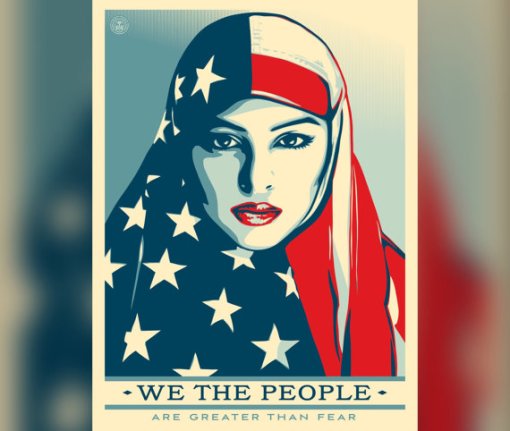

The image, based on a photograph of Munira Ahmed by Ridwan Adhami, was created for the Women’s March by graphic artist Shepard Fairey (who also designed the iconic image of Barack Obama, “Hope”). It offers a striking visual challenge to a long-held orthodoxy, now brought to the fore by Donald Trump and his gang: that Western-style liberal democracy (epitomized by the United States) is incompatible with Islam. And, perhaps even more specifically, that Islam is incompatible with feminism.
Many Western women—including feminists—are still bound by the Orientalist worldview that encumbered our liberal feminist foremothers. Continue reading “We the People by Joyce Zonana”
 In our book
  Activism and Politics have had a complex relationship with Hollywood. Now more than ever actors, directors, and many more associated with the media industry are using their voices, their positions, and their money to causes, political parties, and movements. More and more groups and reports are being generated stating the power of positive representation and even of the necessity of forward progress. Yet, despite the pressure and call for action, there still is heavy resistance, which can be most clearly seen during award season.
  Ever since reading Elie Wiesel’s book, NIGHT, I’ve identified with Madame Schächter, one of eighty Jewish people corralled and hermetically sealed inside one of the cattle wagons on the rail journey to Auschwitz from a ghetto in Sighet. The text tells us, “Madame Schächter had gone out of her mind.” Initially she moaned, confused as to why she had been separated from her family. She soon grew hysterical. “Fire! I can see a fire! I can see a fire!” When her fellow prisoners looked out the window and saw no fire, they attempted to silence her. Nevertheless, she persisted with her cries. They soon tied her up, gagged, and hit her. As the train approached its destination (Birkenau, the reception center for Auschwitz), Madame Schächter screamed, “Jews, look! Look through the window! Flames! Look!” When the Jews looked through the window this time, they saw flames “gushing out of a tall chimney into the black sky.”
 Did the ancient Celts believe in heaven and hell?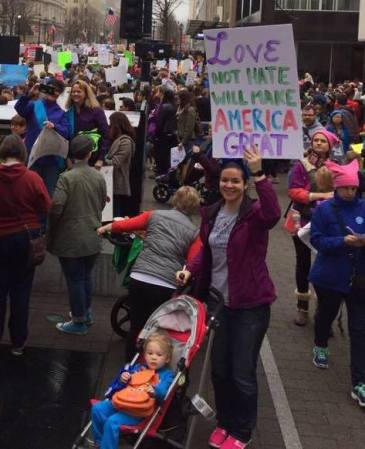
 There are two types of authoritarians: those who jump out in front and say “follow me, only I can solve the problem”; the far greater number of authoritarian personalities are those who want to be told how to think, what to do, “this is daddy, I’ll take care of you.” Those are the people who are the followers and while some of those would like to be leaders themselves, most of them are just happy to follow, and they don’t want to ask questions, and they want to be told what to do and how to think. And that’s a very scary lot. —John Dean
 ke me, today (and most days lately) it is difficult to be positive in a world that seems so full of hate. In fact, I struggled with a topic to write about because, in all honesty, it is hard to see the greener grass from where I sit – with all of the hatred spilling out in neighborhoods, churches, schools, and college campuses – even between family and friends. As I scrolled through Facebook, I came across a video and was struck by its message – we must be relentless in our kindness otherwise evil will win.
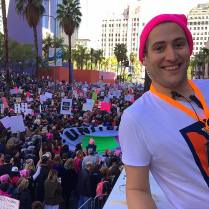 There comes a time in all of our lives when we have to make important decisions. What do I believe in? Who do I want to be? What and who will I stand up for? There has been a lot going on in the world lately and a lot of it, sadly, is pretty awful. While people are learning pretty quickly that elections have very real and long-lasting consequences, what is critical to make clear in the next 4 years of this fascist regime isn’t just that we are taking to the streets to make our voices heard, but that we are willing to disrupt society at every turn to make sure that people on the other side of the proverbial political coin know we will not go gently into that good night.
 I’m sitting in my parents’ balcony in Pune, India, on a quiet morning. Well, this being a bustling Indian city of six million, it can’t really be quiet. As I sit with cup of tea in hand, I try and meditate – I’ve been practicing mindful meditation of late, and so, rather than block out the noises, I embrace the various sounds that make up this Monday morning.
 Feminism and Religion