Who was Mary Magdalene? The first thought of many today is that Mary Magdalene was a repentant prostitute. But was she? Until the third century, Mary was considered an “apostle.”
Mary as an apostle posed a threat to the early Church patriarchs who denied women all authority in the Church. In addition, by early in the first century C.E., Mary Magdalene had become associated with Christian thought identified as heretical by the Church. The easiest way to eliminate Mary’s importance was to cast aspersions on her moral character.
Right around the same time, I learned of an Australian Muslim conference taking a slightly different route, advertising an event with thirteen male speakers and three female ones. Not an ideal ratio, but certainly better than many events. What is troubling is the way men and women appear on the poster. Each man has a picture along with his name. The women are literally faceless, represented by identical balloon figures. While the men appear in color or grayscale photographs, the women are stark black and white, clearly inhuman caricatures. (Other similar events give slightly different lists with only one woman; she appears with different line drawings, one in profile and one “full face” – except, still, faceless.)
Recently, Valentina Khan touched many of us when she wrote a blog entitled The Powers of Evil are Well at Work and I’ve Lost My Spirit. Valentina spoke of the weariness and despair many of us feel when we think about the problems the world is facing today. She said that “right now it just seems like my voice of peace is lost to the voice of fanatics who get more media attention than I ever will.”
Last week I met a young man who has recently begun to try to save a large wetland pool on the island of Lesbos. He told me he feels frustrated that “no one else” is doing anything to save the important and fragile ecosystem of our island. I explained to him that there are many of us who have been working to save the wetlands of Lesbos for fifteen years, but with few or no results.
In January 2015, I presented at the LGBT Faith Leaders of African Descent‘s third annual forum in Harlem, NYC. As an ally, I was honored to be invited. The theme of the forum was “Ain’t No Hurt Like Church Hurt.” I spoke about becoming an ally as wekk as about sexuality in Islam and among Muslims. However, what I learned while listening to other speakers and audience members will stay with me for life.
I have Christian family members who are gay and have dealt with church hurt because of it. Yet, it is not something I ever witnessed up close or spoke in depth about with them. Being Muslim, heterosexual and cisgender at the conference made me feel like an outsider yet everyone treated me as an insider. I felt as if I were witnessing pain I had no business seeing yet I felt obliged to witness and testify to it. So many people stood up to talk about their church hurt. There were so many tears of great pain and rejection shed during the conference. Everyone there was a great example of resilience. Throughout the day, I just kept thinking how blessed I was to be in the company of such wonderful, embattled, yet humble and loving people. Continue reading “LGBT Faith Leaders of African Descent by Jameelah X. Medina”
I almost got in a big fight with my son on Facebook yesterday. I posted a link to an article talking about the work that Miley Cyrus is doing for homeless teenagers. He immediately responded to my post by calling her a “skanky-ho.” Whoa!
I feel I need to do some qualifying here for a moment. I am not always a comfortable when I watch her performances. I am sure it is my age (73) and coming up in a far different time and mindset from what we have now. I feel a bit embarrassed watching some of her movements that have been labeled lewd by many and clearly so by my son on Facebook. I try very hard to not be judgmental or to place negative labels on anyone just because I may not always enjoy what they do. I do recognize that our perceptions are driven by our religious beliefs, our cultural backgrounds and our own inhibitions. I have to confess, I am even a bit jealous that she can be so open with her own sexuality in such a public way. I can tell you, however, I really like her voice and see her as an amazing performer! Continue reading “Miley Cyrus and the Happy Hippie Foundation by Deanne Quarrie”
The word “nun” can conjure images from traditional to irreverent in terms of gender. The gender of those who call themselves nuns can range from feminine to masculine, from a woman who looks like a woman dressed as a woman, a contemporary sister or “nun,” who does not wear the traditional black habit, but contemporary female clothing and perhaps a short veil or “wimple” and a cross around her neck; to a man dressed as nun in extremely sexual female garb, a “drag queen” nun; to the traditionally dressed nun, whose habit is a full-length black gown, and full veil covering everything but her face and hands, who means to conceal gender and become something else – a “nun.”
The physical space of “nun” then has opened the realm of gender for women, and recently men, since the creation of the category “nun” was established with the first order of female religious. Cloistered orders of women began in the fifth century, with the more liberated orders of “sisters” forming in the sixteenth century. The Encyclopedia of Catholicism lists approximately twelve Roman Catholic religious orders of sisters, or as they are commonly called, “nuns.” However, this terminology should be amended to allow for the difference between “sisters”- non-cloistered orders, and “nuns”- cloistered orders. Most traditionally the word nun officially refers to Roman Catholic nuns – those who take solemn vows of chastity, poverty and obedience, and live cloistered lives of silence, and prayerful meditation. Choir nuns, such as that of the famous convent headed by Hildegard de Bingen, (1098-1179), German nun, mystic and composer, chant the Liturgy of the Hours daily – consisting of a set order of readings and prayers, including Morning, Evening, Daytime and Night Prayers. Continue reading “Thoughts on Nuns and Sisters and Perpetual Indulgence by Marie Cartier”
I got the idea to write Femmevangelical: The Modern Girl’s Guide to the Good Newsafter a desperate search during a difficult time for a helpful Christian women’s devotional. Yeah, you remember those books that are meant to inspire and comfort, teach and instill spiritual conviction. But I was unable to find a devotional that spoke to me where I was: on a winding, decade-long spiritual journey and finishing my last semester of seminary, clumsily sounding out a feminist theology drastically different from my fundamentalist evangelical upbringing. In a low place, I wondered if my religious tradition even had the ability to raise my hope anymore, much less empower me. Continue reading “Femmevangelical: The Modern Girl’s Guide to the Good News by Jennifer Crumpton”
I find a whole lot of hoopla swirling around this thing we call “diversity.” By and large, these days people readily admit to being “for” diversity. A former colleague of mine, though, became exasperated with the trite, mechanical way many people rally around the concept, claiming to be firmly planted in the “diversity camp.” He would say, “Diversity? How can you be against it? It just is.”
So, what do we mean when we say we are “for” diversity? I think, at least in part, we are saying we want to see the variety of genders, races, ethnicities, and classes living in our communities permeate every aspect of our institutions. People’s “particularities”–their background (education, sex/gender, race, ethnicity, dis/abilities, and class)–shape and color their perspectives. By incorporating the wide swath of humanity into the public sphere, making room for everybody to contribute to society what is uniquely theirs, not only enriches us, but makes for a more equitable world. After all, when your voice is “heard” and when you see yourself reflected in the wider culture (legal rulings, the arts, economic policies), you are less likely to feel disenfranchised.
In my previous post, I wrote about the importance of rituals. The rituals of the Easter season helped me process some difficult emotions. The way that rituals mark time and demonstrate consistency has been a comfort for me when facing new challenges and settings. But I am quite aware that rituals can become empty. In one of the comments to that post, a woman named Barbara responded, “There came a time for me when familiar and meaningful ritual no longer made sense. I had changed in understanding of what the ritual symbolized and celebrated. And haven’t found new rituals that make sense for me now…or at least I’m not aware of any.” Barbara’s remarks capture not only the loss from no longer being able to relate to existing rituals after life changes, but also the difficulty in finding or creating new rituals to take their place. I thanked Barbara for her honesty and decided that this post would continue the discussion, focusing more on discovery and creation of new rituals.
As I was preparing that post, I watched an episode of Call the Midwife that prompted me to reflect on the need to create rituals when existing ones just don’t work. Call the Midwifeis a BBC-PBS show about nurses and midwives living in a convent in London’s East End at the end of the 1950s and early 1960s. The show is based on the memoirs of Jennifer Worth, and it does a better job than most primetime dramas of showing female characters’ experiences the joys and challenges of their professional lives and personal lives. As it is set in a convent with several characters who are both nuns and midwives, the show also explores the theme of vocation. What does it mean to be called to the religious life? Called to nursing? What does motherhood demand? Continue reading “The Importance of Rituals (Part 2) by Elise M. Edwards”
Saint Hildegard von Bingen (1098–1179) was not only a visionary Benedictine abbess, composer, and Powerfrau extraordinaire. She was also a physician and healer who developed her own highly original system of medical treatment and holistic dietary philosophy.
Saint Benedict of Nursia (480-543), the founder of her order, expressly forbade the study of medicine, which in his era derived solely from texts written by Pagans such as Hippocrates and Galen. Benedict believed that prayer alone must suffice in healing Christians.
But by Hildegard’s time, monasteries had become centers of healing that embraced the medical knowledge of both the Classical Pagan world and the pioneering work of Arab and Persian physicians. Nearly every monastic house had its own infirmary, hospice, apothecary, and medicinal garden. Hildegard would have had ample opportunity to train as a physician and apothecarer at Disibodenberg Monastery, a double monastery housing both monks and nuns, where she lived for most of the first half of her life.
Illumination based on Hildegard’s vision of the human body as the microcosm within the sacred macrocosm.


 Who was Mary Magdalene? The first thought of many today is that Mary Magdalene was a repentant prostitute. But was she? Until the third century, Mary was considered an “apostle.”
 A brilliant site has been making the rounds of social media: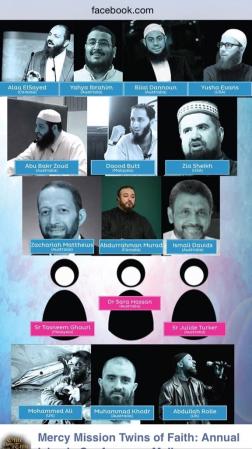




 Saint Hildegard von Bingen (1098–1179) was not only a visionary Benedictine abbess, composer, and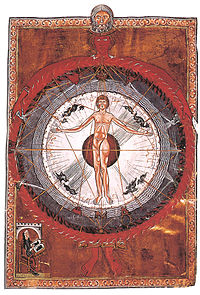
 Feminism and Religion
