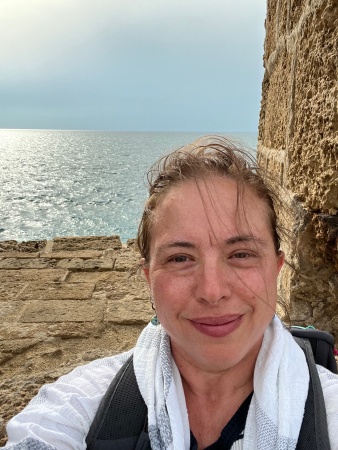
From the Archives: “Shemot: Women’s Misbehaving and Disobeying as the Key to Liberation.”

Author’s Note: This blog was originally published five years ago to the day (12 January 2020). It rings as true then as it does today.

Shemot will be read in synagogues on 18 January 2025.

This week’s Torah portion, or parshah, is Shemot (Exodus 1:1-6:1).  This parshah sets the scene for the liberation of the Israelites from slavery both by introducing main characters and elaborating on just how difficult life was for the Isrealites under Pharoah’s rule.  The parshah contains many noteworthy aspects: the death of Joseph and the multiplication of the Isrealites in Egypt; the increasing wrath of the Egptians; the birth and adoption of Moses; Moses’ encounter with the Divine in the form of a burning, yet unconsumed, bush; the revelation of the divine name, G-d’s plan for Moses’ role in the liberation of the Israelites from slavery; Moses’ attempts to get out of his assigned role; and Moses’ first confrontation with Pharoah.   

In addition, there are many women, who are integral to the salvation of the Israelites, in this parshah.  For the most part, Jewish tradition has acknowledged their part when it comes to discussions of this parshah, especially Shifra and Puah.  Yet, their role is often overshadowed by Moses’ varied miracles, the mighty power of the divine, the revelation of the Torah, the wanderings in the desert, and so on.  However, the Israelites’ liberation from slavery would have looked quite different without women.  

Continue reading “From the Archives: “Shemot: Women’s Misbehaving and Disobeying as the Key to Liberation.””

Guanyin: My Very Own Goddess of Compassion

It was a class that changed the course of a personal history. Mine. The year was 2001. I had arrived in the United States a couple of years earlier to study journalism. In my last term – after four semesters of trying hard to navigate the American education system, what with its confusing terminology of credit hours, electives, majors, minors, I decided to venture out of my comfort zone (this was my Breaking Bad moment) – and took a 3-credit grad course, Religion in China, as an elective (that word again; and oh, when I first arrived, I thought 3 credit hours meant dedication to a grand total of three hours of coursework over the entire semester; you get to choose when).

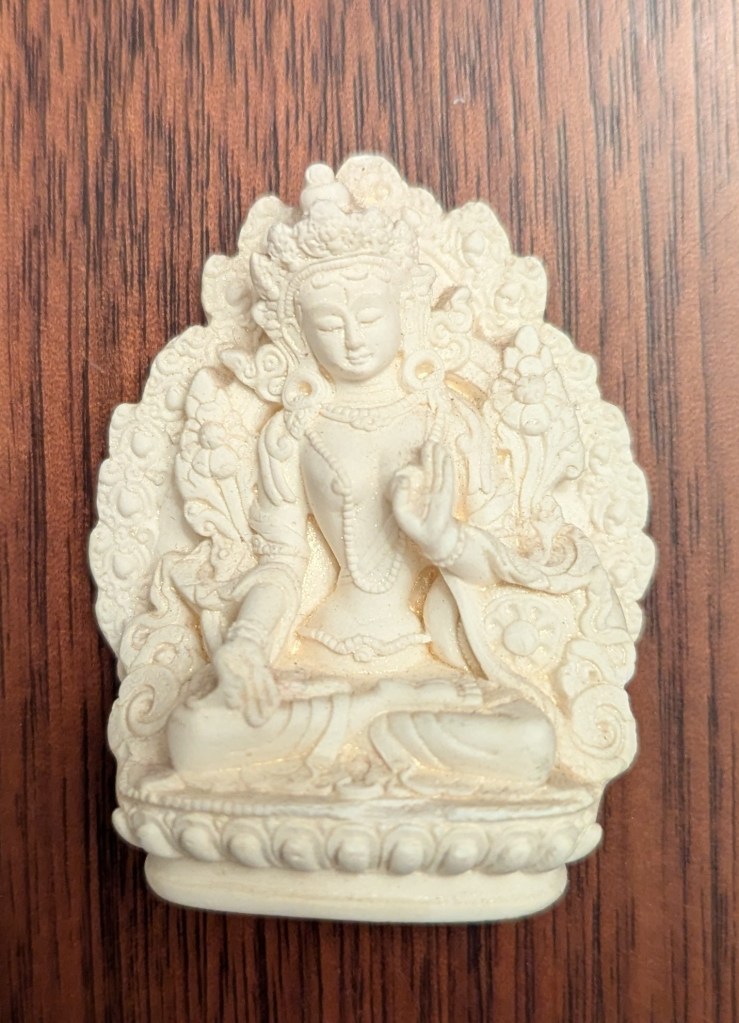
Goddess Tara. Personal collection.

It was in this class I was first introduced to Guanyin, the Chinese goddess of Infinite Compassion and Mercy. Guanyin, a bodhisattva[i] who rushes to the aid of her devotees upon hearing their cries, herself has quite an interesting history. She arrived in China from India as Avalokiteshvara or “the lord who gazed down at the world” as a male. Little wonder then that this gender fluidity makes her a popular deity among members of the LGBTQ community. Somewhere along the journey, Avalokiteshvara transforms into Tara. Apparently, so moved was Avalokiteshwara by the suffering of those trapped in samsara[ii] that he wept copiously, his tears creating a lotus from which sprang the goddess Tara.

Continue reading “Guanyin: My Very Own Goddess of Compassion”

Heart Drum by Sara Wright

I listened to
my heart
murmuring
softly
her voice
a viscous fluid
slow moving river
changing course
from right
to left
pumping molten minerals
over bones
tunneling around limbs
amazement
overcomes me
Whole Earth
holds heart songs
my dogs and me
whistling turkeys
scolding nuthatch
twittering titmouse
cheeping chickadee
browsing deer
astonishment lingers
I am treasuring the
sweet sounds
of this heart
thrumming through
heartbreak
submerged
 in a flow
of wonder…
the kind of
awe that moves
mountains of stone
a raging body
waterlogged
by grief
 – how can it be
this heart
continues
to pulse
drumming
to Nature’s rhythm
while a
crimson soul
breaks open
over and over
keens
drowning
in losses
too deep?
Twin chambers
pulse in my breast
expanding contracting
as they continue
thrumming
Life’s Drum.
Trees, birds
dear friend
(you know who you are)
My Beloved
Healer
Thank You
All
With every heartbeat
my gift to you is
the promise of
Embodied Love.

Continue reading “Heart Drum by Sara Wright”

Malaise and Numb Are We? by Karen Tate

Having finished my usual holiday calls to friends afar there seems to be a general theme.  We are wondering if we’ve all become numb?  Is there a general malaise infecting humanity?  Or at least Americans.  Do we all need a therapist? Or a great Mai Tai? Is it more than the orange elephant in the living room?

The theory started innocently enough.  Why are all the clothes and fabrics for furniture in hues of grey, black, brown and crème?  Where is the color? The life.  Could those who decide these things be suffering unconsciously from the same malaise or might it just be corporate strategy to save money by only offering a limited selection and often a poorer quality of goods at higher prices?  You’ve noticed the more for less we’ve been enduring for the last half a decade.  Corporations blamed Covid and supply chains as our peanut butter cups shrank while the cost exploded but they’ve never recalibrated post pandemic. They just continue to rob us, waiting for us to normalize their greed.  Breeding the manufactured consent.  Speaking of corporate greed, and never condoning violence but curious how you felt when the public sided with the shooter of the United Healthcare CEO?

Our conversations continued something like this…

Continue reading “Malaise and Numb Are We? by Karen Tate”

St. Brigid: Reproductive Justice and the Realms of the Miraculous by Elanur Williams

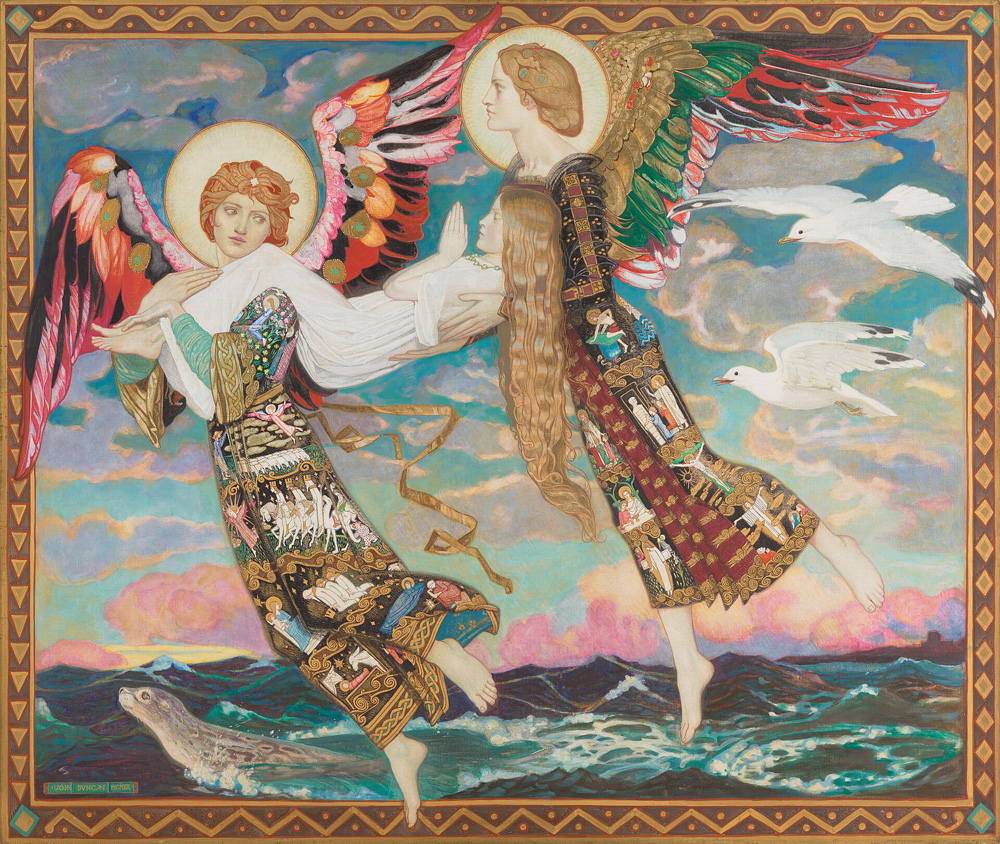
St Brigid being carried away by angels, in a painting by John
Duncan (1913)

One of my favorite saints is St. Brigid of Kildare, the patroness of poetry, learning, healing and protection. She is frequently called upon during childbirth. Brigid’s hagiographies are noteworthy for her remarkable abilities to heal and perform miracles—including her ability to make pregnancies vanish, for those who ask. In Vita Prima and Vita Brigitae (Life of Saint Brigit) published around 650 C.E. by Cogitosus, an Irish monk from Kildare, it is claimed that “Saint Brigid, by the very powerful strength of her faith, blessed a woman who had fallen [pregnant]…and the conception in the woman’s womb decreased and she restored her to health…without childbirth and its pangs.” The pregnant people in Brigid’s tales turned to Brigid to help them reclaim and restore their dignity. Consequently, their abortions served as catalysts for change. “Abortion miracles” have narrative and theological functions: they expose constructs of sexuality, chastity, purity, and sin. In addition, they test our understandings of healing—physical and spiritual—by revealing the intersectionality between medicine, pregnant people, power, and personal agency. Scholars have theorized the presence of “abortion miracles” in hagiographies, and whether they are to be read as a kind of defiance towards early Christian morality, or as a demonstration of chastity’s role and value in early medieval Irish Christianity. Some Irish penitentials view medieval abortions as malefic acts or as a kind of malevolent magic; however, according to Arica Roberts (2020), it can be argued the abortion miracles found in Irish hagiography can instead be read as “medicines of penance” and as contributing to healing.

Continue reading “St. Brigid: Reproductive Justice and the Realms of the Miraculous by Elanur Williams”

Archives from the FAR Founders: Grounding My Love by Xochitl Alvizo

This was originally posted June 6, 2019

I love living in a second-story apartment. Having a view of Los Angeles, of the palm trees, the expansive sky, the distant mountains, and the city lights of downtown, makes life feel bigger, more full of possibilities. In the struggle of transitioning my life back to L.A., the view from my second floor apartment helps make me feel ok in the world. I’m in love with Los Angeles – the land, its topography, its sky, its desertness – and even its traffic. Beside the fact of sometimes being made to arrive late somewhere, I don’t mind being in our famed L.A. gridlocks – I don’t mind being in the slow moving flow of cars. I kind of enjoy being among the thousands of other folks sharing the collective experience of trying to get someplace. Traffic becomes for me a leisurely time when I get to do nothing else but enjoy the city.

Continue reading “Archives from the FAR Founders: Grounding My Love by Xochitl Alvizo”

Legacy of Carol P. Christ: Can Women Have It All Without Changing The World First?

This post was originally published on July 23rd, 2012

In the early days of the second wave of the feminist movement, we really did believe that we could change the world. Our dreams were for a world without racism, poverty, and war, and for a world where women and men would be equal in every respect. Men would take an equal role in child care and women would take an equal role in all aspects of public life.  We were inspired by the dream that women (and men) could have it all, but I don’t think many of us believed that anyone could have it all without radically transforming the world.

We eagerly spoke about the need to lower working hours for both women and men to say a 36 hour week, about flexible working hours, and about the Swedish model that encouraged both women and men to take parental leave.  Changing the conditions of work was a central platform of second wave feminism.

The feminists of my generation understood that it would be very difficult to “have it all” before we changed the world. 

Continue reading “Legacy of Carol P. Christ: Can Women Have It All Without Changing The World First?”

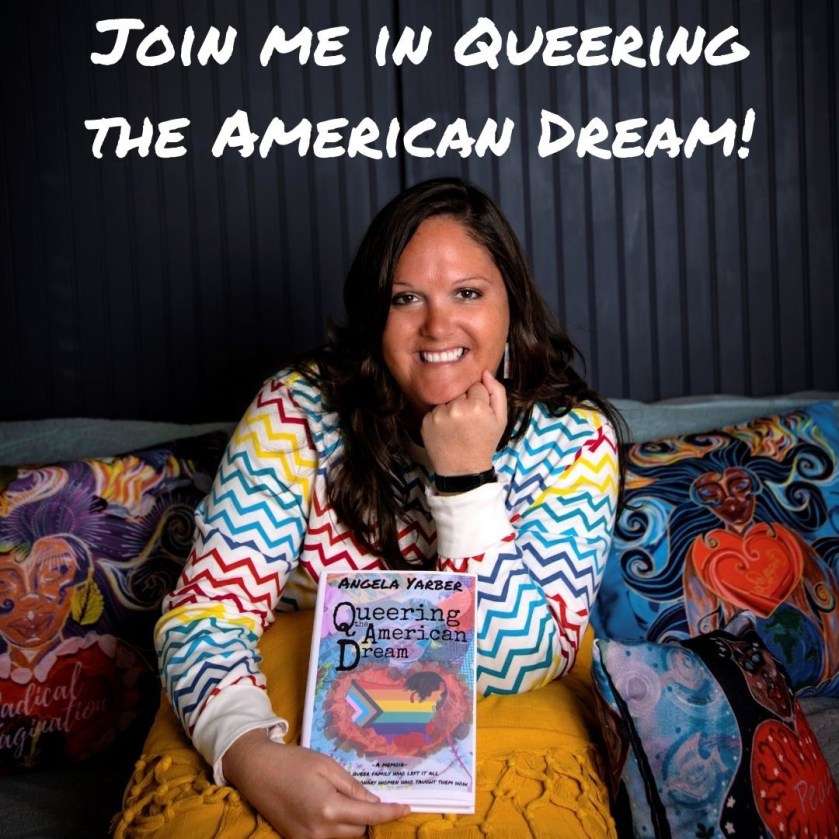
From the Archives: Painting Herstory: Our Lady of Silver Lake by Angela Yarber

This was originally posted August 8, 2015

It has become my new routine during the first phase of my queer little family’s year-long journey. After completing my chores, I run along the trails surrounding Silver Lake and once I’m thoroughly drenched in sweat, I grab a book and push our enormous 15-foot canoe into the frigid waters of the little lake we’re calling home for three months. With a smile that has yet to wipe off my face, I paddle fiercely. I’m typically the only person on the lake.

It’s a steep mile hike from the trailhead, and we’re the only ones “living” here for the summer, so my giant green canoe ripples the silvery waters in solitude. Once I find the right spot, I stuff my life vest behind my head and cozy down into the belly of the canoe, book in hand, goofy grin still spread across my flushed face. In the warmth of the sun, I read. In the belly of the canoe, I drift into the history of the lake, the unwritten annals lapping alongside my rocking boat, the portions on record filling the book in my sun-warmed hands.

Continue reading “From the Archives: Painting Herstory: Our Lady of Silver Lake by Angela Yarber”

BOOK REVIEW: Religion is Not Done With You by Esther Nelson

Goodwin, Megan and Ilyse Morgenstein Fuerst, Religion Is Not Done With You: Or, The Hidden Power of Religion on Race, Maps, Bodies, and Law. Boston, Massachusetts, Beacon Press, 2024, 165 pages.

If I were still teaching university classes in Religious Studies, I would certainly choose Goodwin and Fuerst’s book as an introduction to this broad, often misunderstood, subject we call religion. Their writing style has a youthful familiarity—probably purposively done—to broaden their reach to all audiences.  The theme running throughout their work is religion is what people do.”  “Religion isn’t just feelings or beliefs—it’s systems and assumptions…that shape our lives every day.”

Both authors have master’s degrees and doctorates in religion. Goodwin focuses on gender, sexuality, and American religions.  Fuerst puts her attention on Islam, race and racialization, and South Asia.  Both women claim to be religious people who “care about justice and repairing our broken world.”  They understand that “religion is a force for change—not always bad, not inherently good, but always changed and changing.”  It’s important, they assert, “to call out bullshit takes on religion: takes that insist religion is always and everywhere good and takes that want to write religion off as irrelevant, irrational, or regressive.”

Continue reading “BOOK REVIEW: Religion is Not Done With You by Esther Nelson”

From the Archives: There Is No Santa-The Antlered Flying Goddess With Gifts by Marie Cartier

Moderator’s note: This marvelous FAR site has been running for 10 years and has had more than 3,600 posts in that time. There are so many treasures that have been posted in this decade that they tend to get lost in the archives. We have created this column so that we can all revisit some of these gems. Today’s blogpost was originally posted December 25, 2015. You can visit it here to see the original comments.

Marie bringing in Elen of the Ways
photo by Tony Mierzwicki

One of my colleagues at Feminism and Religion recently wrote of Xmas and Feminine Wisdom. My blog, for Christmas Day continues this exploration.

Elen of the Ways is a figure primarily studied by scholar, Carolyn Wise. She wrote two core articles available on the web here and here. Wise writes that in order to “track” and find Elen of the Ways she had to peel back the layers:

…to the earliest track ways, the migratory tracks of the Reindeer and Elk. Elen moves across vast tracts of time, and land, cloaked and masked appropriately for each age.

Continue reading “From the Archives: There Is No Santa-The Antlered Flying Goddess With Gifts by Marie Cartier”