#SolidarityIsForWhiteWomen and the Power of Micropolitics by Dirk von der Horst

DirkIn my last year of seminary, I experienced a crisis of faith that left me struggling for my theological voice for about ten years.  Sure, there were basics I still affirmed, or wanted to affirm, but speaking my truths was a challenge.  I found my voice again at the now defunct web community Street Prophets, the first place I’d found that combined interreligious dialogue and progressive activism in a way I’d been looking for for all of my adult life.  From 2006-2009, it was home.

It took only one person to destroy that home.  Well, one person and the many people who stood by and let that person attack the LGBT people on the site.

It was this experience that reminded me that I had some serious listening to do when the hashtag #SolidarityIsForWhiteWomen erupted on Twitter on August 12.  Continue reading “#SolidarityIsForWhiteWomen and the Power of Micropolitics by Dirk von der Horst”

Unjust Wars and ‘Innocent’ Bodies by Kelly Brown Douglas

According to a recent online CNN report (15 September 2013) an 8 year old girl in Yemani died from internal injuries after her wedding night. Apparently this was not the first time a young Yemeni girl died under these circumstances.  Despite the fact that there have been various attempts to outlaw child marriage in Yemani, it remains legal.  For some families steeped in poverty, the “innocent” bodies of  young girls becomes a way to make money as these girls are sold for marriage to older men. One Yemeni woman lamented, “this is what poverty can do to people” (CNN online 15 September).

All around the world there are stories of young girls and women whose bodies are being “legitimately” violated.  Even in those places where the violence against women’s bodies is considered a crime, the redress for these crimes fall short of justice.  The story of the Yemeni girls and others like it have raised many theological questions in my mind concerning  notions of innocence,  the meaning of violence, and the implications of just war.  In this blog, I will share my rather fragmented thoughts on these issues as an invitation to conversation. Continue reading “Unjust Wars and ‘Innocent’ Bodies by Kelly Brown Douglas”

WAR, WAR, WHAT ARE WE FIGHTING FOR? by Carol P. Christ

carol-christ“They used chemical weapons, we must do something to stop them.”  A justification widely used in support of President Obama’s decision to launch a military strike against Syria.

We fought the Civil War to end slavery and racism. We fought the Second World War to end fascism. Did we end racism? Did we end fascism? Howard Zinn

At the time of the Revolutionary War, “a not inconsiderable Quaker element was on principle opposed to war, as itself a greater evil than any it might seek to right.”

Michelle Obama is against military intervention in Syria. Does the President dismiss Michelle’s dissent as “womanish”?

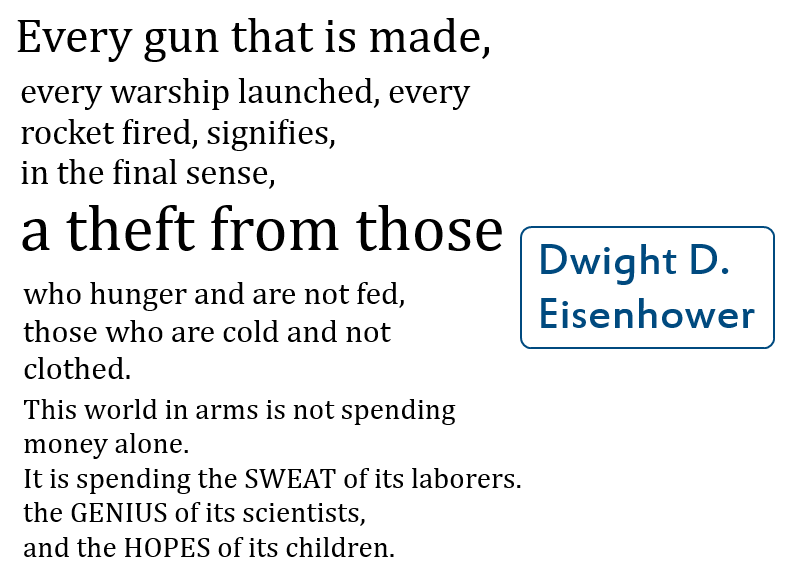
Dwight-D-Eisenhower-Pacifistic-QuotePatriarchy is a system of male dominance, rooted in the ethos of war which legitimates violence, sanctified by religious symbols, in which men dominate women through the control of female sexuality, with the intent of passing property to male heirs, and in which men who are heroes of war are told to kill men, and are permitted to rape women, to seize land and treasures, to exploit resources, and to own or otherwise dominate conquered people.

“[W]e must guard against the acquisition of unwarranted influence, whether sought or unsought, by the military–industrial complex.”  Dwight D. Eisenhower

The drums of war have stopped beating publically–at least for now. Obama’s decision to ask Congressional authorization to bomb Syria for 90 days—remember that number, 90 days–has been tabled—at least for now.  But make no mistake, the  military industrial complex is still barking at the heels of US government decison-makers.  The notion that while women may be for peace, “real men must make war” is still operative in the American psyche. Continue reading “WAR, WAR, WHAT ARE WE FIGHTING FOR? by Carol P. Christ”

Religion is Good Counsel by Kecia Ali

dissertation, Advising, feminism and religion

Last week I received an email out of the blue about a book I published seven years ago.

The greeting was polite. The body of the email managed to be simultaneously critical and vague. The writer began by noting that human beings are accountable “for what we say and do” and that the prophet Muhammad taught that those who start something good are rewarded for the good they do themselves and for those who follow in their footsteps; those who do something sinful are liable for their own sin and the sins of those who follow their guidance. The implication was that my book could lead people astray and I would be responsible for their bad deeds.

She had several concerns. In her view “some points in the book” were offensive to religion; she singled out the chapter on homosexuality. Further, “some questions … were inappropriately directed toward Allah.” The tone of my writing makes it seem as though “I am “attacking [my] religion or [am] not proud of it” – which, she believes, does not reflect my actual feelings.  Even if my inner sentiments are correct, she believes I am mistaken in my judgment about certain basic religious doctrines: though I “look to these issues as [an] American Muslim and [consider] how Islam could apply in U.S.A … in all religions there are basics that cannot be changed.” In her view, my book crossed the line. Finally, she felt that I was not clear “about how Islam respects women.” She signed her email “sincerely.” I believed her. Continue reading “Religion is Good Counsel by Kecia Ali”

Beyond Hemlines: What a Pope Can Teach Us About Modesty by Deborah Farmer Kris

DeborahPhotoPope Francis’ obvious decency appeals to me as a human.  His discourse and homilies appeal to me as a Christian.

But his humble actions appeal to me as a Mormon woman who is weary of witnessing, over and over, how we culturally misuse the term “modesty” and reduce it to base rules governing the attire of (primarily) teenage girls.

Pope Francis gives me hope for the future of our modesty discourse because in five months, he has somehow managed to make humility and  modesty cool again.

First, let’s look at modesty as discussed in the Catholic Catechism:

  • Modesty protects the intimate center of the person. It guides how one looks at others (author note: not how others look at you) and behaves toward them in conformity with the dignity of persons and their solidarity. Modesty inspires a way of life which makes it possible to resist the allurements of fashion and the pressures of prevailing ideologies. Teaching modesty to children and adolescents means awakening in them respect for the human person. Continue reading “Beyond Hemlines: What a Pope Can Teach Us About Modesty by Deborah Farmer Kris”

A New Glossary for Crete: The Power of Naming and the Study of History by Carol P. Christ

carol-christThe words we use affect our thinking. In the case of ancient Crete the repetition of the terms “Palace,” “Palace of Knossos,” “King Minos,” “Minoan,” “Priest-King,” and “Prince of the Lilies” shape the way we understand history–even when we ourselves know these terms are incorrect. We must engage in “new naming.”

Ariadne. May have been a name of the Goddess of pre-patriarchal Crete. The ending “ne” signifies that Ariadne is not of Greek or Indo-European origin and thus predates the later Greek myths.

Ariadnian. The name I have given to the Old European pre-patriarchal culture of Crete, from arrival of the Neolithic settlers from Anatolia c.7000 BCE to the Mycenaean invasion c.1450 BCE. Arthur Evans named the Bronze Age (c.3000-1450 BCE) culture of Crete “Minoan” after King Minos of Greek mythology, son of Zeus and Europa, husband of Pasiphae, father of Ariadne, whose gift of the secret of the labyrinth to Theseus led to the downfall of her culture. Evans assumed that Minoan Crete was ruled by a King.

This image I call “Ariadne Dancing” could become the new “icon” of Ariadnian Crete.

minoan woman dancing

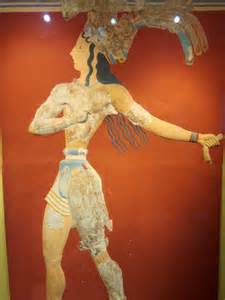
It could and should replace the “icon” of  the “Priest-King” Arthur Evans’ “imaginatively” reconstructed and named the “Prince of the Lilies.”

 prince of the lilies

Once we remove the crown which probably belonged to a Sphinx, the figure’s white color and athletic body suggests it was intended to portray a young female bull-leaper leading a bull. Continue reading “A New Glossary for Crete: The Power of Naming and the Study of History by Carol P. Christ”

Two Reflections for the New Year: 5774 By Ivy Helman

ivyIn June, my friend, Shifra, and I became Co-Chairs of the Ritual Committee at our shul. During the past few weeks, we have occasionally turned to one another and said, “I can’t wait for the High Holy Days to be over!”  Then, we have paused realizing what we have said and have sworn that we didn’t mean it.  We don’t.  Truly, we don’t.  But we are overwhelmed by the sheer amount of detail required for the days to go well.  There are babysitters to find, flowers to pick-up and drop off and pick-up again, kiddushim to organize, chairs to arrange, musicians to contact, mahzorim to bring up from the basement, bulletins and programs to coordinate, volunteers to recruit, parking to find for Tashlich, carpets to be cleaned, pianos to be tuned and so much more.  Thank G-d there is a committee and a community to help us, but we still have much of the organizing and synchronizing to do.  It’s a lot for two people who also have jobs, family and other responsibilities to fit in as well.

What concerns me more than anything in all of this organizing and busyness is that I won’t be personally prepared for the High Holy Days.  These days require personal, spiritual and relational work which all takes time.  I can’t show up on Yom Kippur morning and expect to have an amazingly deep spiritual experience if I have done nothing to prepare myself for it.  To me, this would be the irony of all ironies: the one who has spent the past three months making sure the shul is ready isn’t prepared herself.  Since the last week of August, I have been setting aside time away from the details to make sure that doesn’t happen.  Within the personal work I’ve done, I have found two inspirational and meaningful reflections which I’d like to share with you. Continue reading “Two Reflections for the New Year: 5774 By Ivy Helman”

When Some People Say “Religion” They Mean “My” Religion by amina wadud

Amina Wadud 2 I am Muslim, by choice, practice and vocation

I came to live in India after having already lived in other parts of Asia. Naively, I anticipated that the best of my Asian living experiences would be manifest in India and this centered on a dynamic encounter with diverse religious communities. I have thus been disappointed that the ideals of diversity have given way to exceptionalism and exclusivity.

For example, members of one religion are not encouraged to or interested in visiting the sacred spaces of other religions. In fact, in most cases, they are prohibited. To be sensitive to these constraints I do not visit any sacred place, no matter how much I have wanted, unless I am given permission as a Muslim. (Coincidentally, I am also prohibited as a woman from entering some of the sacred Muslim spaces!)

As a (retired) professor of religious studies I would like to think I can be a respectful observer. Nevertheless, I have little ability to internalize the notion of taboo. That is, I cannot understand that any space constructed by human beings would be defiled by the entry of another human being. My history of social and political advocacy against all forms of oppression just cannot find a space to accept this notion that one person is irredeemably taboo. Continue reading “When Some People Say “Religion” They Mean “My” Religion by amina wadud”

The Institutional Silencing of Women by Natalie Weaver

Natalie Weaver

On July 26, 2013, I had the opportunity to hear Rev. Helmut Schüller speak at the City Club of Cleveland’s Friday Forum.  He spoke to a convened audience of around 150 people, in addition to the much greater broadcast audience, and he responded to questions that ranged from wholly supportive, to sincerely questioning, to highly critical.  I myself sat with a group of vowed religious women from Pittsburgh who seemed enthusiastic about Rev. Schüller’s Austrian Priests’ Initiative, while behind me sat a table of obvious, vocal critics.

Rev. Schüller’s initiative, now represented by over 400 priests, began in 2006 as an effort to mobilize priests to lead the way for change in the Catholic Church in at least four crucial areas: women’s ordination; married priesthood; same-sex marriages; and lay participatory voting in the election of their bishops.  Of course, Catholics have been having these conversations long before the Priests’ Initiative.  What makes Father Schüller’s work different is that it is an “insider job.”  He argued that the laity have done their part, and now it is time for the clergy to speak, even at some personal and professional risk to themselves. Continue reading “The Institutional Silencing of Women by Natalie Weaver”

A Dream Too Far . . .? by Kelly Brown Douglas

Not too long ago I heard an interview with Eugene Allen’s son.  The recently released movie, The Butler is inspired by Eugene Allen’s life in the White House. Mr. Allen served in the White House through the terms of 8 presidents. His story first came to light after President Obama’s first election when a feature article appeared about him in the Washington Post. This feature told of how he never missed a day of work during his 36 years of service at the White House and it recalled what he witnessed from his position as butler when some of the most momentous decisions were being made, especially for black folks between1952-1988, his tenure of service. There are clearly many compelling things about his story, but there is one thing that stood out for me that actually did not come from him or the movie, but from an interview with his son. During this interview his son recalled the January morning in 2009 that he and his father, as invited guests, witnessed Barack Obama being sworn in as the 44th President of the United States.  He said that he leaned over to his father and asked him if he ever dreamed that he would live to see a black man become President. He said his father responded, “I didn’t dream that I could have that dream.”  To dream such a thing was a dream too far for Eugene Allen. He could not dream the dream.

Continue reading “A Dream Too Far . . .? by Kelly Brown Douglas”