Practicing the Presence of the Goddess by Barbara Ardinger

Practicing the presence of the Goddess is a term I invented in the early 1990s when I started teaching a class with that name. It started out as a class where I taught women about the goddesses of the Egyptian, Greek, Roman, and Norse pantheons and gradually turned into lessons on modern paganism, then into a class on creating effective rituals and doing magic, and finally evolved into being in the world—practicing Her presence.

When I wrote about ways of being in the world on April 29, I went past mere existentialism and suggested that benevolence is a good way to be in the world. Be kind to people. Be polite. (Or as kind and polite as it’s possible to be in a world that is markedly unkind and impolite.) What benevolence really is, is one element of what I call practicing the presence of the Goddess. Continue reading “Practicing the Presence of the Goddess by Barbara Ardinger”

Art – A Bridge Between the Physical and Spiritual Worlds by Judith Shaw

judith shaw photoBrushing yellow gold on top of deep crimson, I sense the paints coming alive, even as I feel myself moving outside of ego, outside of time, and inside to my deepest source.

At least forty thousand years ago the human family began to make art; drawing, painting, sculpting and playing music. For much of human history, art has served a dual purpose. Some art has been purely decorative, while much art has expressed a spiritual understanding of our physical existence.

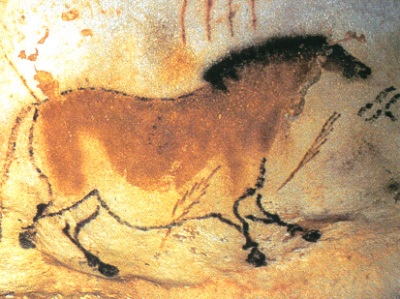
During the Paleolithic period, c.15–18,000 B.C. on the walls of a sacred cave, Lascaux, in southern France, our ancestors created beautiful paintings, often interpreted as a ritual that invoked sympathetic hunting magic. They are a reminder of the bond between the spirit world and the human world. This was a magical time in which humans lived immersed in the connection between the physical and spiritual worlds. Art was a means to both express and facilitate that connection.

Neolithic Goddess Figure

The seasons turned and the art and mythical imagery of the Paleolithic era was transmitted to the Neolithic era in Old Europe. Worship of the Goddess, as giver of all life, continued as did the art which honored Her and our connection to Her. The artists from these ancient days expressed their communal worship through the creation of cult idols and objects, shrines, painted pottery, and religious ceremonialism. The artists, though anonymous, were the hands and eyes of the creator, deepening and transforming the consciousness of their community.

As the human community in the western world developed and grew, art remained firmly grounded in the spiritual. From the megalithic stones of the Celtic era, to the illuminated manuscripts, mosaics and fresco paintings in the churches of the Middle Ages, right up to the work of painters like Van Gogh, Kandinsky, Malevich and Mondrian in the more modern era of late 19th and early 20th century – art expressed our human connection to the divine.

Continue reading “Art – A Bridge Between the Physical and Spiritual Worlds by Judith Shaw”

Magic Names by Barbara Ardinger

Many modern pagans adopt magical names. I think I’ve found one for myself. It’s a good motto, and even saying it aloud reminds me of the daily blessings of the Goddess to her children. The Latin name I’d choose is Beata elle. “Blessed is she.” 

When I attended a pagan studies conference recently to read from Secret Lives (and sign and sell a few copies), I listened very carefully to another presenter who spoke about magical names. When we go through an initiation, he said, we receive a new name. It’s a custom that is familiar to people through the ages and around the world. The presenter spoke about why people adopted magical names during the 19th-century European occult revival and why pagans still take magical names. And he set me to thinking. When you earn your Ph.D., you don’t get a new name. The Ph.D. is indeed an initiatory experience. Ask anyone who’s done it. You go through multitudinous ordeals both physical and intellectual. You face judges, speak what you’ve learned, and finally attain gnosis. But all you get for all your work and suffering are those nifty letters to put after your name. But I digress. Continue reading “Magic Names by Barbara Ardinger”

Mary, Mother of God or Godd/ess?

While I have always intuitively seen Mary as more than Theotokos, my training in orthodoxy came to overshadow my orthopraxis of Mary. But today I hold a different stance because  I have come to view my Marian practice as indeed worship of the Divine Godd/ess. 


At a surprisingly early age, perhaps ten or eleven years old, I became the author of my own religious narrative, meaning, I took it upon myself to initiate and pursue the deep mysteries of my Catholic faith. Weekly Mass became an event, not an obligation, and something to which I attended independent of my large, Irish-American Catholic family.  The singleness of my worship at such a young age drew stares and whispers from those families that arrived intact.  And while I was not unaware of their curiosity, I found it easier to lose myself in the absolute wonder of my environment.  This environment of the tangible and non-tangible is what Andrew Greeley has since come to identify as “the Catholic Imagination,” where a Catholic sensibility is manifested in cathedrals and high art, but is also awash in the mundane of our daily lives. Additionally, our family’s dependence on Saint Jude, the patron saint of lost causes, was a close second to a strong devotion to the Blessed Virgin Mary.  By this I mean to suggest that she was our go-to heavenly figure when in need, and I, the appointed family petitioner. Continue reading “Mary, Mother of God or Godd/ess?”

ON NOT GETTING WHAT WE WANT AND LEARNING TO BE GRATEFUL FOR WHAT WE HAVE BY CAROL P. CHRIST

Many women’s dreams have not been realized. How do we come to terms with this thealogically?

Although I am as neurotic as the next person, I am also really wonderful—intelligent, emotionally available, beautiful (if I do say so myself), sweet, caring, and bold. I love to dance, swim, and think about the meaning of life. I passionately wanted to find someone with whom to share my life. I did everything I could to make that happen—including years of therapy and even giving up my job and moving half way around the world when I felt I had exhausted the possibilities at home.

For much of my adult life I have asked myself: What is wrong with me? Why can’t I find what everybody else has? Even though I knew that there were a lot of other really great women in my generation in my position and even though I knew that many of my friends were with men I wouldn’t chose to be with, I still asked: What is wrong with me? Continue reading “ON NOT GETTING WHAT WE WANT AND LEARNING TO BE GRATEFUL FOR WHAT WE HAVE BY CAROL P. CHRIST”

Why Not ‘Feminine Divine’? by Judith Laura

It twists my gut like an intestinal bug when people use the term “feminine divine” or “divine feminine” when what is meant is female deity. I keep thinking that like many gut bugs, it might just go away on its own—but no such luck.

Here’s how I see the history, the herstory, of this linguistic corruption. From what I remember, “divine feminine” (or “feminine divine” or “sacred feminine”) came into usage sometime in the 1980s by people, some of them authors, who wanted to refer to a female deity (or female deities, or female aspects of the divine) but didn’t want to use the word Goddess or wanted to talk about the subject in a non-religious, even not specifically spiritual, context. Often they also didn’t want their views to be construed as feminist. Sometimes these were participants in the New Age movement or people approaching the newly emerging Goddess movement from a psychological standpoint (“it helps women feel better” or “it helps women find themselves”). It was not unusual for them to speak of the “feminine within” for women and the “inner feminine” for men. For women, what was usually meant was that they had an outer feminine and an inner feminine, and that the inner feminine was spiritual. For men, there was the implied constraint that their feminine part was of course tucked away “within” where only they would be aware of it. These ideas seem to be rooted in the Jungian anima-animus concept.

Though I think that helping women “feel better” or “find themselves” may be a worthy goal and is part of the picture for some interested in Goddess, it is not by any means the full picture and it diminishes the power (and empowerment) of Goddess by making the role of the divine less than in other religions or spiritual paths. Continue reading “Why Not ‘Feminine Divine’? by Judith Laura”

REMEMBERING MERLIN STONE, 1931-2011 by Carol P. Christ

“In the beginning…God was a woman.  Do you remember?”  Feminst foremother and author of these words Merlin Stone died in Feburary last year.

I can still remember reading the hardback copy of When God Was a Woman while lying on the bed in my bedroom overlooking the river in New York City early in 1977.  The fact that I remember this viscerally underscores the impact that When God Was a Woman had on my mind and my body.  Stone’s words had the quality of revelation:  “In the beginning…God was a woman. Do you remember?”  As I type this phrase more than thirty-five  years after first reading it, my body again reacts with chills of recognition of a knowledge that was stolen from me, a knowledge that I remembered in my body, a knowledge that re-membered my body.  My copy of When God was a Woman is copiously underlined in red and blue ink, testimony to many readings.

Though I could then and can now criticize details in the book, the amassing of information and the comprehensive perspective When God Was a Woman provided was news to me when I first read it.  Despite having earned a Ph.D. in Religious Studies from Yale, I did not “know” that Goddesses were worshipped at the very dawn of religion.  I had not heard of the theories of Indo-European invasions of warlike patriarchal peoples into areas already settled by peaceful matrilineal, matrifocal cultures in Europe and India.  I had written my undergraduate thesis on the prophets, studying their words in the original Hebrew, but I did not understand that their constant references to the Hebrew people “whoring” after “idols” and worshipping “on every high hill and under every green tree” referred to the fact that many of the Hebrew people were choosing to worship Goddesses in sacred places in nature.  Nor did I understand that the Genesis story which I had studied and taught took the sacred symbols of Goddess religion– the snake, the tree and the fruit of the tree, the female body—and turned them upside down.  Continue reading “REMEMBERING MERLIN STONE, 1931-2011 by Carol P. Christ”

Goddess Communities in Australia by Patricia Rose

Australia has a very diverse and rapidly expanding number of people for whom the Goddess, however She is understood, is significant. The 2006 census revealed that there were over 30,000 Pagans or followers of other earth-based religious traditions in Australia and, given the way in which religions are classified in the census, this is undoubtedly a serious underestimation. We await the findings of the 2011 census with great interest.

Prior to European settlement in Australia, Aboriginal and Torres Strait Islander peoples followed their own rich spiritual beliefs, which were based on the forces of nature, a reverence for the land and its creatures, and the influence of ancestral spiritual beings. Recently, non-indigenous Australians have become increasingly interested in the indigenous connection to the land and indigenous spirituality.

While it is important not to appropriate indigenous culture, Goddess women and men in Australia are keen to express their spirituality in ways that are relevant to this land and to the Australian culture. We recognize the need to become more attuned to the ways of Australia, to her seasons and her natural cycles, and we can learn from the experiences of indigenous peoples, garnered from millennia of living on and with this land. Continue reading “Goddess Communities in Australia by Patricia Rose”

Football Is a Bad Religion by Barbara Ardinger

As soon as I read Carol Christ’s comments on football, I said, “Yeah! She’s totally right.” I keep asking people I know who watch football games what is enjoyable about watching large millionaires giving each other concussions. I understand that some sports demand skills I don’t possess, but football? What skills? It’s a mystery to me.

The characters in my new novel, Secret Lives, agree with Carol and me about the Super Bowl. The following excerpt comes from Chapter 21, “A World at War.” The Norns, in disguise as the Wintergreen Sisters, have come to town with the intention of taking power over the heras of the novel, the grandmothers who live in Long Beach, CA, and do magic. Our crones, however, have no intention of being taken over, or even seduced by promises of power, but when they meet on Super Bowl Sunday, 1990, they don’t yet know that the war on TV will be only a tiny fragment of the larger war that the Norns will soon wage against them using gigantic ravens and thunderstorms as their weapons.

Let’s listen in on “the girls.” (Madame Blavatsky is the circle’s familiar, a talking cat.) Continue reading “Football Is a Bad Religion by Barbara Ardinger”

The Feast Day of St. Brigid by Carol P. Christ

May we remember Brigid on her day in the fullness of her connection to bountiful and life-giving earth by setting a bowl of milk on an altar or special place in the garden on her holy day.  Who knows, a snake just might come to drink from it.

The Christian Feast Day of St. Brigid of Kildare, one of the two patron saints of Ireland, is held on February 1, the pre-Christian holiday known as Imbloc.  It is well known that St. Brigid has the same name as a pre-Christian Goddess of Ireland, variously known as Brighid (pronounced “Breed”), Brigid, Brigit, Bride, or Bridie.  The name Brigid is from the Celtic “Brig” meaning “High One” or “Exalted One.”  Brigid like other Irish Goddesses was originally associated with a Mountain Mother, protectress of the people who lived within sight of her and of the flocks nurtured on her slopes.

Imbloc marked the day that cows and ewes give birth and begin to produce milk.  It was also said to be the day when hibernating snakes (like groundhogs) first come out of their holes.  In northern countries, Imbloc signals the beginning of the ending of winter.  The days have begun to lengthen perceptibly after the winter solstice when the sun stands still and it seems that winter will never end.  At Imbloc spring is not yet in full blossom.  But if hibernating snakes come out of their holes, it is a sure sign that the processes of transformation will continue and warmer days will not be far off.  As Marija Gimbutas says, “The awakening of the snakes meant the awakening of all of nature, the beginning of the life of the new year.”   Continue reading “The Feast Day of St. Brigid by Carol P. Christ”