Legacy of Carol P. Christ: Love Divine, All Loves Excelling

This was first posted on 09/09/11 and then again on 5/23/22

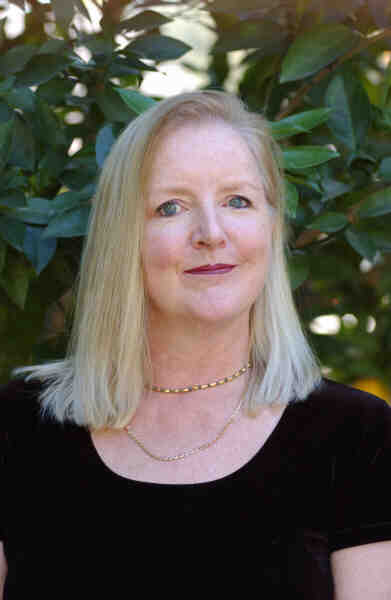
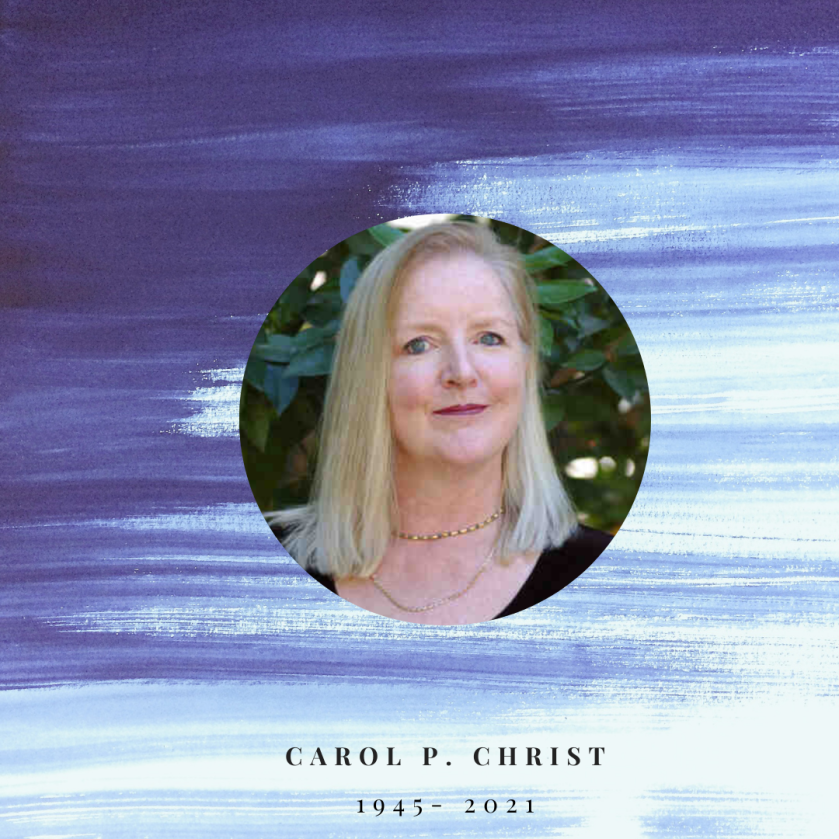
A founding mother of the study of women and religion and feminist thealogy, Carol has been active in social justice, anti-war, feminist, anti-nuclear, and environmental causes for many years.  Her books include  She Who Changes and Rebirth of the Goddess and the widely used anthologiesWomanspirit Rising and Weaving the Visions.

In my last blog I wrote that the image of God as a dominating other who enforces his will through violence–found in the Bible and in the Christian tradition up to the present day–is one of the reasons I do not choose to work within the Christian tradition.  To be fair, there is another image of God in Christian tradition that I continue to embrace.  “Love divine, all loves excelling” is the opening line of a well-known hymn by Charles WesleyCharles Hartshorne invoked these words and by implication the melody with which they are sung as expressing the feelings at the heart of the understanding of God that he wrote about in The Divine Relativity.

Love divine, all loves excelling also expresses my understanding of Goddess or as I sometimes write Goddess/God.  Though I am no longer a Christian, but rather an earth-based Goddess feminist, I freely admit that I learned about the love of God while singing in Christian churches.  Hartshorne wrote that he knew the love of God best through the love of his own mother, and I can say that this is true for me as well.  My mother was not perfect, and she did not understand why I wanted to go to graduate school, my feminism, or my adult political views, but I never doubted her love or my grandmothers’ love for me.  (I count myself lucky.  I know others did not have this experience.)  Like Hartshorne, I also learned about the love of God through the world that I always understood to be God’s body.  Running in fields and hills, swimming in the sea, standing under redwood trees, and encountering peacocks in my grandmother’s garden, I felt connected to a power greater than myself.   Continue reading “Legacy of Carol P. Christ: Love Divine, All Loves Excelling”

Goddess Architectures: How Cultures Shape Sacred Feminine Power

In this essay, I address a gap in goddess spirituality, between a rhetoric of celebrating the body, and lack of truly embodied practice. I reflect on the archetypal language commonly used in goddess spirituality, tracing its roots in Greek mythology and depth psychology while questioning its cultural limits.

By introducing the notion of “goddess architectures”, I explore how ecological, social and cosmological contexts shape symbolic structures, and how sacred feminine power can be named, distributed, embodied or obscured across cultures. Finally, I propose movement as a way back to lived experience beyond symbolic and linguistic frameworks.

Goddess Spirituality into the Lived Body

Over the past thirty years of researching and practising goddess spirituality, I noticed a persistent discrepancy. While this field speaks about honouring the body as sacred, in practice it often feels like rhetorical lip service. The language of embodiment is present, but remains disconnected from the body on many levels. 

Continue reading “Goddess Architectures: How Cultures Shape Sacred Feminine Power”

From the Archives: The Full Spirited Four-Fold Goddess: The Maiden, the Mother, The Queen and the Crone by Mama Donna Henes

Moderator’s Note: This was originally posted on February 24, 2013. Sadly Mama Donna died on Sept. 21, 2024. You can read FAR’s post that honored her life here.

Donna Henes, Urban Shaman, Queen of my self, crones,

The Queen paradigm promotes a new understanding of what it might mean to be a middle-aged woman today who accepts complete responsibility for and to her self, and it celebrates the physical, emotional, and spiritual rewards of doing so.

Although I have been passionately devoted to the Many Splendored Goddess in Her complex multiplicity for more than thirty years now, I am not a believer in the Triple Goddess paradigm. It has never resonated with me because it belies what I believe to be the true nature of nature. The Triple Goddess in Her tripartite phases is widely understood to represent the complete cyclical wholeness of life. She who is Three is likened to the moon, the tides and the seasons, whose mutability She mirrors. And therein, lies the rub.

I am sorry, but forty years of researching, teaching, and writing about Celestially Auspicious Occasions — the cycles of the cosmos and the earthly seasons, and the multi-cultural ritual expressions that they inspire — I can state unequivocally that the moon has four quarters, not three, and that there are, as well, four seasons in the year. Continue reading “From the Archives: The Full Spirited Four-Fold Goddess: The Maiden, the Mother, The Queen and the Crone by Mama Donna Henes”

Legacy of Carol P. Christ: Shadows Of The Goddess In Greek Orthodox Tradition: Easter And The Dormition Of The Virgin

This post was originally published on Aug. 13th, 2012

While I would not wish to argue that Greek Orthodoxy is in any way a “feminist” tradition, the shadow of the Goddess falls long over the two great festivals of spring and midsummer.

In Greek Othodox tradition, there are two major spiritual holidays– Easter in the spring and the Dormition/Assumption of the Virgin at midsummer.  The Panagia, She Who is All Holy, also known as Mother of God, Virgin, and Mary, is a central figure in people’s faith–dethroned neither by the Reformation nor by Vatican II.  Indeed when I speak of the need for the “rebirth of the Goddess” in Greece, I am often told, “the Panagia is our Goddess.”  This may not be theological orthodoxy, but it expresses a truth of practice. Continue reading “Legacy of Carol P. Christ: Shadows Of The Goddess In Greek Orthodox Tradition: Easter And The Dormition Of The Virgin”

Legacy of Carol P. Christ: Connection to Ancestors in Earth-based Theology

carol p. christ 2002 color

This post was originally published on Jan. 14th, 2013

“I am Carol Patrice Christ, daughter of Jane Claire Bergman, daughter of Lena Marie Searing, daughter of Dora Sofia Bahlke, daughter of Mary Hundt who came to Michigan from Mecklenburg, Germany in 1854.  I come from a long line of women, known and unknown, stretching back to Africa.”

Like many Americans, my ancestral history was lost and fragmented due to emigration, religious and ethnic intermarriage, and movement within the United States.  Though one of my grandmothers spoke proudly of her Irish Catholic heritage and one of my grandfathers acknowledged his Swedish ancestry, I was raised to think of myself simply as “American,” “Christian” and “middle class.”  Ethnic and religious differences were erased, and few stories were told.

Over the past two years, I have begun to discover details of my ancestral journey, which began in Africa, continued in the clan of Tara, and was marked by the Indo-European invasions.  In more recent times, my roots are in France, Holland, England, Germany, Ireland, Scotland, and Sweden.  In the United States, my family has lived in tenements in New York City and Brooklyn, in poverty in Kansas City, and on farms in Long Island, Connecticut, upstate New York, Michigan, and Pennsylvania.  My parents and grandparents settled in northern and southern California during the 1930s.  I have lived in southern and northern California, Italy, Connecticut, New York, Boston, and now Greece.

Learning details about family journeys has created a shift in my sense of who I am.  Continue reading “Legacy of Carol P. Christ: Connection to Ancestors in Earth-based Theology”

Legacy of Carol P. Christ: Do White Feminists Have Ancestors?

This post was originally published on Aug. 12th, 2011

Carol P. Christ is a founding mother in the study of women and religion, feminist theology, women’s spirituality, and the Goddess movement.  She teaches in the Women’s Spirituality program at CIIS and through Ariadne Institute offers Goddess Pilgrimages to Crete. Her books include She Who Changes and Rebirth of the Goddess and the widely used anthologies Womanspirit Rising and Weaving the Visions.

Some years ago when I was speaking on ecofeminism, womanist theologian Karen Baker-Fletcher posed a question that went something like this:  What I am missing in your presentation is reference to ancestors.  For black women, this issue is critical.

Baker-Fletcher’s question provoked a process of thinking that continues to this day.  For example, I began to notice that when black women spoke at the American Academy of Religion, they often began by thanking their foremothers Delores Williams and Katie Cannon for beginning the womanist dialogue.  It is far rarer to hear a white woman thank Valerie Saiving, Mary Daly, Rosemary Radford Ruether, or Marija Gimbutas before her talk.

To the contrary, many white women take great pains to distance themselves from feminist foresisters.  I once heard a white woman Biblical scholar tell women students to do work on women in the Bible or other areas of religion without using the word feminist or placing their work in a female or feminist train of thought– if they wanted to get it published.  She was very proud that she had used this method and succeeded.  In other words, she was following in the footsteps of Mary Daly, Phyllis Trible, and Elisabeth Schüssler Fiorenza but acting as if she had invented the study of women and the Bible herself.  The reason for this, she freely admitted, was that male scholars who held power in her field would not respect her work if she used the “f” word. Continue reading “Legacy of Carol P. Christ: Do White Feminists Have Ancestors?”

Legacy of Carol P. Christ: Exciting New Research on Matriarchal Societies

This post was originally published on Aug. 5th, 2011

The following is a guest post written by Carol Christ, Ph.D., a pioneer and founding mother of the Goddess, women’s spirituality, and feminist theology movements, and director of the Ariadne Institute.  She is also the author of multiple books including Rebirth of the Goddess.

Although there are some of us who disagree, the “party line” in the fields of Religious Studies and Archaeology—even among feminists– is that there never were any matriarchies and that claims about peaceful, matrifocal, sedentary, agricultural, Goddess-worshipping societies in Old Europe or elsewhere have been manufactured out of utopian longing.

I myself and most other English-speaking scholars defending Marija Gimbutas’s theories about Old Europe have studiously avoided the word “matriarchy” (speaking rather of “matrifocal, matrilineal, and matrilocal” societies) because the very word “matriarchy” conjures up the image of female-dominated societies where women ruled, waged wars, held men as slaves, and raped and abused men and boys. In fact, this fantasy tells us far more about patriarchy than about it does about matriarchy. Continue reading “Legacy of Carol P. Christ: Exciting New Research on Matriarchal Societies”

Why Celebrating the 9th Anniversary of the Goddess Feminist Activist Spirituality Movement? (Part 2) by Helen Hye-Sook Hwang

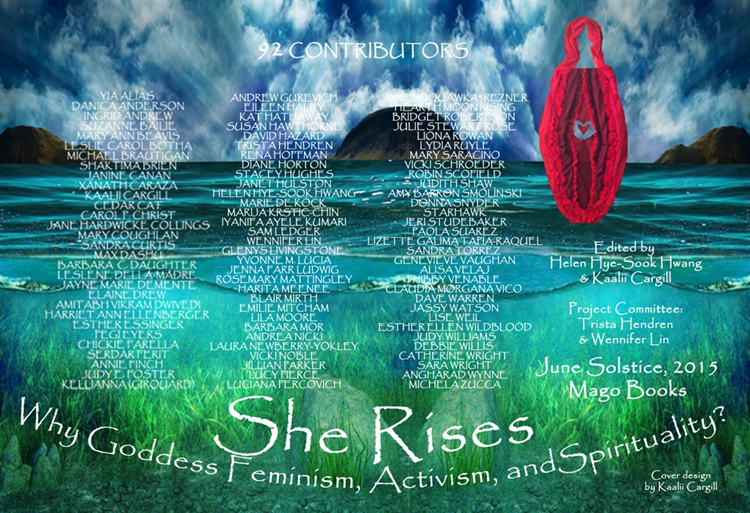
As I noted in Part 1, this year marks the 9th anniversary of the first volume of She Rises trilogy, a collective writing project, which was first published in 2015 by Mago Books. Entitled Why Goddess Feminism, Activism and Spirituality?, the 93 contributors trumpeted the onset of the Goddess Feminist Activist Spirituality. It was followed by the second volume​, How… Goddess Feminism, Activism, and Spirituality?, with 96 contributors, in the following year, and the third one, What… Goddess Feminism, Activism, and Spirituality?, in 2019.​ The 9th anniversary of the first volume provided a new momentum for all contributors of the trilogy to come together as a virtual group, which we named “She Rises…” This group allows the authors of all three volumes to gather together for the first time, while inviting newcomers from outside the She Rises trilogy.

Continue reading “Why Celebrating the 9th Anniversary of the Goddess Feminist Activist Spirituality Movement? (Part 2) by Helen Hye-Sook Hwang”

How we Began the Movement of Goddess Feminist Activist Spirituality in the 21st Century (Part 1) by Helen Hye-Sook Hwang

Mago is an East Asian/Korean word for the Cosmic Mother or the Creatrix. This piece is written as the first of a four-part essay. In this series I am surveying the past 9 years of The Mago Work (A collective effort to restore the consciousness of Mago, the Creatrix), which birthed the Movement of Goddess Feminist Activist Spirituality, while being shaped by the latter.

Continue reading “How we Began the Movement of Goddess Feminist Activist Spirituality in the 21st Century (Part 1) by Helen Hye-Sook Hwang”

Legacy of Carol P. Christ: SHE WHO CHANGES*

This was originally posted on May 21, 2012

She changes everything She touches and everything She touches changes. The world is Her body. The world is in Her and She is in the world. She surrounds us like the air we breathe. She is as close to us as our own breath. She is energy, movement, life, and change. She is the ground of freedom, creativity, sympathy, understanding, and love. In Her we live, and move, and co-create our being. She is always there for each and every one of us, particles of atoms, cells, animals, and human animals. We are precious in Her sight. She understands and remembers us with unending sympathy. She inspires us to live creatively, joyfully, and in harmony with others in the web of life. Yet choice is ours. The world that is Her body is co-created. The choices of every individual particle of an atom, every individual cell, every individual animal, every individual human animal play a part. The adventure of life on planet earth and in the universe as a whole will be enhanced or diminished by the choices we make. She hears the cries of the world, sharing our sorrows with infinite compassion. In a still, small voice, She whispers the desire of Her heart: Life is meant to be enjoyed. She sets before us life and death. We can choose life. Change is. Touch is. Everything we touch can change.

Continue reading “Legacy of Carol P. Christ: SHE WHO CHANGES*”