Five years ago, I wrote an essay for Feminism and Religion musing about rituals for our sons. I wondered aloud how we welcome sons in manhood, how we create rituals of celebrations and rites of passages for our boys as well as our daughters. I have been steeped in women’s ceremony and ritual since I was a girl myself, watching the women wash my mother’s feet and crown her with flowers at her mother blessing ceremony as she prepared to give birth to my little brother when I was nine years old. Her circle of friends honored us too, crowning their daughters with flowers and loosely binding their wrists with ribbon to their mothers as they crossed the threshold into first menstruation.
At 24, I then helped plan the rite of passage for my youngest sister, then 13, as she and her friends gathered into a wide living room, flowers on their heads and anticipation in their eyes as we spoke to them of women’s wisdom and the strength of, and celebration of, being maiden girls on their way to adulthood. I knew then that I would have a ritual for my own daughter, yet unconceived, one day. I birthed two sons and lost another son in my second trimester. I led a circle of mothers and daughters through a series of nine classes culminating in a flower-becked coming of age ceremony while newly pregnant with the rainbow baby who would become my own daughter.
On a hilltop between the horned peak of Mount Psiloritis and the wide blue expanse of the Libyan Sea, Ellen Boneparth, Tina Nevans and I prepare to enter the Kamilari tholos tomb. This round vaulted structure served as a communal and egalitarian burial site for thousands of years, from Neolithic through late Minoan times, and Carol brought more than 40 groups of Goddess Pilgrims here to honour those who have gone before. This is where Carol asked the three of us to perform a farewell ritual for her; she wanted no other ceremony. We each don a scarf and necklace which belonged to Carol and enter the sacred space. Kostantis stays behind to guard the gate, in case any other visitors arrive during our ritual.
2. Invocation
On this spot, hundreds of women have honoured thousands of ancestors. We ask for the benevolent presence and the blessing of all those who knew and loved Carol, living and dead. We ask permission of the spirits of the place to enter for this ceremony. We ask Carol’s own ancestors, and the Minoan ancestors of this place, to bless and welcome Carol as a beloved daughter and granddaughter of both lineages.
We take a slice of honey cake and a pottery cup of grape juice and leave it by the rose bush as an offering, arrayed on a bed of petals and topped with a single daisy and a ring of wild raspberries. We make some wishes in the dusty air, kneel down with our palms upon the warm earth and sing for rain. We walk under a half-moon sky beside a blood-red sun, the sound of coyotes rising into the night as a silent deer watches us, head a triangle of alertness, black eyes staring across the heat-weary field. We catch fireflies, winking above the wildflowers sparks of yellow-green, and find a plump brown toad waiting in the path. Then, we stand quietly together, mosquitoes beginning to cluster around our legs, our heads tilted back watching carefully for fairy silhouettes against the deepening gray of the midsummer sky.
It is summer here in the Northern Hemisphere. Deep summer. Dusty summer. Thirsty summer. Humid summer. In central Missouri, it is the type of thick, wet heat that soaks into you and saps your strength and enthusiasm about life. Life can feel faded, dull, and magic hard to see. The woods, where I find such solace, renewal, and enchantment, become closed to me as poison ivy, thorns, ticks and chiggers, resolutely bar my way. So, I walk on the road these days, in the mornings and at sunset, seeing what I can see from my vantage point on a dusty gravel road. Deep summer I find offers an opportunity to look around to see what flourishes of its own accord, to see what grows without tending, to see what rises wild and unfettered from the natural conditions in which they thrive.
Sometimes as humans we become used to controlling as much of the world as we can control and as much of ourselves as we can control. Sometimes we get focused on what we can cultivate and grow and intentionally tend. So focused on this conscious tending may we be, that we may even rip up or destroy or change what is naturally growing in our own little ecosystem, our own little biome, what is growing right where we are. We may even pull it up and put something else in its place that we think is prettier, or nicer, or even more beneficial or useful. I encourage us to consider summer as a time in which to pause with, appreciate and look at, savor and explore, learn about and discover, what really grows right where you are, what thrives right where you stand, without the need for you to manipulate or control or change it. And, I invite you to also consider how this might apply to the growing and thriving in your own personal life? How or what are you perhaps trying to manipulate or change or control in yourself or with the people in your life? Perhaps it is time to take a step back, to sit back, and to see what is already growing. What is already there? What is thriving in your world? What is thriving for you that doesn’t require wrestling with or changing or trying to make it fit in a certain way? I encourage you to soften and see. Perhaps the mulberry trees are green and spreading in your world. Perhaps the clover is in bloom. Perhaps there are daisies. Perhaps there are monarch butterflies still bravely persistent on the milkweed in the field. Perhaps there are wild onion scapes, with their little purple heads. Perhaps there is yarrow, white, and waiting, and interwoven in its own curious way with the health of your own blood and body. Perhaps that book you want to write is bubbling right behind your fingertips, waiting for your pen to be set against the page. Perhaps that project that sings your name is waiting for you to pause to see it.
We doubt sometimes our place in the natural world. And, yet these plants that surround us, that spring up around us, that grow right where we are, are here and growing, just like we, ourselves, are growing where we are. These plants are intertwined with the health of our own bodies. That is amazing and enchanting and wondrous to me.
My youngest son, Tanner, is six and we are working together on an earth science class, studying planets and the earth and geology and the universe. He came to me saying: “Mom, did you know, there’s real iron in us! There’s real ironin us.” And I replied, “there’s real iron at the core of the Earth too. Isn’t that amazing? The earth has iron in it and so do we.” He looked at me and asked then, “is magic real?” And I replied, “yes, honey, we walk around inside of it every day.” I pause here in the hot exhaustion of summer to marvel that so it is. In truth, it is not only that we walk around inside of it every day. We walk on top of it every day. We walk with it every day. It beats in our veins every day. We live with it every day. If we carry an awareness of this embodied magic with us, then every day becomes enchantment. Every day becomes sacred space in motion. Every day becomes the opportunity to fully inhabit our own living magic as we literally walk around within it each and every day.
So, what is growing for you? What is blooming for you? What is flourishing and healthy, just of its own accord, asking nothing else from you, but witnessing?
The earth is made of days beyond count and roots beyond question. The fire in your belly is that which whirls worlds into being. There is iron in your blood, iron at the planet’s core, iron in the stars, iron in beak of hawk and eye of crow, and iron in the red rocks beneath your feet. This air you breathe is river woven, lightning laced, tear salted, iron eyed, earth kissed, raven winged. Wait, let this breath expand your chest and know: here you are, today, in-dependence with all things.
Molly Remer, MSW, D.Min, is a priestess, writer, and teacher facilitating ritual, making art, and weaving words together in central Missouri. Molly and her husband Mark co-create Story Goddesses at Brigid’s Grove. Molly is the author of nine books, including Walking with Persephone, Whole and Holy, Womanrunes, and the Goddess Devotional. She is the creator of the devotional experience #30DaysofGoddess and she loves savoring small magic and everyday enchantment.
When I was 17, I left the US to live and study in Europe for a year, with Womanspirit Rising crammed into my backpack. This book, edited by Carol P. Christ and Judith Plaskow, gave me the solid ground of a feminist worldview which honoured women, the body, and the earth. My favourite chapter was the last one: Carol’s foundational essay ‘Why Women Need the Goddess’, where she writes, ‘The simplest and most basic meaning of the symbol of Goddess is the acknowledgement of the legitimacy of female power as a beneficent and independent power’. These words, indeed that whole essay, became the pole star for my journey through the world, helping me name what was missing in both the academic world and the world of dance.
Dedicated to Carol Christ, 1945-2021, who taught so many of us how to love the Goddess
She is called “Nude Woman” and currently lives in her natural museum house in Vienna. Nude woman. She is art, but she is not in an art museum. And there are questions: why was she originally painted red? Why are her breasts so large? Why is her stomach so large? Why does she fit in a human hand? What was her purpose? Was it to entice men, or to comfort women? Historians disagree. Is her hair woven? Or is it a hat? Why does she have no eyes? No feet? Why is she there?
Most people know Portugal as a deeply Catholic country with a rich Islamic past and an ancient Sephardic Jewish heritage reaching back to Roman Lusitania. But what about the country’s pre-Roman, pre-Abrahamic Goddess cultures?
Like many foreigners, I moved to Portugal knowing nothing about Portugal’s Goddess heritage.
Then I met Luiza Frazão, Priestess, author, and independent scholar who studied at the Glastonbury Goddess Temple in England with Kathy Jones. After years of training and steeping herself in the lore of the Celtic Goddesses of the Avalonian Tradition, Luiza returned to her native Portugal to research the rich Goddess lore of her country. Intrigued and eager to learn more about her research, I met up with Luiza in the medieval town of Óbidos.
For millennia, people have struggled for gender and many other kinds of equality, with progress achingly slow and sometimes regressing. Egalitarian societies have existed and do exist, such as those described by Marija Gimbutas and Heide Goettner-Abendroth and others. So why does a 21st century egalitarian world seem so far away? Sometimes looking at challenges from a fresh perspective can be illuminating as well as inspiring for the long journey ahead. So, what if we envision equality as a tree, those wondrous beings that make life on earth possible and symbolize our world in so many cultures? What are the roots, the source truths which lead to all forms of equality and, if embraced by everyone, would make equality an assumed fact of life? What is the trunk where the roots manifest as positive supports for equality work? What are the branches, our acts reaching up towards our greatest aspirations for a truly equal society?
Let’s start with the roots, the basic statement from which all forms of equality grow. To me it is “All participate in the essential life force of the universe and are therefore inherently, completely, and infinitely valuable.” “Essential life force of the universal” may or may not refer to a deity, depending on individual beliefs, but it does have a spiritual element in that it relates our individual existence to that universal essence which gave us life, connects us to all other beings, and is beyond any personal characteristics. You may have a different root statement but I think that any root statement is more powerful with a spiritual element.
One of the key factors to me that differentiates feminist spiritual paths from many dominant religious traditions and frameworks is the recognition and acknowledgement of the body as a source of wisdom, a source of pleasure, a source of learning, and a source of knowing. Not viewed as unclean, dirty, or as something to be mistrusted or transcended, we can return to our bodies again and again, dropping down into our bellies, bones, and blood, returning to center, and returning home to ourselves. Those who embark into thealogy quickly realize that it is a spirituality better lived than analyzed. My own experience of my goddess-oriented path is an intensely embodied one. I am here on this earth, in this body, my feet on the ground, my eyes on the sky, listening, feeling, and sensing. This, to me, is sacredness in motion, this is the Goddess right in front of me, she is witnessed in the very fact that my pulse beats in my wrist and that my eyes alight on those three crows coasting lightly into the treetops.
Sara Avant Stover, writing in the Book of SHE says: “Our bodies aren’t indentured servants here to labor for us until we take our dying breath. They are sacred chalices . . . . Our bodies always tell the truth and hold the information we need to thrive” (p. 43).
And, one of my favorite quotes of all comes from Camille Maurine in Meditations Secrets for Women who writes: “Your body is your own. This may seem obvious. But to inhabit your physical self fully, with no apology, is a true act of power.
At one time, I would have focused my attention primarily on women and encouraging women to trust their bodies, to listen to their bodies, and to honor their bodies. I’ve come to see that a goddess-centered approach to ethics, values, and embodied spiritual experience includes all people who have a body. In my heart of hearts I would like all people to value their bodies, honor their bodies, trust their bodies, and listen to their bodies. I think if this was true, the fundamental way in which we relate to, treat, and care for one another would change and the feminist values of cooperation, compassion, and empathy would come to form the foundation of society. Every single one of us begins life within someone else’s body. We enter the world through someone’s body. And, we have a body that interacts with other bodies for our entire lives. This is altogether simple, obvious, and profound. Our bodies are our seats of reality, of being human, of being present in the world. A life firmly rooted in concept of the body as sacred, no longer allows room for violation of or harm to others.
Carol Christ writes in Rebirth of the Goddess: “The rituals and symbols of Goddess religion…[bring] experience and deep feeling to consciousness so that they can shape our lives; helping us broaden and deepen our understanding of our interdependence to include all beings and all people; binding us to others and shaping communities in which concern for the earth and all people can be embodied.”
When I talk to other people about self-trust and building self-trust, I often encourage them to check in with their bodies for a physical response to a decision, idea, choice, or happening. Where does it land in your body? What do you feel inside when you think about making this decision or taking this action? Does your body respond with a “yes” or a “no” when you think about this idea? For me, the sensation comes in my chest, around my heart—a lightening or expansion or a contraction or heaviness. This is not what all people will experience, perhaps you feel the answer in your belly, in your head, around your jaw. Perhaps you feel it as a color, sensation of warmth or coolness, or as a “rightness of being.”
I must also acknowledge that many people have experienced some form of physical trauma or abuse in their lives and that these experiences can complicate our relationships with our bodies, our sense of intuition, and our trust in ourselves. If your body has been a site of violation, it may be more difficult or complex to connect to this body-based sense of “knowing” or intuition that I reference and I do not wish to oversimplify what can be a complex and multilayered personal experience of embodiment.
If you mentally walk through your body, what do you see?
What is your body as home like for you? How re-sourced is it?
What needs attention within you?
Do you have a sense of your inner and outer ground?
What do you feel in your belly, right now?
I have been leading a process this year called #30DaysofGoddess and one of the things I suggest on some of the days is to offer a “body prayer.” Since people have asked for additional guidance with what that means, I sat on my yoga mat one morning and let a body prayer emerge. After I moved through the motions, I typed it out and I offer it to you now (as well as prayercard version of it). May it nourish you.
A Body Blessing: Fold your hands in front of your heart, feel your palms warm and your pulse beat. Kiss your fingertips. Raise your hands and cradle your face with love and then, move one hand to the top of your head and one to your heart. Pause. Cross your arms over your chest, one hand on each shoulder and sway back and forth gently. Kiss your palms and lay them upon your belly. Run your hands down your legs. Wiggle your toes. Fold your hands in prayer pose and bring them back to your heart-level. Breathe deeply and then open your hands. Gaze into them. Envision the day’s potential nestled there. What do you see in your own cupped palms? Kiss your fingertips again and whisper what it is you need to hear. Say: thank you.
Note: I do have a companion video about the body as home here.
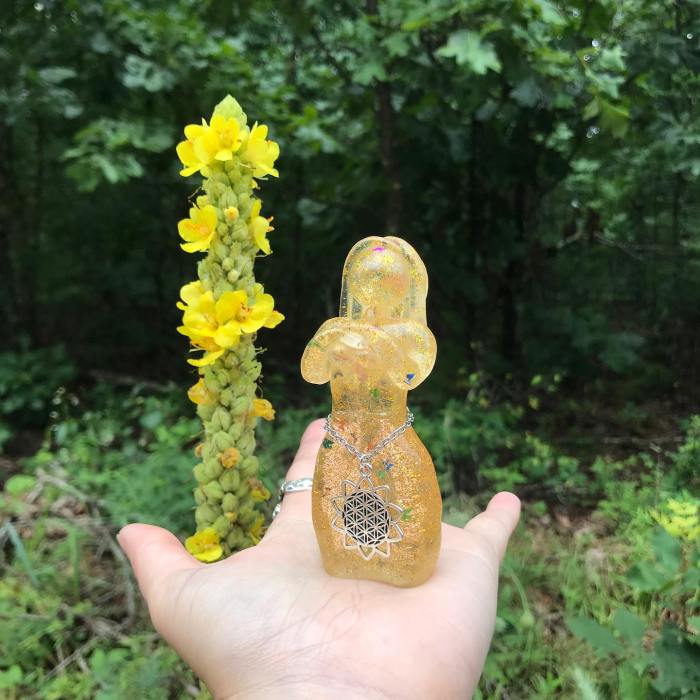
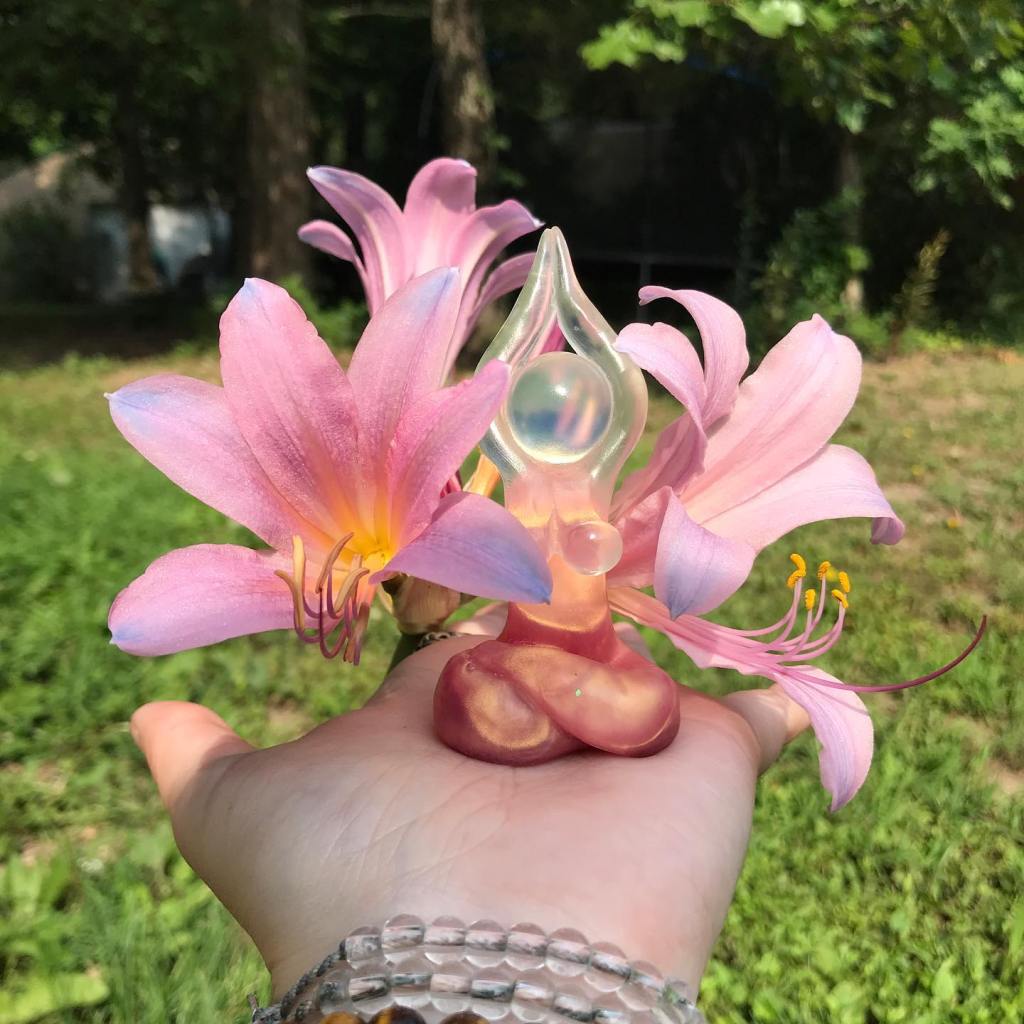
Molly Remer’s new book Walking with Persephone is now available for pre-order from Womancraft Publishing. Her prayerbook, Whole and Holy: a Goddess Devotional was published in November. Molly has been gathering the community to circle, sing, celebrate, and share since 2008. She plans and facilitates women’s circles, seasonal retreats and rituals, mother-daughter circles, family ceremonies, and red tent circles in rural Missouri. She is a priestess who holds MSW, M.Div, and D.Min degrees and wrote her dissertation about contemporary priestessing in the U.S. Molly and her husband Mark co-create Story Goddesses, original goddess sculptures, ceremony kits, mini goddesses, and more at Brigid’s Grove. Molly is the author of Womanrunes, Earthprayer, Sunlight on Cedar, the Goddess Devotional, She Lives Her Poems, and The Red Tent Resource Kit and she writes about thealogy, nature, practical priestessing, and the goddess at Patreon,Brigid’s Grove, Feminism and Religion, and Sage Woman Magazine.
Any new book by Judy Grahn is cause for celebration. For decades, Grahn has been a lyrical and passionate poet, author, mythographer, and cultural theorist whose work features both goddess wisdom and contemporary culture centering on women and queer people. Nightboat Books has just published her newest book, Eruptions of Inanna: Justice, Gender, and Erotic Power, which offers ancient yet fresh world views with which to approach such issues as injustice, sexuality and gender, climate change, and more just when we need it most.
In Eruptions of Inanna, she brings what she calls her “poet’s eye” to eight stories featuring the Sumerian goddess Inanna as well as religious practices of those devoted to her. She explores how these have directly influenced our world and, in her words, can continue to “feed our needs and help us take better care of each other and our world.” According to Grahn, Inanna “is a combination of human, creature, erotic and other energetic forces, and civilization. She also inherited very old powers that grew out of women’s rituals” (55). Her essence engenders sovereignty and self-worth, especially in women and queer people. She is a goddess of love, espousing passion and the joy of eroticism as integral to both life and society. She practices an expansive justice that creates positive outcomes in response to horrific acts. She creates a civilization of the arts, beautiful and useful crafts, abundance, and a jubilant communal life. She demands respect for nature and ecological sustainability.
May you witness a growing trust in the guidance around you. May you allow magic to find you where you are.
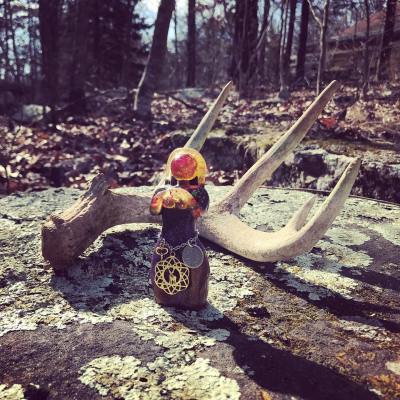
Seven years ago, I did a drum-guided meditation in which I journeyed deep into the forest. On my head as I walked, antlers grew, curving above me. As I followed the sound of drums and the glimmer of firelight, I kept raising my hand to check to see if they were still there, firm beneath my hand. I reached the fire and met the Goddess there, she reached up and took the antlers off my head and cast them into the flames, where they twisted and glowed until they became a golden ring, which she removed and placed on my finger, antlers now wrapped around my index finger. In waking life, I scoured etsy and two years later located a bronze antler ring extremely similar to my vision, which I bought and placed on my own finger in the woods as a symbol of my earth based path, my priestess vows, and some kind of unspoken dedication, felt within but not able to be fully verbalized at the time.








 Feminism and Religion