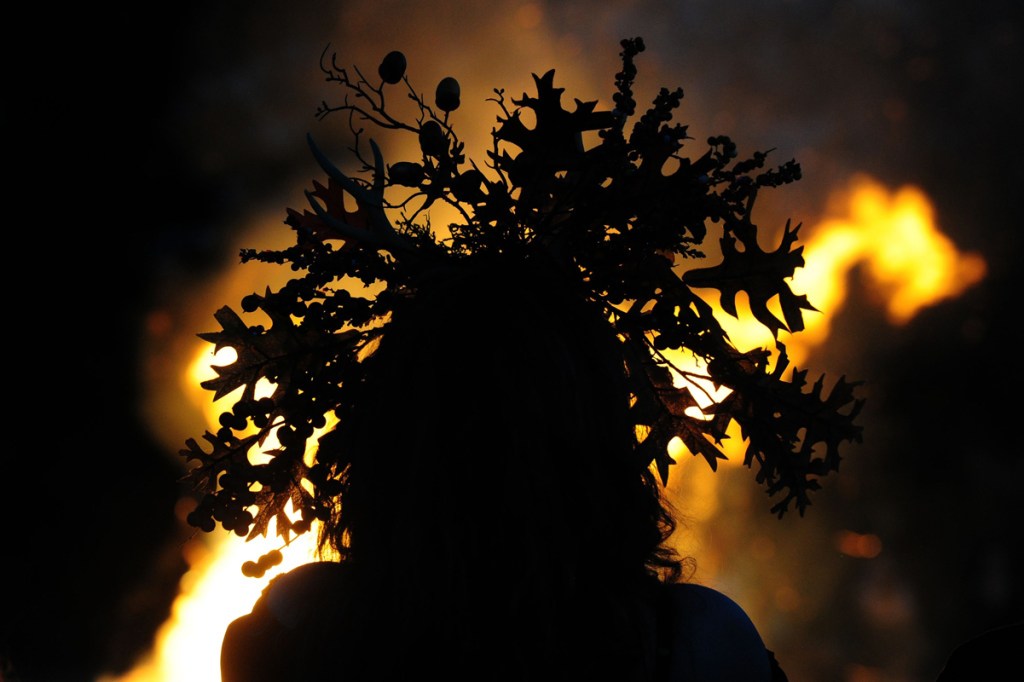
Feminists have always found holy places in the forest, under trees, near springs or wells or by rivers and streams and this year my refuge has been the forest, where the goddess lives still…I have spent most of the summer visiting in a very special forest, one that has been protected by people who have bought up thousands of acres to protect the land from motorized vehicles and other machines that ruin the earth. Old trees shade an understory that is thick with new growth, ground cover and mushrooms abound. There are beaver ponds and springs, rivers, and bogs. When I enter the narrow winding barely discernable paths I feel as if I am parting a veil to enter a holy place because the trees have been allowed to grow and the forest is so healthy.
Most people know Portugal as a deeply Catholic country with a rich Islamic past and an ancient Sephardic Jewish heritage reaching back to Roman Lusitania. But what about the country’s pre-Roman, pre-Abrahamic Goddess cultures?
Like many foreigners, I moved to Portugal knowing nothing about Portugal’s Goddess heritage.
Then I met Luiza Frazão, Priestess, author, and independent scholar who studied at the Glastonbury Goddess Temple in England with Kathy Jones. After years of training and steeping herself in the lore of the Celtic Goddesses of the Avalonian Tradition, Luiza returned to her native Portugal to research the rich Goddess lore of her country. Intrigued and eager to learn more about her research, I met up with Luiza in the medieval town of Óbidos.
This blogpost is a rewrite and an update from one I wrote on Jan 26, 2020 (I’m Getting Triggered by the Impeachment Trial and I Bet I am Not Alone). I was writing about The Former Guy’s 2nd impeachment trial which rattled my bones and hurt my heart. How often have we seen angry men (and sometimes women) abusing women, abusing the earth, abusing the vulnerable, abusing immigrants, abusing power? And yet the pattern never seems to end. In many cases, they not only get away with it, it is actually celebrated.
In that 2020 blogpost I included Bill Cosby’s case as a success story. Look how hard it had been, how many years, how many accusers it took for justice to give us the illusion of being meted out. And now pulled away.
In January 2020 there was a blunder (or so they called it) at the National Archives’ in their exhibit titled “Rightfully Hers.” They put up an image of the 2017 Women’s March and blurred out the protest signs. Oh, the irony to blur out women’s voices in an exhibit named Rightfully Hers. Yes, they apologized. But they had to get caught first.
Part of discovering my love for teaching and moving through my anxiety involved reconsidering my “ideals” of teaching, which were numerous and high minded.
I always wanted to be a teacher. Sure, I had other career dreams as a child too. I wanted to be a model, because I wanted to be pretty like a model. I wanted to be a flying missionary to please my father—you see, it was not quite enough just to do missions. I also needed “save” (pun intended) people with my daring airplane recuses. And in moments of practical mindedness, I thought I should definitely be a “cleaning lady” (aka a housekeeper), because I was very good at cleaning, which was a way of life and survival in my home. But “teacher” was a persistent calling, so I followed in my teacher-mother’s footsteps AND tried to satisfy paternal aggrandizement by becoming a professor.
It occurred to me recently that I have actually been teaching now for nine years. I’ve also discovered in the last few years that I like teaching. And no, I didn’t always know this. I always wanted to like teaching; and sometimes I was sure that I did indeed like teaching. But non-teaching associated trauma during my early career and my social anxiety also sometimes made (and makes) the process excruciating. (Neo-liberal and late-capitalist academic practice, politics and policy don’t help either.) Part of discovering my love for teaching and moving through my anxiety involved reconsidering my “ideals” of teaching, which were numerous and high minded.
Those of us in the Northern Hemisphere are coming out of a long pandemic winter and entering a new season of waxing light, hope, and growth. Yet these continue to be turbulent times. Even with the progress of the Covid vaccine, none of us truly knows when life will ever return to “normal.”
Like us today, the medieval mystics Julian of Norwich and Margery Kempe, the heroines of my new novel REVELATIONS, which will be published on April 27, lived in a time of pandemic and social upheaval, yet both women bore witness to the divine promise that ultimately all shall be well.
During a near-death experience, Julian received a series of divine visions and spent the next forty years unpacking them in her luminous theology of an unconditionally loving God who is both Mother and Father. Julian offered radical counsel to Margery Kempe, a failed businesswoman and mother of fourteen, who was haunted by her own visceral mystic experience. With Julian’s blessing, Margery walked away from a soul-destroying marriage and became a globe-trotting pilgrim-preacher and rabble rouser. Though these two women might seem like polar opposites—Julian, the enclosed anchoress, and free-roving Margery experiencing her visions in the full stream of worldly life—they complement each other. Together their lives and work form a Via Feminina, a distinctly female path to the divine.
The women mystics have always fascinated me. I identify very powerfully with Hildegard of Bingen, the heroine of my previous novel ILLUMINATIONS, as well as with Margery and Julian as spiritual women facing the roadblock of an institutional, male-dominated religion that side-lined them precisely because they were women. But instead of letting this beat them down, they found within their own hearts a vision of the divine that mirrored their female experience. I believe it’s no mere coincidence that both Hildegard and Julian dared to create a theology of the Feminine Divine, of God the Mother. All three women seized their power and their voice to write about their encounters with the sacred, preserving their revelations to inspire us today.
In our modern world, when many traditional religious institutions are crumbling, we can follow in these women’s footsteps and seek the divine—however we perceive the divine—within the sanctuary of our own hearts. This is the birthright no one can take from us, our eternal refuge. This is the Way of the Mystic.
Learn more about Margery and Julian as I discuss these mystics in a series of free virtual events.
My virtual tour kicks off with a very special Literature Lover’s event, sponsored by Valley Bookseller and Excelsior Bay Books in Minnesota. You can watch the video above. I am in conversation with acclaimed author, Elissa Elliot .
For a deep dive into Julian of Norwich’s spirituality, I am teaming up with Christine Valters Paintner of Abbey of the Arts to offer a Virtual Mini-Retreat on May 13, Julian’s Feast Day. You can learn more and register here.
Mary Sharratt is on a mission to write women back into history. Her acclaimed novel Illuminations, drawn from the dramatic life of Hildegard von Bingen, is published by Mariner.Her new novelRevelations, about the globe-trotting mystic and rabble-rouser, Margery Kempe, will be published on April 27. Visit her website.
The archetype of the Weaver is being widely activated. Thousands of women and men come forth to incarnate it by creating webs of spiritual awakening, by honoring ancestral ways of being, and by promoting practical and sustainable ways of living and thriving.
However, many of these efforts collapse due to a lack of genuine communication inside the group. How can we direct our intentions into grounding a vision that is broader than ourselves? How can we weave together in such a way that each feels heard and, at the same time, willing to deeply listen and feel into, not only the group as a set of individuals, but also to what is making its way into birth out of the group as a unit?
Although it seems easy, group synchronization is not a light task and, in order for this to happen at a substantial level, one has to start from oneself. It is necessary for a kind of initiation to take place, an initiation called “soul individuation.” Soul individuation is a deep dive into one´s own underworld in order to unearth and liberate experiences that have caused one´s soul to fragment. Until this is achieved, one can communicate only from that broken place, not from a place of wholeness and authenticity. Journeying to the underworld is not a pleasant process but, it is a necessary step towards balance and integrity. Continue reading “The Sacred Face of Death by Eirini Delaki”
In the 15th century, as now, independent female travelers faced harassment and suspicion.
I’ve always been fascinated with the women mystics, such as 12th century powerfrau and visionary Hildegard von Bingen, the heroine of my 2012 novel, ILLUMINATIONS. Likewise my new novel, REVELATIONS, which will be published in April 2021, is centered on two 15th century English mystics, Margery Kempe and Julian of Norwich. Like Hildegard, they were women of faith facing the roadblock of institutional, male-dominated religion that sidelined them. But instead of letting this beat them down, they found within their own hearts a vision of the divine that mirrored their female experience. I believe it’s no mere coincidence that both Hildegard and Julian dared to create a theology of the Feminine Divine, of God the Mother. All three women seized their power and their voice to write about their encounters with the sacred, preserving their revelations to inspire us today.
While Hildegard and Julian are iconic, Margery Kempe is a more marginal figure–well-known among medievalists but much less known to a general audience. I first encountered Margery in a post-grad course entitled Late Medieval Belief and Superstition. I was blown away by the story of this enterprising woman who survived postnatal depression and a soul-destroying marriage to become an intrepid world traveler and literary pioneer. The Book of Margery Kempe (c. 1436–38) is the first autobiography in the English language.
Margery’s story explodes our every stereotype about medieval women.
She was not just a desperate housewife and mother of fourteen. She rebelled against the straightjacket of an abusive marriage by becoming an entrepreneurial businesswoman. First she ran a brewery, then a grain mill. When both businesses failed and she’d had enough, she left her husband behind and took to the road as a pilgrim, traveling to Jerusalem, Rome, and Santiago de Compostela. This in an age when very few women traveled even in the company of their husbands, Margery blazed her own trail across Europe and the Near East.
Alas, like strong women throughout history, her independence and eccentricities drew suspicion. Before long she found herself on trial for heresy. A guilty verdict would have seen her burned at the stake, yet she kept her spirits high by regaling the Archbishop of York with a parable of a defecating bear and a priest.
Before leaving on her monumental pilgrimage, Margery sought the counsel of her sister mystic, Julian of Norwich. This was an exceedingly vulnerable time in Margery’s life. In leaving her husband and children behind, she had broken all the rules, and she was filled with self-doubt and uncertainty. Julian’s advice to trust her inner calling and not worry too much about what other people thought seemed to have a profound and empowering impact on Margery. While Julian had chosen to wall herself into a cell and live as an anchoress, she gave Margery her blessing to wander the wide world.
Sadly, some historians and theologians try to pit Julian and Margery against each other. Julian is held up as the real saint, the real deal, while Margery is dismissed as a hysterical wanna-be. Because she had the habit of copious weeping when in the throes of mystical experience, many people, both in her time and ours, have refused to take her seriously.
Yet a number of fascinating synchronicities connect Margery and Julian. In so many ways, their stories intertwine and complement each other.
Margery was born in 1373, the same year that thirty-year-old Julian received her “showings”—the divine visions that would inspire her landmark book Revelations of Divine Love, the first book written in English by a woman. Both women lived in Norfolk, in cities less than 45 miles away from each other. Both women were literary pioneers whose lifework was lost to obscurity, only to resurface in the twentieth century.
Immersing myself in Julian’s radical theology of the primacy of divine love was a profound experience. Like Margery, I often found myself moved to tears by the beauty of Julian’s visions, by her absolute assurance that no matter how dire things may seem, all will be well.
But what took me by surprise was how revelatory Margery’s dance with self-doubt was for me. In writing this book and delving into medieval mystical texts, I discovered that our doubts, as painful and wrenching as they are, aren’t a flaw or hindrance. In fact, they lead us deeper into the divine mystery, the vast “Cloud of Unknowing” where God dwells. Only when we set aside our preconceived notions of what we think we believe the divine to be, can we enter this numinous place.
As a mystic, Margery’s especially fascinating to me, because she found her spiritual bliss not in the cloister, but as a laywoman, in the full stream of worldly life with all its wonders and perils. May we all have the power to reinvent ourselves as courageously as Margery did.
Mary Sharratt is on a mission to write women back into history. Her acclaimed novel Illuminations, drawn from the dramatic life of Hildegard von Bingen, is published by Mariner.Her new novelRevelations, about the globe-trotting mystic and rabble-rouser, Margery Kempe, will be published in April 2021. Visit her website.
My daughter turned five years old this week. I am now a five-year-old-mother of one. Big Five <3. I’ve been thinking a lot about the fact that this is the age when children’s brains are developed enough to start creating more permanent memories of their childhood. What will my daughter’s earliest memories be when she is grown?
Four was a pretty chock-full year.
Fires—though those may seem like just another California season to her by now. Pandemic; staying home with Mommy, Daddy, and our new roommates, Auntie and Uncle for weeks on end.
Learning to ride a bike.
Pages upon pages of art, including a whole notebook almost exclusively dedicated to her “study” of “Hazel Vampire” (I blame Uncle and Auntie for this one).
As I have witnessed both the joy of so many across the world at the nomination of Kamala Harris for Vice President and the deep sorrow at the death of Ruth Bader Ginsburg, I am struck by the fact that, in 2020, supremely qualified women still need to be trailblazers to hold high office. After all, goddesses and wise women gave a number of cultures their systems of laws and governance and have been celebrated for their wisdom as judges for millennia.
Here are a few of the goddesses and wise women lawgivers:
the Italian goddess Egeria gave Rome its first laws and taught the correct rules for Earth worship;
the Babylonian Kadi, was goddess of Earth and justice;
Ala of the Ibo people of Nigeria is both the Earth Mother and lawgiver of society;
the Greek Themis, daughter of Gaia, symbolized the social contract and cohesion of people living on Earth;
the Inuit Sedna both gave humanity abundance from the ocean for life from her own body and withheld it when her laws were broken;
Marcia Proba, whose historical reality is unclear, is said to have created the ancient Celtic system of laws known as the Marcian Statutes that may have influenced later British law;
past and present Women’s Councils and Clan Mothers of the Iroquois and other Indigenous peoples as well as those of Societies of Peace have brought harmony and well being to their people for tens of thousands of years.
As the American Embassy was bombed in 1999, I was hunkered in a Russian Orthodox Church, gazing at the brooding, whitewashed faces of icons, hands raised in endlessly frightening benediction. Hundreds of men met my eye, as I found myself asking, “Where are all the women?” In 2005, the sun peaked over the horizon on Mount Sanai as I entered the chapel at Saint Catherine’s Monastery, which houses the oldest collection of Christian orthodox icons in the world. As a sensory overload accosted my eyes, ears, and nose, I scanned the scene to find only two women crammed among all the icons; one was a nameless daughter sacrificed by her own father. Where were all the women? A few years later, I knelt at the Temple of 1,000 Buddhas in Thailand. Not a woman could be found. Where are all the women?
For over a decade, I’ve painted folk-feminist icons of revolutionary women from history and mythology, a subversively artistic attempt to answer my own question by painting the women who have been ignored, excluded, or strategically erased. From Pauli Murray to Sarasvati, Gloria Anzaldua to Papahanoumoku, this work continues to be a gift, joy, and a tremendous part of the mission of my non-profit, the Tehom Center, which empowers marginalized women by teaching about revolutionary women through art, writing, retreats, and academic courses. Continue reading “Subversive Sister Saints by Angela Yarber”