Pesach, Toilets, and Clean, Local Water: Seemingly Mundane Yet Necessary Components of an Embodied Liberation by Ivy Helman

20151004_161012Despite all of the ways Western society has separated the spiritual pursuit from the material and deemed spirituality superior to physicality, the religious holiday of Pesach doesn’t.  In fact, it is the physical liberation of the Israelites from slavery in Egypt that starts them on their path toward the covenant and an even deeper spiritual connection to the divine.  The Exodus story overflows with images, tales and situations in which: bodies are not ignored; nourishment, comfort and care is addressed spiritually as well as physically and the divine’s spiritual gift, so to speak, to the Israelites is not some other-worldly paradise but a this-worldly land flowing with milk and honey.

Of course, this doesn’t mean that the story is perfect: it is replete with war, murder, militarism, forms of colonialism and other manifestations of patriarchal violence.  Patriarchal influences encourage androcentric tellings of events and sexism as well.  Three examples are the all-male priesthood, the tenth plague “death of the first-born” (of course the only first born that counts are boy children), and the over-the-top covenantal concern about women as menstruators, adulterers, untrustworthy and so on. These aspects are important to acknowledge and critique, but we cannot stop there.  We must cherish the story for its insights as well. Continue reading “Pesach, Toilets, and Clean, Local Water: Seemingly Mundane Yet Necessary Components of an Embodied Liberation by Ivy Helman”
The Hebrew Priestess: A Book Review by Joyce Zonana

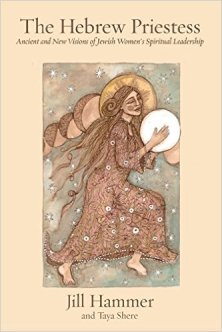
Hebrew Priestess coverWeaver, Prophetess, Shrinekeeper, Witch; Maiden, Mother, Queen, Midwife; Wise-Woman, Mourning-Woman, Seeker, Lover, Fool . . . . Thirteen possibilities for the female self, thirteen aspects of the Goddess, thirteen archetypes for the Hebrew (or any other) Priestess . . . thirteen fact- and dream-filled chapters in Jill Hammer and Taya Shere’s thrilling—and much-needed—new book, The Hebrew Priestess: Ancient and New Visions of Jewish Women’s Spiritual Leadership.

Nearly fifty years ago, anthropologist Raphael Patai introduced readers to the Hebrew Goddess, documenting the influence of Near Eastern Goddess religions on the practices and beliefs of the ancient Israelites. Since then, feminist scholars of religion, along with poets and novelists, have offered brilliant new interpretations of Torah and Talmud, creating feminist midrash and liturgy that open the ancient patriarchal faith to modern (and perhaps also ancient) notions of female authority and autonomy. At the same time, the increasing presence of women rabbis has transformed the congregational, communal Jewish experience for many women and men.

But what we have not had is a shamanic, visionary form of Jewish practice—“earth-based, embodied, ecstatic, energetic” (9)—that integrates ancient and contemporary Goddess spirituality with Judaism: while we have had female rabbis, we have not had formally trained and recognized Hebrew Priestesses.

Jill Hammer
Jill
Taya Shere
Taya

Enter Jill Hammer, who in the compelling Introduction to her book recounts with passion and precision her own meandering but steady journey to the Goddess and her establishment, with co-author Taya Shere, of the Kohenet Hebrew Priestess Institute, a school dedicated to ordaining contemporary Hebrew Priestesses, kohanot.Kohenet,” although it does not appear in the Bible, is the ancient Hebrew word for “priestess.” Continue reading “The Hebrew Priestess: A Book Review by Joyce Zonana”

Mazel Tov Tzidkaniyot of the Wall by Ivy Helman

20151004_161012I have never understood the logic behind sexism. Why is half (or so) of the human race better than the other half? Of course, patriarchy and patriarchal religious traditions offer various seemingly logical reasons, sometimes even divine explanations for the inequality between the sexes. Still, the –isms of patriarchy, whatever their “reasons” or perhaps better excuses, puzzle me.
Even more puzzling are the steps patriarchy-orientated men and women take to preserve these distorted systems. Violence usually goes hand-in-hand attempting to control others in order to preserve the status quo. Obviously if you need to resort to violence to keep people in their place, there is something horribly wrong with society. That being said – one could say that almost no society, nation or culture in our modern times doesn’t have some form of patriarchal violence within it. One would be correct to attribute some measure of the increase of violence to globalization, capitalism, fear, past colonialism and/or neocolonialism. Nonetheless one is hard pressed to find a culture without sexism, without patriarchy and without the need to keep the system in place through violence. Continue reading “Mazel Tov Tzidkaniyot of the Wall by Ivy Helman”

Stealing the Yarn: Jewish Women and the Art of Feminist Dreaming (Part 2) by Jill Hammer

Jill HammerIn my last post, I discussed the uses of dreamwork for Jewish women who are uncovering their own spiritual language. The protagonists of recorded Jewish dreams, from Joseph to the dream interpreters of the Talmud to the kabbalists, tend to be male. Yet there is a legacy of Jewish women dreaming, occasionally documented, and painstakingly uncovered by researchers. This hidden history offers us resources for understanding the women of the past, and for connecting to women in the present.

The Roman poet Juvenal (2nd. cent. CE) mocks a poor Jewish woman of his time for sitting under a tree and telling the meaning of dreams, calling her “high priestess with a tree as temple.” Much later in history, Hayyim Vital, the disciple of master kabbalist Isaac Luria, records in his diary that Jewish women in the city of Sfat (Jewish holy city in Galilee known as a center for Kabbalah) in the early 17th century were actively engaged (along with men) in recording, sharing, and interpreting dreams. Vital mainly records women’s dreams when the women dream about him! He saves these dreams from the dustbin of history, ironically, because he sees the dreams as prophecies of his greatness.

For example, Vital records the dream of a friend and patron, Rachel Aberlin. In the dream, Aberlin watches Vital eat a feast of vegetables at a table full of sacred books. Behind Vital, a fire rages, yet does not consume the pile of straw in which it burns. When Aberlin shares the dream, Vital understands this dream to be a manifestation of a biblical verse: “The house of Jacob shall be fire, and the house of Joseph flame, but the house of Esau shall be straw” (Obadiah 1:18). Aberlin, however, responds to Vital’s interpretation: “You quote me the words as they are written, but I see them as a reality.” (Between Worlds: Dybbuks, Exorcists, and Early Modern Judaism, p. 106ff).

Vital sees the dream’s fire as his own spiritual fire, witnessed by Aberlin. Yet we might read the dream differently. In our dream of Aberlin’s dream, we might imagine that Aberlin’s dream encodes her experience of watching Vital consume the nourishment of sacred books, which she, as a woman, is denied. Yet, the dream suggests, the fire of revelation is behind Vital, eluding him. Within the dream and in waking life, Vital is focused on text, but Aberlin, like Moses, perceives the fire that does not consume. Aberlin, not Vital, is the prophet in the dream— and the waking Aberlin says so. Vital records the dream, without recognizing Aberlin’s implicit criticism of his way of knowing.

Continue reading “Stealing the Yarn: Jewish Women and the Art of Feminist Dreaming (Part 2) by Jill Hammer”

Entering The Cave: Jewish Women and the Art of Feminist Dreaming (Part 1) by Jill Hammer

Jill HammerDreams are my window on my wildest self. They are also a way to observe the conflicts within, and therefore they are a feminist practice, teaching me about my relationship to power, gentleness, love, and brokenness. Claiming my dreams is a way of claiming all the parts of myself. I am inspired in my dream practice by my own Jewish tradition, which has many dream practices, as well as by contemporary knowledge about dreams. Frequently in my dreams, I am able to observe my own longing for the company of women and for the presence of Goddess—deity in a female mode—in my life. Frequently, I learn about my experience as a woman by watching my dreams.

In one recent dream, I found myself in a town called Ursula, visiting a cave. Inside the cave were statues of holy women. After my visit, I expressed a desire to move to this town, Ursula. When I woke up, I remembered a painting I had seen in London when I was young: a depiction of St. Ursula, a fourth-century Catholic saint said to have led eleven thousand women on pilgrimage. Ursula is also the she-bear, an archetype of the sacred feminine. The desire to live in the town of Ursula could be read as a desire to live in the realm of the she-bear: in the company of women. The town of Ursula is also a town of the ancestors: the priestesses, prophetesses and wise women of old, represented by the statues in the cave. Though the imagery in my dream comes from a variety of cultures, the dream reminds me of my desire to connect to the women my tradition through dreams.

I teach Jewish dreamwork (based on biblical, Talmudic, kabbalistic and contemporary texts) to rabbinical and cantorial students at the Academy for Jewish Religion. I have seen how deeply it adds to my students’ spiritual lives. And, as one of the co-founders of the Kohenet Hebrew Priestess Institute, I have seen dreamwork transform the lives of women who are becoming ritual leaders and healers. Kohenet’s dream practice includes dream circles in which each participant offers a different reading of each dream, beginning with “In my dream of this dream.” We begin this way because each of us has a different understanding, influenced by who we are.

At Kohenet retreats, we often find that the dream of one person provides powerful healing for the whole community. For example, one woman dreamed of finding a bearded father-figure in a house. When she went into the basement, she found her mother working and writing next to a goddess shrine (Jill Hammer and Taya Shere, The Hebrew Priestess: Ancient and New Visions of Jewish Women’s Spiritual Leadership, p. 70). The dream expressed an experience many of us shared: the process of unearthing the power of women and the mythic feminine in our own lives.

Continue reading “Entering The Cave: Jewish Women and the Art of Feminist Dreaming (Part 1) by Jill Hammer”