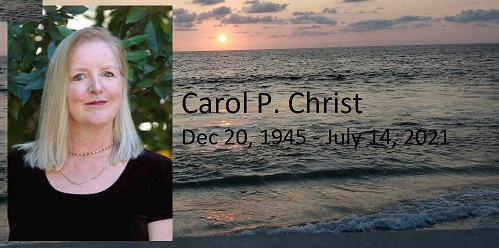
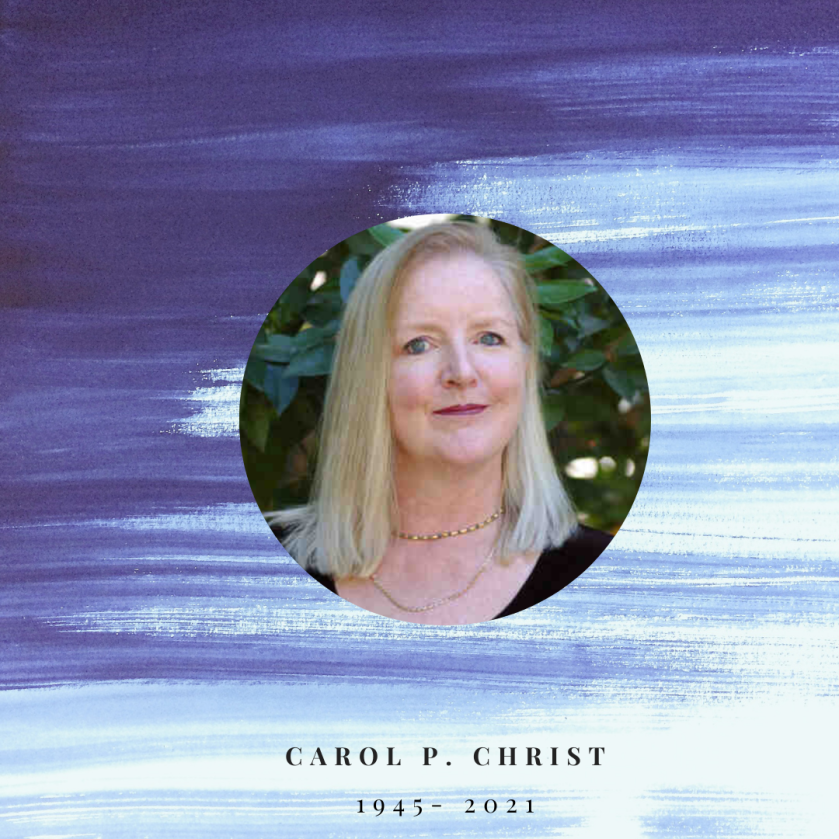
Legacy of Carol P. Christ: Of Human Life*

This was originally posted on December 30, 2011

Watching the last episode of the Australian series Brides of Christ in which Catherine leaves the sisterhood of the convent because of her disagreement with Humanae Vitae brought me right back to the Yale Roman Catholic chapel and the folk mass I attended regularly.  In 1968 just after the publication of Humanae Vitae, priest and co-graduate student Bob Imbelli preached a sermon on the doctrine of conscience, arguing that though it was incumbent on Catholics to think carefully about the papal encyclical on birth control, it was also the responsibility of every Catholic to follow her or his conscience on the matter.  In the episode, Sister Catherine encourages a Roman Catholic mother of six who has already self-induced more than one abortion to take the pill, but the woman decides she cannot go against the church’s teachings.  Catherine allows an editorial against Humanae Vitae to be published in the school newspaper even though she knows it will probably lead to the expulsion of one of her favorite students.

Continue reading “Legacy of Carol P. Christ: Of Human Life*”

Legacy of Carol P. Christ: The Feast Day of St. Brigid

This was originally posted on Jan 30, 2012

May we remember Brigid on her day in the fullness of her connection to bountiful and life-giving earth by setting a bowl of milk on an altar or special place in the garden on her holy day.  Who knows, a snake just might come to drink from it.

The Christian Feast Day of St. Brigid of Kildare, one of the two patron saints of Ireland, is held on February 1, the pre-Christian holiday known as Imbloc.  It is well known that St. Brigid has the same name as a pre-Christian Goddess of Ireland, variously known as Brighid (pronounced “Breed”), Brigid, Brigit, Bride, or Bridie.  The name Brigid is from the Celtic “Brig” meaning “High One” or “Exalted One.”  Brigid like other Irish Goddesses was originally associated with a Mountain Mother, protectress of the people who lived within sight of her and of the flocks nurtured on her slopes.

Imbloc marked the day that cows and ewes give birth and begin to produce milk.  It was also said to be the day when hibernating snakes (like groundhogs) first come out of their holes.  In northern countries, Imbloc signals the beginning of the ending of winter.  The days have begun to lengthen perceptibly after the winter solstice when the sun stands still and it seems that winter will never end.  At Imbloc spring is not yet in full blossom.  But if hibernating snakes come out of their holes, it is a sure sign that the processes of transformation will continue and warmer days will not be far off.  As Marija Gimbutas says, “The awakening of the snakes meant the awakening of all of nature, the beginning of the life of the new year.”  

Continue reading “Legacy of Carol P. Christ: The Feast Day of St. Brigid”

Legacy of Carol P. Christ: THE “G” WORD

This was originally posted on December 10, 2011

Recently, I saw the following line in a promotion for a book to which I contributed: “This volume includes voices from Christianity, Judaism, goddess religion, the Black church, and indigenous religions.” The editors of this book are to be strongly commended for expanding the dialogue in feminism and religion beyond the confines of the Christian hegemony in which it is still all too often framed.  Nonetheless, I felt hurt and offended.  I immediately wrote to the editors asking how they would feel if a book were promoted using the words:  “This volume includes voices from Goddess religion and god traditions such as judaism and christianity.”

Continue reading “Legacy of Carol P. Christ: THE “G” WORD”

Legacy of Carol P. Christ: Should Our Children and Grandchildren Live Better Than Us? And Whatever Happened to Our Dreams?

This was originally posted on November 4, 2011

Last Sunday on Meet the Press Tom Brokaw spoke about the breakdown of what he felt had been a common consensus about American life. He said that Americans are questioning the American dream which tells us that “our children and grandchildren will live better than us.”  He found it disturbing that people now feel their children will not be better off than they were.  The poor no longer see a way out of poverty and the middle class fear that their children will be unemployed for long periods in their lives, burdened with college debt, and unable to afford mortgages and college educations for their children.  I have heard this idea expressed many times in the recent economic crisis, including by progressive journalist Adrianna Huffington.

Continue reading “Legacy of Carol P. Christ: Should Our Children and Grandchildren Live Better Than Us? And Whatever Happened to Our Dreams?”

Legacy of Carol P. Christ: In the Web of Life — No Exceptions

This was originally posted December 2, 2011

Does God love me more than She loves my doggies? Does She love animals more than She loves trees and flowers? Does She love trees and flowers more than She loved the first cells that formed in the waters of our planet? Did She not also love the atoms and particles of atoms that coalesced to form the earth?

In her books Sacred Gaia and Gaia’s Gift Anne Primavesi questions the notion that the dialogue between God and the world began with “our entry onto the scene.”  Primavesi argues that “human exceptionalism,” the view that the world exists for us, and that we are an “exception” to the world, has been and is the predominant Christian view.  In the stories of Adam and Noah, God gives dominion over the creatures of the earth to man.  Theologians asserted that of all the creatures that inhabit the earth, only man is in the image of God, and the image of God in man is found in his rational intelligence, which is shared with no other creature.  Because he is in the image of God, man will escape death, which is the lot of every other living thing.  Rather than challenging human exceptionalism, modern science furthered it, asserting that “matter” was “dead,” and that therefore it was right and just for man to subdue “nature” through technology and to harness it for his needs.  

Continue reading “Legacy of Carol P. Christ: In the Web of Life — No Exceptions”

Legacy of Carol P. Christ: The Black Horse: Our Bodies, Our Selves

This was originally posted on Sept 23, 2011

bust of Plato, wikimedia commons

“The driver…falls back like a racing charioteer at the barrier, and with a still more violent backward pull jerks the bit from between the teeth of the lustful horse, drenches his abusive tongue and jaws with blood, and forcing his legs and haunches against the ground reduces him to torment.  Finally, after several repetitions of this treatment, the wicked horse abandons his lustful ways; meekly now he executes the wishes of his driver, and when he catches sight of the loved one [i.e. his master] is ready to die of fear.”

I can’t seem to get this image from Plato’s Phaedrus quoted in Val Plumwood’s Feminism and the Mastery of Nature out of my mind or my body these days.  The other day I tried to read the above passage to a friend and my body became so tense that I accidentally cut off the phone connection—twice.  Now while I am writing my muscles are tight, and I am beginning to get a headache.  I cannot get the image of the black horse out of my mind because “she” (I know that Plato’s horse was a “he”) has lived in my body for as long as I remember.  She probably first took root in my body when I began to fear my father’s discipline.  She became bigger and stronger every time someone or something in culture told me that my body and the feelings of my body were bad, that I as a girl or woman was unworthy, that the things I cared about were not important, that my thoughts were wrong.  

Continue reading “Legacy of Carol P. Christ: The Black Horse: Our Bodies, Our Selves”

Legacy of Carol P. Christ: Football as a Ritual Re-enacting Male Domination Through Force and Violence

This was originally posted on November 18, 2011

The other day when Paula McGee asked on this blog how Penn State students could rally in support of Sandusky, I was also reading a student paper quoting Rianne Eisler’s opinion that peace and environmental justice cannot be achieved in dominator cultures. Xochitl Alvizo commented that we should not be surprised by the reactions of the students as we live in a “rape” culture.  I would add that we must examine the culture of male domination through force that is “football,” one of the “sacred cows” of American patriarchy, just as we need to examine the culture of hierarchical male domination of the Vatican in the context of child-rape by priests.

Continue reading “Legacy of Carol P. Christ: Football as a Ritual Re-enacting Male Domination Through Force and Violence”

Legacy of Carol P. Christ: REMEMBERING MERLIN STONE, 1931-2011

This was originally posted on February 20, 2012

“In the beginning…God was a woman.  Do you remember?”  Feminst foremother and author of these words Merlin Stone died in Feburary last year.

I can still remember reading the hardback copy of When God Was a Woman while lying on the bed in my bedroom overlooking the river in New York City early in 1977.  The fact that I remember this viscerally underscores the impact that When God Was a Woman had on my mind and my body.  Stone’s words had the quality of revelation:  “In the beginning…God was a woman. Do you remember?”  As I type this phrase more than thirty-five  years after first reading it, my body again reacts with chills of recognition of a knowledge that was stolen from me, a knowledge that I remembered in my body, a knowledge that re-membered my body.  My copy of When God was a Woman is copiously underlined in red and blue ink, testimony to many readings.

Continue reading “Legacy of Carol P. Christ: REMEMBERING MERLIN STONE, 1931-2011”

Carol P. Christ: Weaver of Visions by Beth Bartlett

Author’s Note: Today’s post is the 4000th FAR blog post!  I first became aware of the Feminism and Religion blog when participating in a symposium honoring the life and work of Carol P. Christ in October 2021. I was inspired to write a piece on Christ’s contribution to ecofeminism, that was posted in the FAR blog a year ago today. I wanted to post another piece on Christ on the anniversary of that first post. I’m delighted that it is the 4000th, and so fitting that it is written in honor of Carol Christ, who was such an important part of the FAR blog.

A while ago, a friend asked me what spiritual reading I’d been doing lately. I told him that I’d been revisiting classics from the past. When he asked me who specifically, the first name I mentioned was Carol Christ. Even though he was a minister, he had never heard of her. Sadly, I suspect the same would be true for the vast majority of ministers, priests, rabbis, theologians, and other religious leaders. Yet, I can think of no one who has had a greater influence on my religious and spiritual thought and beliefs.

Continue reading “Carol P. Christ: Weaver of Visions by Beth Bartlett”

Remembering Rosemary Part 2 by Janice L. Poss and Theresa A. Yugar

Editor’s Note: A more formal memorial to Catholic Feminist Theologian Rosemary Radford Ruether was posted here at Feminism and Religion at the time of her passing. Now we are delighted to share these memories of her by two scholars, Theresa A Yugar and Janice L. Poss, who knew her well, especially in her last months. Therese’s reflection is below and Janice’s will appear tomorrow. As Janice notes in her post, “More than any deep theological concept, doctrinal exegesis, or other hyper-scholarly thought, she taught me simply by being who she was – a woman – and she gave me the ultimate gift, the gift of herself.” Through these posts, Theresa and Janice pass on some of Rosemary’s wise and caring gifts to our FAR readers. Part 1 was posted yesterday. You can read it here.

Janice, Theresa with Rosemary

Almost five years ago, Rosemary Radford Ruether suffered a devastating stroke that left her partially paralyzed and no longer able to speak or write, activities that were integral to her life as a writer, teacher, activist, and scholar. During her difficult last years Janice and I learned new ways of engaging her that were academically stimulating and fulfilling for her. We became advocates for her during her disability as she had been an advocate for us. Thus, out of pain grew blessings.

Janice and I dedicate and share with you these two short reflections that reflect our struggle to find our way without her. We know there will be many more reflections composed and shared by others whom she mentored, influenced and touched. Now—in the midst of our grief and sadness at her loss—we offer our personal memories of how she enriched our lives every day until she passed from our midst at 2pm, on Saturday, May 21, 2022.

Continue reading “Remembering Rosemary Part 2 by Janice L. Poss and Theresa A. Yugar”