


This post was originally published on Jan 13th, 2014.
In a provocative essay and heart-breaking painting, Angela Yarber asked us to consider who Jephthah’s daughter is in our time. Angela reminded us that Jephthah was a heroic warrior in the Hebrew Bible who swore in the heat of battle that if his people won, he would sacrifice the first person he would see on returning home. That person turned out to be his unnamed daughter.
Reading Angela’s post and looking at her holy woman icon of Jephthah’s daughter, my mind turned to the story of Agamemnon’s daughter. In this case, the daughter is named: Iphigenia. Agamemnon had gathered his troops to sail to Troy, but lack of wind prevented them from setting off. According to the myth, Agamemnon was told by the Goddess Artemis that he must sacrifice his daughter if the ships were to sail. He did.
In his powerful rewriting of the myth of the sacrifice of Iphigenia, Daniel Cohen questions whether the Goddess requires human sacrifice Continue reading “Legacy of Carol P. Christ: Who Is Jephthah’s Daughter? The Cost of War”


 About six months ago I was hired to write a curriculum for a Jewish organization on biblical women in ancient and contemporary midrash. Midrash—the ancient process of creative interpretation of sacred text that began two thousand years ago and continues to this day—has been one of my fields of expertise, and women in midrash is a particular specialty. I knew the first lesson I wrote would be on Eve (Chava in Hebrew), the first woman of Genesis. Yet as I began to write lessons, I started with Sarah and Hagar, then proceeded to Rebekah and Lot’s wife, Rachel and Leah, even Asnat (Joseph’s wife) and Naamah (Noah’s wife). It became clear over the months that I was avoiding Eve. Whenever I began to think about beginning “her” lesson, I grew anxious and immediately began to think of something else. Only when I had already written six of my ten lessons did I finally, reluctantly, begin to research ancient legends and modern feminist poems on the first foremother of the Bible.
 The Tanakh, Jewish scriptures, predominately call the deity king and lord and use the masculine pronoun. These images evoke a certain level of power. Just how powerful the deity is in then multiplied when “he” is addressed as “G-d of Gods,” “Lord of Lords,” judge, almighty, all-powerful, and warrior-like with vengeance, fury and flaring nostrils. Events like war, army invasion, disease, drought, and famine are often described as divine punishments for wrongs done throughout the Tanakh.
 This is the first part of a series of reflections on the weekly Torah portions. For those of you unfamiliar with Judaism, we read the Torah in sections. There are 52 parshot (or portions), one parshah (portion) is read each week (most often during Shabbat morning services). It is common for rabbis, prayer leaders or someone of the congregation to offer reflections on the week’s parshah at Shabbat services.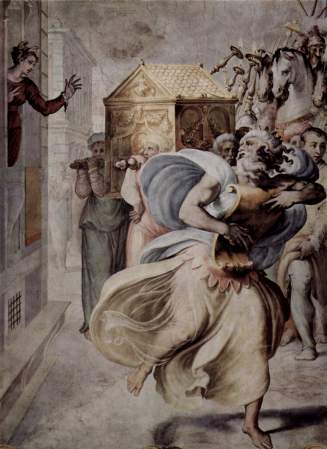
 Feminism and Religion