I longed to re-visit
the desert – my first
journey left me
with a longing for
wide open spaces,
a blue sky dome,
a bowl of stars at night,
so to return 25 years later
was to complete
an unfinished story.
Now I could live among
the stately rock
stark white columns,
conical reptilian hills,
pink and purple sands,
ragged weeds,
Cactus People,
thorns and stickers,
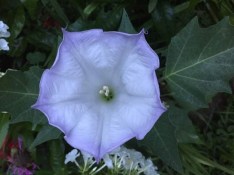
delicate yellow flowers,
under a moon that rarely slept?
Some nights I missed the dark.
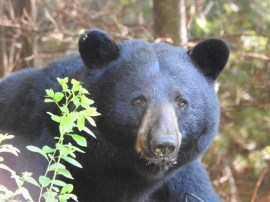
I always missed the Bear
I dismissed the longings
in my body,
Things were different here.
Maybe I could escape
the grief of dying trees,
stripped mountains,
a shrinking wilderness
too many gunmen
the loss of dreams?
That first November
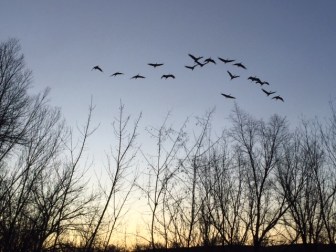
I heard a haunting –
Crane calls
as they touched
down at nightfall.
My bones sang.
How I longed
to meet the bird
whose voice
sent lightening chills
through every nerve.
A fellow college classmate, Diana, and I wrote this poem together as we were inspired by the likes of Adrienne Rich and Sara Ahmed. We wanted to touch on the animosity between trans folk and cis women that often exists between them, and bridge our collective and often shared feelings of joy, rage and injustice into writing. We welcome you to walk the bridge with us.
Pt. 1
What is a woman? A woman can’t satisfy.
Because if she’s not “woman” enough in one aspect or the other she’s not deserving of that title at all.
Gender is a societal construct so I wouldn’t really know how to define a woman.
For many, being a woman means that her brain is in between her legs but how do we persuade them that it’s fucking not?
I know a lot of women who aren’t born with the biology of what a woman is expected to be
I know a lot of women who don’t have breasts, who don’t carry typical reproductive organs within their systems.
Can I recall a time when my resilience surprised me?
My mother always said, “If you feel bad, go out into the garden and eat worms.” Sigh. We didn’t have a garden. My resilience. My head hits the counter, as my father’s hand slams into the back of my head. I am locked in a closet. I am. That would be my mother as I grew up. Kicked up. Weeds grow. They do. What is surprising to me at sixty is not my resilience, but the fact that I never leaned back. Stopped. Being resilient is the inside and out of my blood type—moving through all of my veins. I am surprised if I cut myself there is blood left. But there is. I still bleed.
This is resilience.
Can I recall a time when resistance was the only option?
My father. I am twelve. My best friend is over. I go in the other room with him. I have to. She hears this, my best friend. I resist shame like a knife blade I hold. I leave the room with the blade held out. Shame then holds out a cloak promising me something. A space to hide maybe. I resist. I am in a cold fever. My best friend and I sit; we are watching a documentary on TV. My mother sits behind us. She says to no one, “Things happen at everyone’s house. I bet things happen at your house, too.” My best friend and I say nothing. I resist feeling. On the TV are flamingoes and I will hate flamingoes for the rest of my life.
The papaya, the lemon, the squash.
The everything going bad—not yet.
I can pickle anything I can save—still. And I am never still.
Still…at sixty-four here I am. Rise. This is age—still.
2.
I have a passport to somewhere that does not
exist. As a white skin person with color
roots that do not show. My grandfather could not
have had the chance I have to walk at night
in a white neighborhood and nobody knows who I am,
until they know. And still… I am here. This is race—still.
3.
An ivory castle, an ant hill teeming with fire ants, a
stop sign, the rich woman’s house my grandmother
cleaned, the rich woman was my English teacher. My
father beat me for wanting to go to the Ivy League
school, Sarah Lawrence—I could not want to go
where he did not go. So, I went—to the state school.
But, I went, and I did, and I still…I’m
never still. This is possession.
This is wanting—still.
4.
The dark room without a light. The stars
blink at me to move along. I am less
afraid of a coyote than a man out
with my dog at night walking
it off. Walking off the fear of a pandemic virus.
Walking off the fear of—everything—
where are we headed?
Somewhere.
Walking somewhere – my dog ahead of me,
Her ears pointing. She is…I am
never, ever still.
*
I am a rape survivor many times over, and I survived
to be this woman with a pen. And I am…
never still. Stillness as location.
For this is location—still.
5.
A red apple on the teacher’s desk is never
enough if you are not in the class.
The guy said I wouldn’t get the job at seventeen
because it had to go to a boy even though I
created the job the summer before—
a park director in a dangerous neighborhood that I made
a park because no one wanted it. But I did. And I did.
I knew he was wrong, but it would be twenty years
before the words sexual harassment became a
tool I could use. Because…and still. I am
now. I am never still. This is gender—still.
6.
I am a wave, a crash, a body among bodies
among bodies. I believe in people
fighting for what’s right. My wife and I
got married in 2008 and two days later
the state shut down gay marriage and we
spent our honeymoon protesting.
Her first protest sign,
“When do I get to vote on your marriage?’
*
And here I am. Still. Still protesting this shit, is
a sign I would use later. Still. I am never.
I am never still. And this is relationship—still.
*
It’s a long life, I say to students. A lot can happen.Miles to go before you sleep.
A long road. At sixty-four I think, yes. Maybe yes, it is… A Wonderful Life. And still…
I am never still.
This body I am. This story I am
is to be continued. And still.
For I am never…I am never still.
–Marie Cartier January 9, 2021
With thanks to LA’s Cuties Coffee Shop, Poetry Workshop
Marie Cartier has a Ph.D. in Religion with an emphasis on Women and Religion from Claremont Graduate University. She is the author of the critically acclaimed book Baby, You Are My Religion: Women, Gay Bars, and Theology Before Stonewall (Routledge 2013). She is a senior lecturer in Gender and Women’s Studies and Queer Studies at California State University Northridge, and in Film Studies at Univ. of CA Irvine.
On the path
through the pines
I see clumps of
moss scattered,
an old tree trunk
is raked as if
with claws;
clumps of downed bark
food for the earth.
My heart soars.
Wild hope pours
through me like honey.
— for Alex, a nurse I met who is also a poet, and all nurses
I heard that you are a poet
and a nurse. I imagine all the nurses who also
are something else—a chef, a Mom, a painter… a race car driver.
I want to image your life, this poet – and a nurse, in the middle of a pandemic.
I want to appreciate your life—and your stewardship of life and earth and what is in between.
I never knew nurses took an oath.
And I was a friend’s nurse graduation
at Royce Hall at UCLA, where we had both been to school, and when the
graduating class read the oath for nurses,
all throughout the auditorium nurses
stood up and said the oath with them. So, moving. So surprising.
I loved those nurses, nurses rising, and committing to their oath again.
And again, at every graduation they go to, they say the oath.
Bless those nurses, I thought. So grateful for your service. Continue reading “Poem: An Ode for Nurses during a Pandemic by Marie Cartier”
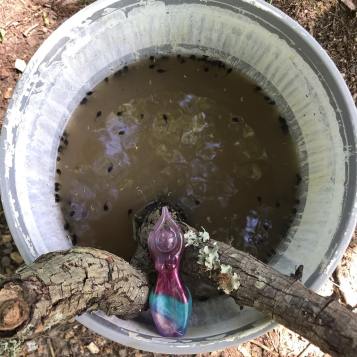
Rescue tadpoles from the evaporating puddle
in the driveway.
Look for pink roses in the field.
Look for wild strawberries
along the road.
Listen to the crows in
the compost pile
and try to identify them
by their different voices.
Plant basil and calendula
and a few more rows of lettuce.
Examine the buds beginning
on the elderberries
and check blackberry canes
to see if the berries have set.
Watch the yellow swallowtail butterflies dance.
Wonder about action and apathy
and what bridges gaps.
Refuse to surrender belief in joy.
Listen for faint echoes of hope.
Feel the tender beat of humanity
pulsing in the world.
Feel the sun on your face
and water seeping
into your jeans.
Remember that even if you have to
move one tadpole at a time,
change is always possible.
It is easy to become exhausted and overwhelmed by the volume of things there are to say, the things there are to think about, to care about, to put energy into, to love, to be outraged about. I want to invite you, at the moment of this reading, to breathe it out, to let yourself come into your body right where you are this second, and put one hand on your heart and one hand on your belly. Remind yourself that you’re whole right here, right now. There is suffering and there is fear and there is pain and there is joy and there is beauty and there is life, and we can hold it all. Let yourself settle and feel, present in this moment, in this unfolding. And, with whatever you feel, whether you feel hopeless or joyful or angry or happy or thrilled or enthusiastic or creative or drained, whatever it is, with your hand on your heart, accept those feelings as okay right now: how you feel, is how you feel; where you are, is where you are; who you are, is who you are. Continue reading “Nourishing Wholeness in a Fractured World, by Molly Remer”
Today, I bring you an old old story from Scotland. It explains how and why winter became spring. Cailleach is another name for the Hag – the archetypal Crone. She represents winter. Brigit is the forever Maiden and stands for spring. There are many ways to spell her name, all of them correct. Ben Nevis is a mountain in Scotland and the word bairns means “babies”.
It’s always important to remember that myths come to us through retellings by countless bards and storytellers. They are layered one on top of the other like palimpsests and sometimes appear contradictory. I think of stories- particularly the ones who have existed for millennia as three-dimensional puzzles to be slowly played with and unlocked in increments. Furthermore, what we see and hear in a story means different things to us at different times and circumstances. There is always something new to be gleaned. Continue reading “Brigit and the Cailleach by Christine Irving”



 — for Alex, a nurse I met who is also a poet, and all nurses
 Today, I bring you an old old story from Scotland. It explains how and why winter became spring.
  Feminism and Religion