The Brass Tacks of the Trump Impeachment by Anjeanette LeBoeuf

AnjeanetteFrom the very moment after the dust settled from the 2016 elections, notions of impeachment started to break. Now three years into the Trump Presidency, impeachment proceedings have been launched. To start, Impeachment is a Constitutionally supported right. It is an element of the “Checks and Balances” system to ensure that no one branch of the government holds too much power. Instigating impeachment processes is not treason, nor is it unpatriotic – it is a testament to the democratic procedures established by the founding fathers and maintained for the last 230 years.

Continue reading “The Brass Tacks of the Trump Impeachment by Anjeanette LeBoeuf”

Metamorphosis and a Press Conference: A Kafkaesque and Shakespearean Fantasy about an Unreal Individual by Barbara Ardinger

Donald wakes up too early. Feeling confused and disoriented, he looks around the room. His bed has disappeared! He seems to be lying on the floor. Why? he asks himself, how’d I fall off my king-size bed? The floor (uncarpeted??) seems to go on around him forever, sans furniture, sans TVs, sans his solid gold toilet, sans even the doors and windows. It’s all a great big blank. All around him. Where am I? he asks himself.

He had disturbing dreams all night, and not just last night, but for…well, awhile. Since the subpoenas. He keeps seeing big, strong, silent men wearing jackets with initials on the back carrying big boxes out of his various offices. All of them. All over the world. In one repeating dream, a man dropped a box. It fell open, scattering papers filled with names and numbers. The men picked everything up, put the papers back in chronological order, and resealed the box. They kept carrying the boxes out to black vans that didn’t have names painted on them.

Continue reading “Metamorphosis and a Press Conference: A Kafkaesque and Shakespearean Fantasy about an Unreal Individual by Barbara Ardinger”

I’m That Trump Voter You Hate by Trelawney Grenfell-Muir

There are people in my family who believe Christianity to be so inherently oppressive and harmful, that anyone who identifies as Christian is culpable for all of the harm done by all imperial colonization by Christian empires and nations, all harm done to Native Americans, to LGBTQ people, most slavery, racism, genocide, ecocide, and basically almost every problem the world has had for 2000 years.

Theirs is not an unusual view. I encounter this view regularly here in the Northeast US, though most people assign the blame to religion in general. For parts of my family, Christianity is the true evil because it was so popular, and thus the religion most commonly tied to violent and oppressive political leaders and structures.

I also encounter this attitude from feminists, quite frequently. According to many feminists, I am everything that is anti-feminist and misogynist… precisely, solely because I am Christian.

Continue reading “I’m That Trump Voter You Hate by Trelawney Grenfell-Muir”

#GunControlNow: While We Still Have Now by Marie Cartier

If you are somewhere:
a movie theater, festival, mosque,
temple or church, bar (especially a gay one although it could be any bar –cheers),
concert, elementary to college classroom, or any other public space in America…and
someone starts shooting,
shooting so fast the bullets spray like
a hose of water —
spray so fast you can’t know where to duck.
if you are somewhere and that happens…
Re-member yourself as a hero:
hide the children, if there are children
cover the babies, if there are babies
lock the doors, if there are doors.
Try to make it out alive.

Continue reading “#GunControlNow: While We Still Have Now by Marie Cartier”

The Berlin Wall—what did the US learn? by Marie Cartier

I am writing this from Berlin. I am here for two weeks for the ALMS conference entitled, “Queering Memory.” Berlin is a city of such memory. You walk the streets and there are small brass plaques in the sidewalk in front of you memorializing Jews that were deported who lived in the residence. Everywhere there is memory of war, and hope.
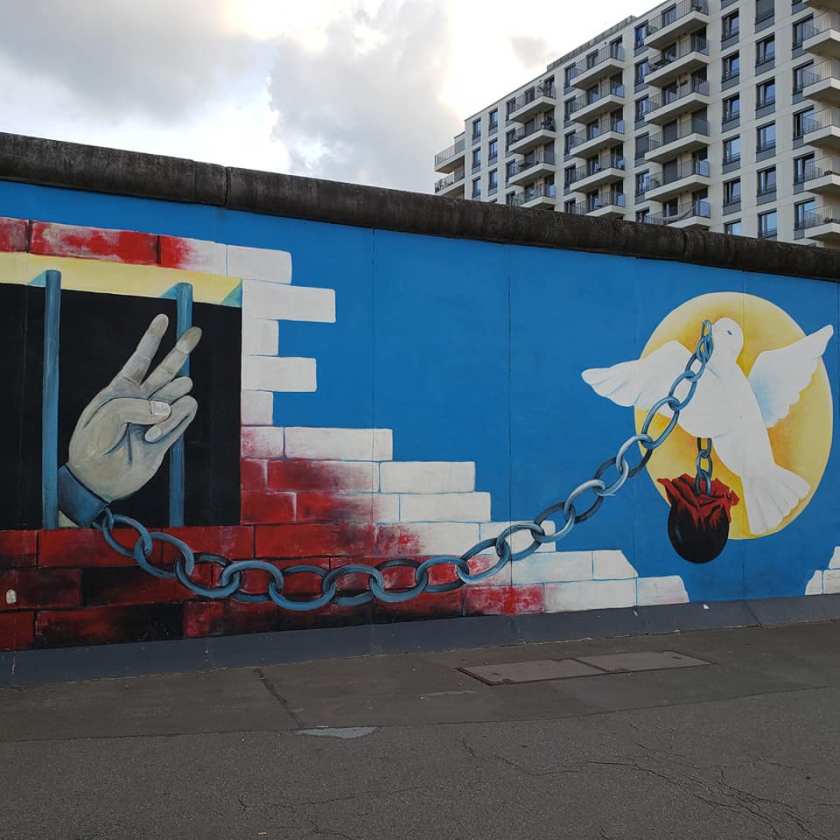
For me, perhaps the most visible symbol is the wall. The Berlin wall was in place from 1961-1989. When it fell, the East Side which had been closed off for decades, burst into freedom, as evidenced by the images on the east side of the wall, at the East Side Gallery – an open air mural gallery painted directly on that side of the wall.

Continue reading “The Berlin Wall—what did the US learn? by Marie Cartier”

We Won’t Go Back by John Erickson

Bottom line: abortion is healthcare. Nearly a fourth of women in America will have an abortion by age 45. Every day, people across the United States make deeply personal decisions about their pregnancies. Those decisions deserve respect.

Someone once asked me: John, why are you a feminist?  It is always a jarring question because I believe all people should be feminists and we should all fight for gender equality no matter what.  I’ve been drawn to Martin Niemöller’s prolific quote:
First they came for the socialists, and I did not speak out—because I was not a socialist.
Then they came for the trade unionists, and I did not speak out— because I was not a trade unionist.
Then they came for the Jews, and I did not speak out—because I was not a Jew.
Then they came for me—and there was no one left to speak for me.

Right now, it seems like a full on frontal assault against all of us.  No matter what community you’re in, you can draw back to an instance of discrimination you’ve faced both pre-2016 as well as after the election of President Trump. Continue reading “We Won’t Go Back by John Erickson”

Falling Down and Going Under by Sara Wright

I have been traveling across country during the past week from New Mexico to Maine, leaving one “home” for another wondering what the word even means for me these days. I suspect the word doesn’t refer to a place, but a state of mind/body that continues to elude me.

In a forested glen in Virginia I first heard the cardinals singing from the trees and smelled fragrant mounds of trailing honeysuckle that cascaded over every bush and lichened granite stone. For a while I seemed unable to soak in enough of the fully leafed out deciduous trees – trees dressed in miraculous shades of lime, deepening to dark spruce. My endless hunger for emerald green was finally appeased by endless rolling hills and blue tipped mountains. Continue reading “Falling Down and Going Under by Sara Wright”

Marianne Williamson. . . I’m Sacredly Smitten by Elisabeth Schilling

I caution myself to be critical and nuanced. I’m sorry, folks. I just haven’t had such dazzling hope or remote interest in politics since. . . well, since I was a puppet junior high evangelist for an independent candidate my Dad liked, and I don’t want to try to remember who it was. But I was 13. And I’m 38 now. What hath made this cold, indifferent, anxious millennial’s soul to warm?

I am into mindfulness, contemplative studies, Eckhart Tolle, Don Miguel Ruiz, Nhat Thich Hanh, the kind of comparative religious studies scholar who has eastern spirituality leanings, so when I heard Marianne Williamson was a presidential candidate, I got curious. I’ve not read A Course in Miracles (although I think I’ve avoided it for the same assumptions Williamson says she initially made) or actually any of her books. Williamson is Jewish and has a pluralistic perspective when it comes to noting the basic underlying wisdom of all religious and spiritual beliefs (I realize we have discussed this before when I called them “wisdom traditions” – is any tradition actually wise/can you separate the violence, oppressions, and misogynies of them?).

She speaks in cool, rushing waters and has a platform that still sounds “political”/political (she breaks down what this word actually means in her latest CNN Town Hall) and is spiritual and based in a rhetoric of love. After the complete loss of hope in what [T . .] represents, and the not-yet healed wounds from [B. . .], she sounds like a reasonable adult, much like Obama did during his years. I wonder if they are friends? They should be.

Continue reading “Marianne Williamson. . . I’m Sacredly Smitten by Elisabeth Schilling”

A Letter to Senator Feinstein by Sarah Robinson-Bertoni

Dear Senator Feinstein,

I distinctly remember celebrating the 1992 historic victory when you and Barbara Boxer were elected as the first female Senatorial duo from any state in the union.  My father brought my sister and me to an election party that evening at Gaia bookstore in Berkeley to watch the results trickle in.  We literally jumped for joy, proud that California could lead the nation in recognizing the full capacity of women to legislate effectively and to send you to Washington.  I never doubted that you would endeavor to represent me even though I was too young at that time to cast my own vote.

I am troubled by the recent media splash that showed your response to young people, who are rightly concerned about their own ability to have a future, represented in their intent to convince you to support the Green New Deal.  At a certain level, it doesn’t matter what name is on the legislation, but what does matter is the content.  Empirical reality, though undeniable in nearly the rest of the world, has been stymied here in the U.S. by those who profit from doubt and confusion.  It is time for more active leadership in government and business to steer away from the shore before the ship of civilization runs aground.

Continue reading “A Letter to Senator Feinstein by Sarah Robinson-Bertoni”

The Modern Problematic Nature of the Sabarimala Temple, Part 2 by Anjeanette LeBoeuf

AnjeanetteThe Sabarimala Temple has received an influx of global attention since last October. In my last FAR post, I researched the origin story of the Sabarimala Temple and its dedicated deity, Ayyappan. Ayyappan’s unusual parentage and chosen attributes and patronage made him adverse to all forms of sexual activity and more importantly, not very keen in having female devotees.

Ayyappan, also known as Dharmasastha, is devoted to protecting the dharma, living a yogic life, and more importantly, a celibate life. Ayyappan demands that all his followers when undertaking his pilgrimage, take a vow of celibacy for the duration. No form of sexual impurity must enter Ayyappan’s Sabarimala temple. This is where the problematic elements really start to come to head. Due to the restriction of sexual impurities, females from the age of 10-50 are denied access, as their very biological state of being female, makes them sexually impure. Their ability to menstruate makes them vessels of this apparent sexual impurity that the god Ayyappan does not want. Continue reading “The Modern Problematic Nature of the Sabarimala Temple, Part 2 by Anjeanette LeBoeuf”