

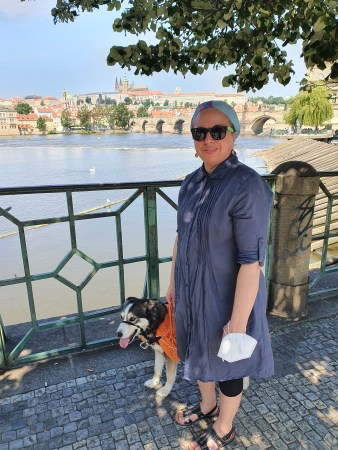
 This month more than most, I feel like I have so much to say that I don’t really know where to begin. It doesn’t help that next door they are remodelling an apartment and, outside my window, there is a crew drilling up the sidewalk and another roofing the house across the street. The noise and its echoing are overwhelming on Prague’s narrow streets.
Perhaps the best place to start is with a similarly loud occurrence. On June 27th, Prague commemorated the 70th anniversary of the execution of Milada Horáková using the city-wide intercom system. Minute-long excerpts from her trial and execution were broadcast throughout the day. Horáková, the only woman to be executed during the Communist regime in Czechoslovakia, was a long-time proponent of democracy and women’s rights. In the field of women’s rights, she focused on the status of women and children, spending considerable effort on women in the workplace and reconciling their work with family responsibilities. She was also an outspoken critic of the Nazi Regime, having spent time as a political prisoner in Terezin. When the war ended, she joined parliament, but resigned right after the communist take-over. After continuing to speak out against the Communists, she was arrested in September of 1949 and charged with attempting to overthrown the government. She along with 12 others were interrogated and tried. Four of them, including Horáková were sentenced to death. She was publicly hanged on the 27th of June 1950. Eighteen long years later, she was posthumously exonerated, and in 2000, the Czech Republic unveiled a commemorative tombstone for her in the National Cemetery at Vyšehrad Castle. In 2017, a film was made about her life and legacy. Continue reading “Listening to the Noise: The Connections between Milada Horáková, Anti-Semitism, and the Black Lives Matter Movement by Ivy Helman.”
 A few years ago, I visited the family farm founded by ancestors from Germany in the Pokonos with a newly discovered cousin. The woman I met was delightful: warm and friendly and very much connected to family still living in the area. Her mother had vivid memories of the farm. In contrast, my great-grandmother left home to marry in Brooklyn. My father had fond memories of visiting the farm as a child, but lost touch with the relatives there when his family moved to California in the 1930s.
 A lof of people have been raving about the Superbowl Halftime show, and for good reasons.
 In a recent post I wrote about
 Like many of you I have been following discussions of the revelation that Virginia Governor Ralph Northam dressed in blackface or as a member of the Ku Klux Klan when he was a medical student. It was reported that Northam was earlier known as “coonman,” an epithet which suggests that he had blackened his face more than once. His later admission that he put only a little bit of black shoe polish on his face because it is hard to get off, when he dressed up as Michael Jackson, seems to confirm that blackface was something he had tried before. There was also the fact that students had been asked by the yearbook committee to submit photographs for their pages: Northam did not say if he submitted the photographs on his page.
 Governor Ralph Northam, a Democrat in the state of Virginia, has many people calling for his resignation after a picture from a 1984 medical school yearbook surfaced showing what some people assert to be Northam wearing blackface or a KKK costume. (Northam insists he is neither one of the people in the photograph and he, as I write this, vows to fulfill his term in office.)
  One of my Facebook friends, a young woman academic, recently posed a question, inviting discussion. (I’ve abbreviated her post for the sake of space.)
 Feminism and Religion