Painting Sojourner Truth By Angela Yarber

This month, I am reminded of the importance of Jacquelyn Grant’s work on womanist Christology.  In White Women’s Christ and Black Women’s Jesus, Grant reviews the white feminist discussion of the so-called problem of Jesus’ maleness, while beginning to construct a womanist response to this incarnational conundrum.  She states, “It is my claim that there is a direct relationship between our perception of Jesus and our perception of ourselves.”[1]

Beginning with Mary Daly, feminists have responded to Jesus’ maleness in a variety of ways.  Daly argues that because the person of Jesus is male, the male is recognized and celebrated as the superior being.  Because of this, the male Jesus is to be rejected or exorcised because Jesus’ gender identity contributes to patriarchy and does not hold salvific power for women.  Rather than rejecting Jesus altogether, Rosemary Radford Ruether asks the seminal question, “Can a male Jesus save woman?” Continue reading “Painting Sojourner Truth By Angela Yarber”

The Joy of Honoring Rosemary Radford Ruether by Dirk von der Horst

DirkA cutting-edge voice in many theological conversations, Rosemary Radford Ruether has been an inspiration to many of us over the last few decades.  The tremendous joy of my last couple of years was co-editing a volume of essays in her honor.  Even discovering just how dreary indexing is was a labor of love for a true pioneer in feminist theology.  The result: Voices of Feminist Liberation: Writings in Celebration of Rosemary Radford Ruether, a collection of fourteen essays by Ruether’s doctoral students, put together by Emily Leah Silverman and Whitney Bauman, along with myself.

Voices of Feminist Liberation documents the current state of her impact and legacy.  The richness of her thought is manifest here in the variety of directions her students have taken her insights.  While most of the essays are scholarly works that engage her ideas above all else, some essays have more personal recollections.  Rosemary’s preface recounts her personal experiences of and with us, with descriptions of incidents from her relationships ranging from hearing a live-in student coming down the hall to slip a paper under the door, to seeing a student’s dissertation prospectus enrage a committee member, to switching from same-sex hand-holding in Palestine to male-female hand-holding in Israel as a small gesture of recognizing cultural difference. Continue reading “The Joy of Honoring Rosemary Radford Ruether by Dirk von der Horst”

We Are All Earthings: Speciesism and Feminist Responsibility Toward Animals by Amy Levin

Amy2“earth’ling: n. One who inhabits the earth.” – Earthlings, 2006

“We need another and a wiser and perhaps a more mystical concept of animals. Remote from universal nature, and living by complicated artifice, man in civilization surveys the creatures through the glass of his knowledge and sees thereby a feather magnified and the whole image in distortion.” -Henry Beston, The Outermost House

I was passing out leaflets at Columbia University a couple weeks back, when a passerby who took a pamphlet on veganism and the cruel uses of animals turned back around to approach me. He said, “I am a vegetarian, so I understand not eating meat. But what is wrong with some of the uses of these animals? What is wrong with seeing eye dogs?”  A valid question indeed, and one I had to pause for a moment to answer. I mustered up something along the lines of the ways that many of the seeing eye dogs in the industry are unfairly treated or neglected. “Oh, he said.” He seemed content with an answer he could relate to – suffering. In my experience leafleting and participating in animal rights advocacy, I receive a number of questions, many of them wanting to know the same thing, what is WRONG with the horse-drawn carriages at Central Park? And each time I (and I presume many other activists) offer similar answers, the suffering answer. But there is another layer, beyond the quick, violent spark of imagination that connects physical pain with empathy. And it has to do with power and structural inequality, and the use of one group for the benefit of another. And it has everything to do with feminism. Continue reading “We Are All Earthings: Speciesism and Feminist Responsibility Toward Animals by Amy Levin”

Catholic Feminists Meet, Strategize by Rosemary Radford Ruether and Theresa Yugar

During July 8-11, 2012 twenty Catholic feminist leaders met in a retreat center near Baltimore to discuss their concerns and hopes in the light of the recent and ongoing attacks of Catholic bishops on women and especially on feminist work in the church. The group consisted of representatives from many sectors of Catholic institutions and movements.  There were the founders of a peace and justice movement of the Sisters of Charity and the Institute for Communal Contemplation and Action. There was a pastor and leadership trainer from an alternative parish and a writer for the National Catholic Reporter.

Many in the group were professors of theology or ethics at Catholic, Protestant or state schools. Among them were teachers at Whittier College, Claremont School of Theology, Santa Clara University and San Jose University in California, Loyola University in Chicago, St. Catherine in Minnesota, Drew University in New Jersey and Boston College. Catholic reform movements were well represented, with leaders from Dignity, the Women’s Ordination Conference, Call to Action and RomanCatholicWomenPriests. There was a teacher at Marymount School in New York City, the President of Marymount School in Los Angeles and a doctoral student in theology. Continue reading “Catholic Feminists Meet, Strategize by Rosemary Radford Ruether and Theresa Yugar”

The Sainthood of Hildegard von Bingen by a Feminist-Friendly Pope? by Cynthia Garrity-Bond

While I celebrate the rise in status of Hildegard to official saint and soon to be Doctor of the Church, I cannot help but be suspicious of the Vatican’s motivations.  One only has to take in the last two months behavior of the CDF, sanctioned by Pope Benedict, to see the real intentions of this papacy—the continued subjugation of all women to clerical authority.

The past month or so has been a very busy time for the Congregation for the Doctrine of Faith or CDF and their examination of women. First they (and this includes Pope Benedict XVI) decided American nuns are guilty of the sin of silence by not speaking out on abortion & homosexuality.  Their “radical feminist” ideology of standing with the poor and disenfranchised, while good, is not good enough for the CDF.  The firestorm of solidarity coming from both laity and religious surely caught the Vatican off guard.  Right?  Well, not quite.  This past week the CDF began its investigation of the Girl Scouts for their purported association with the likes of Planned Parenthood and Oxfam.  While both address the needs of the poor, it is the latter and its troubling advocacy for safe sex via condom use that initiated the inquiry. Keep in mine that in 2010 Pope Benedict retracted from his earlier position and bane on condoms, seeing instead their use as a “lesser evil” in the fight against HIV/AIDS.  The CDF angst is that the message of condom use might be too much sex-talk for impressionable young women.  Continue reading “The Sainthood of Hildegard von Bingen by a Feminist-Friendly Pope? by Cynthia Garrity-Bond”

Do Man-Made Laws Trump the Authority of Jesus? Reflecting on the Meaning of Humility, Priestly Service, and the Issue of Women’s Ordination by Michele Stopera Freyhauf

Maundy Thursday – the imitation of Jesus’ act of service and submission is re-created.  Controversy surrounds the “disciples” – must they be all men?  Are women allowed?  Who steps into Jesus’ role?  Men, women, or both?  Why, when it comes to imitating the act of  humility and priestly service (rooted in our baptismal call), does a distinction of gender need to made at all?

As I progressed towards the intersection, I looked up to witness a grand procession of men dressed in white albs with stoles that often contained subtle hints of gold, worn in a manner to distinguish their role as priests and deacons.  They moved slowly down the sidewalk entering the Cathedral to begin their celebration of the Chrism Mass – a celebration of priesthood and priestly service within the Diocese where all priests and deacons gather to celebrate and re-affirm their commitment to ministry and service to the Church.  It is also during this Mass that the oils used in sacramental celebrations, used by each church, are blessed by the Bishop.

As I continued to watch, I could not help but search the processional line for those with a hair color other than gray.  I wanted to see  how many young priests were in that processional line.  What I found was no surprise –  an aging group of men with the sporadic appearance of younger priests.   The numbers stood as a staunch reminder that we, as a Church, may be faced with a severe shortage of priests in the future.  Something already known and planned for by the Diocese in its campaign to consolidate and close parishes.

Another sad observation was put on public display  –  the absolute absence of women. Continue reading “Do Man-Made Laws Trump the Authority of Jesus? Reflecting on the Meaning of Humility, Priestly Service, and the Issue of Women’s Ordination by Michele Stopera Freyhauf”

Feminism In Theology By Andrew Tripp

At the outset, I need to name and own my identities as a large white male. I have privilege and voice that makes me hesitant to even write to the audience of this blog. While I consider myself a feminist, I have met some who have told me that as a man I cannot be a feminist. Such folks have told me that I lack the existential knowledge of the systemic pressure put on women, and at best I can be an ally.  With that said, if it was not for feminism in theology, I do not know if I could be a theologian.

When I first began attending church as an adult, I went because I hungered for community, for authentic relationships. My tradition has more female clergy than male clergy, and like many churches, the mothers of the church often have been the true leaders. The church I grew up in had a female board president, a female pastor, and I grew up assuming female leadership was part of religious life. For me, religion was about community and I was far more certain of my salvation through community and relationships than with any kind of doctrinal stance. Then I came to seminary, and saw just how different my experience had been from most folks. Classmates were part of traditions that might ordain women, but wouldn’t provide them with the opportunity for prestigious positions. Professors made blatantly sexist comments, and this was in a “liberal” school. Continue reading “Feminism In Theology By Andrew Tripp”

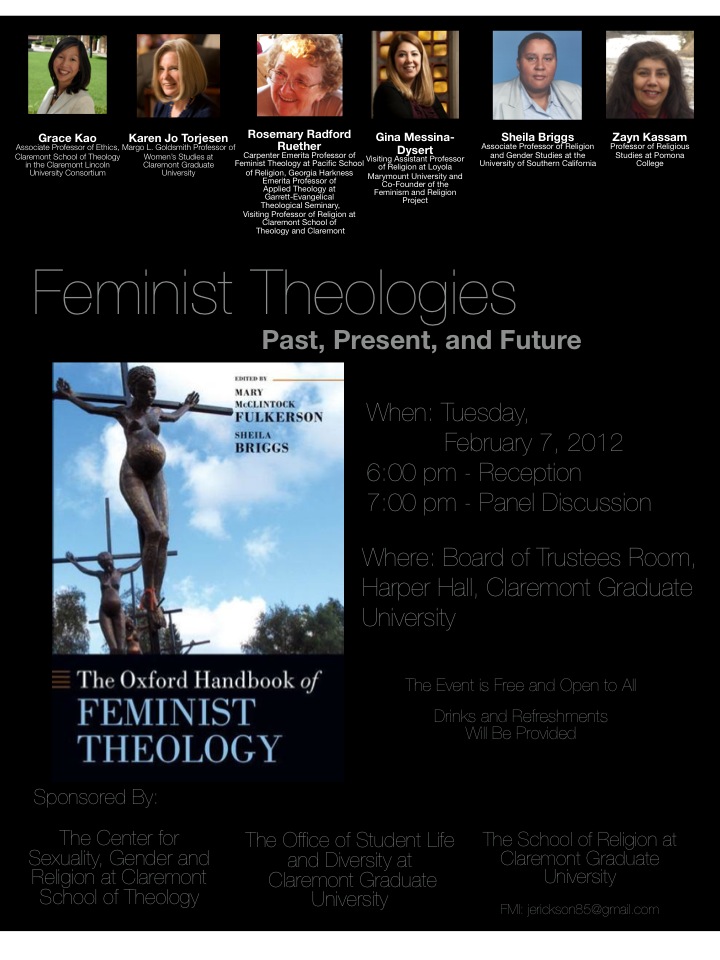
Feminist Theologies: Past, Present, and Future

On February 7, 2012, a panel discussion focused on the past, present, and future of feminist theologies took place at Claremont Graduate University to celebrate the release of TheOxford Handbook on Feminist Theology.  The panel was organized by John Erickson, moderated by Grace Kao, and featured Karen Torjesen, Rosemary Radford Ruether, Gina Messina-Dysert, Zayne Kassam, and Sheila Briggs as presenters.  What resulted was a terrific discussion about women, religion, and feminist theologies.  Many were in attendance and participated in the panel; for those who were unable to attend, here is a video of the presentations from that evening.  We look forward to you sharing your thoughts and comments about the past, present, and future of feminist theologies.

Pushing Boundaries: Learning to be a Reformer By Jared Vázquez

When I consider the role of women in the social reforms of the late 19th century and early 20th century, I am struck by the boldness of those women in a society that is often essentialized as a quintessential model of patriarchy where all the women were too busy swooning under the pressure of corsets into the hands of handsome gentleman callers. But if we take the time to read closely about what activist women did during the late 19th century I believe that it becomes apparent that they developed much of the model by which we not only operate but also judge social reform; those reforming women set the standard by which we measure change. The reforming women of the 19th and 20th centuries altered the landscape of theU.S.in the way that they challenged the status quo of acceptability for the roles that women could play, both in the home and in public, and in the way that they challenged normative gender roles. In these we not only see the impact that was affected on their own societies, but also the legacy that has guided and continues to guide women and men who work for social reform today.

The women of that era challenged gender roles in various ways, in both public and less public ways. Utopian orders, for instance, that began to form in the mid 19th century were not only founded by women, like the Shakers, but were also directed by them and women enjoyed equal status with men in all affairs. The Salvation Army is another group in which women reinterpreted ‘womanly’ behavior in order to advance what they saw as their call to mission and evangelizing  and took to the streets, going into areas that were “unsuitable” for women. The reforming women of the second half of the 19th century were boldly questioning and challenging the notions of social ordering that dictated the ways in which women were “allowed” to behave. Reading the contemporary responses of non-Protestant faiths in the ways that they sought to “properly feminize” their own female membership gives clues to the level to which the challenge on gender roles had reached. Continue reading “Pushing Boundaries: Learning to be a Reformer By Jared Vázquez”

The Undoing of Patriarchy in the Life of Tom Jorde (1922-2011)

Last week I attended the funeral of the one man, who in my feminist musings, was able to image the maleness of God as father, friend and pastor.  If I had thought about it, I would have given him the T-shirt that reads, “This is What a Feminist Looks Like,” but it never occurred to me until now.

A successful sales manager, Tom decided at the age of 36, and with 6 young children, to enter full-time ministry by enrolling in Pacific Lutheran Seminary at the GTU (in Berkeley).  Imagine undertaking an MDIV degree with that kind of responsibility?  As the adage states, “It takes a village,” and it did.  Marie, Tom’s wife, took charge of the kids while his four brothers help support him until his graduation in 1965.  Continue reading “The Undoing of Patriarchy in the Life of Tom Jorde (1922-2011)”