A Christian Response to Racism, Sexism, & the Rise of American Terrorism by Trelawney Grenfell-Muir

Trelawney bio pictureAs our country reels in horror at the brutal massacre of nine worshipers at Emanuel African Methodist Episcopal Church, one particularly important detail has emerged: the young man who killed those nine people entered the world of white supremacism after the object of his romantic interest rejected him and dated a black man.

According to his cousin, the experience dramatically changed the young man, led to his obsession with racist hatred, and motivated him to commit the atrocity. In some ways, the event resembles the 2014 Santa Barbara massacre, in which a young white man with strong racist tendencies massacred young women because he felt angry that women generally did not respond favorably to his romantic advances. Other mass murderers have also exhibited violent misogyny. Moreover, our country has begun to notice that most mass shootings are carried out by white males, and to point out that white masculinity may lead young men into feeling like failures if they do not achieve all the trappings of their supposedly superior race and gender identity.

My questions are: how did we, as a society, fail these young men? And how have we, as a church, failed society? And, most important, how can we help heal these diseases that are killing us? Continue reading “A Christian Response to Racism, Sexism, & the Rise of American Terrorism by Trelawney Grenfell-Muir”

My Fanime Exploration of Fan Fiction—Questions of Consent and Erotic Expression

Sara FrykenbergEvery year, my husband, sister and I attend the Japanese animation convention Fanimecon in San Jose, CA. We cosplay, watch anime and peruse the various panels designed for fan entertainment and education. This year I was even lucky enough to be interviewed for the student film Unconventional, about cosplay culture, which you can check out following the link above!

Since I can’t (and don’t want to) leave my feminist lens at home, I often seek out the panels that address issues of representation, gender, diversity and sexuality when attending this conference; and usually, the con does not disappoint. Here are some examples of the panels hosted at Fanimecon in the past three years: Continue reading “My Fanime Exploration of Fan Fiction—Questions of Consent and Erotic Expression”

Miley Cyrus and the Happy Hippie Foundation by Deanne Quarrie

Deanne Quarrie, D.Min.I almost got in a big fight with my son on Facebook yesterday. I posted a link to an article talking about the work that Miley Cyrus is doing for homeless teenagers. He immediately responded to my post by calling her a “skanky-ho.” Whoa!

I feel I need to do some qualifying here for a moment. I am not always a comfortable when I watch her performances. I am sure it is my age (73) and coming up in a far different time and mindset from what we have now. I feel a bit embarrassed watching some of her movements that have been labeled lewd by many and clearly so by my son on Facebook. I try very hard to not be judgmental or to place negative labels on anyone just because I may not always enjoy what they do. I do recognize that our perceptions are driven by our religious beliefs, our cultural backgrounds and our own inhibitions. I have to confess, I am even a bit jealous that she can be so open with her own sexuality in such a public way. I can tell you, however, I really like her voice and see her as an amazing performer! Continue reading “Miley Cyrus and the Happy Hippie Foundation by Deanne Quarrie”

The Difficult Issue of the Origins of the Buddhist Nuns’ Order by Oxana Poberejnaia

oxanaThe origins of the Buddhist Nuns ‘ Order are a contentious issue in Theravada Buddhism. Paradoxically, it is also the issue that is not discussed a lot. Which is surprising, as in current Buddhism there is a gaping hole where a Theravada Bhikkhuni (Nuns) community should be. The prevailing view is that the nuns’ full ordination line was irrevocably lost long in the past and cannot be restored.

There are separate attempts here and there to bring Theravada Nuns’ Order back, including Ajahn Brahm’s ordaining a group of nuns in Dhammasara Monastery in Australia in 2009. This resulted in severe criticism by some Theravada religious leaders and expulsion of Ajahn Brahm and the monastery he leads from the organisation of the Sangha of Wat Nong Pah Pong.

AniPemaChodronMahayana Nuns receive full ordination, as it is considered that historically the Order did not lose continuity since the Buddha’s times. However, for both Theravada and Mahayana something called “The Eight Garudhammas” – the eight heavy rules – remain a painful issue. These are the rules that the historical Buddha is supposed to have given the first nuns to whom he gave ordination. These eight rules were the condition on which the Buddha would even allow women to become Bhikkhuni.

Continue reading “The Difficult Issue of the Origins of the Buddhist Nuns’ Order by Oxana Poberejnaia”

Islamic Feminism, Body Autonomy and Spiritual Liberation by Vanessa Rivera de la Fuente

Vanessa Rivera de la Fuente. Women and Body AutonomyWomen’s bodies are the preferred territory in which religious oppression becomes cruelly evident. Misogynist narratives in religions are always addressed to them: decency, honor, virtue, holiness, discretion, and shame are embodied in us, We pay for the absence of these patriarchal principles of control, on our bodies too: imprisonment, slut-shamming, bullying, rape, punishment, mutilation, and death.

Feminism makes sense in this world because women allow their struggles to push the boundaries that have been imposed on us by patriarchy, on our minds, spirits and bodies. The right to decide issues concerning our bodies is not only linked to reproductive rights and planning parenthood, but also to the experience of sexuality on the terms we freely decide and the way we interact with our body and relate to it. Freeing women from the traditions’ narratives of oppression accumulated over hundreds of years and designed to indoctrinate a hatred against our bodies is one of the purposes of feminism, including the work of feminists inside those religious traditions. If I have no right to my body, then I have no right to anything. A God who considers me free and worthy, but allows others to decide how I should embody that worth and that freedom is not a God of justice and equality at all.

Continue reading “Islamic Feminism, Body Autonomy and Spiritual Liberation by Vanessa Rivera de la Fuente”

Operating out of the Good: Interpersonal Interactions and Oppression by Ivy Helman

How humans treat one another matters.  Oppression is not only systematic; it is also personal because humans reproduce societal forms of oppression in interpersonal relationships.   Take sexism for example. Sexism, at its worst, manifests itself in intimate relationships through physical abuse, emotional violence, mental manipulation and/or controlling behavior.

This isn’t the only of form of interpersonal oppression that exists between humans.  Humans oppress one another in many subtle (and not so subtle) but equally harmful ways.  For instance, there are also racist remarks and sexual harassment.  Yet, that’s not what I want I want to focus on here.  Instead, I want to look at interpersonal forms of oppression in which agents often believe themselves to be an agent of the good.

Let’s probe two examples.  As the reader will see, each example has its own motivating factor, its own concept of “the good” and at least one oppressive outcome. I believe all of these agents think they are doing what is best for another person and do not necessarily understand the ways in which they are reproducing oppression. If they did, I’m pretty sure they’d modify their behavior, or at least I hope they would.

Example #1

Last month I wrote about a job that I quit because they were so critical of me that I felt like nothing I did was ever good enough.  They treated everyone, regardless of experience, exactly the same.  More than that, the way in which I was made to feel completely inept at teaching dragged down not only my opinion of myself but upped my level of stress as I tried in vain to do better in their eyes.  After months of constant criticism and a poignant discussion with a colleague, I realized that nothing I did would change the system. Likewise, my evaluations would continue to focus on the negative and write off the positive. The corporate culture valued, encouraged and systematized multiple forms of critique with the assumption that this system produced better teachers and better experiences in general. They even had “satisfaction surveys” at their holiday party.  Who does that?empty-exam-hall

Clearly, the company operated out of the assumption that their method of consistently negative feedback motivated people to fix their mistakes. Rather, it inculcated high levels of stress, constant second guessing and poor self-esteem. That’s why it is oppressive. While it motivated me temporarily (I gave my three-week notice after three months of trying to do better in their eyes), no one can operate within that system for long. It is no wonder their turnover rate is so high. I can think of a million other ways to create better teachers.

Example #2

Two weeks ago, I experienced the worst vertigo in my life. I’m not one to rush to a doctor at the drop of a hat so for me to spend the day in the emergency room, something is wrong. Yet, my treatment here in Prague was awful. In the end, I went to three different hospitals before I was seen. The first nurse we went to turned me away saying I wasn’t bleeding and the doctor would not help me. Another office within the hospital took my insurance card and my passport about ten minutes after I arrived. After an hour of waiting, and watching the staff struggle with a patient seizing and puking up blood in the hallway of the treatment area, I was told that it would be hours before I would be seen. I was the only patient in the waiting room. The doctor told me that she did not consider my symptoms to be an emergency and that she was there to help the emergencies. What made matters worse was that she made it clear that she wasn’t going to treat me until she was sure no other emergencies would arrive. How can one be sure no other emergencies would arrive? Clearly, that would never happen. She literally said, “While I can’t technically turn you away, I want you to know you will be waiting a long time.” She was turning me away the only way she could by making me the last patient to receive treatment.

stethoscope-23441288983461x1ZClearly, the doctor felt stressed and overwhelmed. She was trying the best she could. Her concept of the good was to help only those patients she considered to be emergency cases. Yet, she also was extremely quick to judge how she thought I was feeling and made me feel that my experience was insignificant. Rather than value my experience and take what I was saying seriously, she behaved oppressively. Yet, to me, the worst part of the treatment was her telling me that if she could, she would turn me away. I’m speechless.

***

Because of these experiences I’ve spent a lot of time thinking about how we treat each other and the ways in which our behavior replicates societal oppression. What bothers me the most is that these people thought that they were acting within the framework of the good. I’ve been wondering whether their definition of the good is wrong. If it is not, then why is their behavior, motivated by a definition of the good, not actually doing good? How could behavior be modified to better align with definitions of the good?

In both of the examples above, I would say that their intentions within their understanding of the good are generally correct (creating better teachers and helping emergency cases first when swamped), but it is the way they are put into practice that produces oppressive behavior. Here, analysis of individual interactions and experiences needs to be assessed as well as corporate models that require certain interactions. Is there a way to do so outside of individual human initiative? From where does the motivation come? Do I, the receiver of poor treatment, have the moral responsibility to call them out on their actions?

I’m not sure how to answer these questions. On the one hand, I believe that they may not be aware of the ways in which their behavior oppresses others, so I should speak up. Yet, on the other hand, people who behave oppressively need to take responsibility for their behavior.

What I am sure about is this: humans often oppress others even when they act out of a common definition of the good. Yet, operating out of the good requires that all of our interactions create experiences that are liberating and life affirming. Failing to do so only replicates oppression. Humanity has a long way to go.

Are You Ready for Some Football? by John Erickson

Although putting women in charge of drafting new policies that address the “woman problem” currently facing the NFL, it too reeks of the similar dismissive and patronizing actions women face when trying to obtain leadership roles in their religious traditions. Supercilious progress for the sake of progress isn’t progress and progress under the guise of silence is still misogyny. We need women in positions of leadership in both the NFL as well as in religious traditions. The culture of violence and silence will only continue, albeit with a Band-Aid firmly in place, holding the painful experiences and histories of women, long forgotten and often overlooked, until society values their rights just as much as the men leading the prayers and those that are being prayed for on Sundays across America.

John Erickson, sports, coming out.There is never a reason for physical violence.  There is never a reason to hit your partner or child to the point where they are unconscious or bruised.  There is never a reason to inflict violence against someone else, but apparently there are exceptions to these rules if you’re an NFL football player.

In my native state of Wisconsin, watching football on Sunday is synonymous with attending church prior to the game.  Watching football on Sunday is a cultural norm in many, if not all, different regions of the country where individuals, whether you like it or not, gather each Sunday to both praise and pray that your team ends up on top.
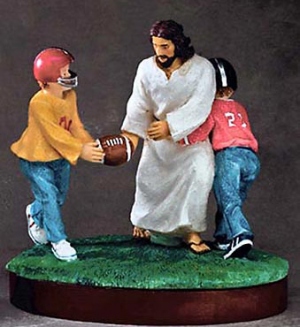
Football Jesus

In Wisconsin, you attend church with your family and head to your desired destination where you gather with friends and family to eat, talk about your life, and of course watch your local football team battle their weekly rival.  Although I am not much of a football fan these days, I have very fond memories of attending football games, watching them with my family and talking about the Green Bay Packers’ Super Bowl chances.  It was my time to both bond with the men of my family as well as catch up on the gossip the women would whisper back and forth to each other at the dinner table while the men were in the other room screaming at the TV.

Although I’m sure I will watch more games in my future, lately, all I do is cringe when I think about the growing violence that women and children face and have faced in the large shadow of an organization worth north of $9 billion dollars.

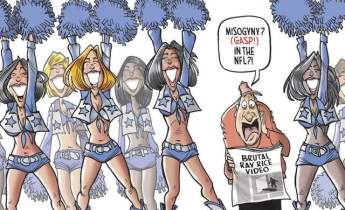
The biggest scandal to hit the news waves lately is that of Baltimore Ravens running back Ray Rice’s assault of his wife in an Atlantic City elevator.  Although Rice and the various other incidents regarding NFL players and violence is disturbing, the biggest problem facing the NFL isn’t just its treatment of women but its continual commodification of them as a disposable resource emblematic with the culture of violence that it has created.

photo (1)

If you didn’t know, women make up an estimated 45% of the NFL‘s more than 150 million American fans and have, in recent weeks, become their most valuable resource and source of criticism.  However, after a long string of incidents stemming back from NFL teams underpaying cheerleaders to the Ray Rice incident, one needs to ask what the roles of women, if any, are outside of the disturbing images of the abused wife, hypersexualized cheerleader?  Is being dragged out of an elevator by your abusive husband the only way to get women’s issues addressed in the NFL by fans, league owners, and the NFL commission?

The roles of women in the NFL and religion have many similarities.  Aside from end zone celebrations where players praise God for his apparent direct role in helping them score a winning touchdown or certain players edifications as gods on Earth, women make up the crux of both NFL fandom and attendance but are responsible for the gatherings similar to the ones I, and many others, grew up with.
bilde

Although putting women in charge of drafting new policies that address the “woman problem” currently facing the NFL, it too reeks of the similar dismissive and patronizing actions women face when trying to obtain leadership roles in their religious traditions.  Supercilious progress for the sake of progress isn’t progress and progress under the guise of silence is still misogyny.  We need women in positions of leadership in both the NFL as well as in religious traditions.  The culture of violence and silence will only continue, albeit with a Band-Aid firmly in place, holding the painful experiences and histories of women, long forgotten and often overlooked, until society values their rights just as much as the men leading the prayers and those that are being prayed for on Sundays across America.

Ann Braude said it best in her foundational text Sisters and Saints that “if we want to understand the history of American women, we need to examine the religious beliefs and activities that so many have found so meaningful.” Without women, we wouldn’t have many, if not all, of the religions that are present throughout the world today and in case we forget, without women, we too wouldn’t have the millions of little boys who grow up being taken to and from practice by their mothers with the hope that they too could one day become the professional football players that fans scream and pray for.

Without women, there is no NFL and without women, there is no religion.  Kelly Brown Douglas said it best on this very blog when she stated, “It is the violence that violence creates.”  Although I agree with her, I would only add that while violence does indeed create violence, the real sin isn’t the violence itself but rather the silence that follows.

Let us pray that we will continue to not be silent and that we will rise up and fight for the millions of women (and men) each day who do not live in fear that their significant other’s multimillion dollar contract will not be reinstated but rather that they and their children may not see another day on this Earth.

 John Erickson is a Ph.D. Candidate in American Religious History at Claremont Graduate University.  He holds a MA in Women’s Studies in Religion; an MA in Applied Women’s Studies; and a BA in Women’s Literature and Women’s Studies. The LGBTQ and women’s rights movements, masculinity studies, gender theory, and the utilization of technology in forming communities and creating new teaching methodologies influence his research interests.  His work is inspired by the intersectionality of feminism, queer identity, LGBTQ history, and religious and sexual cultural rhetoric. He is a Non-Fiction Reviewer for Lambda Literary, the leader in LGBT reviews, author interviews, opinions and news since 1989 and the Co-Chair of the Queer Studies in Religion section of the American Academy of Religion’s Western Region, the only regional section of the American Academy of Religion that is dedicated to the exploration of queer studies in religion and other relevant fields in the nation.  When he is not working on his dissertation, he can be found at West Hollywood City Hall where he is the City Council Deputy and Chief of Staff to Councilmember Abbe Land. He is the author of the blog From Wisconsin, with Love and can be followed on Twitter @JErickson85

The Declaration of Independence: A Misogynistic Mash-up of Greek Philosophy and Roman Law

Stuart WordPress photoRegardless of political identity in America there seems to be an almost religious reverence for the Declaration of Independence (DI).  By far the most quoted sentence from it is the one that begins “We hold these truths to be self-evident, that all men are created equal.”  Though it is hardly ‘self-evident,’ the history behind the words in these two clauses betrays the fact that they constitute a misogynistic mash-up of Greek philosophy and Roman law.

First, the Greek philosophy in the first clause.  Precisely because of how often this portion of the DI is quoted (perhaps most memorably by Martin Luther King), the idea that there are ‘truths’ that are ‘self-evident’ may seem–self-evident.  From the perspective of the history of Greek philosophy, however, such an idea is as problematic as it is peculiar and for that very reason can reliably be traced back to one source: Plato.  The most likely direct source is the introductory section of an ancient Platonic commentary on Greek mathematical methodology.

Though relatively obscure today, it was a much admired work in the Renaissance and for a few centuries thereafter, influencing a wide range of disciplines, including law.  As a consequence of that influence law was conceptualized more geometrico (in a geometric manner), with legal documents drafted (as they often still are today) with a list of ‘defined’ terms first followed by the propositions to which they relate.  Similarly, judicial decisions still slavishly follow a quasi-mathematical methodology, ‘applying’ law to the ‘facts’ of the case, as if plugging numbers into an equation, with everything set out in a sequence of paragraphs identified by a combination of Roman numerals and arabic letters (‘as applied’ in Hobby Lobby (see the majority’s penultimate paragraph)). Continue reading “The Declaration of Independence: A Misogynistic Mash-up of Greek Philosophy and Roman Law”

The Case for a Woman Pope: Mary Magdalene by Frank Shapiro

Frank shapiro picThere’s a lot of hullabaloo these days about belief in God, atheism, separation of religion and state. However, like it or not, Western civilization is a Christian one.

Ever since the Roman Empire officially became Christian in the 4th century Christianity has formed an integral part of the Greco-Roman culture, forging the West’s crystallization.

And within this religious-political-cultural matrix, women have been striving for equality of power in virtually every field. Most of the time men had the upper hand.

Yet in Christianity’s early maturation period an egalitarian approach to the gender issue was the accepted norm. Following a good start in gender power sharing in the Early Christian Church, this enlightened approach gradually changed for the worse. In the early 6th century women found themselves stigmatized and demoted from almost all the major roles in church service and liturgy.

So what went wrong? Continue reading “The Case for a Woman Pope: Mary Magdalene by Frank Shapiro”

Anne Hutchinson, Sor Juana, and Kate Kelly: Reflections on Equality and Excommunication by Erin Seaward-Hiatt

Erin-Close-Up-BW On June 11, 2014 the New York Times made waves in the world of Mormondom with their breaking news that two members of the Church of Jesus Christ of Latter-day Saints (LDS) are facing excommunication on the grounds of apostasy. Active Church members Kate Kelly and John P. Dehlin both received letters from their local church officials in early June summoning them to participate in scheduled Church hearings to discuss their so-called heretical public activism. By many accounts, this appears to be Dehlin’s first notice of formal disciplinary action for his faith-mending work with Mormon Stories, but Kelly has been under official fire from the LDS Church since late May for her efforts in founding and operating Ordain Women (OW)—a pro-women’s ordination group of active believers—more than a year prior. The excommunication threats came on the heels of a church-wide trend that preaches acceptance and diversity among members and beyond, but sends a mixed message to those who, like Kate Kelly, find themselves asking sincere questions only to be either silenced or rejected by their Church and cut off from communal worship of their God.

Ever since the New York Times story broke, the web has seen a swarm of responses in the form of news, interviews, blog posts, and social media discussion; watching everything unfold has been a fascinating study in feminist thought. Kelly herself responded publicly to her disciplinary letter here, saying that she had been transparent about Ordain Women with her bishop from the group’s inception and that not once had she been called in to discuss her work. The formal letter came only after Kelly had moved across the country, and the disciplinary hearing is scheduled to occur with or without her on June 22, 2014. On June 23, Kelly received the word that the trial had resulted in her excommunication.

As I’ve read through the slew of ideas and arguments surrounding what amounts to Kate Kelly’s spiritual fate, I can’t help but notice a strong underlying theme of patriarchy at work in squelching what Kelly believes are sincere questions about the lives of Mormon women. Commentators have tried hard—in classic anti-feminist fashion—to discredit Kelly’s work with Ordain Women, making certain that readers see her as a disingenuous religious deviant worthy of silencing. Throughout the spill of voices about Kelly’s Church standing the underlying point seems to be that as a Latter-day Saint she has no right to contest her Church’s doctrine or its patriarchy, that she is imagining inequality into the Church, that the Church’s discipline will be for her own spiritual good, and even that her group, Ordain Women, is lying in its claims about inequality. Continue reading “Anne Hutchinson, Sor Juana, and Kate Kelly: Reflections on Equality and Excommunication by Erin Seaward-Hiatt”