The Norns, Spiritual Mystery and Me, Part 1 by Janet Maika’i Rudolph

In 2020, I began writing my biography because some weird things were happening in my life including some which were time-bending. To help make sense of it, I wrote up “conversations” with the mythical characters of Persephone, Inanna and the Norns of the Norse. Throughout my bio, I speak to the Norns as an out loud meditation on the nature of time, fate and energy.

The three Norn sisters are Urd, Verdandi and Skuld. Their names come from Old Norse which is not a spoken language. The actual translation of their names is open to speculation. In general, here are their common meanings.

  • Urd – past
  • Verdandi – happening or present
  • Skuld – future or debt.

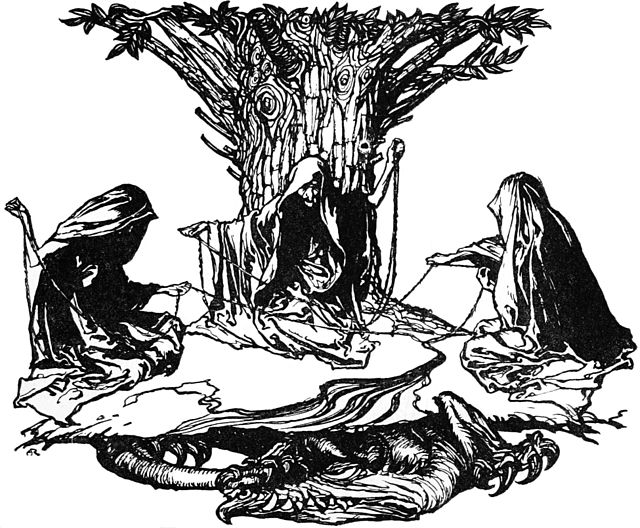
By mythological tradition, they show up at a child’s birth and then weave their “fateful” decisions about that child’s life into a tapestry. They are considered more powerful and fearsome than the gods because even the gods are ruled by the hands of fate (or Norns in this case). They were also treated as oracles where kings and warriors went to consult them much as was done in Delphi Greece.[1]

Continue reading “The Norns, Spiritual Mystery and Me, Part 1 by Janet Maika’i Rudolph”

My Daily MEDS by Xochitl Alvizo

After a spring semester-long sabbatical this year, I am back to campus and to teaching. I was effectively off from January to August and the timing could not have been better. After my dad’s death last July (2021), my world was turned upside down. One of the things that happened with his death was a deep realization that he had a lot to do with my sense of grounding. I wrote about this in a previous post, but I hadn’t quite realized how much he was a source of affirmation and grounding for me, an external one—his death was a catalyst for me to learn how to access that grounding more fully for myself, from within.

Having been on sabbatical, then, was helpful in terms of regaining my brain for research and writing, which was its objective, but also for giving me the time and mental space to work on the grounding aspect of my internal life. A few things came together for me during this time. Leading up to the sabbatical and overlapping with it, I got to participate in the Latinas in Leadership (LIL) program with the Hispanic Theological Initiative – a program designed to strengthen the professional development of the Latina women participants.

Continue reading “My Daily MEDS by Xochitl Alvizo”

My Daughter’s Religions by Sara Frykenberg

I find it interesting how certain or settled we often expect our little ones to be instead of getting curious about them or acknowledging that they are curious.

My daughter, Hazel, is six years old and will be starting first grade next week. She loves cats, swimming, her cousin, and food. Purportedly, Chinese style barbecue pork buns come first in her heart, even before mommy and daddy (though we are a close second). She also prefers to run instead of walk; and has recently declared that she is Taoist and Shinto. This determination came after some discussion which went something like this:

Sitting at the kitchen table one morning, Hazel declares “My best friend asked me if I was a Christian and I told her I was. I am a Christian.”

Mommy the agnostic is a little surprised. Daddy, the atheist, is biting back a retort—he is somewhat hostile towards Christianity. I am only hostile to abusive, hetero-Patriarchal Christianity. I say to Hazel, “Oh. That’s interesting. Do you know what that means?”

“No. What do Christians believe,” she asks.

Continue reading “My Daughter’s Religions by Sara Frykenberg”

Taking it to the Cauldron, by Molly Remer

If I squint,
I can almost see steam lifting
from a cauldron in the forest
and smell change
drifting through the air.
I am looking at the shards
of the year,
some new-broken,
some re-collected,
some shining with possibility,
and I feel the call,
the urge,
the promise,
to tip them all into that bubbling vat
and see what She will steep me
into next.

Each year, in August, I honor what I call a “Cauldron Month” for myself. This is a month in which I “take it all to the cauldron” and let it bubble and brew and stew and percolate. I pull my energy further inward to let myself listen and be and to see what wants to emerge. It is a month in which I delete my social media apps and mindfully, intentionally draw my scattered attention inward in order to listen to my inner wisdom, to take all of my bubbling ideas to the metaphorical cauldron of my own being and see what is brewing, what is stewing, and what is ready to be dished up. I clarify goals for the remainder of the year, my next word of the year usually finds me, and I take time to consciously “steep” in my own flavor. It is a time of clarity and renewal for me, a time when I withdraw from outer life and re-collect my energy in order to determine where to put my focus for the remainder of the year.

It may seem strange to withdraw energetically at such a ripe and burgeoning time of the year, when life is bursting with things to harvest and ideas to share, but that is exactly why I do it—because when life feels the most full, is when I known I most need some dedicated time of discernment. August, I find, is always a crucible of change and choice for me. It is when big projects are birthed, when new doors open, and when I reach metaphorical crossroads of change—crossroads in which I decide what to harvest, see what has withered, and come to understand what to sacrifice.

We are held between
summer’s fatigue
and summer’s fire,
there has been a blooming
and a ripening,
and now a harvesting and a fading,
as the time comes
to turn the page.

Cauldron Month dates back to 2016, a year in which my pace of living became unsustainable and I experienced a persistent and inexplicable cough that lasted for six full months. After this experience, I came to clearly see a pattern in myself, of speeding up and revving harder and harder through the spring and summer, until I reach an annual point of having taken on too much, in which I must make choices about what to let go of and what to pursue. It helps to know it, to name it, to say to myself: oh, yes, this. Cauldron time is here again. The understanding of this pattern has helped me to prepare for it, when I feel the familiar tension, the drive to push and speed, I step back instead. I sit down. I shut things off. I get still and I listen.

That first year, feeling overwhelmed by commitments and at my physical and temporal limits. I did a guided meditation called the Moon Goddess Ally Journey. During the meditation, in the temple in which I met the moon goddess, right as the meditation was coming to a close, the Cauldron from the Womanrunes oracle card system appeared quite clearly etched on the floor of the temple–it was very large, covering the whole floor, and felt like a dramatic and powerful wake-up call. I knew in this moment: I need to take my life into the Cauldron. I need to see what is brewing. I need to steep in my own magic. August has never been the same since.

Future Cauldron Months after have held varying experiences—some rich and powerful and some painful and challenging, what they all hold in common is that they illuminate the next steps and invite me into the next chapter. Some years I’ve joked with friends have been “Slow Cooker Months” instead and some years—like 2020—have felt like Cauldron Years, in that the whole year is a process of transformation and re-emergence. I have written some more about these experiences in a past post for FAR here.

Each year, I do what I can to honor the call of the Cauldron—persistent and insistent—and in so doing I remember that it is often in the mess that the story lives. What sometimes bubbles up from the Cauldron during this period of incubation isn’t particularly pretty, it can even be hard to confront, and yet, we continue to let it bubble, we continue to breathe and bear witness to our own interior lives, beyond the clamor and confusion of so many other voices that may fill our lives and days.

The Cauldron is a rune of alchemy and change, but also of centering of containment and contemplation—a marrying of what might seem like opposites, but that which really co-exist. During this month or another one that feels right to you (a lot of people choose December or January), consider taking it all to the metaphorical Cauldron of your life…what are you cooking? What flavors do you want to add? What do you want to create? What needs time and focus to bubble and brew? Can you allow yourself to steep in your own flavors? The Cauldron asks us what we’re cooking, but it also offer boundaries, containment, a safe space in which to stew up our truest magic.

May you be inspired by some time in cauldron,
may you be inspired by time with yourself,
may you be inspired by that which surrounds you,
connected to Goddess,
connected to the earth,
connected to the animals, plants,
the wisdom of the wind,
the song of branches,
and the symphony
of river, stone,
leaf, and breath.


Take it to the Cauldron and listen to the deep within.

Last year, I also made a free toolkit for sacred pauses which has lots more Cauldron Month info in it for you.

Sending you all love. Glad to share some of the miracle of being here with you.

There are days when the sky
holds its breath
and dreams seep up
from the skin of the world
and into my feet.  

Molly Remer, MSW, D.Min, is a priestess, mystic, and poet facilitating sacred circles, seasonal rituals, and family ceremonies in central Missouri. Molly and her husband Mark co-create Story Goddesses at Brigid’s Grove. Molly is the author of nine books, including Walking with Persephone, Whole and HolyWomanrunes, and the Goddess Devotional. She is the creator of the devotional experience #30DaysofGoddess and she loves savoring small magic and everyday enchantment.

Untangling the Triad of Life Force, Spirit and Soul by Eline Kieft


Calling Home at the Sealskin Soulskin Workshop 2018. Image Credit Justyna Skowronek

Most cultures recognize an animating ‘life force energy’, such as chi, qi, ki, kundalini, n/um, ruach, prana and mana. Life force is very closely related to ‘soul’, and often indicates vitality, original nature, instinct, intuition or inner compass. Another term is ‘spirit’, and I must say, it confused me for a long time how they are related, and how they are different. In this article I explain how I understand the nuances between these terms.

Shamanic paradigms consider ‘spirit’ as the animating life force both in our bodies and in the animist world around us. In Traditional Chinese Medicine, this concept is called ‘Qi’, or life force energy. This can be affected by ongoing stress or other health concerns that sap our vitality, but while we live it’s always there.

‘Soul’, in shamanic views, refers to an original essence that makes us who we are. This metaphysical part of us is in direct relationship with the sublime. The soul “continues beyond death and into eternity and into infinity. We could literally say that our soul has a body, much more than saying that our body has a soul” (Villoldo, 2018). This soul essence can be damaged: parts of it can ‘leave’ following traumatic events.

Continue reading “Untangling the Triad of Life Force, Spirit and Soul by Eline Kieft”

The Magic of the Labyrinth by Janet Maika’i Rudolph

Labyrinths are magical. I’ve always been drawn to them. About two years ago, a local Episcopalian Church rebuilt their beautiful outdoor labyrinth and opened it to the public. In concert with them, I have been delighted and honored to offer guided walks there. Doing these walks, both in leading them and in walking myself, have given me the opportunity to reflect deeply on what they mean from many perspectives: historical, personal, spiritual, philosophical, experiential.

When I walk a labyrinth, it feels like I am mirroring the universe while expanding my internal journey. Teresa of Avila agrees with me (or, more accurately, I with her). She wrote, “If we learn to love the earth, we will find labyrinths, gardens, fountains and precious jewels! A whole new world will open itself to us. We will discover what it means to be truly alive.”     


Continue reading “The Magic of the Labyrinth by Janet Maika’i Rudolph”

Crumbs of Our Souls, by Molly Remer

So, what trail of crumbs has your soul been dropping for you? And how might you savor and kiss these fallen crumbs, rescuing them from where they’ve been kicked under the table?

Something that I keep coming back to in recent years is accepting the reality of our lives as they are right now, really inhabiting where we actually are. To be clear, this does not mean settling for injustice or not taking action—it does not mean settling into apathy or turning away from suffering, it means inhabiting our own lives in full, in the present.

My word of the year for this year is attend and with that I mean, pay attention to where you are, pay attention to your life right now, not what you think your life should be, not what you think other people’s lives are, not what you want to pretend to be, but what is your life right now? Can we take an actual unflinching look at the reality of our lives, right now? I invite you to take a brief pause and let yourself inhabit your own life right now, as it is, no need to change anything about it. It is what it is. For example, I hear the distant sounds of my brother mowing. I hear birds. I am looking at full-leafed trees and the drippy little fingers of green pollen on the oaks, the long, green flowers on the mulberry trees. This is the first sunny day and blue sky that I’ve seen in what feels like several weeks (possibly exaggeration). I feel a tightness in my shoulders, but here I am. And, here you are. What do you feel where you are? What do you see where you are? What are you hearing where you are? What is your life like right now?

I feel at strange, tender, and tentative point of reemergence this summer. I know that the pandemic experience has been very different for different people according to your geographic region, according to the culture and climate of the state in which you live, and according to your type of employment or your life’s structure. Many people who are employed in some kind of service industry did not have the luxury of just stepping out of society and retreating to their homes during the pandemic years. For people like me who work at home and who already school their kids at home, it wasn’t that big of a stretch to just further close off my life and just stay home and not go places. It took me practically two years to even miss doing things outside my house externally with other people. So, acknowledging that there are some people who never had the choice of just retreating to their homes and stepping out of society, people who had to keep riding public transportation, people who had to work at restaurants or in stores or in health care, people who are students and had to go to classes. There wasn’t the option to step out and away for some of us. For others of us, the last two years have been almost a kind of hermitage where you’re suddenly just withdrawn from everything and in a type of waiting place. For me, I have in many ways appreciated this withdrawal in its own way, the opportunity become small and closed in. And, now, at the cusp of summer, I’m also starting to recognize that becoming so small and closed in is now beginning to feel tight and confining. As we consider reemergence, we may find it is time for us to decide: What do we want to step back into and what do we want to stay out of?

In Jennifer Louden’s Oasis program (of which I am a long-time member), she spoke of reemergence as a theme and one of the things she noted that I found really powerful is that we may have in some ways forgotten how to exercise our “no” or our boundaries, because we’ve had an automatic built-in, “oh, it’s a pandemic. I’m not going to do whatever.” Now, as we re-emerge, we have to actually say, “No, I still don’t want to do that.” Or, “Yes, I do, let’s try to rebuild that.” What I’m recognizing in myself is that it’s very hard to tease apart what I still actually want to do and what I’ve actually just gotten out of the habit of doing and so actually feel some type of trepidation or anxiety about doing again. For some things that I haven’t been doing, it is not that I truly don’t want to do them again, it’s that I am also holding some kind of fear of stepping back into it. And, these things may be all rolled up together. For example, I am unsure whether I really do not want to have a big summer solstice ritual this year, or whether I just feel nervous about it, because it’s been several years since I’ve had a bigger group ritual and so I’m afraid I don’t know how to do it anymore. Which is it? When is it really your heart or intuition saying, “I laid this down and I want to leave it laid down.” When it is your heart or intuition saying, “This is something I want to pick back up.” What is obligation telling us we should pick back up when inside we know we no longer want it? And, what is fear making us afraid to pick back up that we really DO want to pick back up?

One of the books I just finished this year is A Woman’s Book of Soul by Sue Patton Thoele. It is a book of daily meditations that is a little more Christian in orientation than I usually prefer, but it also has some interesting things in it too. In a section called savoring our souls, Thoele writes: because the demands of day to day life have a way of dulling our spirits and cutting us off from our hearts, it’s essential that we find ways to reinstate solitude into our lives and through it experience the beauty of heart and soul. One day while suffering from solitude starvation, I ran across a poem in which the poet talked about wandering alone through his house savoring and kissing the ‘fallen crumbs’ of his soul. I smiled as I read the poem because it validated the feelings I often have when home alone. I wander. Touching, appreciating, remembering, singing, gathering, and kissing the fallen crumbs of my soul. Very often, this is the time I choose to change the symbols in the miniature Zen Garden given to me by my son, a simple task taking only a few minutes at the most, but nonetheless, a richly replenishing ritual in which I savor my soul. If your soul has been dropping a trail of crumbs as it accompanies your body through its days, how would you like to savor and nourish it? Can you arrange for some solitary time at home in which you sweep up and kiss your soul crumbs? Gently close your eyes and imagine a time in your own home when you are blessed by the renewal of solitude. Cherish it. Wander or sit quietly. Give yourself the gift of enjoying the solitude in ways that warm your heart, fill your spirit, and revitalize your soul. It is a sacred assignment to rescue the crumbs of our souls that have been kicked under the table by too much activity and too little aloneness, to collect and kiss them all better.

The affirmations at the end of this section are: I need and deserve time alone and I am adept at balancing time alone and time with others.

So, what trail of crumbs has your soul been dropping for you? And how might you savor and kiss these fallen crumbs, rescuing them from where they’ve been kicked under the table?

Deep breath, a hand on your heart, let yourself settle into center and then perhaps you may wish to read this prayer aloud:

I dedicate myself to the full living of my own life
in all its joys and complexities.
I dedicate myself to walking my path.
I dedicate myself to being present.
I dedicate myself to brave and joyful wholeness.


May you nourish the crumbs of your soul.

Molly Remer, MSW, D.Min, is a priestess, teacher, and poet facilitating sacred circles, seasonal rituals, and family ceremonies in central Missouri. Molly and her husband Mark co-create Story Goddesses at Brigid’s Grove. Molly is the author of nine books, including Walking with Persephone, Whole and HolyWomanrunes, and the Goddess Devotional. She is the creator of the devotional experience #30DaysofGoddess and she loves savoring small magic and everyday enchantment.
The Magic of the Ordinary, by Molly Remer

“Nothing is so simple, or so out of the ordinary for most of us, then attending to the present.”

— Ernest Kurtz & Katherine Ketcham, The Spirituality of Imperfection

I often speak of being in the temple of the ordinary, of seeing the enchantment in the ordinary. In the book The Spirituality of Imperfection, the authors write that “beyond the ordinary, beyond material beyond possession, beyond the confines of the self, spirituality transcends the ordinary, and yet, paradoxically, it can be found only in the ordinary. Spirituality is beyond us, and yet it is in everything we do. It is extraordinary. And yet, it is extraordinarily simple.”

This spring, I presented at an event and the concept of “being versus doing” arose. I reminded participants that “being” is not a competitive sport. We cannot not be, we are being all the time. I think sometimes the pressure we put on ourselves to be better, to “do” being better, can be really hobbling. Likewise, the sensation that spirituality is somewhere “out there” or that it has to be bigger than or better than or transcendent instead of present in the ordinary. On a goddess based path, with a feminist orientation, I find that the Goddess herself pervades all of existence, pervades your whole entire life, even the rough and weary places, even the ragged and strange places. Returning to Kurtz and Ketcham, they write: “Now…beyond the ordinary is not meant to suggest something complicated, different, different or self-consciously special. Nothing is so simple, or so out of the ordinary for most of us, then attending to the present. The focus on this day, suggested by all spiritual approaches, attending to the present, to the sacredness present in the ordinary, if we can get beyond the ordinary is, of course, a theme that pervades Eastern expressions of spirituality and other expressions too.”

I know that I often find myself seeking or longing for the special moments, the magic, the flashes of transcendence, and sometimes this can cause me to miss the ordinary, to miss the present, to miss where I am because I’m longing for something else. Adages to the effect of “do what you are doing” and “be where you are” may begin to sound cliché almost and the reason they do is because it’s so simple and so out of the ordinary to simply come back to attending to the present. The present moment is, in my eyes, truly where we find the goddess, in the pulse of presence in the every day. In the book She of the Sea, author Lucy Pearce addresses the question of the transcendent ordinary as well: “I want to write of the oceanic mystery, the soul of goddess magic, the sacred that which lies beyond words, because the repeated deliberate seeking of connection to this is at the heart of what I do and who I am. It is my creative and spiritual practice. I want to speak of this so that you can close your eyes turn inwards and smile knowing, just knowing until our conversation can continue without words…I want to share what I have known and for not to sound strange, yet strangeness is its nature. The soul is not of this world. It’s not rational, the sacred is not logical, but nor is this chaotic, magnificent, contradictory, and complex world of ours. And yet, we insist on pretending that it is and being disappointed, afraid, or bemused when it shows us its reality, again and again.”

The sacred is not logical, and neither is the world itself, but we pretend that it is, and then we get disappointed when we see reality. I originally learned the phrase “don’t argue with reality” from self-help author Wayne Dyer. There can be a whole range of potential experiences that are beyond objective reality or the reality that people sometimes insist is all there is. Jeanette Winterson, in her book Lighthousekeeping writes: “I do not accept that life has an ordinary shape, or that there is anything ordinary about life at all. We make it ordinary, but it is not.”

Maybe we are trying to make things ordinary that are not. My kids are growing up and getting ready to graduate from high school. One of my sons is very into science and loves biology and genetics and he is fond of boiling things down to an “everybody’s just a mass of cells having a collective hallucination” type of rhetoric that leaves little room for the esoteric and little room for inherent meaning. However, for me, I come back to the reality of being human as its own kind of miracle, its own profound magic. The reality of having this body with all these cells, which are doing all these things day in and day out that I don’t consciously know how to do, and yet my body does them every single day. That’s magic, even if we can explain the objective “why” of it. I don’t consciously know how to beat my own heart, but wait a second, yes, I do, because here it is beating every day from birth till death. Some people may be quite attached to maintaining the assertion that life is random and pointless, but this is not the story I see. I see wonder. I see magic. I see a miracle in motion. I am awestruck at the impossible reality of being a bundle of cells typing this essay right now. Yes, I am “only” a bundle of cells and that is absolutely pure magic to me. In fact, your very presence right here, right now is proof of the sacred on this earth in my eyes. May we all love the ordinary and let it whisper of the magic right beneath the skin.

Breathe deep
and allow your gaze
to settle on something you love.
Draw up strength from the earth.
Draw down light from the sky.
Allow yourself to be refilled and restored.
There is good to be done on this day.
Let your own two hands
against your heart be the reminder
you need
that the pulse of the sacred
still beats
and the chord of the holy yet chimes.

Molly Remer, MSW, D.Min, is a priestess facilitating women’s circles, seasonal rituals, and family ceremonies in central Missouri. Molly and her husband Mark co-create Story Goddesses at Brigid’s Grove. Molly is the author of nine books, including Walking with Persephone, Whole and HolyWomanrunes, and the Goddess Devotional. She is the creator of the devotional experience #30DaysofGoddess and she loves savoring small magic and everyday enchantment.
From the Archives: Longing for Hermitage by Elizabeth Cunningham

This blog was originally posted on October 20, 2013. You can read the comments here.

At least since the days of the Desert Mothers in the 4th and 5th centuries CE, there have been women in the Christian tradition (and doubtless other traditions) who have lived lives in religious solitude, whether by choice or circumstance.  In Medieval Europe many churches had anchorholds, small enclosures inhabited by men or women dedicated to a life of solitude and prayer. The word anchorhold implies that the presence of the anchoress or anchorite grounded the church community, but the word derives from the ancient Greek verb (pronounced anachōreō) for to retire or withdraw.  Anchoress Julian of Norwich is still revered as the author Revelations of Divine Love, possibly the earliest surviving book written by a woman in the English language.  Six centuries after her death, her vision of Jesus our Mother continues to challenge, comfort, and inspire.

Continue reading “From the Archives: Longing for Hermitage by Elizabeth Cunningham”

Carol P. Christ’s Legacy: THE LABRYS: A RIVER OF BIRDS IN MIGRATION

Moderator’s Note: Carol Christ died from cancer in July, 2021. Her work continues through her non-profit foundation, the Ariadne Institute for the Study of Myth and Ritual and the Goddess Pilgrimage to CreteThis blog was originally posted July 29, 2013. You can its original comments here.

labrys seal ring

“There’s a river of birds in migration, a nation of women with wings.” Goddess chant, Libana

On the Goddess Pilgrimage to Crete, I explain that many of the names given to “Minoan” (c. 3000-1450 BCE) Cretan artifacts and architecture are products of patriarchal and Eurocentric imaginations, and as such, are misleading.  For example the name “Minoan” was given to the culture of Bronze Age Crete in honor of “King Minos,” who was said to have ruled in Crete a few generations before the Trojan War–several hundred years after the end of the culture to which his name was attached.  In fact, despite his eagerness to find evidence that King Minos ruled at Knossos, the excavator Sir Arthur Evans finally had to concede that the best he could do was to produce a fresco of a “Prince of the Lilies” which he identifed as the image of the male ruler of the culture he called “Minoan.”  Evans’ Prince had white skin, a fact that Evans conveniently overlooked–because according to his own interpretation of “Minoan” iconography, white skin would mark the figure as female.  Mark Cameron, who reviewed Evans’ reconstruction of the fresco, suggested that the Prince is more likely to be a young woman who is perhaps leading a bull to take part in the bull-leaping games.  He also stated that the “crown” belonged to another fresco altogether.

Continue reading “Carol P. Christ’s Legacy: THE LABRYS: A RIVER OF BIRDS IN MIGRATION”