Liberalism as Feminist Religious Tradition: Friend or Foe? By Amy Levin

Come, come, my conservative friend, wipe the dew off your spectacles, and see that the world is movingElizabeth Cady Stanton

Whenever I find myself in conversation with a liberal skeptic who assumes that the existence of a liberal Mormon or Catholic is about as likely as aliens walking the planet, I do two things. First, I show them our blog. Second, I attempt to describe the complicated, long, and constantly evolving relationship between American liberalism, religion, and feminism. The roots of this complex triad are planted in a complicated history whereby, on the one hand, religious liberalism helped women gain equal rights and social justice, while on the other hand, it created divisions among some religious women who felt liberalism threatened their theological beliefs. Of course, the term “liberalism” is fraught with its own contemporary meanings. However, religious feminists throughout history have nevertheless engaged in practices we could place under the rubric of liberalism, including the push toward cosmopolitanism, modernism, and political progressivism. The difficulty was (and still is) maintaining their religious practices and beliefs.

Continue reading “Liberalism as Feminist Religious Tradition: Friend or Foe? By Amy Levin”

Art – A Bridge Between the Physical and Spiritual Worlds by Judith Shaw

judith shaw photoBrushing yellow gold on top of deep crimson, I sense the paints coming alive, even as I feel myself moving outside of ego, outside of time, and inside to my deepest source.

At least forty thousand years ago the human family began to make art; drawing, painting, sculpting and playing music. For much of human history, art has served a dual purpose. Some art has been purely decorative, while much art has expressed a spiritual understanding of our physical existence.

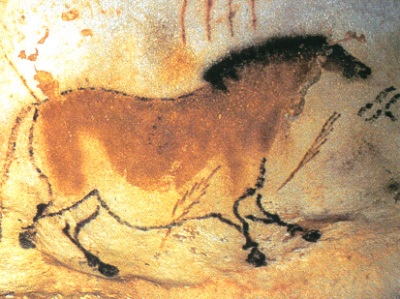
During the Paleolithic period, c.15–18,000 B.C. on the walls of a sacred cave, Lascaux, in southern France, our ancestors created beautiful paintings, often interpreted as a ritual that invoked sympathetic hunting magic. They are a reminder of the bond between the spirit world and the human world. This was a magical time in which humans lived immersed in the connection between the physical and spiritual worlds. Art was a means to both express and facilitate that connection.

Neolithic Goddess Figure

The seasons turned and the art and mythical imagery of the Paleolithic era was transmitted to the Neolithic era in Old Europe. Worship of the Goddess, as giver of all life, continued as did the art which honored Her and our connection to Her. The artists from these ancient days expressed their communal worship through the creation of cult idols and objects, shrines, painted pottery, and religious ceremonialism. The artists, though anonymous, were the hands and eyes of the creator, deepening and transforming the consciousness of their community.

As the human community in the western world developed and grew, art remained firmly grounded in the spiritual. From the megalithic stones of the Celtic era, to the illuminated manuscripts, mosaics and fresco paintings in the churches of the Middle Ages, right up to the work of painters like Van Gogh, Kandinsky, Malevich and Mondrian in the more modern era of late 19th and early 20th century – art expressed our human connection to the divine.

Continue reading “Art – A Bridge Between the Physical and Spiritual Worlds by Judith Shaw”

Reflections on My Spiritual Journey: Claiming Judaism By Ivy Helman

“Is Ivy Helman Jewish?”   This question and knowing that eventually I’d have to respond one way or another to it has caused me many sleepless nights.  At the same time my faith journey has become integral to who I am and I would like to spend some time today sharing it with you.

Why share this and why now?  Well, first, I have not been ready until now.  In addition, external forces which I will talk about in a minute are making my spiritual path an issue.  So I share my story with a measure of concern about its possible effects but also with a great deal of joy about the ways in which my faith journey has challenged me to grow, reflect and change.

Margaret Farley emailed me about two weeks ago asking me how I identified religiously.  Someone had emailed her asking if I was Jewish because this person had read one of my past blogs in which I wrote “my rabbi” on feminismandreligion.com.  This same person is reviewing my book: Women and the Vatican: An Exploration of Official Documents.   Here is how I answered Margaret: “Hi Margaret, I’m Catholic although I do attend services at a Jewish synagogue on occasion since I was raised in essentially a multi-faith home.  On that blog, there really is no Jewish voice, so I try to comment on ideas from that tradition as much as I can.  Ivy.”  I felt unauthentic sending that email.  But, I did.

Still troubled by that answer and rather than put my friends and colleagues in the middle of questions about my faith, I feel that this has now become a public issue that I must address.  It is a question I have known I would have to answer at some point.  Nevertheless, this is not a decision that came easily or quickly.  I’ve literally agonized over it now for months.  During the time, I’ve never questioned my resolve to be Jewish and to continue to follow that spiritual journey in my life; I’ve worried more about how other people will respond and how their responses will affect my career in academia.   If I were allowed to rewrite that email to Margaret, then this is what I would say. Continue reading “Reflections on My Spiritual Journey: Claiming Judaism By Ivy Helman”

Do Man-Made Laws Trump the Authority of Jesus? Reflecting on the Meaning of Humility, Priestly Service, and the Issue of Women’s Ordination by Michele Stopera Freyhauf

Maundy Thursday – the imitation of Jesus’ act of service and submission is re-created.  Controversy surrounds the “disciples” – must they be all men?  Are women allowed?  Who steps into Jesus’ role?  Men, women, or both?  Why, when it comes to imitating the act of  humility and priestly service (rooted in our baptismal call), does a distinction of gender need to made at all?

As I progressed towards the intersection, I looked up to witness a grand procession of men dressed in white albs with stoles that often contained subtle hints of gold, worn in a manner to distinguish their role as priests and deacons.  They moved slowly down the sidewalk entering the Cathedral to begin their celebration of the Chrism Mass – a celebration of priesthood and priestly service within the Diocese where all priests and deacons gather to celebrate and re-affirm their commitment to ministry and service to the Church.  It is also during this Mass that the oils used in sacramental celebrations, used by each church, are blessed by the Bishop.

As I continued to watch, I could not help but search the processional line for those with a hair color other than gray.  I wanted to see  how many young priests were in that processional line.  What I found was no surprise –  an aging group of men with the sporadic appearance of younger priests.   The numbers stood as a staunch reminder that we, as a Church, may be faced with a severe shortage of priests in the future.  Something already known and planned for by the Diocese in its campaign to consolidate and close parishes.

Another sad observation was put on public display  –  the absolute absence of women. Continue reading “Do Man-Made Laws Trump the Authority of Jesus? Reflecting on the Meaning of Humility, Priestly Service, and the Issue of Women’s Ordination by Michele Stopera Freyhauf”

The Power of Feminist Rituals by Grace Yia-Hei Kao

“These were very simple rituals and yet they were so powerful.”

Jeanette Stokes’ 25 Years in the Garden is on my bedside table. It’s a book I read several years ago with a small group of feminist Christians when I was living in Blacksburg, Virginia. The following passage from one of her essays got me to thinking back to the 2012 PANAAWTM conference (Pacific, Asian, and North American Asian Women in Theology and Ministry) I had attended just two weeks ago:

“Rituals are part of everyday lives: reading the newspaper, checking the weather, waiting for the mail to come, or talking with a family member at the end of the day. Rituals can also mark the extraordinary events in our lives: the birth of a child, the death of a loved one, a birthday, marriage, anniversary, or divorce” (Stokes, 2002, p. 37).

Continue reading “The Power of Feminist Rituals by Grace Yia-Hei Kao”

On Being in the Moment By Ivy Helman

Time.  We mark years, months, days, hours, minutes and seconds. We mark seasons.  We mark life events.  We live our lives in time: both circular and linear.  Time began before we did and time will continue after we cannot experience it any further.   Some say we repeat time with rebirth.  Others suggest that we only have one lifetime of which we should make the most.  Still others suggest there is existence outside of time with concepts like infinity and eternal life.  We sure do write, discuss and ponder time a lot, but do we ever really experience it?  Meaning: what would it be like to live in the moment, to be aware of and completely conscience within an instance of time, not thinking of the past, not worrying about the future, but being fully present in the here and now?

Sci-fi geek that I am, I often recall the Star Trek: The Next Generation movie entitled Insurrection when Captain Picard and Anij discuss experiencing a moment of time.  Anij explains to Captain Picard, “You stop reviewing what happened yesterday. Stop planning for tomorrow. Let me ask you a question. Have you ever experienced a perfect moment in time?”  A few lines of dialogue later, she picks up the topic again by describing what being present is like. ”We’ve discovered that a single moment in time can be a universe in itself. Full of powerful forces. Most people aren’t aware enough of the now to even notice.”  The visual effects show water stopping and a butterfly’s slow flight if I remember correctly.  Captain Picard is obviously caught up in these moments of time as well as being mesmerized by Anij herself.  The power of both the moments of time and Anij herself is palpable. Continue reading “On Being in the Moment By Ivy Helman”

My First Experience at a Women-Only Conference by Grace Yia-Hei Kao

“This ain’t your daddy’s conference!”

I knew that I was going to be attending a totally different type of conference than I had ever been to before when I received the following instructions on additional items to pack: (1) my own mug with which to drink coffee or tea (“we will go green in this conference as much as possible”), (2) 3 oz. of water “from a source of nature near your home” to be offered during “opening worship,” and (3) a small, modest, pre-owned, homemade, or inexpensive “earth-honoring gift for exchange.”

Continue reading “My First Experience at a Women-Only Conference by Grace Yia-Hei Kao”

The “Curse of Eve”—Is Pain Our Punishment? Part 2 by Stacia Guzzo

In the first part, I posed the question about whether or not the so-called “Curse of Eve” could be interpreted alternatively from the traditional understanding of Genesis 3:16a (the result of Eve’s disobedience being the punishment of painful childbirth for all generations of women). I considered an alternate interpretation of “sorrow” rather than “pain” for the verse, a lens through which the punishment could then be seen as impacting the God-human relationship rather than as a condemnation of pain.

I would like to further examine the consequences of this consideration. What if we were bold enough to interpret both the punishments of Adam and Eve (toiling over the land and pain in childbirth, respectively) as symbolic for all of humankind—and, furthermore, as speaking specifically of the God-human relationship? After all, men certainly aren’t the only ones who have toiled in the fields to bring forth food (I say this specifically thinking of a female farmer who lives down the road from me, and remembering her 10-14 hour days laboring over her harvests). Nor are all women subject to painful childbirth; in fact, the documentary Orgasmic Birth specifically devotes its study to women who find the experience of birth both sensual and ecstatic.  If interpreting the Scriptural “curses” as literal and final, these not-so-exceptional exceptions would seem to contradict God’s decree.  Yet when interpreting the punishments as indicative of a schism in relationship between God and humankind, the implications can be more clearly understood. Continue reading “The “Curse of Eve”—Is Pain Our Punishment? Part 2 by Stacia Guzzo”

The “Curse of Eve”—Is Pain Our Punishment? Part I

I have been involved in several interesting discussions lately involving  friends asking me what I thought of the so-called “Curse of Eve.” This “curse,” which is generally used in reference to the pain of childbirth, is assumed from the text of Genesis 3:16a. On one side, I have had friends and colleagues argue that the pains of labor are a direct result of Eve’s sin, and thus all women who bear children will suffer them as a reminder of their inherent sinful nature. On the other hand, I have had friends question this interpretation: Why, they ask, would God use such an incredible event to punish us? And what about women who don’t experience any pain in childbirth at all? Or who do not have children? Is God’s punishment reserved for those who procreate? This doesn’t seem to make much sense in a larger spiritual framework. Continue reading “The “Curse of Eve”—Is Pain Our Punishment? Part I”

Goddess Meditation: Pattini by Laura Loomis

I first became interested in Goddess spirituality because of my love of storytelling.  Centuries-old stories yield multiple layers of meaning, and can be told many different ways to get at different truths.  In this respect, the written word is both a blessing and a curse.  It preserves stories that might otherwise be lost; who knows what tales were told about the Venus of Willendorf, or the giant heads on Easter Island?  But it also gives rise to the idea that there is a single “right” version of sacred stories.  Adam and Eve can be a meditation on choice and responsibility, but the insistence on taking the story literally can turn it into a command to disbelieve science.

I’ve been working on some meditations about the connection between Goddess spirituality and political activism.  Last weekend, with people across the country rising up against Proposition 8, I was reminded of a story from Sri Lanki, about the Goddess Pattini.

Pattini (also called Kannaki or Kannagi) began life as an ordinary woman, in a less-than-perfect marriage.  Her husband Kovolan was a philanderer, lured away from her by a beautiful young dancer.  After he’d burned through all their money, the dancer left him broke and alone.  A wiser Kovolan returned to Pattini and begged her forgiveness. Continue reading “Goddess Meditation: Pattini by Laura Loomis”