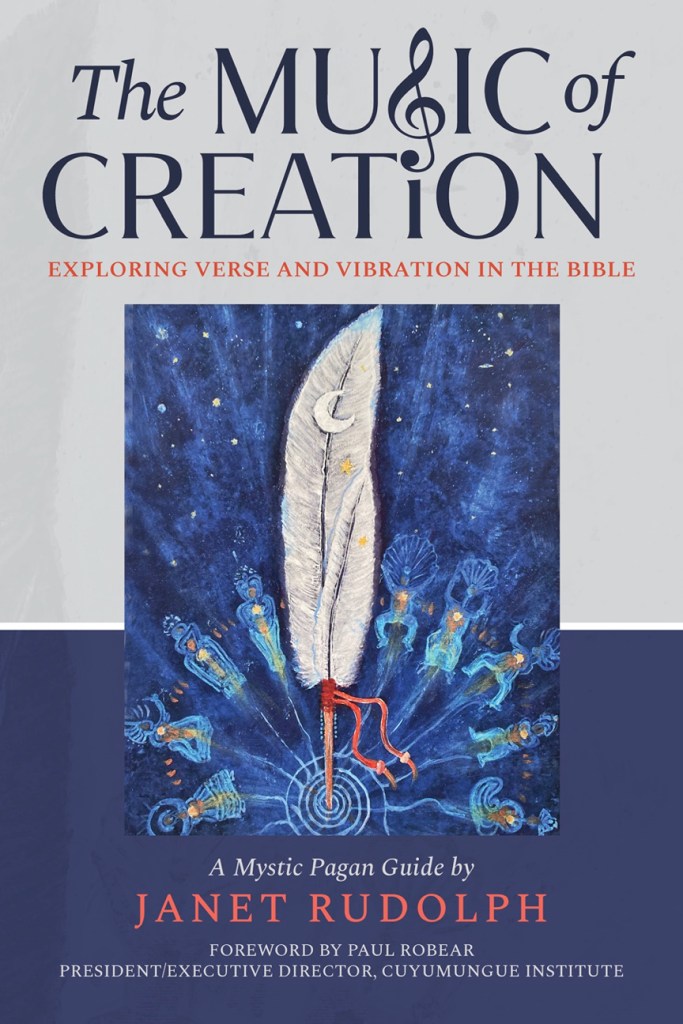
“What if the teachings within the Bible were not dualistic, but taught of oneness, connection, and the flow of energy?” (9) In The Music of Creation: Exploring Verse and Vibration in the Bible, Janet Rudolph (whom FAR readers already know as a FAR co-weaver) explores the definitions and vibrational elements of the sounds of original Hebrew words in the Bible. This is her latest book. In this book, Janet creates retranslations that express the energy, flow, dynamism and movement of the verses. She also discusses ways for readers to experience the power and potential of the verses for themselves. As she notes, Hebrew is a “sacred language” so that “the words themselves carry a vibrational element that we, as human beings, find meaningful and compelling” (3). In doing so, her retranslations revive the energy of “nature and its cyclical wisdom” (4). These are remnants of the original teachings, bringing forth their fresh beauty, inspiration, and world perspective we so need now.
“All the women knitted. . . . So much was closing around the women who sat knitting, knitting, that they their very selves were closing in around a structure yet unbuilt, where they were to sit knitting, knitting, counting dropping heads.”[i] – A Tale of Two Cities
So does Charles Dickens tell the tale of perhaps the most infamous resistance knitter, the character of Madame DeFarge in his A Tale of Two Cities. Using a different pattern of knots for each letter of the alphabet, Madame DeFarge uses her knitting to encode the names of spies and traitors to be beheaded by guillotine in the French Revolution’s Reign of Terror.
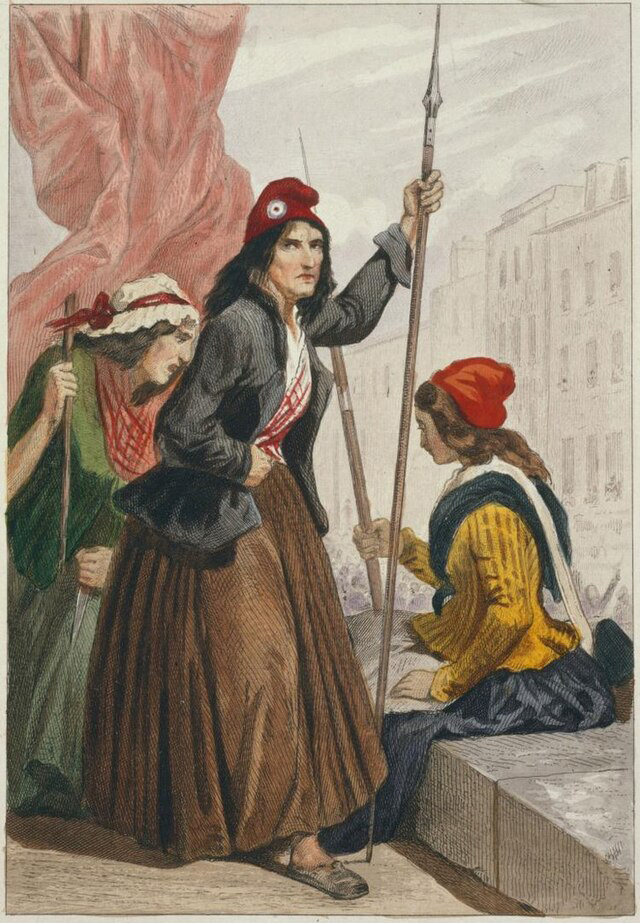
Tricoteuse
Her character is based on the true story of the tricoteuse – the women who notoriously knitted while sitting next to the guillotine. They undoubtedly took up this public position because just a few months before the Reign of Terror began they were banned from government proceedings and prohibited from forming any political assembly. Initially praised for their role in the resistance after successfully forcing Louis XVI to acquiesce to their demands following their march on the palace at Versailles protesting rising food prices, they had become too much of a threat to the aristocrats. It is said they were knitting liberty hats.
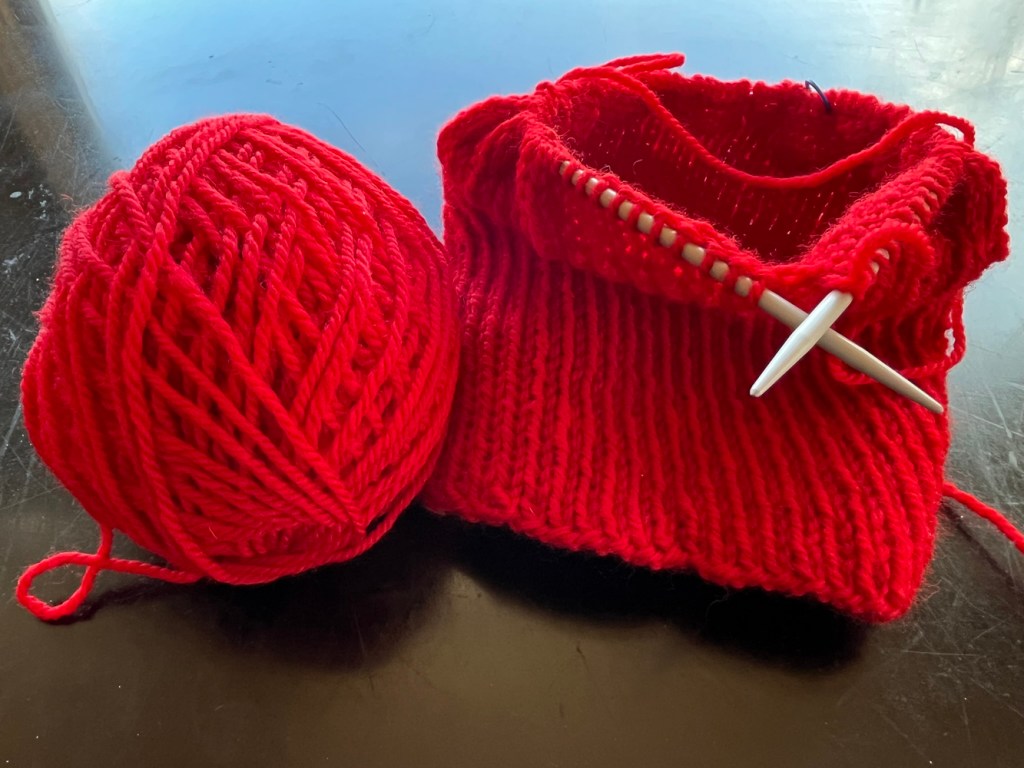
Fast forward to today. Begun with a simple “Melt the Ice” pattern designed by Paul Neary from the yarn shop in Minneapolis, Needle & Skein, women and men all over the world are once again knitting liberty hats. The red pointed hats are modeled after the nisselue — or “Santa hat”– that Norwegian women knit as a symbol of resistance to the Nazis who were occupying Norway during WW II. Needle & Skein made the pattern available for $5, with proceeds going to support rent and food assistance to those unable to leave their homes due to ICE’s ongoing presence in the Twin Cities. As of March 5th, they had already raised $705,000.
That the movement has become worldwide is extremely moving to those of us in Minnesota. It lets us know we are not alone. It has become a sisterhood of sorts, with a continual round of Facebook messages like this one from Elisabet Engström, “I am knitting the Melt the Ice hat right now. . . . It feels so good to be a part this. I live in Sweden. Happy knitting to all of you.” Another writes from Ibaraki, Japan, that has a cultural exchange program with Minneapolis, that she is knitting MTI hats “in solidarity and support.”[ii] I particularly loved this one, “I changed the pattern a bit, but I’m loving the resistance and how much it’s already earned for donation. I’m 82 and can no longer march, but I can do this.”[iii]
These days, at every protest I attend and just walking around town, I see people, mostly women, wearing the red Melt the Ice hats. There’s something particularly fortifying about wearing one’s convictions so visibly in solidarity with others doing the same. On the 84th anniversary of the Naz’s banning the wearing of the nisselue hats, people all around the world wore the red MTI hats they had inspired, proudly displaying their resistance to the occupation forces of ICE that have terrorized cities and immigrant communities throughout the US.
I first engaged in knitting resistance in 2009 when students in my course, “Women, Peace, and War” participated in CodePink’s Mother’s Day action against war, displaying a banner on the White House fence with the words, “We will not raise our children to kill another mother’s child.” CodePink sent out requests for 4X4 knit squares in pink yarn, and so we began to knit. Many of the students already knew how to knit. We taught those who did not. Most class sessions we were all busily knitting while discussing the readings on women’s roles in war and peace, and by the due date sent in a few dozen squares. It was a wonderful exercise in activist engagement that also brought us together as a community in the classroom and with other anti-war feminist activists throughout the country.
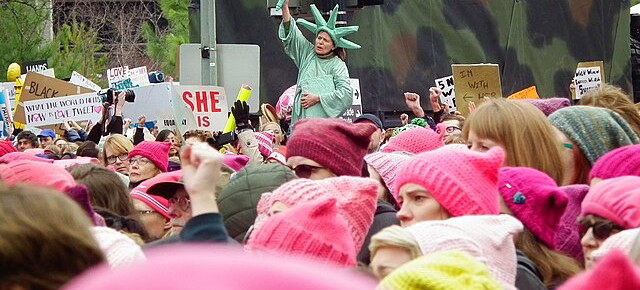
Many people first engaged in knitting resistance when Kat Coyle of Ravelry – the social group for knitters and crocheters – created a pattern for the “pussy hat”[iv] – a symbol of resistance to Donald Trump worn in the first Women’s March following his inauguration in 2017. The streets in Washington, DC and other cities across the country were filled with pink pussy hats.
Women’s March on Washington in 2017
These are just a few of the hundreds of ways knitting and other crafts have been used in resistance to oppression, tyranny, violence, and war. In 2003, Betsy Good coined “craftivism” – a combination of “craft” and “activism” – to describe this worldwide movement.[v] As one craftivist described it, craftivism is “a strategy for non-violent activism in the mode of do-it-yourself citizenship or do-it-together citizenship’.”[vi] Craftivist and author Sarah Corbette wrote, “To be a craftivist is not just to be someone who likes craft: it is to be someone who hones their craft to question injustice, encourage peace and show ways to achieve a better world for everybody involved.”[vii]
Craftivism includes all forms of fiber and needle arts – from knitting and crocheting to embroidery and quilting and more – from the use of quilts encoded with messages about the underground railroad and its resurgence as a medium for resistance during the Civil Rights movement to the AIDS memorial quilt,[viii] from suffragists’ embroidered banners for votes for women to the embroidered arpilleras of women in Chile to document human rights abuses during Pinochet’s regime. But the craft that is currently engaging so many is knitting. Knitting has featured prominently in anti-war resistance, such as the aforementioned CodePink banner. During WWI and II, knitting was central to resistance workers who knit secret messages into scarves and mittens and sweaters, using knit and purl stitches to represent dots and dashes in Morse Code, or dropping stitches in strategic places to represent German train activity. Women knit themselves into webs during anti-nuclear protests at Greenham Common in the 1980s and decorated the perimeter fence around the air base with ribbons and knit items. The British “Cast Off Knitting Club” knit grenade purses to protest the Iraq War and in the US Starhawk and fellow protestors created a yarn web around the Pentagon.
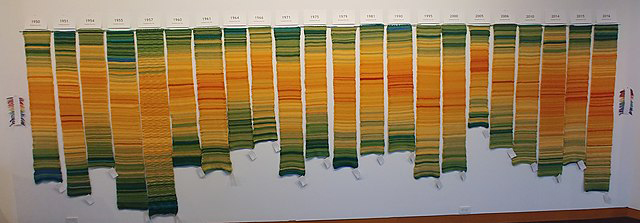
The Tempestry Project
Knitting has been used as a form of protest for countless other causes as well. Suffragists in the US knit, sewed, and embroidered banners with declarations of women’s right to vote. The “Tempestry” project was begun in 2016 in response to concerns that the incoming Trump administration would minimize climate data. Participants knit ‘temperature scarves’ with specific color-coding to record climate change data in various places in the US.[ix] The “Liberty Crochet Mural” – consisting of 40 individual crocheted squares assembled into a 17ft x 11ft yarn mural — celebrates women’s reproductive autonomy and freedom to choose. In the “Welcome Blanket” project — a response to the first Trump administration’s proposed 2,000-mile wall along the United States–Mexico border, Los Angeles artist Jayne Zweiman and dozens of other fiber artists knit, sewed, crocheted, and wove 3,500,640 yards of blankets to welcome immigrants.[x] And the Minnesota MTI hat is not the only anti-ICE knitting project. In Portland, Tracy Wright formed “Knitters Against Fascism,” which designed and promoted the Portland frog hat and conducts “knit-ins” outside the Portland ICE facility.[xi]
MTI hat in production
In Part II, more on knitting resistance and feminism, gentle protest, and community building – tomorrow
Laware, Margaret L. “Circling the Missiles and Staining Them Red: Feminist Rhetorical Invention and Strategies of Resistance at the Women’s Peace Camp at Greenham Common.” NWSAJournal, Vol. 16, No. 3 (Autumn, 2004), pp. 18-41.
[iv] The “pussy hat” was inspired as a protest against Trump’s infamous statement in a 2005 tape, “When you’re a star, they let you do it. Grab them by the pussy. You can do anything.”
[v] The term “craftivism” is usually attributed to Betsy Greer, but she actually coined the term when after she mentioned a connection between craft and activism, “Buzz,” one of the women in her knitting circle, said, “You could call it craftivism.” Greer then posted it on her online journal in 2000, and in 2003 bought domain named craftivism.com, which has become a worldwide network of craftivists.
[viii] Evidence suggests that quilt patterns such as the “Log Cabin” or “Flying Geese” may have been used in the Underground Railroad to provide coded messages to guide enslaved people to freedom. Women in the Civil Rights movement organized quilting circles as a form of resistance. The quilts made during the Civil Rights movement were often sold to raise funds for the movement. The AIDS memorial quilt originated in San Francisco in 1985 to memorialize those lost to AIDS. Gert McMullin, the ‘mother’ of the quilt, sewed the first stitch and since then 50,000 panels have been added, honoring more than 110,000 individuals. Weighing 54, it is thought to be the largest community art project ever created. It has raised more than $3 million dollars for AIDS services. Other famous resistance quilts include The Border Wall Quilt Project, a collection of 8” x 16” quilt pieces expressing concern about the border wall and the Broken Treaty quilts, created by Gina Adams, with texts taken from treaties to demonstrate the broken promises and injustices to indigenous peoples.
[x] The project quickly exceeded its goal and aims to encircle the globe in 36,521 handmade pieces. 8,000 have been collected so far. To learn more or participate, see Welcome Blanket.
[xi] The proceeds from the sale of the pattern have raised $500 for local food shelves.
Moderator’s Note: This piece is in co-operation with The Nasty Women Writers Project, a site dedicated to highlighting and amplifying the voices and visions of powerful women. The site was founded by sisters Theresa and Maria Dintino. To quote Theresa, “by doing this work we are expanding our own writer’s web for nourishment and support.” This was originally posted on their site on March 4, 2025. You can see more of their posts here.
Out of forty monuments along the National Mall in Washington, DC, none celebrate women and their contribution to American history.
One of our NWW [Nasty Women Writers] categories is Breaking the Bronze Ceiling where we track the effort to increase the number of monuments dedicated to real women in public spaces.
I’ve made many trips to Washington, DC, trekking the National Mall specifically to visit monuments. Why didn’t I notice women were missing? Am I so conditioned to not seeing women recognized and honored at the highest levels that I don’t even expect it or question their absence?
I felt ignorant and complicit.
It’s 2025 and there is not a single monument to honor women on our National Mall, a place that “draws roughly 36 million visitors a year, more than Yosemite, Yellowstone and the Grand Canyon combined”(Schuessler).
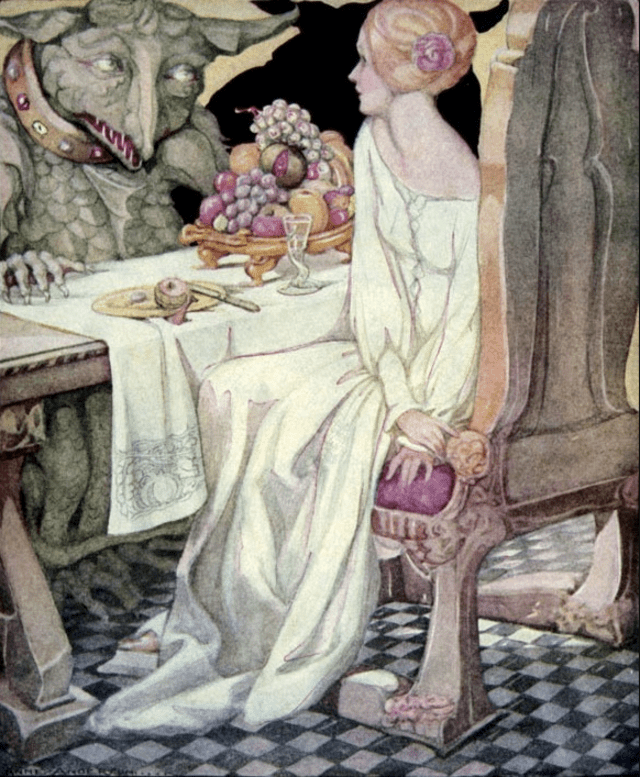
Annie Anderson, Beauty and the Beast, wikimedia commons, public domain
For most of cinematic history, the moral universe of film was anchored in clarity. The hero was dharmic—principled, disciplined, and guided by a moral compass that was neither ambiguous nor negotiable. The villain, by contrast, represented a clear rupture in the ethical order. Actions had consequences; justice was intelligible; human beings possessed agency, responsibility, and accountability. Main stream cinema reflected a world in which right and wrong, virtue and vice, were not merely narrative devices but metaphysical coordinates. One could locate a character on the map of moral compass with precision.
Older Indian cinema often adhered to a strong moral framework in which even the most charismatic or beloved protagonists were ultimately required to pay for their transgressions on screen. Unlike today’s era of morally ambiguous films—where anti-heroes may triumph, consequences are negotiable, and ethical lines are intentionally blurred—classic cinema rarely allowed wrongdoing to go unpunished. Yet this does not mean that earlier films lacked sophistication or ambiguity; rather, they explored moral conflict within a clear ethical horizon, allowing audiences to empathize deeply with flawed characters while still witnessing their inevitable downfall. For example, in Deewaar (1975), Amitabh Bachchan’s Vijay becomes an iconic rebel whom audiences passionately sympathize with, yet he must die in the end to restore moral order. In Parwana (1971), his obsessive, morally dark character meets a tragic ending, demonstrating the same principle. Even beyond Bachchan, iconic villains like Gabbar Singh in Sholay (1975) was originally written to die as a narrative necessity. Through such storytelling, older cinema balanced empathy with accountability, illustrating that complexity and moral clarity once powerfully coexisted.
I write to find out who I am becoming and when I implored Sedna to take me back to the sea I came to know my roots to Place were broken by age by betrayal by loneliness by advocating for a planet animals, trees by people who do not listen by people who will not see
like Mother Pine moaning outside my door I too moan Unforgiving Ice and Wind Treachery on every path Trees encased in White
At the Bottom of the Well Water Murmured accept this Break
Underground Mycorrhizal threads remain your Guides
Sedna rises meets you on dry land for the second time in one year
If you were taught that “men lead” is God’s design, this is your permission slip to ask a harder question: what if that teaching was never Eden’s plan — but a wound the world mistook for a rule?
Many of us grew up inside churches that loved us, baptized us, and gave us language for hope—while also wrapping womanhood in shrinking instructions: be agreeable, be modest, be quiet, be helpful. We learned to make ourselves small so that men could feel large. We learned to translate our leadership as “support,” our wisdom as “intuition,” and our authority as “being difficult.” We learned to carry the room’s temperature without ever touching the thermostat.
Feminism — and the women who lived it before it had a name — has always asked religion to remember itself. Not to abandon Scripture or tradition, but to recover what was true before fear called itself theology. Before we rewrite our lives, let’s reread the beginning.
A forgotten reading of the oldest story
Look again at Genesis: the woman sees that the fruit is “desirable to make one wise” (Gen. 3:6). In Scripture’s own poetry, Wisdom is feminine—personified as Lady Wisdom (Hebrew: Chokma) calling us to life (Prov. 8:1-4, 22-31). And Genesis 3:6 ends with four words we usually skip: “who was with her.”Translation: she leads; he lingers.
During my doctoral research, I worked in the field with a Lemba co- Researcher who remains a good friend, Dr. L. Rudo Mathivha of Johannesburg and the Northern Province. When we sat with the women in the village of Hamangilasi, we asked Hanna Motenda, one of the interpreters and a retired schoolteacher, about the women’s concept of God. Throughout the interviews, the women’s conversations both in this village and elsewhere reflected God imaged as male. I also asked whether the women imagine God as an external force, living in Nature or in Heaven, or as something living within themselves.
Hanna Motenda: Ourselves. God is in us. They say God is everywhere. Even in Nature, when we look at anything, we see God. Quoting others, she added, “God is like the wind, He’s everywhere and wherever I am, He’s there.”
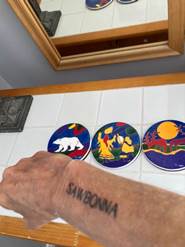
Tattooed upon my body. Residing in my soul. Sawbonna. Serpent. Snake. SHE who is. Was. Always will be. Like waking from a solemn sleep. I walked with the intention of heading to my home where I have been building houses. Papier-mâché mansions and tiny, tiny shacks. Sheds too, that speak of shelter. Of warmth. Of community.
After time with Jess and Benn in Emma’s office, heading in the direction of my cozy cave of light. My sanctuary. Where silence rarely slumbers. I looked up. Above me there, right there, blue, blue, sky. Fat potent clouds. One errant, silent-speaking breeze redolent with hope. Reeking of Sawbonna. I knew that the time had come.
I knew what I had do. I did not return home. I turned left on to Hunter Street. Wended my way to Simcoe Street.
After conversation with Nelson at Henry’s Barber Shop, Riverside Tattoo and I became acquainted. It was mid-afternoon.
I am a pupil of this thing we call life. Swelling and swollen with the capacity to transform and to be transformed by language: Logos Incarnate=Word Made Flesh. Fleshy is this thing. And I am fully aware that Word sculpts me. Oft-times seeks an answer to the query: to what is my life tied? My response is bound with choice. I must forever remember choice. Choice that comes ever clearer the more mis-takes I have made, the sharper the dynamic degrees of un-learning weld my heart to my intellect in a new way. Age-ing and Sage-ing too, sturdy accomplices in this rollicking and rocky gavotte HERe on the body of Godde: Earth. Earth HERself ever evolving and unfolding. Mysteriously. Meticulously. With slow and un-seen purpose. Tied we are the HER and our choices. Each expressions of this vitally significant relationship.
On my way to the Keynote I was invited to share with the John Howard Society, I watched the summer heat and haze emboldened by the relentless forest fires in Western Canada, finger its way in Central Canada, brush strokes of clotted air painting the sky a raw grey, causing lungs to feel the squeeze, noting that the beauty of the vastness of the un-burning forests through which I was being driven, was in no way diminished, curtailed, or truncated. Trees. Roots down deep. Sipping moisture. Sharing, far below the Earth, millennia of silent stories. Of as yet un-tapped Wisdom. Breathing us. Beckoning us, who journey upon and with HER to listen. And listen closely. Ask. Listen. Do that.
Moderator’s Note: This piece is in co-operation with The Nasty Women Writers Project, a site dedicated to highlighting and amplifying the voices and visions of powerful women. The site was founded by sisters Theresa and Maria Dintino. To quote Theresa, “by doing this work we are expanding our own writer’s web for nourishment and support.” This was originally posted on their site on July 13, 2021. You can see more of their posts here.
Spending summer 2021 in New Hampshire, I drive through Nelson quite often these days. Each time I do, I think of May Sarton, her years here, who she was, her art, and all she accomplished. I always glance down the road at the cemetery where she now rests.*
This post is one I wrote about May two years ago and it feels right to run it again since I feel so close to her these days. Enjoy!
May Sarton: Leaping the Waterfalls
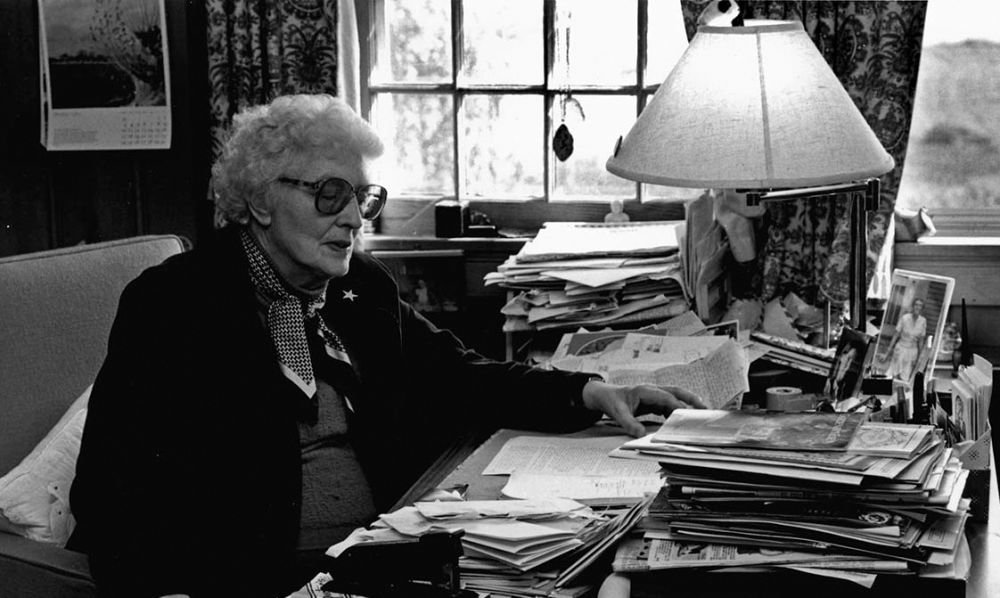
I’d been duped. The gray-haired writer who moved to the small town of Nelson, New Hampshire in 1958 was not who I imagined. I only discovered this when I began work on this post. Far from the tranquil woman in my mind, May Sarton was an enigma, even to herself.
At forty-six, May Sarton purchased her first and only house, attempting to extract herself. In a destructive relationship, struggling to reign herself in, she sought to settle, to live where only those she wanted to see or those who really wanted to see her would visit. Plus, the dramatic move would provide fresh writing material.




 Feminism and Religion