Self-calming with Syllable Counting and Rhyme Finding by Elizabeth Cunningham

In times of stress, I like to count syllables. It soothes me the way the click of knitting needles might soothe others. Finding rhymes is also calming. Below are poems in forms that require syllable count and/or rhyme, the last three written recently. I hope you are all sheltering well.

Villanelle: 10 syllables to a line. A, B rhyme scheme, with repetition of the 1st and 3rd lines.


noon

I have come to love the silence of noon
the cars have all gone wherever they go
I can hear the bees hum their tuneless tune

the noon of the day is the sun’s full moon
listen, the air is still, the wind lies low
I have come to love the silence of noon

the chainsaws silent, no wood to be hewn
no scratching the dirt, it’s too hot to hoe
I can hear the bees hum their tuneless tune

each shadow cast, now drawn close, is a rune
thickets conceal spotted fawns and a doe
I have come to love the silence of noon

this refuge from noise, a sweet daily boon
a full body blessing, crown to tiptoe
I can hear the bees hum their tuneless tune

each noon is a moment, passing so soon
the wild meadow flowers before we mow
I have come to love the silence of noon
I can hear the bees hum their tuneless tune Continue reading “Self-calming with Syllable Counting and Rhyme Finding by Elizabeth Cunningham”

When the Tomb Feels Safer than the Garden by Tallessyn Zawn Grenfell-Lee

I have always loved Lent and Holy Week. When I was young, I enjoyed the challenge of fasting. Holy Week was the powerful culmination of it all, so I would try to make the fast even harder then, like a sprint at the end of a marathon. Chocolate quickly got boring, so once I gave up all desserts. Another year, I gave up lying. (I’m a PK – Preacher’s Kid; enough said.) And then there’s the famous year sometime in my 20s when I decided I’d better give up swearing. (PK, remember?) Both my sister Trelawney and my husband just love to remind me of how I literally swore while walking out of the Ash Wednesday service. And didn’t even notice. And when they finally explained why they were laughing at me, I, of course, immediately cursed again. Sigh. Well, I respond each time, that’s why I decided to give it up in the first place!

My kids and I have also had a lot of fun observing Lent and Holy Week. Each year, it teaches us something new about abundance – especially amid the wealth of intensity and ritual during the last week. We are not legalistic about it; we just want to learn and grow together. One year, we limited plastic as much as possible. And I’ll never forget the year we gave up paper products. That was the first year we didn’t get sore noses, because we used handkerchiefs instead of tissues. As Trelawney likes to say, we finally stopped blowing our noses on a tree. Continue reading “When the Tomb Feels Safer than the Garden by Tallessyn Zawn Grenfell-Lee”

The Practice of Bearing Witness by Stephanie Arel

She looked away and stared out the window, trying to hold back the tears in her eyes. “The tents,” she said and shook her head looking down at the ground. The tears were coming, but softly. I asked her what the tents represent. She shrugged her shoulders and said into the camera phone: “The bodies I guess. They don’t have enough room for the bodies.”

In this time of the coronavirus, as in Italy and Spain, New York City has room neither in the hospitals nor the morgue for the bodies that are dying. Up from 25 a week, to 24 a day, bodies are being buried on Hart Island, or City Cemetery, where the unclaimed and unidentified have been interred for decades. Others are waiting in refrigerated trucks for friends and family members to collect them. This New Yorker along with thousands of others have seen the stark reality, one that left even Trump sick at heart.

We are witnessing a global pandemic. Evidence of the ravages of the coronavirus lies all around us. The response to the virus has made physiological, economic, and psychological impacts on our lives. We have changed our working styles, dealt with lowered income, or lost our jobs. Staying secluded at home, we have taken on new roles for which we were not prepared; many of us have become sick, and some have died. We are together witnessing a major world disaster.

What does it mean to be a witness? What will it mean to carry that witnessing forward to future generations to mark this historic event so that when something like it happens again, future generations will have the tools they need to respond more quickly, adapt more easily, recover more rapidly? For this generation, just as those who researched and learned from the Spanish Flu, we bear witness. Continue reading “The Practice of Bearing Witness by Stephanie Arel”

Persistent Beauty by Molly Remer

I knelt beside a sprinkling
of deer fur
dotted with delicate snowflakes.
Don’t take a picture of that,
my husband said,
people will think it is gross.
I don’t find it gross.
I find it curious.
I find it surprising.
I find a story.
Sometimes I feel like
I have to battle a horde
of demonic trolls
before I can take care of myself,
I tell him,
and yet somehow,
I say,
always,
always,
I find my life is still a poem,
in the quietude,
in the battling,
on my knees in brown gravel
to better see this spray of fur
and how the frost
glows like white stars.


I sit on a stone in the pines and let the winds come, sweeping my hair back and lifting my lamentations from my forehead, where they have settled like a black cloud.

I let the air soften my shoulders and my sorrows, sunshine bright on thick brown pine needles, slickly strewn across the steep hill. Continue reading “Persistent Beauty by Molly Remer”

Feeling Squeezed by Esther Nelson

Tyler Foggatt, associate editor of The New Yorker magazine’s, “The Talk of the Town series,” recently contributed (March 23) an essay titled “Cooped Up.”  She notes that China, the first country to shut down due to COVID-19, is now in the process of opening up.  More than ten million people in Xi’an, the capital of Shaanxi Province, were under lockdown.  She writes, “When restrictions were eased, earlier this month, the city’s [Xi’an] divorce rate spiked.”  Marital conflicts, often existing underneath the radar, bubble to the surface and sometimes explode during periods of quarantine (forced togetherness).

According to Foggatt, American psychologist Lawrence Birnbach predicts that the divorce rate in the U.S. will rise as the current pandemic unfolds.  Two of his patients, married to each other and self-quarantined together, reported they have argued more than ever, mostly having to do with how thoroughly (or not) one person washes their hands and wipes down surfaces.

I think many of us can relate to this.  Long before the current health crisis developed, my spouse and I went about our lives quite differently.  At times we clashed.  Keeping our distance from each other—even before social distancing became the “right” thing to do—was effective inasmuch as that strategy kept things from boiling over, at least most of the time. Continue reading “Feeling Squeezed by Esther Nelson”

A Theological Conversation by Natalie Weaver and Valentine

My son asked me to discuss with him the theological problem of the dual natures, i.e., the divine and human natures, coexisting in the person of Jesus.  He asked me to begin by assuming the premises that 1) Jesus was a real, historical person and 2) that Jesus was both human and divine.  The question then became, “Did Jesus know he was God?”

Of course, as a theologian, I was delighted to have this conversation with my son.  It was fascinating to see how his mind worked, to hear him evaluate the strengths and weaknesses of high and low Christologies, to hear how he resolved the question himself, and to have an opportunity to share my own thoughts with a genuinely engaged, truly curious, and attentively listening dialogue partner in the person of my teenage son.  Not too shabby a victory for any parent!

As we talked, he continued to provide context for the question, which began as a classroom debate in his high school theology seminar.  Apparently, the students were tasked with taking some element from their in-class discussion, evaluating it, and then applying it practically by a twofold retrospective reflection in which the students were 1) to identify a specific situation in their life that could have gone better and 2) to share how their insight drawn from class would have made all the difference.  Now, my son expressed a bit of frustration with this assignment because he would have preferred to discuss how today’s insights might help him in the future, rather than to dwell in the past.  As his wheels turned, I left him alone to puzzle out his assignment, with the promise that I eagerly would return in an hour to see what he produced, accompanied by my own essay on the same task.

Continue reading “A Theological Conversation by Natalie Weaver and Valentine”

Beth March and the Courage of the Gentle Giver by Cathleen F

As someone who spent my prepubescent years watching director Gillian Armstrong’s “Little Women”, I was eager to see Greta Gerwig’s newly released version. Previously unexplored contours of each character, and of my changed perceptions, were made visible through this iteration. The most difficult and touching part of the film that lingers with me is the story of Beth, pianist and caretaker. Beth’s untimely death brings grief into the center of the March family narrative, and Gerwig’s portrayal brought up grief in me about my experiences with invisibility as a paced introvert in a culture that celebrates speed and extroversion.

I grew up wanting to be like Jo March, the outspoken, reactive protagonist. Jo was the rebel, the obvious feminist, and, mostly importantly to me, the brave one. Beth seemed to me to be boring, relegated to a life at home, bound by illness and a preoccupation with the needs of neighbors. Her steadiness looked to me like obedience; she could not fight away the disease that eventually killed her, and I wished to be everything besides her, the introvert who observed and cared and loved music and then died. As I grew into my own introverted, observant, caregiving tendencies, I began to wonder if I had been tricked by my culture, by my upbringing, to think I was Beth when I was really Jo! While social pressures certainly influenced my personality, as they do for us all, I didn’t want to believe that perhaps I was growing into my natural temperament, endowed by the Universe, expressed in my mind and body. As a woman in the 21st century, as a feminist, I was supposed to be like Jo, not the way I was (am). To have a deliberate or tender nature was, in my subconscious perception, to betray the spontaneous, assertive natures of those more worthwhile feminists who got things done. Continue reading “Beth March and the Courage of the Gentle Giver by Cathleen F”

I Hope “This Changes Everything” by Elise M. Edwards

elise-edwardsLast week, I attended a film festival in Waco, Texas that showed the 2019 documentary This Changes Everything. Spending Friday evening at a film festival seemed like an enjoyable and appropriate way to kick off a weekend that would culminate with the Academy Awards (the Oscars).  I had no idea that this film would inform the way I viewed the movie industry and its most celebrated awards show.  It did change everything for me.

This Changes Everything is about the representation of women in film, particularly their underrepresentation and misrepresentation on screen and in the film- and television-making process.  It is not the first time this theme has been explored in a documentary. What struck me at this viewing, though, was the way the film portrayed patterns that resonated with my experiences in academia and in religious communities.  There are parallels between the way sexism manifests in entertainment and  I, along with other members in the (predominantly female) audience, couldn’t help but see parallels in Hollywood’s patterns of exclusion and the discriminatory conditions we confront in numerous other industries and professions.  What were these patterns?

Continue reading “I Hope “This Changes Everything” by Elise M. Edwards”

A Lonely Mystic by Molly Remer

I want to be a lonely mystic
dwelling in devotion,82419444_2537557396456467_4177258129500667904_o
constantly dialoging with divinity,
drenched in wonder,
and doused with delight
in knowing my place
in the family of things.
I want to weave spells
from wind and wildness,
soak in solitude,
and excavate  the depths
of my own soul.
I want great expanses of time
to be and to listen,
to feel and know,
each step a prayer,
ceaselessly walking with the goddess.
I crave the clarity of insight
dropping with a flash
into my open hands,
the clear space of listening
with no other voices in my head.
I want to pray with my eyes wide open83673511_2550947128450827_73123862618832896_o
from sunrise until sunset,
never missing an opportunity
to commune with the sacred,
to feel myself enrobed,
ensconced,
ensorcelled,
enspelled
with divine wonder, curiosity,
awareness, and understanding.
I want to light candles
and speak spells,
weave magic from the ordinary
and listen,
always listen,
to the whispers of my heart.
I want a chamber of quietude
with only crows and owls
for companions,
the soft eyes of deer
in a wooded glade
my witnesses,
steam rising from my broths and brews,
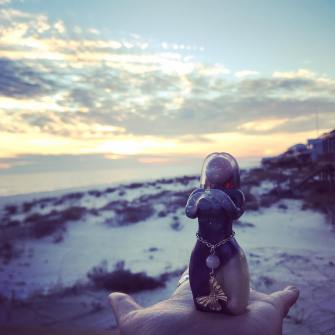
weeds and roses twining together
into the medicine of my spirit.
I want to be quiet and contemplative,
waiting in the shadows to spot the magic,
to feel the power,
to see through to the threads of things.
I want to feel still and holy
grateful and graceful,
to be an enspirited beacon
embodying my prayers.

Instead,
I am a mama mystic
I nestle children against my shoulder,
my nose resting in blonde hair and needs,
mediate disputes,
knead bread dough,
make dinner,
fold laundry,
read books,
find filaments of magic
wound around the smallest things,
claw solitude from scraps,
and weave small spells
and bits of enchantment
from moments of magic
that wander by my full hands and head.
I gently coax quiet poems
from full spaces,
let prayers wind up over days,
nosing patiently into the cracks
between my deeds.
And, with my hands in the dough,
or my nose in the hair,
or the hand in mine,
I am drenched in devotion,
dialoging with divinity,
each step a prayer,
and knowing my place
in the family of things.
This is where the goddess dwells
right through the middle of everything,
in the temple of the ordinary.
Here, she says,
this too,
is holy,
sacred,
true,
and it needs you,
not that bloodless,
imaginary,
perfect priestess,
of silent
secret praise.
This is the real work of living
and it shows you who
you
are.


*“Family of things” phrasing from Mary Oliver.

Molly Remer has been gathering the women to circle, sing, celebrate, 65317956_10219451397545616_5062860057855655936_nand share since 2008. She plans and facilitates women’s circles, seasonal retreats and rituals, mother-daughter circles, family ceremonies, and red tent circles in rural Missouri. She is a priestess who holds MSW, M.Div, and D.Min degrees and wrote her dissertation about contemporary priestessing in the U.S. Molly and her husband Mark co-create Story Goddesses, original goddess sculptures, ceremony kits, mini goddesses, and jewelry at Brigid’s Grove. Molly is the author of WomanrunesEarthprayer, the Goddess Devotional, She Lives Her Poems, and The Red Tent Resource Kit and she writes about thealogy, nature, practical priestessing, and the goddess at Patreon, Brigid’s Grove, and Sage Woman Magazine.

The Terrible-Horrible, Wonderful-Beautiful, Superbowl Halftime Show by Trelawney Grenfell-Muir

A lof of people have been raving about the Superbowl Halftime show, and for good reasons.

A lot of people have been raging about the Superbowl Halftime show, and for good reasons.

[Please hang in there with me as I conduct a back and forth exercise in this blog post; try to read it all the way through.]

Two famous, talented women of color performed impressive, culturally rich songs and dances, and along with children of color, they denounced the racism and cruel policies of the current administration. In many ways, it was the most progressive, ethically compelling Halftime show in history.

That’s all wonderful. It’s so wonderful, that one might ask whether anything more should be said. Why bring negativity into such a fabulous, fantastic celebration of culture and denunciation of racism? Continue reading “The Terrible-Horrible, Wonderful-Beautiful, Superbowl Halftime Show by Trelawney Grenfell-Muir”