“You may not remember, 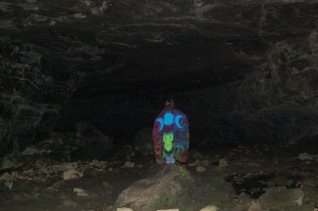
but let me tell you this,
someone in some future time
will think of us.”
—Sappho
I put on my boots and jeans, grab my priestess robe, pack a basket of ritual supplies, and meet four close friends in a nearby cave. We feel a little nervous about holding ritual on unfamiliar land, but we decide to push our boundaries and do it anyway. The land needs us, says my friend. The other people who come here are meth-heads and vandals.
We take our drums and climb to the top of the cave, singing as we find our way up the steep hillside. On top, looking out across the country, we sing: cauldron of changes, feather on the bone, arc of eternity, ring around the stone. We laugh and practice some more songs, some hearty, some tentative and new. We tie up small bundles of our symbolic burdens with stones and let them down over the edge
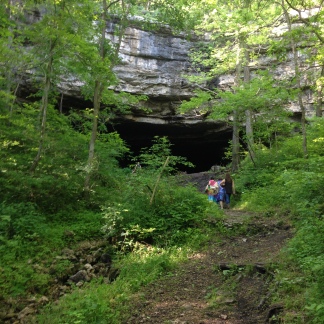 using handspun wool yarn until the yarn releases, taking our burdens with them. Suddenly, we hear the sound of tires on the gravel. Slamming doors. The sound of loud men’s voices. The smell of cigarette smoke. A ripple of uncertainty passes through us. We are once again tentative and we feel a current of unease. What should we do? we whisper to one another. The voices draw nearer, there are calls and hoots. My friend looks at me and says: this is where we make our stand. We hold hands in a line at the edge of the cave roof, gazing out into the horizon. A hawk wheels overhead. We sing. The approaching voices quiet. We sing louder.
I am a strong woman, I am a story woman, I am a healer, my soul will never die.
We project our voices and yell: we are the witches, back from the dead!
The voices stop. We wait. We hear doors slamming. The sound of tires on gravel. We are alone once more.
We descend into the cave singing a song composed on the spot: Deeper, deeper. We’re going deeper. Deeper, deeper. Deeper still.
We strike a pose based on the carvings described in the classic book, When the Drummers were Women. Archaeologists described 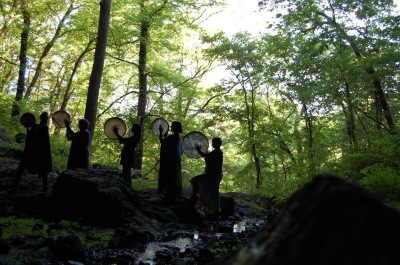 carvings of priestesses carrying drums as, “women carrying cakes to their husbands.”
We shout: “we’re not carrying cakes!”
I stand on a rock in the center of the cave and sing: she’s been waiting, waiting, she’s been waiting so long, she’s been waiting for her children to remember to return. My friends join the song and we move deep into the darkness where we face the “birth canal” at the back of the cave, listening to the small stream within trickle, laugh, and bubble as it emerges from the dark spaces deep within the heart of the earth. We begin to sing:
Ancient mother we hear you calling. Ancient mother, we hear your song. Ancient mother, we hear your laughter…
Just as we sing the words, ancient mother, we taste your tears, droplets of cave water fall on our faces, splashing our eyelids.
It might seem simple on the surface, but gathering the women and calling the circle is a radical and subversive act. A revolutionary act. In my work with women’s circles and priestessing, I am repeatedly reminded that gathering with other women in a circle for ritual and ceremony is deeply important even though it might just look like people having fun or even being frivolous, it is actually a microcosm of the macrocosm—a miniature version of the world we’d like to see and that we want to make possible.
In the book, Casting the Circle, Diane Stein observes that women’s rituals, “…create a microcosm, a ‘little universe’ 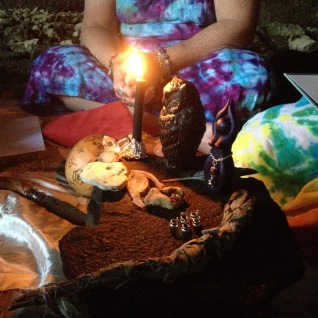 within which women try out what they want the macrocosm, the ‘big universe’ or real world to be. Within the safety and protected space of the cast circle, women create their idea of what the world would be like to live in under matriarchal/Goddess women’s values…The woman who in the safety of the cast circle designs the world as she would like it to be takes that memory of creation and success out into daily life…By empowering women through the microcosm of the ritual’s cast circle, change becomes possible in the macrocosm real world.” (p. 2-3)
It starts with these private ritual and personal connections and then, as Stein explains, “A group of five such like-minded women will then set out to clean up a stream bed or park in their neighborhood; a group of twenty-five will join a protest march for women’s reproductive rights; a group of a hundred will set up a peace encampment. The numbers grow, the women elect officials to government who speak for their values and concerns. Apartheid crumbles and totalitarian regimes in Eastern Europe end, disarmament begins, and laws to control polluters are enforced. Homes, foods, and jobs are opened to the world’s homeless, and often begins in the microcosm of the Women’s Spirituality ritual circle” (p. 3)
“Feminism catches fire when it draws upon its inherent spirituality. When it does not, it is just one more form of politics, and politics never fed our deepest hungers.”
–Carol Lee Flinders (in The Millionth Circle)
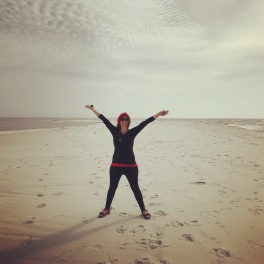 Molly has been “gathering the women” to circle, sing, celebrate, and share since 2008. She plans and facilitates
women’s circles, seasonal retreats and rituals, mother-daughter circles, family ceremonies, and red tent circles in rural Missouri and teaches online courses in Red Tent facilitation and Practical Priestessing. She is a priestess who holds MSW, M.Div, and D.Min degrees and finished her dissertation about contemporary priestessing in the U.S. Molly and her husband Mark co-create Story Goddesses, original goddess sculptures, ceremony kits, and jewelry at Brigid’s Grove. Molly is the author of Womanrunes, Earthprayer, and The Red Tent Resource Kit and she writes about thealogy, nature, practical priestessing, and the goddess at Brigid’s Grove.


 I love going to outdoor movie screenings. Sitting outdoors on a summer evening with good company brings me joy. Last week, I went to an screening of Moana, the Disney movie about a teenager who goes on a quest through the Pacific Ocean with the demi-god Maui. Moana goes on this journey to help her people. The movie came out last year, but I didn’t see it. I have to admit that I wasn’t even interested in it until Simone Biles performed a dance to one of Moana’s songs on Dancing with the Stars. It was then that I realized that the movie has an empowering message. I asked my friend Natalie, who is also a feminist religion scholar, about Moana. She has three young daughters, so I trusted her to be more current than I am. Her enthusiastic response sold me, as did her remark, “There’s not even a love story in it!”
 I haven’t shared this story with too many people, yet it is one that has always remained on the back burner of my mind.
 ke me, today (and most days lately) it is difficult to be positive in a world that seems so full of hate. In fact, I struggled with a topic to write about because, in all honesty, it is hard to see the greener grass from where I sit – with all of the hatred spilling out in neighborhoods, churches, schools, and college campuses – even between family and friends. As I scrolled through Facebook, I came across a video and was struck by its message – we must be relentless in our kindness otherwise evil will win.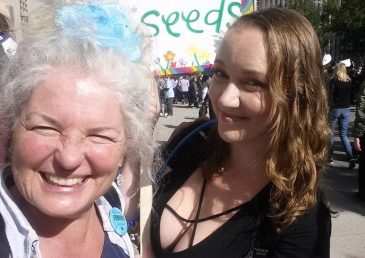
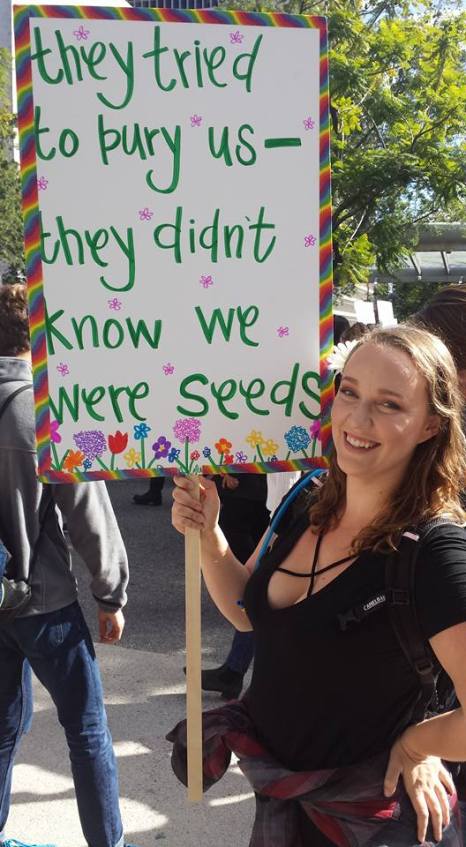
 Viśākhā is often called the greatest female lay follower of the Buddha. She prompted the Buddha to give numerous teachings. She also donated generously to the Sangha (monastic order). Her crowning contribution was building a monastery called Migāramātupāsāda.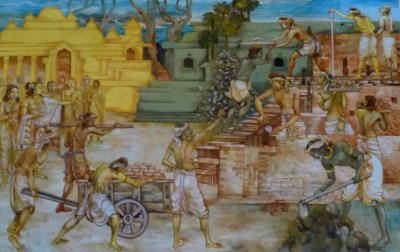
 As many of you may already know, on August 24, 2016, feminist theologian and scholar Rosemary Radford Ruether suffered a significant stroke. There has been some speculation from those who know or have known Rosemary about her current condition. Here is the short of it. While Rosemary has made progress, her doctors and therefore Medicare feel it is insufficient to warrant continued physical and speech therapies. Those who interact with Rosemary on a daily or weekly basis disagree with this medical prognosis. The stroke damaged the part of Rosemary’s brain that allows for communication, therefore she, at this time, is not able to speak. That said, Rosemary recognizes individuals, is able to respond to some commands and engage in therapeutic exercises. The more attention and care she receives the greater her capacity grows for a more meaningful life that includes a level of agency.
  Although “the” Ramayana is a fluid narrative, scholarship has traditionally recognized the Sanskrit Valmiki Ramayana as the most authoritative of Ramayanas. But recent studies have brought to light the hundreds of regional stories of Rama and Sita which are more popular with the masses. These would include Krittibasa’s Ramayana in Bengal, Kamban’s Tamil Iramavataram in South India, notably in the state of Tamil Nadu, Tulsidas’s Ramcharitamanas among the Hindi-speaking belt of northern India, and so on. But even here, a pattern seems to emerge; all the above-mentioned authors are male. Within this scenario, a rather unique text stands out, and that is Chandravati’s sixteenth century Bengali Ramayana, for its author was a woman. Even more fascinating is the double-toned nature of the narrative – through Chandravati’s own voice and through the voice of its tragic heroine, Sita.
