
May Alcott Nieriker (1840-1879): Little Woman, Big Ambition, part 2 by Maria Dintino

Part 1 was posted yesterday

May clearly defines her audience,

“For I am supposing our particular artist to be no gay tourist doing Europe according to guide-books, with perhaps few lessons, here and there, taken only for the name of having been a pupil of some distinguished master, but a thoroughly earnest worker, a lady, and poor, like so many of the profession, wishing to make the most of all opportunities, and the little bag of gold last as long as possible”(6).

In her book, she covers three art hubs, London, Paris, and Rome, providing information on means of travel, places to stay, artists to study with, galleries and museums to frequent, scenic sites for sketching and painting, and even stores to buy art supplies and clothing. A more useful document, I cannot imagine! Julia Dabbs concurs with this assessment in her article Empowering American Women Artists: The Travel Writings of May Alcott Nieriker:

Then as now, it is difficult to imagine a reader not being inspired by May’s words of encouragement, her practical advice, and her passion for art.”

Continue reading “May Alcott Nieriker (1840-1879): Little Woman, Big Ambition, part 2 by Maria Dintino”
May Alcott Nieriker (1840-1879): Little Woman, Big Ambition, part 1 by Maria Dintino

Moderator’s Note: This piece is in co-operation with The Nasty Women Writers Project, a site dedicated to highlighting and amplifying the voices and visions of powerful women. The site was founded by sisters Theresa and Maria Dintino. To quote Theresa, “by doing this work we are expanding our own writer’s web for nourishment and support.” This was originally posted on their site on Oct 22, 2024. You can see more of their posts here. 

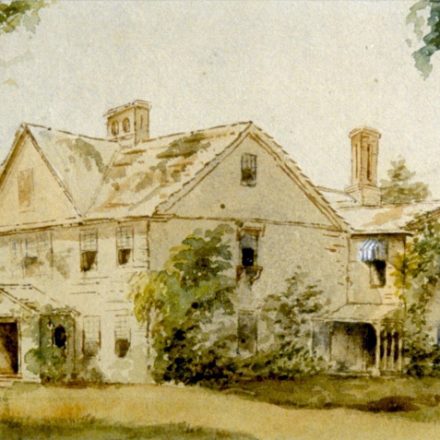
The Orchard House, painted by May Alcott.

The youngest sister of Little Women author Louisa May Alcott, May Alcott Nieriker, was a successful artist. Her accomplishments were many and her unflappable relationship with her sister Louisa made it all possible. Here’s to sisterhood of all kinds, where unwavering love and support make so much possible!

Visiting the literary houses lining the streets of Concord, Massachusetts, I found myself in the Orchard House, a house and family made famous by Louisa May Alcott’s blockbuster novel Little Women (1868).

Entering an upstairs bedroom, I was struck by the artwork on the walls and was told it is the work of May, the youngest Alcott sister, Amy in Little Women. Her parents, progressives in their time, allowed her to paint and sketch on her bedroom walls. I was informed that most of the artwork displayed in the house is also that of May’s.

My curiosity was stoked: Who was this woman?

Continue reading “May Alcott Nieriker (1840-1879): Little Woman, Big Ambition, part 1 by Maria Dintino”

Beth March and the Courage of the Gentle Giver by Cathleen F

As someone who spent my prepubescent years watching director Gillian Armstrong’s “Little Women”, I was eager to see Greta Gerwig’s newly released version. Previously unexplored contours of each character, and of my changed perceptions, were made visible through this iteration. The most difficult and touching part of the film that lingers with me is the story of Beth, pianist and caretaker. Beth’s untimely death brings grief into the center of the March family narrative, and Gerwig’s portrayal brought up grief in me about my experiences with invisibility as a paced introvert in a culture that celebrates speed and extroversion.

I grew up wanting to be like Jo March, the outspoken, reactive protagonist. Jo was the rebel, the obvious feminist, and, mostly importantly to me, the brave one. Beth seemed to me to be boring, relegated to a life at home, bound by illness and a preoccupation with the needs of neighbors. Her steadiness looked to me like obedience; she could not fight away the disease that eventually killed her, and I wished to be everything besides her, the introvert who observed and cared and loved music and then died. As I grew into my own introverted, observant, caregiving tendencies, I began to wonder if I had been tricked by my culture, by my upbringing, to think I was Beth when I was really Jo! While social pressures certainly influenced my personality, as they do for us all, I didn’t want to believe that perhaps I was growing into my natural temperament, endowed by the Universe, expressed in my mind and body. As a woman in the 21st century, as a feminist, I was supposed to be like Jo, not the way I was (am). To have a deliberate or tender nature was, in my subconscious perception, to betray the spontaneous, assertive natures of those more worthwhile feminists who got things done. Continue reading “Beth March and the Courage of the Gentle Giver by Cathleen F”