Go, Dodger Blue? by Xochitl Alvizo  

Attending a Dodger game as a four- or five-year-old with my uncle, the biggest Dodger fan I ever met, was my first professional sporting events experience. To this day, I’m not a sports fan by any means, but if you ever do catch me watching or rooting for a sports team, it will be for the Dodgers, as it got wired into me at a very young age. 

So, I was one of the 51 million people across the U.S., Canada, and Japan tuning-in to watch the 7th game of the 2025 World Series between the Dodgers and the Blue Jays. I cheered, clapped, and whoo-hoo’d as the Dodgers made the final winning double-play in yet another extra-innings game in the series. But it was not without mixed feelings that I cheered on the team that has been part of my life and family upbringing.  

Continue reading “Go, Dodger Blue? by Xochitl Alvizo  “

The Gospel of Salome by Kaethe Schwehn, Book Review by Michelle Bodle

What would happen if you were a disciple of Jesus and you had an encounter with someone who told you a different narrative than what you had heard in the past? How would you react? What would you preserve? How would you reconcile the stories you have been told and have told others as an apostle with what someone is now proclaiming?

            The Gospel of Salome is a work of Biblical fiction focused on Salome, a character who we hear of being present at the crucifixion and the empty tomb in the Gospel of Mark. Some scholars have connected her with “the mother of Zebedee’s children” in the Gospel of Matthew or “his mother’s sister” (i.e. Mary’s sister) in the Gospel of John. Schwehn takes a different approach, portraying Salome as a woman who was sought out for her skills in medicine, finds herself in the presence of John Mark, one of Jesus’s disciples who has come to Alexandria.

            Going back and forth between speaking to John Mark in the present and living in her memories of the past, Salome tells the apostle that she is the true mother of Jesus. However, there is another factor to consider in her proclamation – Salome’s dementia, which is threatening to steal her memories. Memories about Salome’s agreements with Mary about Jesus’s desire to learn how to heal or Mary asking Salome to not be present in Jesus’s life. Memories of being at the cross and the empty tomb.

Continue reading “The Gospel of Salome by Kaethe Schwehn, Book Review by Michelle Bodle”

The Beast at Our Door: Fenrir Wolf and ICE by Janet Maika’i Rudolph

Binding of the norse mythological wolf, Fenrir. From Guerber, H. A. (Hélène Adeline) (1909). Myths of the Norsemen from the Eddas and Sagas. London : Harrap. This illustration is on page 92. Digitized by the Internet Archive Wikimedia Commons

When I was a shamanic trainee, our group spent a lot of time and focus on the “beast within” This concept has had many expressions in different circumstances – the shadow side (Jung), the dark side (Star Wars), letting loose the “dogs of war” (William Shakespeare), reptilian instincts (psychology). 

Mythology has many stories about this phenomenon. In our group, we studied the stories as a way to learn what we must do in our own lives to tame the beast so we had this energy available to use the energy without letting the crueler destructive aspects of the beast run rampant. Here are two of the stories as we discussed them.

Fenrir Wolf

Fenrir Wolf is a deity from the Norse tradition who was known and feared as a great monster. Tyr was the only God in Asgard brave enough to tend to Fenrir. For a long time, Tyr fed and cared for him. Eventually, though, Fenrir grew too large to handle and began running throughout the land called Midgard, killing both gods and people. Odin called a council to discuss how Fenrir could be slain. 

Continue reading “The Beast at Our Door: Fenrir Wolf and ICE by Janet Maika’i Rudolph”

Living in an Ever-Changing Co-Creative Universe by Carolyn Lee Boyd

Grand Star Forming Region. These stars are only a few million years old.

Imagine living in a co-creative universe where all beings, including the Divinity and humans, are ever co-evolving reality in a way that nurtures life. What kind of a world would that be? Feminist theologian and FAR contributor Carol Christ brilliantly describes how these ideas, part of an approach called process philosophy, deeply resonate with Goddess thealogy in her 2003 book She Who Changes: Re-Imaging the Divine in the World

She writes “process philosophy states that all life in is process, changing and developing, growing and dying, and that even the divine power participates in changing life. Humans and other beings are not things (substances or essences) situated in empty space, as has often been thought by philosophers and scientists, but are active processes ever in relation and transition…” (3). In fact, “the whole universe is alive and changing, continually co-creating new possibilities of life” (45). Further, “Process philosophy asserts that feeling, sympathy, relationship, creativity, freedom, and enjoyment are the fundamental threads that unite all beings in the universe, including particles of atoms and the divinity” (3). 

Continue reading “Living in an Ever-Changing Co-Creative Universe by Carolyn Lee Boyd”

Witch Hazel, a Tree that Belongs to Women! part 1 by Sara Wright

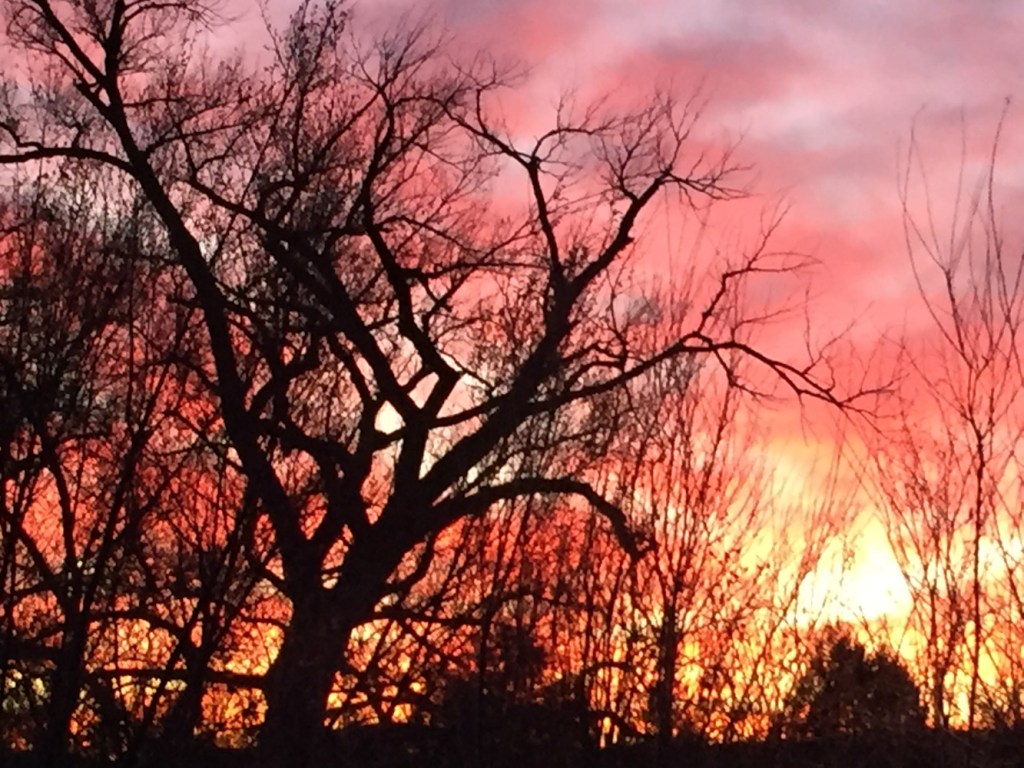
Yesterday, I was on my way home at dusk when the clouds parted and the mountains were drenched in deep gold. Still waters mirrored earth, land, sky.

I soaked in the last of the fall color that is still striking in a few protected places, gathering in images of still waters to remind me that nature is home.

Why do I need this visual reminder?

  Yesterday I read an article that queries the issue of human cruelty triggering the usual overwhelm. Every day it’s something. I force myself to stay present to what’s happening on a peripheral level. To do this, I need to keep myself grounded in the rest of nature to help me deal with what’s happening to this planet and her people. I am struggling hard to maintain some sort of balance despite the pain and chaos.

I have no answers to what is happening cross culturally on a global level unless we begin to re-establish a heart- level connection with humans and the rest of nature. The warnings I receive have become more dire making it impossible for me to block them out.

When I can surrender to nature’s beauty, I can also locate myself as a speck in the life of a five -billion year old planet even if it’s just for a few seconds at a time. My love for my dog, the birds at my feeder, free roaming bears, the kindness of neighbors and friends,   also help me to feel that I am being given a gift.

Continue reading “Witch Hazel, a Tree that Belongs to Women! part 1 by Sara Wright”

NO Kings Day Protest – Lakewood, CA by Marie Cartier 

Note – usually we have a Carol Christ Legacy post on Mondays. Today we have a post in the spirit of the elections taking place this week across the United States.

October 18, 2025

Largest single day protest in US history- over 7 million people- 2700 + gatherings

P.s. That’s my wife in the inflatable bear costume– NO KINGS and YES ON 50!

Continue reading “NO Kings Day Protest – Lakewood, CA by Marie Cartier “

Samhain and the Goddess by Judith Shaw

The wheel of the year is turning us once again toward the dark half of the year. Here in the United States, the bright, shining days of youth and achievement receive the most attention. Death and darkness are rarely honored and often feared.

But the ancient Celts had a completely different view of their place in the world. With a strong belief in reincarnation, the Celts saw death as simply a point of transition in a very long series of lives. People honored the darkness of both night and winter as starting points. In the Celtic worldview a day began at sunset, not sunrise, and the New Year began on Samhain, October 31—the midpoint between Fall Equinox and Winter Solstice.

Samhain, one of the four great fire festivals of Celtic tradition, might have begun long before the Celts arrived in Ireland under the influence of an ancient goddess, Tlachtga (tclak ta). She was most likely from the time of the Fir Bolgs, (fair bolak) the Bronze Age inhabitants of Ireland from the East, and later incorporated into the Celtic pantheon.

Tlachtga--celtic-goddess-painting-by-judith-shaw
Tlachtga, Celtic Goddess of Sun & Lightning, gouache on paper
Continue reading “Samhain and the Goddess by Judith Shaw”

Dancing for the Ancestors: Ahouache Dance in Southern Morocco by Laura Shannon

This autumn I am once again in southern Morocco, bringing friends and students to experience traditional Berber women’s dance and culture. 

The Berbers or Imazighen* are the indigenous people of North Africa, who have lived for at least 12,000 years in the Maghreb region (Morocco, Algeria, Tunisia, Libya, Mauritania, and Western Sahara). Within this vast area, different Berber tribes follow various forms of social organisation, yet remain linked by language, culture, and a shared sense of identity. 

Among the Berbers, 

The ‘religion’ of women is expressed in the cult of the family, in religious practices performed close to their environment and in the management of clairvoyance and healing within the domain of the traditionally sacred… [The] domain of the sacred is found in the family community as it extends to the village, according to social relations determined by a spirit of collective responsibility. This is found between the living but also with the Ancestors. – Makilam

Even though the Souss Valley and Anti-Atlas mountains of Morocco where we are travelling is far from the Kabylia region of northern Algeria Makilam describes, her comments also apply here.

Continue reading “Dancing for the Ancestors: Ahouache Dance in Southern Morocco by Laura Shannon”

How Women Construct And Are Formed By Spirit: She Who Is Everywhere In Women’s Voices, part 2 By D’vorah Grenn, PhD

part 1 was posted yesterday

 How God is Constructed

During my doctoral research, I worked in the field with a Lemba co-
Researcher who remains a good friend, Dr. L. Rudo Mathivha of Johannesburg and the Northern Province.  When we sat with the women in the village of Hamangilasi, we asked Hanna Motenda, one of the interpreters and a retired schoolteacher, about the women’s concept of God. Throughout the interviews, the women’s conversations both in this village and elsewhere reflected God imaged as male.
I also asked whether the women imagine God as an external force, living in Nature or in Heaven, or as something living within themselves.

Hanna Motenda: Ourselves. God is in us.  They say God is everywhere. 
Even in Nature, when we look at anything, we see God.  Quoting others, she
added, “God is like the wind, He’s everywhere and wherever I am, He’s
there.”

Continue reading “How Women Construct And Are Formed By Spirit: She Who Is Everywhere In Women’s Voices, part 2 By D’vorah Grenn, PhD”

How Women Construct And Are Formed By Spirit: She Who Is Everywhere In Women’s Voices, part 1 By D’vorah Grenn, PhD

I dedicate this article, an excerpt from my dissertation to Rita Rosalind Kolb Grenn, Hanna Eule, Verena La Mar Grenn & their mothers,
Franziska Silberstein, Kaye Schuman and Regina Possony,
and to the Kolb, Berlstein, Bernstein, Mathivha, Sabath, Gruenbaum,
Silberstein, Lawler and Scott female ancestors.

Creator woman by Raphalalani

“She is Creator of the Universe, and of Mankind…She is Creator Woman”
– Meshack Raphalalani, Venda artist describing his sculpture, 2001

The Shekhinah1 is considered an alternative way of thinking about God in the orthodox community… not the major way of thinking about God…
but not heresy at all.  It’s right there in the tradition.
– Blu Greenberg, co-founder, Jewish Orthodox Feminist Alliance, interview, 2001

He created me in his image so he’s inside, within me.
– Hanna Motenda, Lemba translator at Hamangilasi village, 2001

Continue reading “How Women Construct And Are Formed By Spirit: She Who Is Everywhere In Women’s Voices, part 1 By D’vorah Grenn, PhD”