Grief Overshadows Joy by Sara Wright

Fall is the season of ‘the cutting away’, a poignant time to celebrate the deepening darkness as we turn inward. I think the powers of the goddess are strongest at this time of year… I wrote this wistful poem in celebration of Autumn as I am experiencing it this year… perhaps the personal reflection that follows is the kind of thinking that is capable of opening a door to a new way of perceiving?  

Autumn Gold

Autumn gold

stains the maples

beech hay ferns too

each day

 a deeper glow

bittersweet bleeds

into lemon

liming veins

scarlet sears a leaf

or two

salmon rose blurs…

 fir balsam hemlock

spires reach

skyward

forest green

needles

soak in drops

of rain.

Continue reading “Grief Overshadows Joy by Sara Wright”

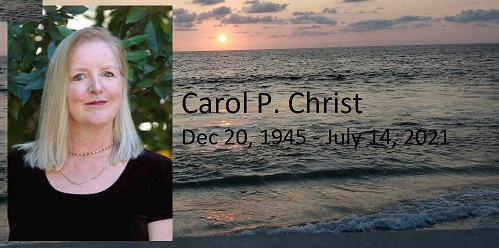
Legacy of Carol P. Christ: The Devil’s Bargain: “If You Can Convince a White Woman”

This was originally posted on August 12, 2019

This week’s news from America. Where to begin? When will it end?

The President of the United States is a racist who incites racist violence. Republicans have been slow to condemn the President and are not likely to pass a complete ban on assault weapons and to make those currently in circulation illegal.

After reading a speech condemning hate speech and gun violence that he obviously didn’t write, the President scheduled a round-up of brown people working in chicken-packing factories in Mississippi to coincide with his unsympathetic visits to the cities of Dayton and El Paso, where two recent mass killings by assault weapons occurred. The next morning, we were greeted by images of little children coming home from school in small towns in Mississippi to find their parents missing. We were told that none of the surviving victims of the El Paso shooting wanted to meet the President.

This is not the America I want. But it is the America that many Americans seem to want. I would like to think that women as a group reject the President and his agenda. Sadly, this is not true.

Continue reading “Legacy of Carol P. Christ: The Devil’s Bargain: “If You Can Convince a White Woman””

Is the Divine the Unknowable Unknown? A Feminist Take by Ivy Helman

I attended a number of High Holy Days services (online) over the past couple of weeks. In one of them, one of the rabbis said that the divine is the unknowable unknown. I cannot remember what the Rabbi said to contextualize or explain their train of thought; I think I was too intrigued by the idea that I got lost in my own thoughts. In fact, I have been thinking about the unknowable unknown ever since.  

As I write this, I’ve come to this conclusion: if the divine is present among us and the world around us, then there is much we can intuit. In addition, there is much that we can experience the more we interact with other humans and nature.  On the other hand, if the divine is understood as a detached, distant being of a completely different essence than humanity, of course, what can we really know about such a divinity?  How would we even know if that divinity even existed? We probably wouldn’t.  Here is the difference between a  feminist understanding of the divine as this-worldly and empowering and a patriarchal conception of a distant divinity wielding power-over. Yet, interestingly, even the most patriarchal image of the divine has insisted on being relatable to human beings. Nonetheless, how we imagine the divine does matter.

In her book, Models of God: Theology for an Ecological, Nuclear Age, Sallie McFague argues that the words and ideas we use to describe the divine are important. She advocates for the use of metaphors to describe the divine, stating that we can only describe what the divine is like, not what divinity actually is. In fact, she warns the reader of long-lasting models for the divine as these can lead to idolatry, an understanding that limits divinity and, because of this, is essentially untrue. She writes on page 99 that, “[i]f we use only the male pronoun [for the divine], we fall into idolatry, forgetting that God is beyond male and female…” In other words, we are limiting the divine and furthermore speaking an untruth.  

This talk makes we wonder if she too is of the camp that we cannot understand divinity; that the divine is quite different from us. I mean if we cannot and should not have any long-standing model for the divine but only use shaky fleeting metaphors, our understanding of the divinity is genuinely limited and amorphous. Yet, there is a difference between some knowledge and experience of the divine and the idea of the divine as the unknowable unknown, isn’t there?

That being said, I find much of what she has to say extremely helpful when it comes to traditional understandings of divinity.  In her book, she implicates as problematic the long-standing models of divinity as Father and King, among others.  These out-dated models move us further and further away from the divine because they are thought to definitively explain who the divine is in relation to us.  

Let us look at Yom Kippur, the Day of Atonement, as an example of this in Judaism.  Here, we have a day in which we are highly vulnerable as we reflect on the ways in which we have not always treated ourselves, others, the world around us, and the divine as we should (had hoped to). Yet, we enter the synagogue and repeatedly address the divine as Avinu Malkeinu (Our Father, Our King).  Why is the understanding of divinity that we approach one of judge, strict parent, and ruler over us?  Does that not drive a wedge of sorts between divinity and humanity? Does that not make being inscribed in the book of life seemingly impossible unless we are non-human-like?

Contrary to what we often hear in shul, Judaism recognizes some 70 diverse understandings, or names for the divine. These names range from Hashem (the Name) and Shalom (Peace) to Shechinah (the in-dwelling) and Kadosh Israel (the Holy One of Israel). And there are many, many more.  

Returning to our example again, instead of the umpteen rounds of Avinu Malkeinu, what would it be like on Yom Kippur if we approached the divine as Shaddai (Comforter), Hamakon (the Present One, literally the Place), or YHWH-Rapha (The One Who Heals)? These understandings seem to offer the compassion we need on a most vulnerable day.  How much easier would it be to connect to divinity that understands us?  Perhaps we could learn a little more about divinity in that case, and we could in the process become much closer to the holy?  And, isn’t that the point of Judaism? To be holy like the divine is holy?  I think so. 

From a feminist perspective, how we understand the divine has real-life consequences which can shape how we understand ourselves and the world around us. Just imagine what Yom Kippur would feel like, if we called on the divine that day as the comforter, the present one, and the one who heals. It would feel totally different, and for very good reasons.

Who would have thought that some three weeks ago or so, I would have heard a phrase about the divine that still has me in a quandary? I mean, in the end, I suppose there are ways in which the divine is unknowable. Importantly, though, that does not make the divine wholly unknown. Rather, it is often the language we use about the divine that puts distance between us and divinity, that makes divinity less and less known.

Ivy Helman, Ph.D.: A feminist scholar and faculty member at Charles University in Prague, Czech Republic where she teaches a variety of Jewish Studies, Feminist and Ecofeminist courses.  

A Celtic Pilgrimage: Becoming a Bard by Trelawney Grenfell-Muir

Trelawney at the moment of initiation. (Photo credit Greg Martin/Cornwall Live)

As I gazed up at Grand Bard Mab Stenak Veur, I could feel my eyes shining with joy, my gratitude, awe, love, and reverence for Kernow thrumming through me like the crescendo of a bright, glorious song. My whole world focused in that moment to the feel of his hands clasping mine — as though all Kernow were embracing me and holding me; the sight of his kind eyes and gentle smile— as though Kernow were lighting beacons to greet my homecoming; the sound of his voice proclaiming my new name, “Bleydh Ow Resek,”— as though Kernow herself were naming me to be her own child, come home at long last to my mother, who longs for me even as deeply and powerfully as I have always longed for her.

While I started learning Kernewek only four years ago, my journey to Bardhood started much earlier. I believe it began at birth, when my parents gave me the Christian name Trelawney, after the revered Cornish rebel leader who stood up against English oppression. Though no one in New England had heard of Kernow (Cornwall), my family’s joyful pride in our Cornish identity shaped my life. We were taught how my grandfather Jack left Kernow as a child because his parents responded to the call for more Methodist pastors to come to the United States.

Continue reading “A Celtic Pilgrimage: Becoming a Bard by Trelawney Grenfell-Muir”

Triple Goddess in the Land by Eline Kieft

A Modern Pilgrimage to the Isle of Lewis & Harris, Part 1

For a long time, I felt a soft but insistent tug to go to the Isle of Lewis & Harris, on the west coast of Scotland. Third time lucky, because the trip got cancelled twice due to Covid-19. Even this time was a challenge, with flights being pulled, and airport strikes causing last minute changes. It was as if the Goddess was asking me, “how serious are you about this, daughter?”

Eventually I managed to get to Edinburgh on time, all the way by train from our small sleepy village in France, to catch the connecting flight to the island. 

In this post (Part 1), I write about meeting the Triple Goddess in the Land. Part 2: The Stones, focuses on my Equinox ceremony in the Callanish Stone Circle.

Continue reading “Triple Goddess in the Land by Eline Kieft

Authenticity by Beth Bartlett

The leaves have finally begun to turn. I’ve been longing for the trees to reveal their true beauty in all their colorful array, and am glad for this beginning. Soon the woods will be filled with the golden, amber, scarlet, and orange glow of the maples, aspen, birch, and oaks of the northern forest.

Hawk Ridge

It is the time of year I would take my Women and Spirituality students to a sacred spot on a ridge high above Lake Superior to explore their spiritual connections with the earth. They would share a particular way they felt a connection to the natural world – often a lake, or a place from their childhood, a tree they loved to climb, their dog, or a stone they carried.   We would circle the large pine and invoke Starhawk’s “Open-Eyed Grounding” practice.[i] They would read and comment on their favorite passages from the readings – selections from Susan Griffin’s Woman and Nature and Carol Christ’s “Rethinking Theology and Nature.”[ii] Then they would disperse across the ridge for their solo encounters with nature, before gathering together again, each returning with something they had discovered during that time.  Then we would talk about the changing colors of the leaves surrounding us and talk about how these were the true colors of the leaves, finally emerging now that the chlorophyll that had disguised them in green was beginning to wane. Taking our cue from the leaves, we would talk about authenticity – about their coming into their own true colors. For that is the work of spiritual growth and transformation — to emerge as our own true selves. Yet, how often our unique and precious beings are taught to mask our true color, blend in — be “green” like everyone else.  What a vivid and beautiful world when we come into our own and share our unique gifts and being with the world.

Continue reading “Authenticity by Beth Bartlett”

Rites of Fall, by Molly Remer

“Sometimes there is small magic
and scraps of enchantment.
Sometimes we push for more
and sometimes we yield,
joining hands
to welcome the sweet what is
as we witness the wheel’s turn…”

Each year fall waltzes in,
slow and supple,
her golden light illuminating 
the pines, 
her slowed rhythm 
tugging at our hearts and bodies, 
her red and brown cloak 
settling over the land. 
We are invited 
to yield to grace,
offering up our gratitude 
and celebration, 
releasing our stored up 
worries and concerns 
into her capable hands, 
remembering how to let things go,
how to scatter our offerings 
and our troubles into the winds. 
Now is the time to sit in the stillpoint,
to call ourselves back home,
to accept her invitation 
to sit in the center 
of our very own lives 
and choose, 
to recall our strength and to be held.
Extend your hands into autumn. 

Continue readingRites of Fall, by Molly Remer

The Miracle of Becoming by Sara Wright

We use the word “transformation” very casually in our culture. Humans including feminists have ‘adopted’ the word to describe an inner shift in mental awareness, and of course this can happen, although not usually after a weekend spiritual retreat. The dictionary defines transformation as a dramatic change in form or appearance. In animals, transformation becomes a metamorphosis – a true change in form during that creature’s life cycle. In physics the word denotes an induced or spontaneous change of one element to another by a nuclear process. As a naturalist and ethologist it seems to me that humans may not really know what the word transformation really means. Doesn’t transformation include both mind and body? Perhaps we need to turn to nature to find out! One point becomes abundantly clear. Transformation is fraught with danger and only some creatures (and humans?) are able to survive the shift. What follows is a story of transformation that moved me to tears.

When the extraordinary creature emerged from a split translucent capsule I could hardly believe my eyes. Although I have witnessed butterfly transformation many times over the course of my life none have moved me like this butterfly birth did.

Continue reading “The Miracle of Becoming by Sara Wright”

Legacy of Carol P. Christ: “Fertility” and the Regeneration of Life

This was originally posted on October 12, 2020

Prehistoric and indigenous religious traditions are often disparagingly mischaracterized as primitive fertility religions, concerned not with higher morality, but rather with the processes of reproduction of humans, animals, and plants. When these religions feature a Great Mother Goddess, it may be assumed that these religions are primarily focused on birthing human babies. Nothing could be farther from the truth.

Indeed, archaeologist Marija Gimbutas discovered that in the symbol systems of Old Europe, the Goddess is only rarely imaged as pregnant or giving birth. Nor is She portrayed solely in human form. Rather, She is portrayed with a bird head, wings, and a plethora of other animal and plant features. If She is a Great Mother Goddess, She is revered as the Source of Life, not simply as a mother of human babies. Gimbutas states that in Old Europe the Goddess was worshiped in as a symbol of the powers of birth, death, and regeneration in all of life. Gimbutas said these societies were matrilineal and probably matrilocal. Recent research into matrilineal and matrilocal egalitarian matriarchies provides insight into the values of prehistoric societies. The Minangkabau of West Sumatra, Indonesia are matrilineal and matrilocal, with family ties being traced through the mother line and land being held communally and in perpetuity by the maternal clan. Though the Minangkabau trace their ancestry through their mothers and grandmothers, it is important to note that, as Peggy Reeves Sanday discusses in Women at the Center, it is not birth or the ability to give birth that is celebrated as the highest value, but rather the nurturing of the weak and the vulnerable.

Continue reading “Legacy of Carol P. Christ: “Fertility” and the Regeneration of Life”

Death By Drowning: A Poem Written the Day After The Supreme Court Overturned Roe v. Wade by Marcia W. Mount Shoop

Today at 10:06am
I found him
belly up
only a little bloated
water his deep
dark grave.

Turn the bucket
over
Talk gently
“How long have you been
in here, friend?”

Turn him over
his final rest
decomposing leaves,
Poison Ivy canopy
Sets off the blue

Continue reading “Death By Drowning: A Poem Written the Day After The Supreme Court Overturned Roe v. Wade by Marcia W. Mount Shoop”