So, what trail of crumbs has your soul been dropping for you? And how might you savor and kiss these fallen crumbs, rescuing them from where they’ve been kicked under the table?
Something that I keep coming back to in recent years is accepting the reality of our lives as they are right now, really inhabiting where we actually are. To be clear, this does not mean settling for injustice or not taking action—it does not mean settling into apathy or turning away from suffering, it means inhabiting our own lives in full, in the present.
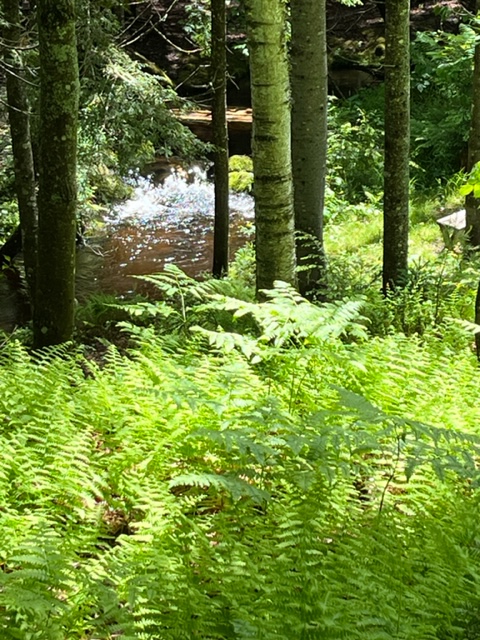
My word of the year for this year is attend and with that I mean, pay attention to where you are, pay attention to your life right now, not what you think your life should be, not what you think other people’s lives are, not what you want to pretend to be, but what is your life right now? Can we take an actual unflinching look at the reality of our lives, right now? I invite you to take a brief pause and let yourself inhabit your own life right now, as it is, no need to change anything about it. It is what it is. For example, I hear the distant sounds of my brother mowing. I hear birds. I am looking at full-leafed trees and the drippy little fingers of green pollen on the oaks, the long, green flowers on the mulberry trees. This is the first sunny day and blue sky that I’ve seen in what feels like several weeks (possibly exaggeration). I feel a tightness in my shoulders, but here I am. And, here you are. What do you feel where you are? What do you see where you are? What are you hearing where you are? What is your life like right now?
I feel at strange, tender, and tentative point of reemergence this summer. I know that the pandemic experience has been very different for different people according to your geographic region, according to the culture and climate of the state in which you live, and according to your type of employment or your life’s structure. Many people who are employed in some kind of service industry did not have the luxury of just stepping out of society and retreating to their homes during the pandemic years. For people like me who work at home and who already school their kids at home, it wasn’t that big of a stretch to just further close off my life and just stay home and not go places. It took me practically two years to even miss doing things outside my house externally with other people. So, acknowledging that there are some people who never had the choice of just retreating to their homes and stepping out of society, people who had to keep riding public transportation, people who had to work at restaurants or in stores or in health care, people who are students and had to go to classes. There wasn’t the option to step out and away for some of us. For others of us, the last two years have been almost a kind of hermitage where you’re suddenly just withdrawn from everything and in a type of waiting place. For me, I have in many ways appreciated this withdrawal in its own way, the opportunity become small and closed in. And, now, at the cusp of summer, I’m also starting to recognize that becoming so small and closed in is now beginning to feel tight and confining. As we consider reemergence, we may find it is time for us to decide: What do we want to step back into and what do we want to stay out of?
In Jennifer Louden’s Oasis program (of which I am a long-time member), she spoke of reemergence as a theme and one of the things she noted that I found really powerful is that we may have in some ways forgotten how to exercise our “no” or our boundaries, because we’ve had an automatic built-in, “oh, it’s a pandemic. I’m not going to do whatever.” Now, as we re-emerge, we have to actually say, “No, I still don’t want to do that.” Or, “Yes, I do, let’s try to rebuild that.” What I’m recognizing in myself is that it’s very hard to tease apart what I still actually want to do and what I’ve actually just gotten out of the habit of doing and so actually feel some type of trepidation or anxiety about doing again. For some things that I haven’t been doing, it is not that I truly don’t want to do them again, it’s that I am also holding some kind of fear of stepping back into it. And, these things may be all rolled up together. For example, I am unsure whether I really do not want to have a big summer solstice ritual this year, or whether I just feel nervous about it, because it’s been several years since I’ve had a bigger group ritual and so I’m afraid I don’t know how to do it anymore. Which is it? When is it really your heart or intuition saying, “I laid this down and I want to leave it laid down.” When it is your heart or intuition saying, “This is something I want to pick back up.” What is obligation telling us we should pick back up when inside we know we no longer want it? And, what is fear making us afraid to pick back up that we really DO want to pick back up?
One of the books I just finished this year is A Woman’s Book of Soul by Sue Patton Thoele. It is a book of daily meditations that is a little more Christian in orientation than I usually prefer, but it also has some interesting things in it too. In a section called savoring our souls, Thoele writes: because the demands of day to day life have a way of dulling our spirits and cutting us off from our hearts, it’s essential that we find ways to reinstate solitude into our lives and through it experience the beauty of heart and soul. One day while suffering from solitude starvation, I ran across a poem in which the poet talked about wandering alone through his house savoring and kissing the ‘fallen crumbs’ of his soul. I smiled as I read the poem because it validated the feelings I often have when home alone. I wander. Touching, appreciating, remembering, singing, gathering, and kissing the fallen crumbs of my soul. Very often, this is the time I choose to change the symbols in the miniature Zen Garden given to me by my son, a simple task taking only a few minutes at the most, but nonetheless, a richly replenishing ritual in which I savor my soul. If your soul has been dropping a trail of crumbs as it accompanies your body through its days, how would you like to savor and nourish it? Can you arrange for some solitary time at home in which you sweep up and kiss your soul crumbs? Gently close your eyes and imagine a time in your own home when you are blessed by the renewal of solitude. Cherish it. Wander or sit quietly. Give yourself the gift of enjoying the solitude in ways that warm your heart, fill your spirit, and revitalize your soul. It is a sacred assignment to rescue the crumbs of our souls that have been kicked under the table by too much activity and too little aloneness, to collect and kiss them all better.
The affirmations at the end of this section are: I need and deserve time alone and I am adept at balancing time alone and time with others.
So, what trail of crumbs has your soul been dropping for you? And how might you savor and kiss these fallen crumbs, rescuing them from where they’ve been kicked under the table?
Deep breath, a hand on your heart, let yourself settle into center and then perhaps you may wish to read this prayer aloud:
I dedicate myself to the full living of my own life
in all its joys and complexities.
I dedicate myself to walking my path.
I dedicate myself to being present.
I dedicate myself to brave and joyful wholeness.
May you nourish the crumbs of your soul.
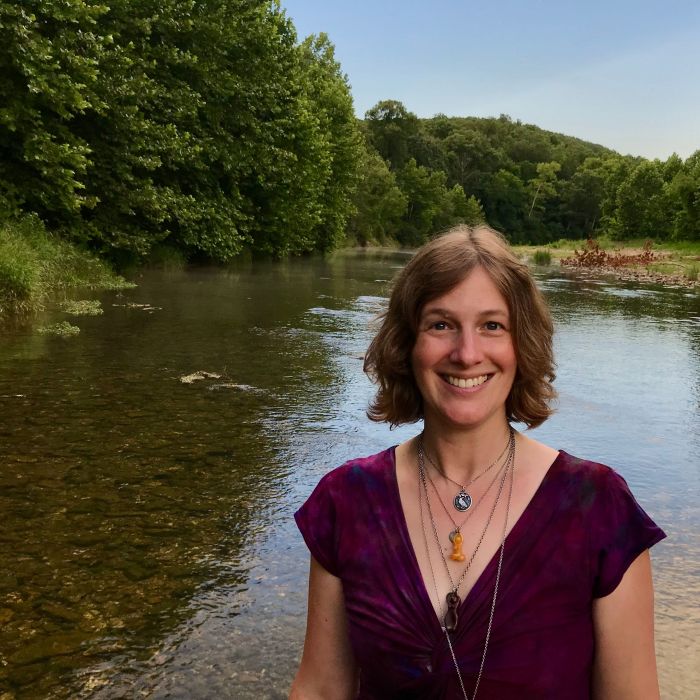
Molly Remer, MSW, D.Min, is a priestess, teacher, and poet facilitating sacred circles, seasonal rituals, and family ceremonies in central Missouri. Molly and her husband Mark co-create Story Goddesses at Brigid’s Grove. Molly is the author of nine books, including Walking with Persephone, Whole and Holy, Womanrunes, and the Goddess Devotional. She is the creator of the devotional experience #30DaysofGoddess and she loves savoring small magic and everyday enchantment.