

 El Presidente was enlarging his war against his citizens. This meant the roads were more crowded than before with refugees fleeing the capital city for safety among the farmers on the plains and up in the hills. Some of these refugees arrived, of course, at the farm of the wicked witch.
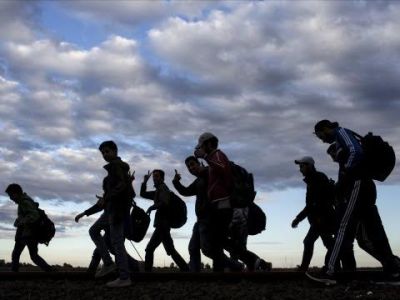
Whenever a family arrived, the witch would put on her wickedest face and voice (she’d been practicing) and tell the children she was going to roast them and eat them with mashed potatoes and baby gravy. The children believed her for about a minute and a half, whereas their parents just smiled as each family was taken in hand by the senior refugees and led to rooms where there were new beds. The tenured refugees had (with the witch’s permission) taken charge and somehow found enough lumber to build two new rooms (lean-tos) at the side of the house. They were also working the farm and doing whatever they could with other providers of shelter to make newcomers as comfortable as possible. All the farms across the plains and in the hills had nearly run out of food to feed their guests, but with the coming of spring and tiny green shoots already showing, many of the people were hopeful. Continue reading “Springing Forward with the Wicked Witch by Barbara Ardinger”
 Beneath all being is a universal rhythm that is as deep as natural law and as easy to find as the beat of a drum. After giving up an early interest in percussion 50 years ago when a school music teacher told me “girls don’t play drums, ” I discovered this in a World Rhythms hand drumming class at a local music conservatory. The other students, our uber-patient teacher, and I were pounding away, practicing rhythms and counter-rhythms, when we were suddenly all embraced by the flow of a single central pulse and, freed from the constant task of trying to stay on beat, created, for that moment, an entity of sound that was unique, beautiful and complex, and living.
 Last month, I attended a lecture by Anglican theologian Adrian Thatcher on his recent book,
  A friend recently asked me whether I believed in sin. It was a strange question for me to consider because the concept of “belief” as applied to “sin” already suggests that sin itself is not a self-evident or manifest reality. Considering the question, I had to answer that I didn’t actually believe in sin as an objective ontic something. Hurt, wounds, violence, injustice, suffering – these are objective realities that I have no trouble identifying. It was in naming the contrast or painful human experiences as sin with which I had the difficulty, since sin connotes moral, spiritual, intellectual, or volitional defect or evil. My intuition pushes back against this reading of the suffering the world reflects, at least in the microcosm, the imperfection of creatures, or perhaps better put, animals, and in a best case scenario, animals in process.
 During the January 21st Women’s March in New York City, I was inspired and delighted by so many of the signs women and men had crafted to express their opposition to the current disastrous regime in the United States: “Grab America Back,” “Support Your Mom,” “Sad!,” “Miss Uterus Strikes Back.” But one image stood out, mesmerizing me: that of a woman proudly wearing an American flag as hijab, with a message below—“We The People Are Greater Than Fear.” For several blocks as we made our way up Fifth Avenue, I walked beside a woman carrying that sign, and it became, for me, the most powerful symbol of the resistance we must all wage during the dark time ahead.

 In our book
  Activism and Politics have had a complex relationship with Hollywood. Now more than ever actors, directors, and many more associated with the media industry are using their voices, their positions, and their money to causes, political parties, and movements. More and more groups and reports are being generated stating the power of positive representation and even of the necessity of forward progress. Yet, despite the pressure and call for action, there still is heavy resistance, which can be most clearly seen during award season.
  On the morning of January 20, 2017, the world watched Donald J. Trump stand on Capitol Hill for inauguration as the 45th president of the United States. He did not stand alone. Timothy Michael Dolan, Catholic cardinal and archbishop of New York, also stood, and he invoked the divine feminine as he opened the inaugural ceremony with a recitation of King Solomon’s prayer from the Book of Wisdom.
 Ever since reading Elie Wiesel’s book, NIGHT, I’ve identified with Madame Schächter, one of eighty Jewish people corralled and hermetically sealed inside one of the cattle wagons on the rail journey to Auschwitz from a ghetto in Sighet. The text tells us, “Madame Schächter had gone out of her mind.” Initially she moaned, confused as to why she had been separated from her family. She soon grew hysterical. “Fire! I can see a fire! I can see a fire!” When her fellow prisoners looked out the window and saw no fire, they attempted to silence her. Nevertheless, she persisted with her cries. They soon tied her up, gagged, and hit her. As the train approached its destination (Birkenau, the reception center for Auschwitz), Madame Schächter screamed, “Jews, look! Look through the window! Flames! Look!” When the Jews looked through the window this time, they saw flames “gushing out of a tall chimney into the black sky.”
