In previous articles I have developed my personal perspective on Islamic feminism as a third narrative pathway that responds to the two traditional hegemonic discourses that exist on Muslim women, which I call “idealization of inequality” and “demonization of Islam
The search for gender justice within the framework of Islam has been called Gender Jihad is focused on installing a legal and social equality for Muslim women and groups or identities in the otherness, in line with the equality of divine origin established in the Qur’an. I think this socio-political equality begins with unpacking the epistemic violence prevailing in religious narratives that affects the representations and validation of women and persons in the otherness as equals, ie, like people, like men, the discursive and biopolitics referent of what is “Humankind”.
Islamic feminism is a narrative that provides answers to the epistemic violence represented by the speeches of idealization and demonization. As Gayatri Spiviak said, such epistemic violence is an orchestrated, widespread and heterogeneous project to constitute the colonial subject, as other. Women in religion are colonized subjects. Epistemic violence leads to epistemic injustice that results in unfair practices such as, for example, considering that the testimony of some people is less credible because they belong to certain gender, based on a distorted image of the other, which dehumanizes the individuals who are giving testimony.
The Gender Jihad posed by Islamic Feminisms seeks to establish a declaratory place that is an authentic expression of the agencies women and people in the otherness in relation to a hegemony with a strong colonial bias, represented for the narratives of idealization and demonization. Gender Jihad is the building of an episteme, understanding the right of Muslim women to enunciate and interpret a reality that challenges them, for and by themselves since, as Amina Wadud says “defining religion is to have power over it.”
This discursive possibility is possible thanks to the Tawhidic paradigm developed by Amina Wadud in the early 90s and in her book “Qur’an and Woman,” a methodology that can decolonize fields of knowledge, bodies and representational policies of the mainstream narrative about Muslim women and Others.
The merit of her paradigm, among many, is to systematize existing concepts in the Muslim cosmogony, in a way that provides a frame for gender analysis from Islamic theology and promoting the empowerment of women through it. Recognizing, on the one hand, the inherent equality of women as human beings, it gives theological support to a legal equality that for centuries have been at the discretion of Muslim scholars. On the other, it enables women, through rescuing Ijtihad, in our enunciation and narrative capacity as religious subjects. If humans are equal before God, then Women and Others are, by divine right, equally able to read, decipher, interpret and convey their perspective on religious matters.
There cannot be any political transformation, without having an equal right to speak, equal freedom to express thoughts, equal entitlement of movement of the body and ideas, equal agency to occupy material and symbolic spaces, without restrictions.
There can be no Gender Jihad without appropriating the readings and discourses on gender, religion and jihad.
Gender Jihad begins with the recovery of the right to say and represent, therefore, is a struggle that could have as a prior aim the acquiring of epistemic justice.
This is relevant because “Who can speak” will mark simultaneously “on what terms that person talk.” What concepts and meanings can be used within the framework of the construction of a particular view of reality? What terms become the lens for discerning reality: development, democracy, gender equality, civil society, religion, social agency, etc. Only and exclusively from the enunciation (the power to speak) and from the ability to define the context in which speaking occurs, can one have a voice, that is, be a subject.
This framework for a new reality, based on the epistemic justice, will allow Muslim women to define their own place and have a voice to counteract epistemic injustice. Wadud offers a system of hermeneutic model that enables a “who can speak” and “on what terms” from an interpretation of the Quran from a gender perspective, which recognizes Muslim women agency to define and interpret religion, to build a speech based in empowerment and to rise as “political individuals of faith,” establishing a mapping for the construction of a reality in which they position themselves as people, beyond stereotypes and myths.
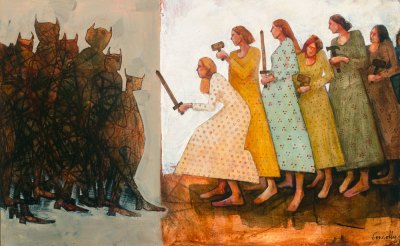
Image: Women Fighting Demons – Caitlin Conolly
Vanessa Rivera de la Fuente is a social communicator, writer, mentor in digital activism and community educator in gender and capacity development. She has led initiatives for grass roots female leaders’s empowerment in Latin America and Africa. She is an intersectional feminist interested in the crossroads between Religion, Power and Sexuality. Her academic work adresses Feminist Hermeneutics in Islam, Muslim Women Representations, Queer Identities and Movement Building. Vanessa is the founder of Mezquita de Mujeres (A Mosque for Women), a social media and educational project based in ICT that aims to explore the links between feminism, knowledge and activism and highlights the voices and perspectives of women from the global south as change makers in their communities.


 Acknowledging and responding to feminine divine energy is an inherently radical, feminist act. With age my feminism and spiritual path have become inexorably intertwined and I have become more comfortable and confident in my identity as a daughter of the goddess, a priestess, and as a feminist. My feminism is continually being shaped by a call to serve the goddess in a variety of ways, particularly in response to an activating third element in my feminist goddess path (no surprise for fellow triad lovers who practice a Celtic spiritual path). This third activating element is my relationship with my body and my work to reclaim Body Sovereignty.
  I have blogged excerpts from my novel
 Killing us slowly with your rules.
 Theology is often viewed as abstract and removed from the problems of the real world. Yet many of the problems of the real world are caused by bad theologies. If bad theologies shape the world, might the same not be true of good theologies?
 If I had such an opportunity, I would not hesitate to bleed free in a moonlit forest with other women during the flow of blood from our wombs in sacred ritual. This said, I currently take on a nurturing and maternal role for myself, the earth and humanity through the creation and use of my reusable menstruation cloths.
 Recently I have come across several stories of women’s fringe spiritual movements or practices. This made me think about the role of outsiders’ or minority views in religions and society.
 Outside my childhood home grows a yellow rose bush descended from one planted by my great-grandmother, Jennie, a century ago. That bush has given her descendants many gifts of spirit over the years— her love of beauty despite a life of tragedy and constant toil, her deep connection to nature persisting through four generations, her hope for the future inherent in planting anything that will take years to fully develop. When I contemplate my own fall garden and its plants sowing seeds for next year, I ponder the special responsibility we, as spiritual feminists, have for leaving to those who will come after us a legacy of inner resources that they will need to meet the challenges of the planet they will inherit and hopefully make into their own sustainable world of equality, peace and happiness.
 While I am joining the conversation a bit late, I find it necessary to comment on the significance of the “upgrading” of the celebration of St. Mary of Magdala to a feast – on par with the male apostles. While such a day that honors her is quite overdue, I am grateful to Pope Francis for acknowledging this incredible woman and her leadership in the Christian movement.