November, A Silent Month? by Barbara Ardinger

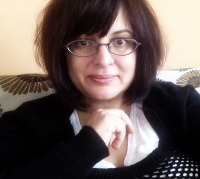
Barbara ArdingerNovember, which begins with All Saints Day (yesterday) and All Souls Day (today), gives us a quiet, welcome break between the loud make-believe of Halloween and the incessant caroling of the winter solstice season with its popular holidays. In the Northern Hemisphere, the days are noticeably shorter and darker now. Where I grew up, it’s gray, cloudy, and often rainy. It has always seemed to me that people are turning inward and the month is closing in on itself. Even today in southern California, I feel a delicious melancholy composed of silence and rest from hard work.

giant head

For two millennia, the standard-brand churches have admonished women to be silent. As it is written, “Let the woman learn in silence with all subjection. But I suffer not a woman to teach, nor to usurp authority over the man, but to be in silence” (1 Timothy 2: 11-12).

Let’s say that today is a typically gloomy November day. The sun is lazy and clouds are floating mysteriously across the sky. Look, they’re gathering over there in the east. As clouds often do, they begin to assume shapes. Let’s look closer…and we begin to see a fiery mountain. Above that fiery mountain floats a giant head. Listen! The head is speaking. “I am One, the Great and Powerful. Thou shalt not take My Name in vain. Thou shalt have no other gods before me for I am a jealous God—”

But the silence of this gloomy November day is suddenly broken as the women standing in the mud at the foot of the fiery mountain suddenly begin to shout back at the preaching giant head. “There’s been plenty of gods before you,” one woman shouts. “And even more goddesses came before you,” calls another woman. Continue reading “November, A Silent Month? by Barbara Ardinger”

The Sphere: A Symbol of Ancient Greek Female Spirituality by Stuart Dean

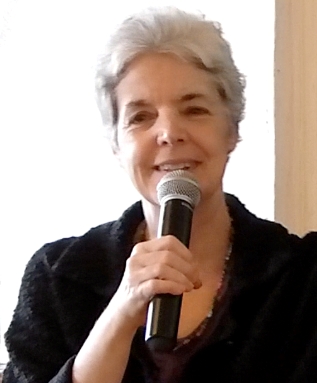
Stuart WordPress photoOriginally, in ancient Greek, ‘sphere’ simply meant ‘ball.’  Though its grammatical gender varied, it was primarily a feminine noun.  It is in that sense and with that gender that it bounces into Western literature in the episode of the Odyssey where Nausicaa and her companions are playing catch on a beach (Odyssey 6.100 ff).

Nausicaa is said to be conducting her companions in ‘molpe,’ a curious term that seems to refer to dancing, music and poetry as a single form of performance art.  Authorship (including possibly female authorship) and dates of individual episodes of the Odyssey remain debatable, but both from this episode as well evidence from other sources there is no doubt that in general what Nausicaa and her companions are doing here relates to an actual custom among Greek women that dates back to well before writing was adopted. Furthermore, molpe was spiritually significant.  As the conductor of its performance Nausicaa is compared to Artemis.

The reference to Artemis as one of those who ‘holds heaven’ (Odyssey 6.150), suggests that the sphere with which Nausicaa and her companions are playing may have been intended (at least by the author of this episode) to be a symbol of the celestial sphere.  That suggestion is bolstered by an appeal to what is to be found in the fragments that survive of the poetry of Sappho, who it is readily apparent considered herself as much a musician and choreographer as a poet.  That is to say, whereas Nausicaa may be a fictional persona, with Sappho we have the only direct evidence of any substance directly from an actual woman of what constituted molpe.  From how she refers to a female performer of molpe as goddess-like (S. 96), followed immediately by a comparison of yet another woman’s beauty to that of the moon, as well as other fragments of poems where either the appearance or movement of women in connection with a molpe performance is related to celestial events such as the appearance of a full moon or the movement of the Pleiades, it is clear that for Sappho choreography was in effect applied cosmology (see S. 154 and S. 34 and how it is surely echoed in a much later Latin poem here). Continue reading “The Sphere: A Symbol of Ancient Greek Female Spirituality by Stuart Dean”

Kali Ma (Part 3 of 3) by Nancy Vedder-Shults

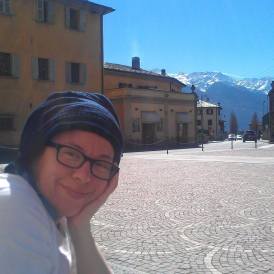
nancymug_3In contrast to the linearity of our time concept in the West, Indians view life as infinite and cyclical.  Although Hindus, like ancient Greeks, believe in four ages of humanity (the so-called yugas), these occur not just once, but repeat cyclically every several million years.  Similarly, the creator god Brahma is said to have a daily cycle which has recurring effects on the existence of the world.  When Brahma awakes the world is created anew, and when he falls asleep it dissolves once again into the primal waters of eternity.  Fortunately for us, Brahma’s day lasts 4,320,000,000 human years.

Holland Cotter, in reflecting on Eastern art, once brought these temporal differences into sharp focus when he contrasted two of the major icons of East and West  — Christ on the cross and the dancing Shiva.  He said, “The Christ figure embodies the Judeo-Christian concept of divine history as a straight, purposeful line from the Fall of Man (sic.) to redemption, but with a tragic human story of self-sacrifice, loss and atonement at its heart.  The dancing Shiva is, by contrast, a dynamic, joyous cyclical image: a poised, uplifted foot and hands form a circle echoing the nimbus of flames surrounding the figure.  The image represents a culture which…views both humans and gods as participants in a cosmic game that periodically grinds to a catastrophic halt only to begin again.”[i]

Like Shiva, Kali has been depicted surrounded by a halo of flames.  But unlike Shiva, her portrait is far from a joyous image.  In one example, a 17th or 18th century North Indian sculpture, Kali is personified as a voracious, old hag squatting on a victim whose entrails she eats.  Slicing open the belly of the anonymous corpse, Kali scoops out its intestines with her bony fingers and gobbles them with her protruding teeth.  The anonymity of the victim brings home to the viewer the fact that ultimately we are all Kali’s prey.  And the flames burning around her head reemphasize this point, for as the aureole of the Dancing Shiva, they are the fires of the final conflagration at the end of each world period.  But in this image we realize that such flames flicker constantly, since time erodes all that has ever existed and Kali swallows all she has ever birthed.[ii] Continue reading “Kali Ma (Part 3 of 3) by Nancy Vedder-Shults”

Cerridwen, Dark Goddess of Transformation, Inspiration and Knowledge by Judith Shaw

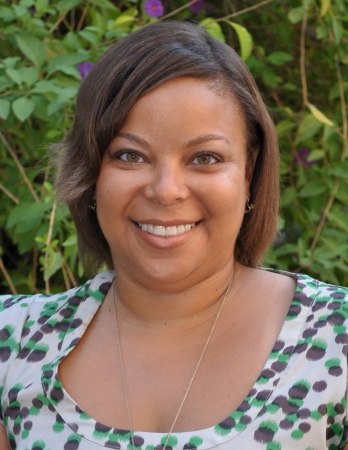
judith Shaw photoCerridwen, Dark Goddess of Transformation, Inspiration and Knowledge is best known as the mother of Taliesen, the greatest of all the Welsh poets.   But Her story is much older and Her powers run deep.

Cerridwen (“White Sow”, or “White Crafty One”) has many other names:  Dark Moon Goddess, Great Mother, White Lady of Inspiration and Death, Goddess of Nature, and Grain Goddess. She rules the realms of death, fertility, regeneration, inspiration, magic, enchantment and knowledge. Her ritual pursuit of Gwion Bach symbolizes the changing of the seasons, nature’s yearly cycle of death and rebirth.

Continue reading “Cerridwen, Dark Goddess of Transformation, Inspiration and Knowledge by Judith Shaw”

The Nuns Jumped Over the Wall by Dawn Morais Webster

Dawn Morais Webster, the Pope off to his summer palace, Castel Gandolfo. He tells the world he will now become just a “humble pilgrim.”

One of the most prized dishes in Chinese cuisine is called “The Monk Jumped Over the Wall.” The name comes from the folk belief that the monk was unable to resist the aroma of this delicious dish and jumped the wall in search of it.

Reading Jo Piazza’s If Nuns Ruled The World: Ten Sisters on a Mission, it is clear that these nuns, and others like them, have been drawn by people’s needs, to jump the walls of patriarchy and prejudice.

And there’s no putting them back behind those walls.

Just ask media maven, Sr. Maureen Fiedler: “After all, Jesus was a feminist, and we claim to follow him.”

One nun, though, has accepted being put behind bars for literally breaking through the fences around the nuclear facility in Oak Ridge,Tennessee. Sr. Megan Rice is unfazed by clerical disapproval.

“I don’t believe in excommunication,” she says, “because I don’t see the institutional Church as the real Church.” Continue reading “The Nuns Jumped Over the Wall by Dawn Morais Webster”

Serpent Healing by Laura Shannon

Laura Monty DSCN0280Snakes have been considered sacred in Greece and the Balkans, as well as other cultures, since at least 7000 BCE. They are symbols of rebirth and regeneration, as they travel between our world and the world below, disappear and re-emerge from the earth in spring, and shed their skins in seasonal renewal.

Knossos Snake Goddess

The Cretan Snake Goddess from Knossos (ca 1600 BCE) stands serenely with serpents wrapped around her body, showing how snakes were considered benevolent and were revered, not feared. Snakes are also powerful symbols of healing. Recently, I had an extraordinary experience of ‘serpent healing’ after a serious injury.


Friends of mine run a yoga retreat centre in Mani, Greece, called The Spirit of Life, where their son keeps a number of snakes including a beautiful Royal Python named Monty. Monty and I have met on several occasions over the years, and whenever I have spent time holding him, I have felt a sense of great peace and calm. More than that, Monty has shown an uncanny ability to move directly to places of tension in my shoulders, and to gently yet firmly massage sore muscles in a soothing way.

Therefore, on a recent visit, I decided to let Monty go wherever he wanted, just to see where he might choose to move. I had had quite a bad fall from my bicycle several weeks before, resulting in multiple injuries, to my back and to my right elbow, hand, rib, shoulder, calf and foot. Continue reading “Serpent Healing by Laura Shannon”

The Ancestors Live in Us by Carol P. Christ

Carol Christ in LesbosOn the recent Goddess Pilgrimage to Crete women had the option of riding up a winding road on a mountainside in the back of a farm truck singing “She’ll Be Comin’ ‘Round the Mountain” or could choose to go with the guard in his closed automobile.

That evening one of the older women who had chosen to ride in the car said, “I saw how much fun you were all having, but I have done that before. This time I was happy to let the rest of you do it.”

“That’s exactly how I feel about death,” I responded. “Some people want to live on after death, but I don’t. I am happy to let others do it. The only thing that would upset me would be if life did not go on after me.” Continue reading “The Ancestors Live in Us by Carol P. Christ”

Thinking about Global Activism and Social Change, Personal Intentions and Spiritual Consciousness by Jameelah X. Medina

Jameelah MedinaThe events in this world begin with the individual. The world’s occupations trace back to the individuals who create them and those who ignore or support them. The world’s genocides trace back to the individuals who create them and those who ignore or support them. The world’s offensive wars trace back to those who create them and those who support them through action or inaction. Daring to exclude Divine Decree from this discussion, the events that take place in the world are due to the malice within mankind. This malice can be direct and intentional, or it may be malice by default due to the absence of benevolence. These atrocious events begin with the individual because unjust rulers, dictators, invaders, executioners and occupiers, only have the power to rule, dictate to, invade, execute and occupy because they have subordinates who give their obedience and acquiescence. We are those subordinates as a group and as individuals. The question is: Why do we obey and acquiesce?

The reasons for our obedience, acquiescence is in part due to political ignorance, fear and a sense of powerlessness, but also due to a lack of self-consciousness, soul-consciousness, a finely-tuned conscience, purpose, and intention.

Acquaintance with One’s Soul

The soul or spiritual heart of the individual determines either positive or negative, good or bad thoughts, action and chain reactions. Individual spiritual illness and disease is at the root of what we see occurring on this earth, from the rape of Mother Earth, who has sustained us in her womb with perfect balance since before our collective memory can recall, to the complete disregard for human life and its intrinsic value through legal, illegal and unchallenged annihilations and genocides under the guise of “national security,” “liberations” and “democracy,” and in the form of wars, prisons, miseducation, and unnatural natural disasters.  Because the root cause of these events is at the individual level, we are each and all accountable and responsible for correcting it. This correction begins with our intention. Continue reading “Thinking about Global Activism and Social Change, Personal Intentions and Spiritual Consciousness by Jameelah X. Medina”

The Descent of Inanna to the Underworld by Deanne Quarrie

Deanne QuarrieInanna provides a many-faceted image of the feminine. She is a goddess of order, fertility, grains, love, war, heaven and earth, healing, and emotion. She is called the “Lady of Myriad Offices”. Most of the powers once held by her, “the embodied, playful, passionately erotic feminine; the powerful, independent, self-willed feminine; the ambitious, regal, many-sided feminine” were eroded by the patriarchy throughout time.

Her descent to the Underworld is a valuable story at any time of the year but even more so here as the wheel turns fully into the dark of the year. During the dark of the year, we are to turn inward, our most introspective work is to be accomplished at this time. It is vital that we enter the darkness as did Inanna, bare and bowed low. Continue reading “The Descent of Inanna to the Underworld by Deanne Quarrie”

Honoring Our Dead, Holding their Stories by Marie Cartier

MarieCartierforKCETa-thumb-300x448-72405Next Saturday, November 1,  is the holiday Día de Muertos, or Day of the Dead. This is a Mexican holiday that has currency now throughout the world—but especially in California. After all, in 2014 Latinos will surpass whites in California demographics. It is prevalent at this time in Southern California to see sugar skulls decorated—to even have children make decorated sugar skulls and honor the dead. The holiday provides a focal point for a centered observance and prayer dedicated to those who have died in the past year. It is connected to the other holidays at this time, particularly Halloween where as we Wiccans often say “the walls between the worlds are thin.”

Another tradition celebrated at this time is creating an altar for loved ones—or several altars or ofrendas. The altars can hold sugar skulls, photos and artifacts of the deceased, and marigolds. Marigolds are a symbol of death and are referred to as “the flower of death.” Marigold petals might mark a path from a home to a grave in a village so that the dead can find their way back for this holiday. Marigolds make arches and decorations in and around the altars/ofrendas for the scent of the marigold is purported to draw the dead back for the Day of the Dead reunion. The holiday has its roots in indigenous Mexican holidays and continues back possibly 4,000 years to Aztec rituals honoring the goddess Mictecacihuatl, the Queen of the Underworld. Continue reading “Honoring Our Dead, Holding their Stories by Marie Cartier”