

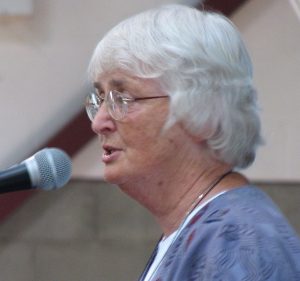
Introduction: Miriam MacGillis is a modern-day prophet who not only holds a broad understanding of cosmology but brilliantly expresses it. She was an early colleague of Thomas Berry, introducing many people to the Story of the Universe. I have had the great honor of transcribing the tapes of her lecture series called Education for a Small Planet from 1986. Below is an excerpt from Tape 1B. It is edited for clarity. Excerpts from tape 1A can be read here and here.
***

Thomas Berry speaks about three principles which have been at the heart of the unfolding of the universe from the beginning. They are very simple and can’t be separated. I’m just separating them now [to discuss them]. In reality they’re three in one. They are extremely simple. Very often, the simplest things are the hardest things to grasp. But once we really begin to reflect on them and their implications, it’s so logical, so clear, so simple.
The first is the principle of differentiation. When we talk about the universe and its guidance system, this principle becomes even more highly articulated when we get to the Earth. It’s a very simple dynamic. Literally, all it means is that from the very beginning everything that is, is differentiated. You couldn’t have a universe unless there was differentiation of its elements. Because hydrogen and helium and carbon or whatever, grow into more complex structures . . it’s because they are different that they interact with each other and in that interaction cause each other to change. They cause each other to break down from being what they are in their simple state. In the dying of what they were in their simple state, they change and become transformed into something more complex.
Continue reading “Miriam MacGillis Discusses Thomas Berry’s View of the Universe, Transcribed by Janet Rudolph”
 The term ‘PaGaian’, which became the title of my work, was conceived in at least two places on the planet and in the opposite hemispheres within a year of each other, without either inventor being aware of the other’s new expression. It was some time before they found each other … one party in Australia, myself having published a book with
  Originally, in ancient Greek, ‘sphere’ simply meant ‘ball.’ Though its grammatical gender varied, it was primarily a feminine noun. It is in that sense and with that gender that it bounces into Western literature in the episode of the Odyssey where Nausicaa and her companions are playing catch on a beach (
