Gratitude and Sharing: Two Fundamental Principles of Goddess Spirituality by Carol P. Christ

carol p. christThe more I practice the spirituality of the Goddess, the more I understand that earth-based spiritualities are rooted in two fundamental principles:  gratitude and sharing.  We give thanks to the earth for the gift of life. As we recognize our interdependence and interconnection in the web of life, we are moved to share what has been given to us with others. *

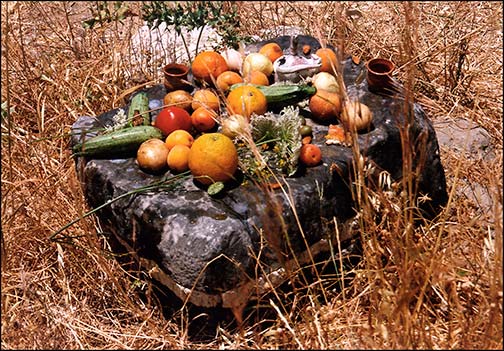
When I first began to lead Goddess Pilgrimages in Crete, I was inspired by a line in Homer to begin a pilgrimage tradition of pouring libations of milk, honey, water, and wine on ancient stones. At first I knew the form, but not its deeper meaning.  It gradually dawned on me as I thought about the large number of pouring vessels in the museums, the altar stones, and the Procession Fresco from Knossos, that an important part of Minoan rituals involved processions in which people offered first fruits back to the Mother whose body had produced them, and poured libations on altars.
kernos stone kay keys

Over twenty years of performing the ritual of pouring libations has convinced me that this was not “a” but “the” central Minoan ritual.  Its purpose is to thank Mother Earth for the bounty She has bestowed on us. Continue reading “Gratitude and Sharing: Two Fundamental Principles of Goddess Spirituality by Carol P. Christ”

The Joy of Honoring Rosemary Radford Ruether by Dirk von der Horst

DirkA cutting-edge voice in many theological conversations, Rosemary Radford Ruether has been an inspiration to many of us over the last few decades.  The tremendous joy of my last couple of years was co-editing a volume of essays in her honor.  Even discovering just how dreary indexing is was a labor of love for a true pioneer in feminist theology.  The result: Voices of Feminist Liberation: Writings in Celebration of Rosemary Radford Ruether, a collection of fourteen essays by Ruether’s doctoral students, put together by Emily Leah Silverman and Whitney Bauman, along with myself.

Voices of Feminist Liberation documents the current state of her impact and legacy.  The richness of her thought is manifest here in the variety of directions her students have taken her insights.  While most of the essays are scholarly works that engage her ideas above all else, some essays have more personal recollections.  Rosemary’s preface recounts her personal experiences of and with us, with descriptions of incidents from her relationships ranging from hearing a live-in student coming down the hall to slip a paper under the door, to seeing a student’s dissertation prospectus enrage a committee member, to switching from same-sex hand-holding in Palestine to male-female hand-holding in Israel as a small gesture of recognizing cultural difference. Continue reading “The Joy of Honoring Rosemary Radford Ruether by Dirk von der Horst”

A Meditation on the Shamrock By Barbara Ardinger

With the eyes of your imagination, see our bright goddess standing tall and fine at her anvil. Her holy and wholly unquenchable fire is burning in the forge. See her holding her hammer and tongs. Perhaps she’s beating a sword, for we sometimes need to defend ourselves, or perhaps she’s beating a sword into a plowshare, for we also need to feed the hungry.

February 2 is the pagan sabbat, or holy day, devoted to the great Celtic triple goddess Brigid (pronounced “Breed”). Brigid is the goddess of poetry, fire, and smithcraft. We’re told that she was converted to Christianity by St. Patrick and later canonized. Her temple was located at Cill Dara (better known as Kildare), where a holy fire was maintained for a thousand years. It was put out during the Dissolution of the Monasteries under Henry VIII when that British king left the Roman church. The fire was relit, but extinguished again in the 18th or 19th century. Today there is an order of Irish nuns that keeps Brigid and her fire alive. As you read the following meditation, imagine that you’re hearing the voice of an elderly priestess. Continue reading “A Meditation on the Shamrock By Barbara Ardinger”

Awakening to the Mystery of Absolute Beginnings by Carolyn Lee Boyd

carolyn portrait

As I rise at 5:30 each morning, my spirit reawakens in a between-the-worlds realm of absolute beginnings. For those few minutes of quiet and slowly revealing dawn light, I revel in mystical newness, endless possibility, a horizon that is only the future.  By 7 am, when I can hear cars on the road and see television screens through windows as I walk to work, normal, plodding space-time has taken over, leaving just a shimmer to linger in my memory.

I remember living all day with this feeling of being at the very beginning of my world when I was a young child and everything that I did and thought was for the first time. I believed this sense was lost forever when I was later taught by society, as so many of us are, that I was only the tiniest, most ordinary mite in a world already built many eons ago by people with a much brighter genius than me.  Continue reading “Awakening to the Mystery of Absolute Beginnings by Carolyn Lee Boyd”

Brigid, Goddess of Healing, Poetry, and Smithcraft by Judith Shaw

judith Shaw photoBrigid, the Celtic Goddess of Healing, Poetry, and Smithcraft, begins her reign on Imbolic, February 2, the midpoint between winter solstice and spring equinox. On this day the ancient Celts held their Fire Festival in honor of Brigid and the growing light. In Scotland, as recently as the mid-twentieth century, houses were cleaned and the hearth fires rekindled on February 2, to welcome in  Brigid.  Remnants of this festival are found in America today on Groundhog Day.

Like the Cailleach, She existed in many places and  was known by many names.  The Irish called her Brighde; she was Bride in Scotland,  Brigantia in Northern Britain, and Brigandu in France.  Some called her Brid, Brig or Brighid.  Later she was transformed by Christianity into Saint Bridget.  Her older name was BREO SAIGHEAD.   Her name has various interpretations, many relating to fire – “Power,” “Renown” “Fiery Arrow of Power ” “Bright Arrow”, “The Bright One”, “The Powerful One”, “The High One” and “The Exalted One”.

Brigid, Celtic Goddess Continue reading “Brigid, Goddess of Healing, Poetry, and Smithcraft by Judith Shaw”

Sustaining Feminist Spiritualities in the Seeming Absence of Community by Elisabeth Schilling

LaChelle Schilling, Sustaining Feminist SpiritualitiesThe spirituality I cultivated during my teens through evangelistic Pentecostal Christianity was based on possession, hierarchy, and exclusivity, although I would not have said that at the time.

As I gradually moved away from that faith community in my mid-20s, no longer wanting to equate a rewarded closeness to God with being set apart from others, I began finding myself participating in quiet conversations with the readings of Thomas Merton, Elaine Pagels, and with poetry by writers such as Olga Broumas.  The words I was drawn to might not have been expressly or consistently religious, but they offered spiritual nourishment in their eroticism, earthiness, and sacred metaphor.

It was also around that time when I decided that feminist theologies were healing in their questions and re-visions of God and concepts of salvation and sin. To understand that being a spiritual and/or religious person could mean being aware of and pursuing my desires and connections to other people instead of being a gatekeeper was redemptive. Continue reading “Sustaining Feminist Spiritualities in the Seeming Absence of Community by Elisabeth Schilling”

Truth and Consequences–This Feminist’s Perspective? by Marcia Mount Shoop

Marcia headshotIn John’s Gospel, Pilate’s response to Jesus’ self-identification as the one who “came into the world to testify to the truth” is a simple question:  “What is truth?”  His question hangs in the air as he moves from that conversation to the throngs he sought to please.  Pilate took the temperature of that crowd to decide Jesus’ fate even though he, himself, found no reason to charge Jesus with a crime.  Pilate asks the question from a position of power—literally holding life and death in the ambivalence and maybe even in the sincerity of his words.

The “t” word has been center stage in our collective conversation of late with Lance Armstrong’s Oprah-event confession  and the Manti Te‘o girlfriend-dying-of-cancer hoax at Notre Dame .   The Internet is abuzz with reactions to both confessional moments.  Lance Armstrong’s confession apparently didn’t play well with the general public.   And people are weighing in about whether Manti Te‘o could really be so naïve or if he just didn’t know how to tell everyone the truth when the story got out of hand.   Continue reading “Truth and Consequences–This Feminist’s Perspective? by Marcia Mount Shoop”

Miracles Of The Great Mother by Jassy Watson

Jassy under the Holy Myrtle tree Paliani conventjassy Panagia in tree

I was brought up in a household where attitudes to God and church were quite negative. My Nanna, however, was deeply religious, and I can still remember sitting in her dining room as a very young child staring up in awe at a painting of  ‘The Last Supper.’ I was completely mesmerised, there was something haunting about that painting that left a lifelong impression. Art became a passion very early on in life, and whenever I came into contact with images of a religious nature emotions stirred. I was spellbound by divine mystery. The most profound feelings were engendered when I met with images of Mother Mary and the infant Jesus. Continue reading “Miracles Of The Great Mother by Jassy Watson”

What Happens When Women Are Not Ordained? by Meagen Farrell

Meagen Farrell, women's ordinationWhat is a vocation to the Christian clergy? A woman or man feels a calling from God, and that spirit is tested in the community of believers. After discernment through study, prayer, and service that person submits herself for ordination. Simple, right?

Of course, as readers of the F-word blog, you know it is not that simple. Though women’s ordination is a common practice in many Christian denominations, it is far from universal. The issue has caused division within the Anglican Communion and dissension in the Roman Catholic Church. Despite the controversy, the number of women in discernment (contemplating  or preparing for ordination) and the denominations ordaining them continue to grow. Continue reading “What Happens When Women Are Not Ordained? by Meagen Farrell”

Epona, Celtic Horse Goddess by Judith Shaw

judith shaw photoEpona, Celtic Horse Goddess was worshipped by the Gauls (the Celtic French). Her worship spread to Britain and Rome from Western Europe. Hundreds of statues and shrines dating from between the first and third centuries CE have been found in France alone.

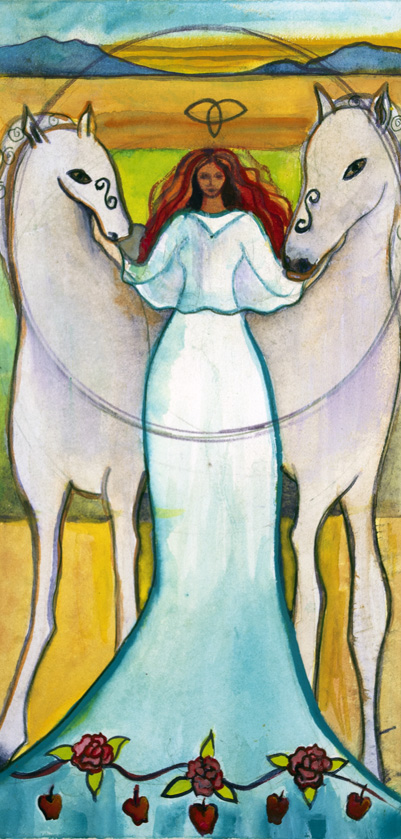
Today we can understand Epona mainly from her images, as few stories of her have survived.  She is often shown either riding a white horse side saddle or standing or sitting between two horses.  Many images show her feeding mares and foals from a cornucopia or a basket of fruit.

Epona, Celtic Horse Goddess Continue reading “Epona, Celtic Horse Goddess by Judith Shaw”