

 I am a Protestant in large part because I like to read. Even after grappling with feminist critiques of patriarchal religions, a spirituality rooted in the Word (capital “W”) is very deep-seated in me. One reason I think of my faith as biblical is that a scriptural religion engages me in my favorite activity. At the same time, there are real connections between exclusive dependence on written records and the erasure of women’s history, as well as various ways in which women have been excluded from literary production. The opposition between text and world often becomes a manifestation of the hierarchy of mind and body that many feminists have seen as damaging. It’s like the question of “why are there no great women composers?” The problem with this question is not only that it ignores great women composers such as Hildegard of Bingen, Barbara Strozzi, Louise Farrenc, or Thea Musgrave. As feminist musicologists Marcia Citron and Suzanne Cusick have shown, the question reinforces a hierarchy in which composers, those who create musical texts, have precedence over those who perform and listen. It also relegates places where women’s contribution has been essential to the production of music – educating children, for example – to irrelevance. Continue reading “Textual Religion and the Marginalization of Two Huldas by Dirk von der Horst”
Monthly Highlight: Emilie M. Townes
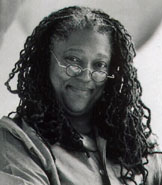
“In my teaching I want to get students excited about that notion of, you know, you’re not just here to get a Yale degree and have it on your diploma and be able to hang it on your wall…You should be here thinking about what kind of contributions can I make to society….What are you doing that helps enhance the lives of all of us, as opposed to (our) own little idiosyncratic research interests.” – – Emilie M. Townes
Emilie Townes is a pivotal person in the field of Womanist and Christian ethics as well as a foremother and pioneer in Womanist theology. Cornel West of Princeton University said:
“Emilie Townes is the towering womanist ethicist of our time….In this ice age of indifference and evasion, her powerful voice and viewpoint summon us. And we thank her for her vision and courage.”
At an opening address at the Convocation in 2005, Townes stated that there is a need to live in a “deep walking hope” that shapes lives “in ways that are not always predictable, not always safe, rarely conventional” and protests “with prophetic fury the sins of a world, and sometimes theological world views, that encourage us to separate our bodies from our spirits, our minds from our hearts, our beliefs from our actions.” Continue reading “Monthly Highlight: Emilie M. Townes”
Winds of Change in the Roman Catholic Church by Michele Stopera Freyhauf
 In 2007, I had a conversation with a professor who felt that change was in the air for the Roman Catholic Church. The basis of this opinion was based on language. The words and the context used in writings that emerged from the Vatican were changing and somehow different – a difference that went beyond personal writing styles of Pope John Paul II and Pope Benedict XVI. This professor was hopeful that positive change for women could be coming. He was right about change in the Church, however, the changes surrounding women that emerged have not been positive.
As I continue to reflect on these words, I ponder the issue of language; specifically the impact words have and the way they are used to facilitate subtle changes in thinking, opinion, and beliefs. The method of persuasion that seems to be employed is the Aristotelian Rhetorical Theory that utilizes the five canons of rhetoric: invention, organization, style, delivery, and memory.
An example of this can be seen clearly in the changes in the liturgy that occurred last year. First, the teaching comes out with the rationale as to why the liturgy needs to change. From there a discussion, especially through the media, addressing the upcoming modifications are followed by subtle changes in the liturgy beginning with the call – response and the language in the creed. Next, the language of the celebrant began to change. Finally, the full implementation of changes is made with the addition of new gestures or movements. When I discussed the mass changes with a family member, there was an admittance that the changes no longer affect them – the changes were no longer noticeable. Their memory was impacted because the routine is now second nature.
In order to come to grips with the issue of language and the observation of my professor, I wanted to do a cursory review of the writings issued by the Vatican during this period. Admittedly, with a blog post, there is a limitation as to the depth and breadth of information that can be disseminated. It is my hope to eventually complete a thorough review of the modification of language used during Pope Benedict XVI’s papacy. For now, I want to address a few observations.
Continue reading “Winds of Change in the Roman Catholic Church by Michele Stopera Freyhauf”
Morals, Malala, and Mapping by Kile B. Jones

Once again, recent events have me thinking of the ethical paradigms people utilize to comprehend and explain violent acts against women. These violent acts galvanize our moral compasses and beg for answers to our most fundamental moral questions. Do cultural relativism, pragmatism, divine command theory, utilitarianism, quasi-realism, virtue ethics, or moral realism better map on to the sentiments that arise in us when faced with misogynistic violence? Can we honestly say that an act is morally wrong when it is tangled up in the cultural and political characteristics of a certain country or group? Or can we justify, in the manner of moral realism, that certain acts are inherently wrong no matter what the context or culture? As you can tell, my ethical plate is full.
The first event that had me thinking of issues is the shooting of Malala Yousafzai. Malala, who I think should have won “Time Person of the Year” instead of President Obama, was gunned down on her school bus by members of the Taliban for being, amongst other threats, the “symbol of the infidels.” Malala survived a shot to her head and neck, and has since received innumerable awards and honors for her efforts to promote women’s education. Recently, 5 female school teachers were shot and killed by Islamic militants in the same province where Malala was shot. These teachers are thought to have been killed for their work fighting polio, since some Muslim extremists in that area think polio vaccines are a Western way of sterilizing Muslim children. Continue reading “Morals, Malala, and Mapping by Kile B. Jones”
Patterns for the New Year by Sara Frykenberg
 Life last year continually pushed me to figure out how I should care for those close to me while also caring for myself. I have been pushed to see the difference between myself and other people: their choices and my own. This is perhaps, the most difficult challenge I faced in the first year of the Age of Aquarius… and life has been an unrelenting teacher.
Happy 2013! Or a statement more accurate to my feelings: Happy end of 2012! Last year around this time, I wrote a post entitled: Celebrating the Beginning of the Aquarian Age. The push to evolve was and is very exciting to me. This shifting astrological paradigm challenges us to break away from those habits and patterns that no longer serve us. But excited as I am, I have to admit that the first year of the Age of Aquarius really kicked my butt.
Did last year feel exceptionally difficult for anyone else out there? I really felt like I couldn’t catch a break for the entirety of 2012. This is not to say that my year was simply filled with loss and grief, though I am dealing with loss and a great deal of grief. But some really great things happened last year too, which I celebrated, but also found extremely difficult to manage. Many of my roles and relationships radically changed in ways that were more difficult than I expected or wanted. Riding the Aquarian tides, I felt tossed about and was often confused. I kept telling myself: just hang on. Just hang on, because you are not alone riding these cosmic waves. Hang on, because you will learn how to swim in these new waters.
Therefore, in honor of the New Year, I would like to take this opportunity to evaluate and strategize for my how.
I am not usually one for making new years’ resolutions. The cultural rhetoric surrounding resolutions either presupposes failure or relates success to the amount of money you spend to achieve a goal. Yet today I find myself considering how I approached last years’ challenges, successfully and unsuccessfully. I have concluded that I need to create more life giving patterns and habits in 2013. Many things I am doing now, my coping mechanisms and my defenses, can no longer meet my needs. So, I guess I am making resolutions. I, however, prefer to say that I am actively hope-ing to evolve my praxis of living. ;) Thus, I set the following intentions for 2013: Continue reading “Patterns for the New Year by Sara Frykenberg”
Inspiration by Jassy Watson
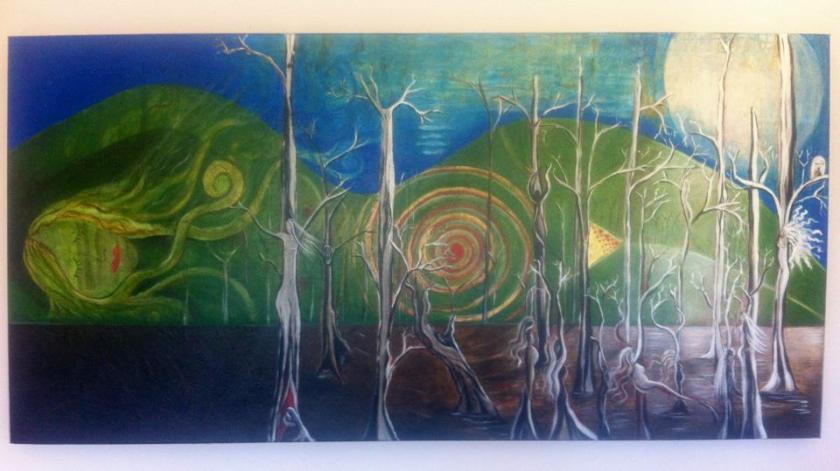
 This “Mountain Mother” painting is an ode to women’s earth wisdom and is my prayer for reclaiming of that wisdom to heal the earth and all her beings.
When I am inspired to paint I can think of nothing else, the desire to put brush to canvas takes over every ounce of my being, and it is difficult to be present in everyday life. There are other times where I’ve wanted to create but inspiration was lacking: I would start a painting and have no desire to finish it. I would often get quite frustrated at myself. It’s only recently that I’ve had the realisation that down time is just as significant as the up time. Rather than get anxious about not creating a masterpiece, I have learnt to go with the flow, take pleasure in the time of rest, because I know it’s all part of the cycle. My inspiration always returns with abundance. Presently I am bursting at the seams with creativity, and I can’t find enough hours in the day to let all this inspired energy out. I am overcome with a sense of urgency I can’t explain. I am committed to paint and write with the intention that my personal message becomes part of the global message for change as our sacred feminine wisdom is being called forth. I am determined and full of courage to be part of the movement that brings about a shift in all aspects of life.
My present state of inspiration can be attributed to my recent Goddess pilgrimage to Crete with Carol Christ. I am sure that anybody who has attended such pilgrimages will attest that these experiences are life-changing. Travel alone is profound, but to share the experience in a circle of twenty amazing women is even more so. We sang, danced, trekked through the Cretan countryside, delved deep into caves; the womb of our great mother, climbed mountains and cleansed in the sea. We prayed and communed with the goddess daily, participating in rituals that were meaningful, un-contrived and safe. While I have always known that the goddess is everywhere, within and without–encountering her ancient past in a present day context is a feeling I’m not sure I can adequately describe with words, hence my desire to express some of these feelings through my art.
Endarkenment By Molly

It is from this dark space that we emerge—whether from our own mothers or from the more mysterious cosmic “sea” of soul—and it is to darkness that we return when we close our eyes for the final time.
I find that within Goddess circles the idea of “the dark” remains commonly associated with that which is evil, negative, bad, or unpleasant. The Dark Mother, while acknowledged and accepted, is often at the same time equated with death, destruction, challenge, trials, and obstacles. While I recognize that the concept of a dark, demonic, and destructive mother might too have a place in goddess traditions (as with Kali or Durga), I also think this is unnecessarily limiting and that the idea of the “Dark” in general is in need of re-visioning. It is not just with regard to the role or place of death within the wheel of life or the Goddess archetype that Goddess as Dark Mother and destroyer can be honored or recognized, but the Dark as a place of healing and rest can also be explored. Continue reading “Endarkenment By Molly”
Arrogant or Confident? by Deanne Quarrie

For a woman to know of her own sacredness, to know how powerful she is, to know that she can achieve her wildest dreams brings the greatest joy imaginable.
I grew up as an “Army Brat.” The biggest impact that had on my life was of having to change schools often. As an introvert I don’t integrate easily into new surroundings or with new people. It was not horribly difficult when I attended schools in the military dependent school system but when it was time for me to enter high school, my parents decided that my brother and I needed to be exposed to “normal” life. What that meant was we were suddenly thrown into small community schools where students seldom experienced the welcoming of strangers.
Teenagers are cruel – well, not just teenagers – children are cruel. For the most part they are not “other” concerned. Their focus is on “self” and while a new student in class might be a curiosity to them, in actuality a new student, if smart or attractive, is instantly a threat. They are perceived of as competition. I know this because it happened over and over to me as the new kid in town in three out of four of my high school years. Continue reading “Arrogant or Confident? by Deanne Quarrie”
We Are All Earthings: Speciesism and Feminist Responsibility Toward Animals by Amy Levin
 “earth’ling: n. One who inhabits the earth.” – Earthlings, 2006
“We need another and a wiser and perhaps a more mystical concept of animals. Remote from universal nature, and living by complicated artifice, man in civilization surveys the creatures through the glass of his knowledge and sees thereby a feather magnified and the whole image in distortion.” -Henry Beston, The Outermost House
I was passing out leaflets at Columbia University a couple weeks back, when a passerby who took a pamphlet on veganism and the cruel uses of animals turned back around to approach me. He said, “I am a vegetarian, so I understand not eating meat. But what is wrong with some of the uses of these animals? What is wrong with seeing eye dogs?” A valid question indeed, and one I had to pause for a moment to answer. I mustered up something along the lines of the ways that many of the seeing eye dogs in the industry are unfairly treated or neglected. “Oh, he said.” He seemed content with an answer he could relate to – suffering. In my experience leafleting and participating in animal rights advocacy, I receive a number of questions, many of them wanting to know the same thing, what is WRONG with the horse-drawn carriages at Central Park? And each time I (and I presume many other activists) offer similar answers, the suffering answer. But there is another layer, beyond the quick, violent spark of imagination that connects physical pain with empathy. And it has to do with power and structural inequality, and the use of one group for the benefit of another. And it has everything to do with feminism. Continue reading “We Are All Earthings: Speciesism and Feminist Responsibility Toward Animals by Amy Levin”
Blessings for the New Year on Feminism and Religion by Marie Cartier

I remember being in Korea for the 2009 International Women’s World Congress with Hye Sook Hwang and Inhui Lee and many (many) others and realizing then in ways I had not before, how crucial feminist scholarly friendships are to not just my work –but my sanity. The way we see things and the way we talk about things makes sense in a way that many times the rest of the world does not make sense. I re-member, to use Mary Daly’s phrasing, Hye Sook’s Magu scholarship that awakened in me and many others the Goddess magic of Korea. I re-member Inhui’s work with the female shamans of Korea and their rituals to honor and memorialize with honor the “comfort” women—Korean women used as sexual slaves by the Japanese during World War II. I went to that conference on the urging of Hye Sook and came home from that conference with new lifelong friends—among them Inhui. At that time none of us were doctors—now we all are. Continue reading “Blessings for the New Year on Feminism and Religion by Marie Cartier”
 Feminism and Religion