Breaking Up with Chick-fil-A by Gina Messina-Dysert

I haven’t eaten fast food in many years; however as a new mom Chick-fil-A offered something quite different than other fast food chains: healthy options, freshly made food, clean space, and a great spot for play dates; not to mention the organization’s commitment to the environment.  My daughter and I have made many trips to our local franchise in the last year.  It became a usual spot for play dates, the go to place for dinner when I was on a time crunch (grilled chicken nuggets, fresh fruit, and chocolate milk has saved the day many times over!), and let’s not forget the perfect option for Baby S to get some play time in while Mommy connected to the free Wifi to get some work done.  Yes, Chick-fil-A felt like a mommy’s dream come true.

I am embarrassed to say that I had heard rumors that Chick-fil-A was anti-same sex marriage; but I ignored all the warning signs trying to hold on to the many positives I thought the chicken chain brought to my life.  With the recent blow up of Dan Cathy’s response “guilty as charged,” when asked about Chick-fil-A’s support for families led by heterosexual couples, I can no longer turn a blind eye.     Continue reading “Breaking Up with Chick-fil-A by Gina Messina-Dysert”

Olympic Inspiration: My Athletic Mirror by Sara Frykenberg

What I realized was that my ability was different from hers and that I really could, as in ‘I had the ability to,’ decrease our time.  I carried our arms differently; and it surprised me.  I’ve never forgotten this sudden sense of myself and of my own power.

Watching the Olympics this week, I found myself very inspired… and very reflective.  You see I was once an athlete.  Not an Olympic caliber athlete, but an athlete none-the-less.  I swam competitively for eight years.  My events were the 100 and 200 freestyle and the 200 and 400 Individual Medley.  I started swimming in 8th grade.  I worked out 30 hours a week through my last two years of high school; and I was relieved when I started swimming for an NCAA division one team in college because the NCAA limited workout hours to *approximately* 20 per week—so I had more time to study.  I was a swimmer and I was completely dedicated to my sport.

But as I got older, my times slowed and I no longer felt successful; so I began to deny myself the title “athlete.”  It’s still hard for me to claim this title (even when applying it to the past) because my body has changed so much, as has my competitive drive.  I am more comfortable identifying as an academic.  Plus, as therapy and my feminist academic studies helped me to realize, I had often used my swimming to physically punish myself, literally. Continue reading “Olympic Inspiration: My Athletic Mirror by Sara Frykenberg”

IS ‘HAVING TO HAVE’ ONE OF THE ROOTS OF SUFFERING? by Carol P. Christ

There is a strong thread of fatalism in modern Greek culture that has been a powerfully healing antidote to my American upbringing in the culture of “I think I can, I can.”  When confronted with an obstacle, many Greeks throw up their hands, raise their eyebrows, and say, “What can we do?” This phrase is not an opening toward change, but a closing–an acknowledgment that there are many things in life that are not under our control.

In American culture we are taught that if we work hard enough, we can achieve our goals. This view can bring a light of possibility into fatalistic cultures. The truth, however, lies somewhere in the middle–between fatalism and belief in the power of individual or collective will.

In American culture the belief that we can “have it all” if only we work hard enough is the root of much personal suffering.  If things don’t turn out as we imagined they should have, we often blame ourselves. Continue reading “IS ‘HAVING TO HAVE’ ONE OF THE ROOTS OF SUFFERING? by Carol P. Christ”

A Feline Petit Prince by Barbara Ardinger

I am tamed by cats. I live with them. Note that I do not say that I “own” cats. Cats are their own beings, as are the dogs and fish and gerbils and parrots and other critters that may live with us. Do farmers and ranchers really own their chickens and cows? I don’t think so. They’re our kin. We’re all the children of the Goddess, of our blessed Mother Earth.

I wrote recently about one of my all-time favorite books, Le Petit Prince, by Antoine de Saint-Exupéry, a book I first read in my high school French I class. Le Petit Prince is said to be a children’s tale, a sort of fairy tale of the desert. Actually, it’s “about” many things: the value of childhood innocence, the incomprehensibility of serious adults (in his voyage from Asteroid B-612 to earth, the prince visits a king, a businessman, a drunk, and a lamplighter), the follies and the lessons of love. In the Sahara Desert, the Little Prince meets a golden desert fox that tells him that we see better with our hearts than with our eyes. The fox also asks the Little Prince to “tame” him, that is, to allow them to become familiar and friendly with each other.

I am tamed by cats. I live with them. Note that I do not say that I “own” cats. Cats are their own beings, as are the dogs and fish and gerbils and parrots and other critters that may live with us. Do farmers and ranchers really own their chickens and cows? I don’t think so. They’re our kin. Continue reading “A Feline Petit Prince by Barbara Ardinger”

The Solace of Another Woman’s Story by Yvonne Augustine

This week, I read an excellent, gripping, poignant blog post by Feminist Philosopher Leanne Dedrick entitled “Things That Make Me Cry: The Practice of Unbelief.” The purpose of the piece was Leanne’s desire to address a misperception by some non-atheists that atheists are devoid of emotion, violently hostile to anything associated with faith, and unable to deal honestly with the Divine. She also corrects the erroneous assumption that atheists seek to “hide from, or purposefully turn […] away from, the ‘saving grace’ of religion.” In the post, she wrote specifically about her own journey from ultra-conservative Christianity to atheism. Continue reading “The Solace of Another Woman’s Story by Yvonne Augustine”

Girls Gone Gray by Erin Lane

My hair started “going gray” at nineteen. Prophetic, you could say, for a college girl whose life was going the same way.

The gray hair began around my temples, curling around my ears like a vine before following my hairline to the forehead and down the spine of my scalp. I remember calling my mother and telling her between tales of new classes and new boys of my new whiskers. “Oh, and mom, you will not believe it. I found a gray hair. What is that?”

Her laugh vibrated though the phone. “That is normal. I went gray at 19. Your father went gray at 19. Your brother has it coming in, too, nowadays.” She added, “Sorry.” But she didn’t sound it. Continue reading “Girls Gone Gray by Erin Lane”

Through Body and Space: A Glimpse into Women Worshippers of Aadhi Parashakthi by Amy Levin

Once what happened was after people started believing someone around also started believing in this temple and one person kept a statue on their steps. Her Aunty she believed and she is very much interested in small things. So she started decorating it up. And what happened was the statue starting getting bleeding, like monthly monthly. And the dress which the statue wore during those periods was stained with red bleeding. So they asked Guruji about what is this and he said that the shakti has come into the statue. So if you keep this in the home it will turn into a temple so go and leave it outside. This was followed by entry of snakes, king cobras, so what they did was they went and left it in the sea, after which her grandmother had a dream that you have left me in the water but still I am with you. I am the temple opposite here,  put a lamp everyday at that place. So they started putting it out there, and now there is an earthen Kali which as come up in that place by nature.  –Interview with Premila, March 18, 2008 Continue reading “Through Body and Space: A Glimpse into Women Worshippers of Aadhi Parashakthi by Amy Levin”

Soror Mystica: New Myth for a Changing Earth by Gael Belden

Once, when my life collapsed around me, as life is wont to do at times, I began creating clay images, placing them near the headwaters of watersheds around the United States. I called this project 100 Clay Buddha’s and it seemed at the time an incantation and a prayer for water, for the planet.  Later, I came to understand that I was also re-figuring my life, image by image, waterway by waterway.

I was also working at the time with particular koans, myths, and fairy tales because they speak not only to the personal, but to the collective –to the ways things have been over time. The hero’s journey monomyth, although genderless in its most distilled terms, seemed, though its imagery, to speak mostly to the theme of the outer quest (slaying dragons, returning from battle, and whatnot). I felt as a woman, however, my journey had to do with a descent into the Great Below and with that a dying into something new. Continue reading “Soror Mystica: New Myth for a Changing Earth by Gael Belden”

Why Some Mormon Feminists Stay by Caroline Kline

In my almost two decades as a Mormon feminist, I’ve seen my fellow Mormon feminists come and go. Mostly go. Remaining a practicing Mormon while also embracing feminist principles is for many of us a harrowing and angst-inducing endeavor. While some have ultimately found a measure of peace in our decisions to stay practicing or partially practicing, others find they simply cannot live with the dissonance. As I’ve watched myself and other women around me navigate the huge decision about whether to remain in the Church, I’ve come up with a few theories as to why some of us stay.

First, and most obviously, a Mormon feminist is more likely to stay if she fully embraces Mormonism’s basic truth claims about Joseph Smith as prophet and Mormonism’s exclusive restored priesthood. However, many Mormon feminists have nuanced takes on those questions. They might think of Joseph Smith as an inspired man who tapped into some compelling theological ideas about eternal progression and humankind’s divine potential, but might pull back on exclusivity claims. Continue reading “Why Some Mormon Feminists Stay by Caroline Kline”

WHEN THE OLYMPICS CELEBRATED THE STRENGTH OF GIRLS AND THE RENEWAL OF LIFE by Carol P. Christ

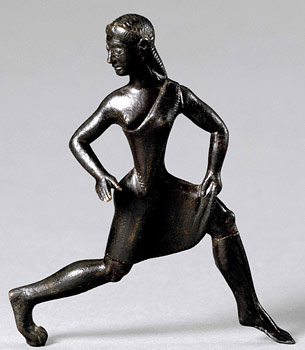
The first “Olympics” were races of girls of various age-groups around a 500 foot stadium in ancient Olympia. The races of girls were held every four years on the new moon of the month of Parthenios (September/October). They were dedicated to Hera Parthenos who renewed her virginity in the river Parthenias. The winners of the races wore olive crowns and feasted on the flesh of Hera’s sacred cow.

These “Olympics” for Hera and for girls came before the more celebrated Olympics for men that were dedicated to Olympian Zeus. The temple of Hera at Olympia is older than the temple for Zeus and the girls’ Olympics were tied to the more ancient lunar calendar.

What did the girls’ Olympics celebrate? Continue reading “WHEN THE OLYMPICS CELEBRATED THE STRENGTH OF GIRLS AND THE RENEWAL OF LIFE by Carol P. Christ”