
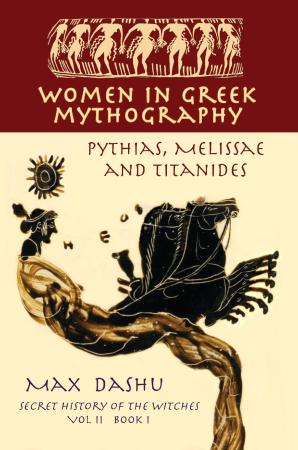
Women in Greek Mythography: Pythias, Melissae and Titanides by Max Dashu, Book Review by Carolyn Lee Boyd

Cover photo: Eos, titanis of Dawn, Black-figure lekythos attributed to the Sappho Painter, Athens, circa 500 bce (Public Domain, courtesy of New York Metropolitan Museum)

Demeter and Persephone, Hera, Athena, Medusa, Artemis are often the first, sometimes only, goddesses modern women experience, and they have profoundly influenced our 21st century attitudes about gender, violence, and more. Yet, as Max Dashu says in her new book, Women in Greek Mythography, Greek history has “served as a template for supremacy, from male domination and Hellenic colonization, to modern Eurocentric ideologies about history” (xi). While most Greek scholarship generally glosses over these malevolent influences and ignores women’s lives, Dashu focuses on “female spheres of power, priestesses, witches, and of course systemic patriarchy” (xi) in order to “map realities of women’s lives, both their spiritual authority and their subjugation; the spaces they carved out, their ceremonies, and the stories they wove into their tapestries” (xi).
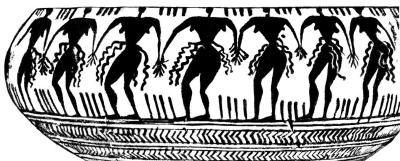
Women dancing in leafy belts: not the Greece we were shown. © 2022 Max Dashu.

Women in Greek Mythography is not only a fascinating historical story of Greek myth and religion to be read cover-to-cover, but a rich sourcebook full of meticulously documented facts. She draws from scholarly works of history and mythography, as well as analyzing images on vases, friezes, sculpture and more. She has carefully rendered 270 drawings of these images so that readers can judge their meaning themselves. She delves into language, seeking out the origins of words that may indicate where goddesses and myths originated and their relationships to one another. She demonstrates that goddess mythologies often had many variations, sometimes conflicting, with many “countless regional deities that were subsumed under Olympian names, the local origin myths, ceremonies, and customs” (xiv).  

Continue reading “Women in Greek Mythography: Pythias, Melissae and Titanides by Max Dashu, Book Review by Carolyn Lee Boyd”
Embracing the Shadow Woman of Justice in Dark Times by Carolyn A. Cushing

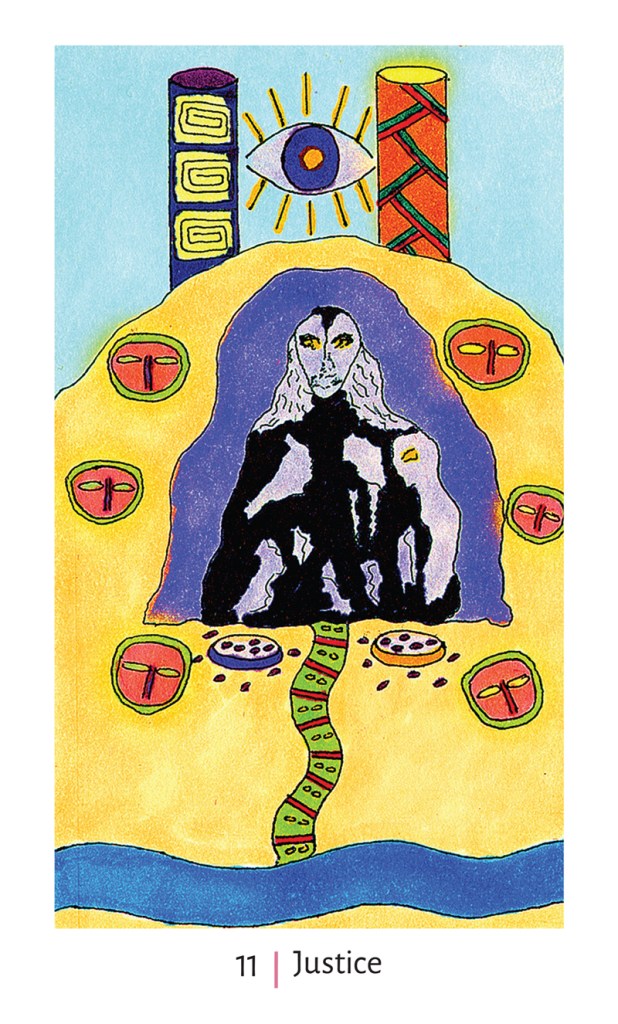
Justice/Shadow Woman by Rachel Pollack. From the forthcoming The Shining Tribe Tarot: Definitive Edition

Prayer to Justice  

Justice, we call you into the center of our hearts, our minds, our spirits. 

May the fire of your being inspire us to believe your beauty can shine forth in our world.

May the flow of your being purify and release us from wounds that come from the places where You are violated.

May the breath of your being pass through us and form on the lips of all words of wisdom.

May the endurance of your being aid us to persist in serving You.

May we hear your truth. May we know your balance. May we gather your wisdom.

Justice, guide us.

Justice seems so far away, obscured by terror, purposely ignored in these days of war and season of darkness. How can we invite Her back? What will bring Her renewal? 

Continue reading “Embracing the Shadow Woman of Justice in Dark Times by Carolyn A. Cushing”

In Search of the Light by Beth Bartlett

The approaching winter has felt darker than usual.  Here in the north, where usually we are blanketed with snow this time of year, this year we have none.  All around town people are putting up Christmas lights, but without the snow to reflect the light, the beams and sparkles of light do not carry. Without the softening effect of billows of snow, they can even seem a bit garish.

But it is not just the lack of snow that renders these days darker. With the wars raging in the Ukraine, Gaza, Yemen, Sudan and smaller conflicts around the world; the rise of hate crimes against both Jews and Palestinians in this country; the alarming possibility of a misogynist fascist man – who, echoing Hitler labels his political opponents “vermin” – becoming President of this country again; the ongoing climate crisis — these can seem dark days indeed, rendering our attempts at holiday cheer a bit garish as well.

Continue reading “In Search of the Light by Beth Bartlett”

The Webs We Weave, by Molly Remer

Each year, as fall peeks around the door tasting the air and sending cool tendrils of change slipping across the horizon and skimming across our shoulders, I feel clarity descend, a sharp and sudden certainty that I do know exactly what I want to do and where I want to focus. 

In early September, we watched an orb weaver spider make her web by our studio. Much faster than we might have imagined, she tumbled gracefully through almost empty space, connecting long strands from porch gutter to hydrangea bush, returning to the center often to stabilize before launching into the next direction. The sun was setting and we stayed captivated by her dedicated intention, moving next around the middle and expanding from the center rapidly connecting her many threads. Finally, we walked on the road, watching the sunset illuminating the bluestem grasses in the field as the nighthawks darted bat-like above our heads on their annual migration. We returned to the web at dusk surprised to see how much finer the structure had become, each strand now laid very close to the one above it in a radiating circle. As we watched, I felt a sense of liberation chiming in my bones, freedom that comes from knowing with firm and dedicated awareness which way to go, trusting the threads of my own life to hold me as I make my way with both purpose and grace.

Continue reading “The Webs We Weave, by Molly Remer”

Winter Solstice: Celebration of the Powers of Fire by Sara Wright

I have a problem with the belief that Winter Solstice is primarily about celebrating ‘the coming of the light.’ This one – sided thinking negates the cross-cultural reality that this is a festival during which candles are lit to light up the night and roaring fires blaze inside and out bringing warmth to all. Winter Solstice is above all else a Festival of Fire.

Fire is an ambiguous element (as all the elements are) carrying both a positive and negative charge. On one level fire brings warmth and light on cold winter nights. On the other hand, fire also incinerates, destroying everything it touches. Approaching a Festival that celebrates the Element of Fire should be done with consciousness and caution.

Continue reading “Winter Solstice: Celebration of the Powers of Fire by Sara Wright”

Legacy of Carol P. Christ: The Black Horse: Our Bodies, Our Selves

This was originally posted on Sept 23, 2011

bust of Plato, wikimedia commons

“The driver…falls back like a racing charioteer at the barrier, and with a still more violent backward pull jerks the bit from between the teeth of the lustful horse, drenches his abusive tongue and jaws with blood, and forcing his legs and haunches against the ground reduces him to torment.  Finally, after several repetitions of this treatment, the wicked horse abandons his lustful ways; meekly now he executes the wishes of his driver, and when he catches sight of the loved one [i.e. his master] is ready to die of fear.”

I can’t seem to get this image from Plato’s Phaedrus quoted in Val Plumwood’s Feminism and the Mastery of Nature out of my mind or my body these days.  The other day I tried to read the above passage to a friend and my body became so tense that I accidentally cut off the phone connection—twice.  Now while I am writing my muscles are tight, and I am beginning to get a headache.  I cannot get the image of the black horse out of my mind because “she” (I know that Plato’s horse was a “he”) has lived in my body for as long as I remember.  She probably first took root in my body when I began to fear my father’s discipline.  She became bigger and stronger every time someone or something in culture told me that my body and the feelings of my body were bad, that I as a girl or woman was unworthy, that the things I cared about were not important, that my thoughts were wrong.  

Continue reading “Legacy of Carol P. Christ: The Black Horse: Our Bodies, Our Selves”

From the Archives: “I Missed a Day Again: Reflections on Hanukkah.”

Author’s note: This post was orginally published December 13th 2015. Nonetheless, I still find this post relevant and my hope is that you, dear reader, do as well. Chag semeach!

When I first started back on my journey to reclaim Judaism, I distinctly remember the first Hanukkah I lit candles. Not only was I bringing light into the literal darkness of night, I was also kindling the divine spark within myself. Each night I walked through a meditation I had created using the letters of the word Hanukkah, since there were eight letters and eight nights. I remember some of the words I had assigned to the nights: Holiness, Attentiveness, Night, Understand, Knowledge and Keep. I can’t remember the rest, but I do remember feeling the calm of the candlelight and the deepness of the meditation. I also remember that at some point, either I missed a night of lighting or I repeated one night twice because the days were officially over, and I still hadn’t lit all eight candles.

Continue reading “From the Archives: “I Missed a Day Again: Reflections on Hanukkah.””

Initiation and Descent, part 2 by Terry Folks

Part 1 was posted yesterday, you can read it here.

Stage Nine – Reward (Seizing the Sword) – Healing the Mother/Daughter Split

Some contemporary versions of the Heroine’s Journey have the heroine or hero seizing the sword quite dramatically. She takes possession of the treasure ‘sword’ as knowledge, experience, or greater understanding. My reward was more subtle but deeply profound. It took Her awhile to help me understand but eventually I stopped fighting and leaned into Mother Mountain. When I was calmer, when I became still, stopped trying so hard … when I finally surrendered I was able to ask Her why.

Why Mother Mountain? Why COVID? Why now?

Her response was as clear as though She was speaking in my ear:

It was the only way we could meet each other. Every step you have taken up to now has led you to this sacred moment.

I wept.

Continue reading “Initiation and Descent, part 2 by Terry Folks”

Initiation and Descent part 1 by Terry Folks

Review: In my first two posts about my recent Goddess Pilgrimage to Crete, I invited you to consider your stage in your current Heroine’s Journey as you followed me.

In my hybrid of Joseph Campbell’s mono-myth with feminist scholar Maureen Murdock’s version, the first six stages of the Heroine’s journey are: Ordinary World, the Call to Adventure, Refusal of the Call, Arrival of Mentors, Crossing the First Threshold, and Encounters with Tests, Allies, and Enemies. These archetypal stages were overlaid with Murdock’s Separation from the Feminine, Identification with the Masculine, Gathering of Allies, Road of Trials, Meeting Ogres and Dragons, Finding the Boon of Success, and Awakening to Feelings of Spiritual Aridity and Death.

Briefly: At home on Vancouver Island, Canada, I was overworked, other-focused, burnt out and overwhelmed with horrific family crises. I was terrified of doing the Goddess Pilgrimage on my own. I finally accepted divine assistance and flew to Crete. I tested positive for COVID on the first day of the pilgrimage.

Continue reading “Initiation and Descent part 1 by Terry Folks”

The Divine Presence Within and All Around Us by Xochitl Alvizo

Back in 2008, I took a class with Mark D. Jordan titled Queer Incarnation. As you can imagine from the title, the topic was the incarnation of God in Jesus within Christian understanding but though a queer theory lens.

The idea that God took flesh and made God’s home among us.

God took flesh.

Continue reading “The Divine Presence Within and All Around Us by Xochitl Alvizo”