
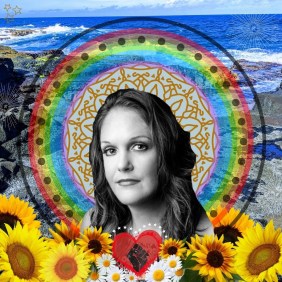
Subversive Sister Saints by Angela Yarber


As the American Embassy was bombed in 1999, I was hunkered in a Russian Orthodox Church, gazing at the brooding, whitewashed faces of icons, hands raised in endlessly frightening benediction. Hundreds of men met my eye, as I found myself asking, “Where are all the women?” In 2005, the sun peaked over the horizon on Mount Sanai as I entered the chapel at Saint Catherine’s Monastery, which houses the oldest collection of Christian orthodox icons in the world. As a sensory overload accosted my eyes, ears, and nose, I scanned the scene to find only two women crammed among all the icons; one was a nameless daughter sacrificed by her own father. Where were all the women? A few years later, I knelt at the Temple of 1,000 Buddhas in Thailand. Not a woman could be found. Where are all the women?

For over a decade, I’ve painted folk-feminist icons of revolutionary women from history and mythology, a subversively artistic attempt to answer my own question by painting the women who have been ignored, excluded, or strategically erased. From Pauli Murray to Sarasvati, Gloria Anzaldua to Papahanoumoku, this work continues to be a gift, joy, and a tremendous part of the mission of my non-profit, the Tehom Center, which empowers marginalized women by teaching about revolutionary women through art, writing, retreats, and academic courses. Continue reading “Subversive Sister Saints by Angela Yarber”
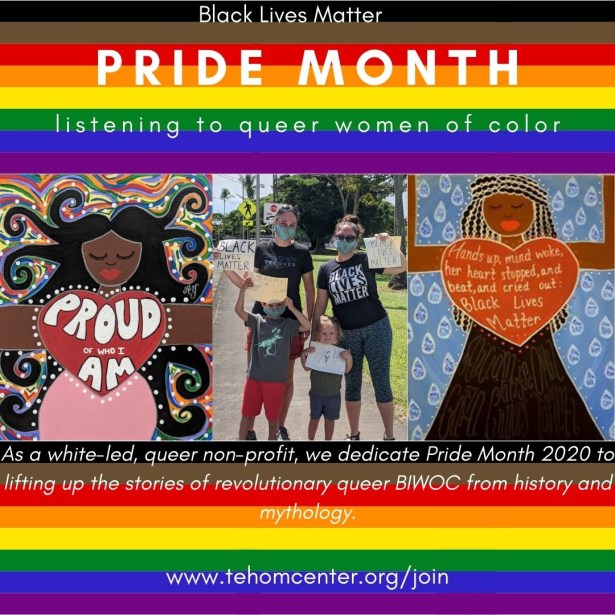
Coming Out of Quarantine by Angela Yarber

As Pride Month and Black Lives Matter protests co-exist, the spirituality of queer women of color teaches white allies how to listen.
After nearly eighty days of sheltering in place, I feel like I’ve stepped out and found the world on fire. June isn’t supposed to be this way. It’s Pride Month, after all, and I’m queer, eager to dance alongside my favorite drag queens, albeit reticent to embrace capitalism’s commodification of our beloved rainbows.

Most of our annual Pride events have been cancelled due to concerns of social distancing amid a global pandemic. I support these cancellations, though my first family outing since quarantine was a Black Lives Matter protest in Hilo, Hawai’i; we all stood six-plus feet apart, wore masks, and waved our signs beneath the King Kamehameha statue. As my six-year-old was complimented on how he wrote his own sign, I adjusted my three-year-old daughter’s face mask and thought about how queer BIPOC started the Stonewall riots only 51 years ago. I thought about how we queers would have every right to demand our Pride celebrations, storming capitals with glitter bombs, and demanding our civil liberties, not completely dissimilar to the myriad gun clad white dudes demanding haircuts only weeks ago. But we don’t. Continue reading “Coming Out of Quarantine by Angela Yarber”

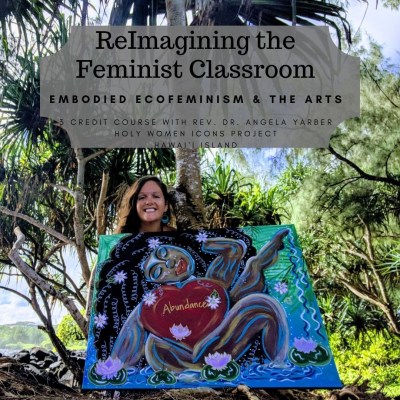
Reimagining the Classroom: Embodied Ecofeminism and the Arts Course on Hawai’i Island by Angela Yarber

“The classroom remains the most radical space of possibility in the academy.”-bell hooks

Like many academics, my “in the box” dream was to be a professor. The full-time, tenured kind. Like many queer feminist academics, I know that such dreams are rarely reality. When you’re also an artist and activist with a strong penchant for wanderlust, these dreams are simply unattainable fairytales. Never one for “in the box” living, I left the traditional academy and traditional church years ago, wandering over the garden’s walls with Lilith as my intrepid guide. I’ve told the story before. My wife and I left our jobs, sold our home, traveled full-time with our toddler, and turned the Holy Women Icons Project into a non-profit while building an off-grid tiny house on the television show Tiny House Nation in Hawai’i. It’s become old news. But since we’ve been doing this for several years now, those faraway dreams are finally starting to become reality. The academic classroom, the activist’s platform, the artist’s studio, the feminist’s megaphone, and the farmer’s orchard are fusing into one creative, life-giving, empowering space for teaching. The Holy Women Icons Project’s first academic course, “Embodied Ecofeminism and the Arts,” is actually happening. Seminarians and doctoral students from Berkeley join us in January. They’re soon followed by undergraduates from New York and seminarians from Atlanta. And I’m reaching out to more and more schools interested in creatively, subversively, and sustainably decolonizing the classroom with us for one week on the Big Island.

Continue reading “Reimagining the Classroom: Embodied Ecofeminism and the Arts Course on Hawai’i Island by Angela Yarber”

Holy Women of Pride: Queer Spirituality and Worship Resources by Angela Yarber

As we enter Pride month, do you ever finding yourself wishing there were unabashedly queer resources to aid clergy and people of faith in nurturing spirituality, celebrating queer families, or offering liturgies that celebrated revolutionary queer women? Look no farther! The Holy Women Icons Project—a non-profit seeking to empower marginalized women by telling the stories of revolutionary holy women through art, writing, and special events—has created three such resources. Thanks to a generous grant from The BTS Center, these affordable and accessible online retreats and resources are available for clergy and laity alike. Check out these three offerings, along with the revolutionary seven queer women of color who inspired them!
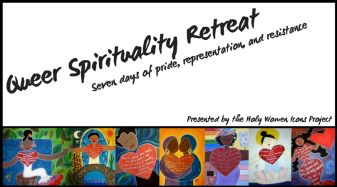
HWIP’s 7-Day Online Queer Spirituality Retreat is an opportunity to subversively queer your spirituality, and for the LGBTQ+ community to celebrate our spirituality without having to translate it through the lens of heteronormativity. Open to everyone, the Queer Spirituality Retreat features seven different queer women of color: Pauli Murray, Frida Kahlo, Perpetua and Felicity, the Shulamite, Marsha P Johnson, Guanyin, and Gloria Anzaldúa. The most important part of the retreat is, of course, the revolutionary queer women who make it possible. So, allow me to briefly introduce you to seven queer women of color… Continue reading “Holy Women of Pride: Queer Spirituality and Worship Resources by Angela Yarber”

Embracing Lost Vocation: Painting Mother Goddess by Angela Yarber

The awakening occurred at 1:27am with the pterodactyl-cry only uttered by toddlers. It continued around 2am when said pterodactyl joined weary moms in bed. Stinging tears splattered pillows with a swift headbutt to my nose, later accompanied by footied talons jabbing my ribcage as this tiny person became the human crossbar of a giant “H,” vertical moms arching precariously on either edge of the overstuffed bed. 5:30am came all too soon as both children arose, crows louder than any rooster, tired moms stretching their aching backs. Navigating this whole feminist parenting thing is complicated, y’all. As an artist, author, activist, and academic, I thought I had a handle on my identity and vocation; now I feel like motherhood is the only moniker defining my exhausted reality.

I was recently given the opportunity to speak at a conference for artists, academics, and activists, the so-called spiritual weirdos who think and create and do at the intersections of art, scholarship, spirituality, and social justice. It was enlivening and inspiring. What struck me, though, were the asides that often occurred when anyone asked whether I had children, and if so, what ages. Throughout my travels and during the conference, the consistent reaction upon sharing that I’m a mother of a two and five-year-old was, “Woah. You’re in the thick of it.” “Don’t worry. It gets easier.” “This, too, shall pass.” Rarely have I felt so validated. Continue reading “Embracing Lost Vocation: Painting Mother Goddess by Angela Yarber”

Celebrating Pride: Honoring the Spiritualities of Queer Holy Women of Color by Angela Yarber

With rainbow colors erupting from even the big box stores, I find my super queer-feminist-self scratching my head at the way Pride has transformed into a capital enterprise. I mean, I’m pretty stoked that the cultural climate seems to be slightly more affirming of queer people, but as queer culture is commodified, I cannot help but think of what is being lost or forgotten. And I want to shout from the rooftops that the rich spiritual history of Pride rests firmly on the shoulders of queer women of color who have marched and meditated, prayed and protested long before rainbow Pride headbands were available at chain stores across the land. It is for this reason that, in honor of Pride Month, the Holy Women Icons Project (HWIP) has launched a 7-Day Online Queer Spirituality Retreat that celebrates seven different queer holy women of color.

HWIP’s 7-Day Online Queer Spirituality Retreat is an opportunity to subversively queer your spirituality, and for the LGBTQ+ community to celebrate our spirituality without having to translate it through the lens of heteronormativity. Open to everyone, the Queer Spirituality Retreat features seven different queer women of color: Pauli Murray, Frida Kahlo, Perpetua and Felicity, the Shulamite, Marsha P Johnson, Guanyin, and Gloria Anzaldúa. Each retreat day takes about 20 minutes and includes an inspirational quote, an icon image, a reflective essay, a guided writing exercise, a ritual exercise, and a closing blessing. The most important part of the retreat is, of course, the revolutionary queer women who make it possible. So, allow me to briefly introduce you to seven queer women of color who should make us all proud…

Continue reading “Celebrating Pride: Honoring the Spiritualities of Queer Holy Women of Color by Angela Yarber”

Women’s History Month: Painting and Empowering Adolescent Girls by Angela Yarber

In celebration of Women’s History Month, the Holy Women Icons Project is excited to launch Revolutionary Girls, a new program seeking to empower marginalized adolescent girls by telling the stories of revolutionary women through art, writing, and discussion. Partnering with local schools and other non-profit organizations in the Puna District of Hawai’i County, we are creating a curriculum that features often overlooked historical and mythological women whose lives, legends, and legacies embody empowerment, resilience, and emotional intelligence that can embolden adolescent girls to become socially aware revolutionary leaders.

Research shows that girls’ self-esteem plummets in early adolescence, due in part to unrealistic body images in media and casual (or even overt) sexism from parents, teachers, and peers. Our Revolutionary Girls project aims to counter these negative influences by offering girls aged 11-15 a space of empowerment. Prior to adolescence, many girls believe they are as smart, strong, and capable of leadership as boys. At the onset of puberty, girls are often taught that their only value is in their appearance, and that they are not as capable or valuable as men and boys. Simultaneously, girls are exposed primarily to the histories and myths of men in power while in the classroom, the revolutionary lives, legends, and legacies of countless revolutionary women altogether absent from their textbooks and lessons. Continue reading “Women’s History Month: Painting and Empowering Adolescent Girls by Angela Yarber”

The Protest Goddess by Angela Yarber

I’ve long held that feminism, in order to be true and engaged and practical, must be intersectional. The work of justice for women must also include justice for other marginalized groups. Because many women are also LGBTQ, people of color, people with disabilities, Muslims, immigrants, and others marginalized for identities other than their gender. Paying attention to these intersections—of sexuality, gender, race, class, ability, religion—and acknowledging that many people have multiple intersecting identities for which they are oppressed is vital to the work of justice.

These thoughts remained at the forefront of my mind as I recently marched in one of the sister marches of the Women’s March in my home of Hilo, Hawaii. I heard many straight, white, cisgender women claim that women are not oppressed while mocking the march as irrelevant. I heard some gay men purport that such a march was unnecessary. And I wondered. Are not women of color also women? Muslim women? Immigrant women? Women with disabilities? Queer women? Trans women? Are not our quests for liberation and rights and legal validity interrelated, mutually dependent, might I even say, intersectional? Continue reading “The Protest Goddess by Angela Yarber”

Goddesses of Mindfulness for a New Year Feminism and Religion by Angela Yarber

I’ll be honest. For me, 2017 royally sucked. Though “feminism” was dubbed the “word of the year” by Merriam-Webster’s—as evidenced by the Women’s March, the Handmaid’s Tale, Wonder Woman, and the Me Too Movement—the reason feminists thrust our fed-up fists into the air in protest so frequently was because of the way women are routinely unjustly treated.

In the midst of this global, political, national fury, I experienced personal struggles in 2017 with the death of my brother and my mother’s cancer diagnosis. There was beauty and goodness that filled the year, to be sure, but you can believe me when I say that I am welcoming 2018 with open arms. As I entered into conversation with myriad feminists across the gender spectrum around the world, it seems that many echo these sentiments. We could not wait to bid 2017 farewell. Yet, I knew that I did not want to enter the year filled only with bitterness and resentment. Rather, I wanted to mindfully move forward with radical gratitude, hope, and intentions set on creating a more beautiful 2018. Enter the goddess. Continue reading “Goddesses of Mindfulness for a New Year Feminism and Religion by Angela Yarber”

Grieving through the Holidays: Painting Holy Women Icons of Grief by Angela Yarber

The holiday season is a particularly difficult time for grief. Whether it is grieving someone who died earlier in the year as you celebrate your first holiday season without them, or the lasting memories of loved ones who are no longer present at family gatherings, this time of year makes grief bubble to the surface. Since this is my first holiday season without my little brother, who died in March, I’ve planned ahead with coping strategies that I’d like to share with other feminists struggling to grieve through the holidays.

Upon the death of a loved one, most people in the West are offered commodified grief, costly funerals, and stifled feelings pre-packaged as dignified tradition. When deathcare became a commercial enterprise at the turn of the twentieth century, there was what mortician and author Caitlin Doughty calls a seismic shift in who was responsible for the dead. “Caring for the corpse went from visceral, primeval work performed by women to a ‘profession,’ an ‘art,’ and even a ‘science,’ performed by well-paid men. The corpse, with all its physical and emotional messiness, was taken from women. It was made neat and clean, and placed in its casket on a pedestal, always just out of our grasp (Caitlin Doughty, From Here to Eternity: Traveling the World to Find the Good Death, 136).”

Continue reading “Grieving through the Holidays: Painting Holy Women Icons of Grief by Angela Yarber”