Creativity as Spirituality by Jassy Watson

Jassy

According to Robert. C. Fuller author of Spiritual not Religious, “an idea or practice is ‘spiritual’ when it reveals our personal desire to establish a felt-relationship with the deepest meanings or powers governing life” (2001, p. 2). According to this definition, creativity and even more specifically, artistic expression, can be considered a spiritual practice. Christine Paintner, writing for Spirituality in Higher Education states that “cultivating the arts as a spiritual practice is a path to freeing our imaginations and developing valuable skills for vital living in the world” (2007).

What is Spirituality?

 Spirituality is usually considered to be a search for meaning in life. By making sense of and finding meaning, spirituality can often align us to our purpose. It also provides “a set of values to live by, a sense of direction, and a basis for hope” (Paintner, 2007). Spirituality can also assist us in encountering mystery and further developing and nurturing a relationship with it. It is also about transformation, for it challenges us to grow and expand. Spiritual practice also invites us to commit to a set of practices such as prayer, ritual, meditation, chant and service that enable us to encourage a way of being intentional in our relationship to the self, others and the divine. Continue reading “Creativity as Spirituality by Jassy Watson”

Painting Martha Graham by Angela Yarber

angela

Joining Virginia Woolf , the Shulamite, Mary Daly, Baby Suggs, Pachamama and Gaia, Frida Kahlo, Salome, Guadalupe and Mary, Fatima, Sojourner Truth, Saraswati, Jarena Lee, Isadora Duncan, Miriam, Lilith, Georgia O’Keeffe, Guanyin, Dorothy Day, Sappho, Jephthah’s daughter, Anna Julia Cooper, the Holy Woman Icon archetype, Maya Angelou, and all my other Holy Women Icons with a folk feminist twist  is the dancing revolutionary Martha Graham. So, as the contemporary and modern dancers on So You Think You Can Dance continue to amaze us this summer, let us remember from whence they came.

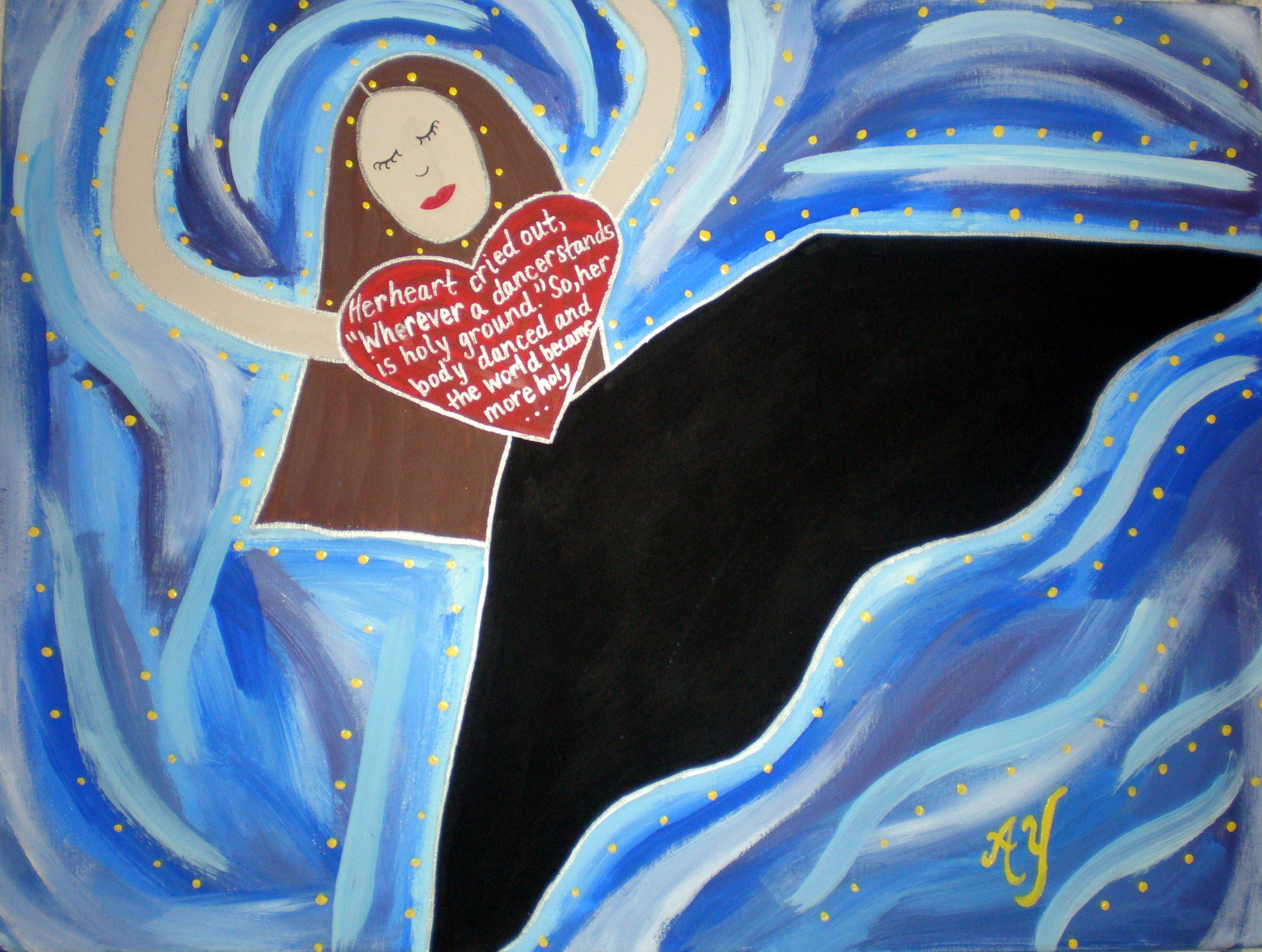
Martha Graham’s contribution to the world of dance cannot be overestimated. She is regaled as the Picasso of the dance world, revolutionizing it by introducing an entirely new quality of movement known as modern dance. Not only did Graham revolutionize the dance world, like Isadora Duncan before her, she also made great contributions to feminist spirituality. One of her most famous statements may well have been “wherever a dancer stands is holy ground.” Like most dancers who are so in tune with their bodies, Graham new the holiness therein, the ways in which the body can express the ineffable when words alone simply cannot. “The body never lies,” she famously reminds us.

Martha Graham Continue reading “Painting Martha Graham by Angela Yarber”

Writing Holy Women Icons by Angela Yarber

angelaFor two years I have had the great privilege of writing a monthly article about one of my Holy Women Icons with a folk feminist twist for Feminism and Religion. Virginia Woolf , the Shulamite, Mary Daly, Baby Suggs, Pachamama and Gaia, Frida Kahlo, Salome, Guadalupe and Mary, Fatima, Sojourner Truth, Saraswati, Jarena Lee, Isadora Duncan, Miriam, Lilith, Georgia O’Keeffe, Guanyin, Dorothy Day, Sappho, Jephthah’s daughter, Anna Julia Cooper, the Holy Woman Icon archetype, Maya Angelou, and many others that will follow in the months and years ahead have guided, empowered, and inspired me as an artist, activist, feminist, scholar, and preacher.

I knew from that outset that writing about them would deepen my relationship with each of these amazing women. I also knew that their power and efficacy monumentally increases when they join together. This colorful cloud of witnesses has filled myriad galleries, reminding viewers of the powerful women who have paved the way for us today. Many have left the group, finding a resting place in the homes, offices, and galleries of friends, colleagues, and strangers who have purchased or commissioned an icon along the way. And those that remain erupt the hallways of my home with a cavalcade of color, daily reminders of who I am called to be and become.

Between researching their stories, painting them, hanging them in galleries, and selling them, I knew that one day I would bind their stories together in a book. So, it is with tremendous joy that this dream has become a reality. Parson’s Porch Publishing, a non-profit publishing house whose mission is to “turn books to bread” by giving their profits to feed the poor, has lifted up the stories and images of nearly fifty of my beloved Holy Women Icons in a book. So, along with originals, commissions, and prints, Holy Women Icons are now available as a book and as individual greeting cards. It is my sincere hope that by binding the stories of these holy women together, they may provide inspiration and empowerment for all readers, binding all our diverse stories together in a collective cry for beautiful, unabashed, prophetic justice for all. Continue reading “Writing Holy Women Icons by Angela Yarber”

Painting Maya Angelou by Angela Yarber

angelaAuthor. Performer. Activist. Poet. Actress. Playwright. There are few others whose accomplishments are as prestigious, prolific, or expansive as Maya Angelou’s. I initially encountered her work in a ninth grade literature class. The first of her seven autobiographies was our assigned reading. I voraciously consumed every word of I Know Why the Caged Bird Sings, my heart filled with grief, my eyes filled with tears, my mind filled with questions. It is no wonder this book is the most acclaimed of all her autobiographies, books of poetry, and essays. As a fourteen year-old, my mind was opened to the power of stories, particularly the stories of those vastly different from oneself, and to the oppression black women like Angelou experienced in the United States. As a native white Southerner, I Know Why the Caged Bird Sings was my first foray into grappling with the nuances of white privilege.

In college, my creative writing professor packed all ten of the creative writing minors into a van to drive to a neighboring college where Angelou was lecturing. I sat in awe, riveted by every word. And upon the completion of my Ph.D., I moved to Winston-Salem, the place Angelou calls home. I have yet to meet her. If I could, I’d surely hand her the icon I painted in her honor, knowing that my words would fail to express how profound my gratitude is for the work she has done in our world. Continue reading “Painting Maya Angelou by Angela Yarber”

Painting Sappho by Angela Yarber

angela

“Someone, I say, will remember us in the future,” she once wrote.  To my knowledge, she was never dubbed a prophet.  A muse, yes.  A romantic, perhaps.  But never a prophet, rarely holy, and nary an icon.  Until now.   Hailed as one of the best Greek lyric poets, many have tried to forget her, or at least the more provocative elements of her life.  The passionate poet Sappho was born on the island of Lesbos around 620 BCE (sometime between 630-612 BCE).  The word lesbian stems from the place of her birth and her name is the origin of the word sapphic, though most scholars assert that little is known of her actual life and that the majority of her poetry is not autobiographical.  Yet her lyric poetry speaks of love for both sexes and myriad people.

What is more, the idea of homo and heterosexuality are not transhistorical essences, but instead are relatively recent socio-historical constructs. To say that there were strict sexual binaries in the ancient world in which Sappho lived would be an anachronism. Sexuality was much more fluid.  Not surprisingly, many scholars have tried to name and claim male lovers for Sappho, a heteronormative attempt to erase her fluid sexuality, her hope to be remembered in the future dashed, demeaned, forgotten.  In fact, during the Victorian Era, many asserted that Sappho was the headmistress of a girls’ school, another attempt to straighten out her memory, her poetry, her love. Continue reading “Painting Sappho by Angela Yarber”

Painting Dorothy Day by Angela Yarber

angela

Radical Revolutionary.  One with the workers.  Daily works of mercy.  One who challenged the status quo.  She never wanted to be called a saint, though the Claretian Missionaries proposed that she be canonized in 1983.  The Catholic Church calls her a “Servant of God.”  I call her a Holy Woman Icon.  She joins the myriad other Holy Woman Icons with a folk feminist twist that I feature each month: Virginia Woolf , the Shulamite, Mary Daly, Baby Suggs, Pachamama and Gaia, Frida Kahlo, Salome, Guadalupe and Mary, Fatima, Sojourner Truth, Saraswati, Jarena Lee, Isadora Duncan, Miriam, Lilith, Georgia O’Keeffe, Guanyin.

Born on November 8, 1897 Dorothy Day’s radical spirit, her development of the Catholic Worker Movement, and  her solidarity with the poor have taught countless women what it means to be a revolutionary.  This American anarchist and activist converted to Catholicism as an adult after living what many describe as a bohemian lifestyle.  She advocated the Catholic economic theory of distributism, daily works of mercy, pacifism, and solidarity with the poor. Continue reading “Painting Dorothy Day by Angela Yarber”

Painting Holy Women By Angela Yarber

angelaEach month, I focus on one of my Holy Woman Icons with a folk feminist twist, highlighting the often unsung stories of feminism’s heroines: Virginia Woolf , the Shulamite, Mary Daly, Baby Suggs, Pachamama and Gaia, Frida Kahlo, Salome, Guadalupe and Mary, Fatima, Sojourner Truth, Saraswati, Jarena Lee, Isadora Duncan, Miriam, Lilith, Georgia O’Keeffe, Guanyin, and many others who will be featured in the months to come.  While some of these holy women may not be incredibly famous to the wider public, most of their names and stories are familiar to the readers of Feminism and Religion.  They are goddesses, saints, artists, dancers, scholars, clergy, and pillars of the faith.  We tell their stories in our classrooms.  Their stories embolden us to stand tall, stay strong, and continue working for justice and equality.  But what of the women whose songs really are unsung, whose stories never grace the pages of our textbooks?  What about the women who have, indeed, emboldened us, paved the way for us to be who we are, but who our readers have never heard of?  This month I would like to focus on one of these women.  You’ve probably never heard her name, but I know her very well.  It is her courage that has given me strength, her compassion that has taught me to love.  Her name is Mary Harrell and she is my mother.

In her seminal work that highlights the importance of telling women’s stories, FAR’s own Carol Christ begins by saying:

Women’s stories have not been told.  And without stories there is no articulation of experience.  Without stories a woman is lost when she comes to make the important decisions of her life.  She does not learn to value her struggles, to celebrate her strengths, to comprehend her pain.  Without stories she cannot understand herself.  Without stories she is alienated from those experiences of self and world that have been called spiritual or religious.  She is closed in silence.  The expression of women’s spiritual quest is integrally related to the telling of women’s stories.  If women’s stories are not told, the depth of women’s souls will not be known.  (Carol Christ, Diving Deep and Surfacing: Women Writers on Spiritual Quest.  Boston: Beacon Press, 1980) Continue reading “Painting Holy Women By Angela Yarber”

Painting Guanyin by Angela Yarber

As hundreds of thousands of people are dying in Syria and myriad individuals suffer from political unrest in Egypt, as we continue to debate the sexuality of young women (yes, we’re still talking about Miley Cyrus) in the face of America’s rape culture and as countless nameless victims are ravaged by war, poverty, racism, and violence, I sometimes find myself overwhelmed, as though my two hands are never enough to reach out, help, rage, change.  And I find myself—and our world—in need of mercy and compassion.  Since I always focus on one of my Holy Woman Icons with a folk feminist twist, I am drawn this month to the Goddess of Mercy.  So, Guanyin joins this great cloud of witnesses who inspire, embolden, and surround us: Virginia Woolf , the Shulamite, Mary Daly, Baby Suggs, Pachamama and Gaia, Frida Kahlo, Salome, Guadalupe and Mary, Fatima, Sojourner Truth, Saraswati, Jarena Lee, Isadora Duncan, Miriam, Lilith, and Georgia O’Keeffe.

In English we know Guanyin as the Goddess of Mercy and Compassion.  Generally regarded among East Asian devotees as originating from Avalokitesvara, her name is shortened from Guanshiyin, which means “One who hears the sounds/cries of the world.”  In the Lotus Sutra, Avalokitesvara is a bodhisattva who is androgynous and can take on the form of any female, male, adult, child, human, or non-human sentient being in order to teach the Dharma.  Typically she is depicted in female form and she is widely venerated by East Asian Buddhists.  Though she is particularly poignant for Buddhists, Guanyin is present in almost every facet of Chinese religion, from Buddhism to Taoism to shrines for local fishermen. Continue reading “Painting Guanyin by Angela Yarber”

Painting Georgia O’Keeffe by Angela Yarber

Hailed as the Mother of American Modernism, her seemingly vaginal flowers lauded by feminists and artists alike, Georgia O’Keeffe stands as a sentinel for strong, creative women who balk at tradition and embrace a faraway freedom.  Though she adamantly denied any association with female genitalia embedded in her sensuously up-close-and-personal flowers—even from feminist artists as famed as Judy Chicago—she remained a female force unbound, painting, living, loving, and creating on her own terms.  So, it’s no wonder that she joins my Holy Woman Icons with a folk feminist twist: Virginia Woolf , the Shulamite, Mary Daly, Baby Suggs, Pachamama and Gaia, Frida Kahlo, Salome, Guadalupe and Mary, Fatima, Sojourner Truth, Saraswati, Jarena Lee, Isadora Duncan, Miriam, and Lilith.

Born in November 1887, O’Keeffe knew she would be an artist from the young age of seven.  Whether you’re familiar with her intricate flowers, soaring skyscrapers, or desert skulls depends largely on the period of her life that interests you.  Whether it was the rural Wisconsin farm of her childhood, the bustling city of New York where she began her relationship with famed photographer Alfred Stieglitz, the peaceful lake in the Adirondack Mountains where they summered, or the harsh desert landscapes of New Mexico where she devoted her later years, she found inspiration and captured beauty wherever she lived, camped, traveled, hiked, or drove in her Ford Model A.  Continue reading “Painting Georgia O’Keeffe by Angela Yarber”

Painting Lilith, Leaving Church by Angela Yarber

 Lilith has been a misunderstood, appropriated, and redeemed woman throughout the ages.  Many feminists claim her as an empowering figure in Jewish mythology, her story reclaimed by contemporary artists such as Sarah McLachlan, who created the all-women music tour, “Lilith Fair.”  Others have claimed that Lilith was a demon who seduced men and strangled children in the night.

Based almost entirely on Judith Plaskow’s beautiful Midrash, “The Coming of Lilith,” this new Holy Woman Icon with a folk feminist twist has empowered me to reject the sexism and heterosexism that was rendering me broken.  So, she joins Virginia Woolf , the Shulamite, Mary Daly, Baby Suggs, Pachamama and Gaia, Frida Kahlo, Salome, Guadalupe and Mary, Fatima, Sojourner Truth, Saraswati, Jarena Lee, Isadora Duncan, and Miriam as powerful women who have done holy and remarkable things.  First, her story.  Then—if I may—my own.

Continue reading “Painting Lilith, Leaving Church by Angela Yarber”