Scholars of Mythology by Barbara Ardinger 

Barbara ArdingerHere’s how my mind leaps around. I was mooning about and trying to figure out what I wanted to write for this blog when I picked up one of the books in the stack at the other end of the couch. I bought The Mythology of Eden by Arthur George and Elena George because I’d read the thoughtful review by Judith Laura, a Goddess scholar I know and respect.

In their introduction, the Georges present a paragraph by biblical scholar Millar Burrows that explains that myth is:

a symbolic, approximate expression of truth which the human mind cannot perceive sharply and completely, but can only glimpse vaguely, and therefore cannot adequately or accurately express. … It implies not falsehood, but truth; not primitive, naïve misunderstanding, but insight more profound than scientific description and logical analysis can ever achieve. The language of myth in this sense is consciously inadequate, being simply the nearest we can come to a formulation of what we can see very darkly. … The procedure is quite legitimate if [we] understand what is being done (p. xii). (Burrows’ book is An Outline of Biblical Theology, published in 1946.)

Mind leap: Wow, I said to myself, does this describe the revisionist fairy tales I write? I try to see through that dark glass more clearly and recast old ideas in new ways. (I hope this doesn’t sound too pretentious. I don’t mean it to.)

Mind leap: And, I further said to myself, we scholars who write for Feminism and Religion often write about myth, though we don’t always acknowledge that our religious stories are indeed myths. It’s like the old joke—“If I believe it, it’s religion. If you (or they) believe it, it’s myth.” Even though we sometimes call our myths the inerrant word of this god or that goddess, the stories in all of our holy books are our instructive myths. Read Burrows’ definition again. Continue reading “Scholars of Mythology by Barbara Ardinger “

November, A Silent Month? by Barbara Ardinger

Barbara ArdingerNovember, which begins with All Saints Day (yesterday) and All Souls Day (today), gives us a quiet, welcome break between the loud make-believe of Halloween and the incessant caroling of the winter solstice season with its popular holidays. In the Northern Hemisphere, the days are noticeably shorter and darker now. Where I grew up, it’s gray, cloudy, and often rainy. It has always seemed to me that people are turning inward and the month is closing in on itself. Even today in southern California, I feel a delicious melancholy composed of silence and rest from hard work.

giant head

For two millennia, the standard-brand churches have admonished women to be silent. As it is written, “Let the woman learn in silence with all subjection. But I suffer not a woman to teach, nor to usurp authority over the man, but to be in silence” (1 Timothy 2: 11-12).

Let’s say that today is a typically gloomy November day. The sun is lazy and clouds are floating mysteriously across the sky. Look, they’re gathering over there in the east. As clouds often do, they begin to assume shapes. Let’s look closer…and we begin to see a fiery mountain. Above that fiery mountain floats a giant head. Listen! The head is speaking. “I am One, the Great and Powerful. Thou shalt not take My Name in vain. Thou shalt have no other gods before me for I am a jealous God—”

But the silence of this gloomy November day is suddenly broken as the women standing in the mud at the foot of the fiery mountain suddenly begin to shout back at the preaching giant head. “There’s been plenty of gods before you,” one woman shouts. “And even more goddesses came before you,” calls another woman. Continue reading “November, A Silent Month? by Barbara Ardinger”

The Wages of Greed and Hubris by Barbara Ardinger

Barbara ArdingerHistorical note: I took the name Formosus (r. 891-896) from one of the popes of the Dark Ages. After his death, his body was exhumed, dressed in papal vestments, and put on trial for political crimes. The corpse was found guilty, and the vestments were torn off it. Then it was thrown into the Tiber. A monk pulled it out, and it is said that the corpse was then burned.

Of course, if the fisherman in this story resembles anyone in modern politics….

Near the bend of the great blue river where it empties into dark sea, there once lived a fisherman and his wife. Although they were so poor they lived in a rickety hovel on the bluff above of the river, the fisherman’s wife was smart and thrifty and the fisherman himself was unusually devout. He always managed to save a brass coin to drop into the basket at the church of the new religion in the town. Of course, the fisherman also found time to pay frequent visits to the public house in the town, where he had many friends with whom he often sang long into the night. He had also gained a bosom companion at the new church. This was a dwarf named Formosus, who held an ambiguous ecclesiastical office. The fisherman visited Formosus whenever he had a new thought, and the pair often retired to the public house to continue thinking together.

Every morning the fisherman climbed down the path to the riverbank to catch fish for his wife to sell. One morning, when he cast his line into the sparkling blue water, he felt something heavy on the hook. He pulled and pulled, and eventually a great, shiny dolphin rose out of the water. Now everyone knows that dolphins almost never leave the dark sea or swim in inland rivers.dolphin

“This is a great miracle!” said the fisherman. “I’ll have to tell my friend Formosus about this and get his interpretation of this miracle.” He took great care to pull the hook out of the dolphin’s lip without tearing it. After apologizing to the fish for hooking it, he released it back into the river. During that afternoon, he caught only a few small fish. “Oh, well, At least we can eat them for supper.”

When he stopped at the church to see Formosus on his way home, the dwarf was not there. The fisherman soon found his friend at the public house. When he told him about the dolphin, the first words the dwarf said were, “Fool! It must have been a magical fish. When you released it, why didn’t you ask it for a favor?” Continue reading “The Wages of Greed and Hubris by Barbara Ardinger”

Community: A Guided Meditation by Barbara Ardinger

Barbara ArdingerAs I read the blogs posted here, I’m more and more interested in the comments. They show that we and our readers are turning into a real community. For this reason, I’ve decided it might be fun to reconstruct a guided meditation on community from my book Goddess Meditations, which was published in 1999. Goddess Meditations was the first book I wrote after I moved to Long Beach in 1996. I’m rewriting the meditation because I know more now and writer better than I did back then.

Yes, we here at Feminism and Religion are a community, and in my opinion there’s nothing better than community. Individuals come together to form small communities. Small communities come together to form larger communities. And so it goes. Hopefully we’re building up to a world-wide community.

netLet’s begin. Sit comfortably, close your eyes, and take several deep, easy breaths. When you feel relaxed, call into your mind the familiar image of a fishing net. See a vast net that stretches up and down as far as you can see, every knot a sparkling star. See yourself in the center of this shining net, but know that each of us stands at his or her own center of the net. The stars revolve around each of us, they shine for each of us. This net has as many centers as it has knots that are shining stars. This net is our community. The Weaver of our net is the Great Goddess. Continue reading “Community: A Guided Meditation by Barbara Ardinger”

Uppity Women Unite by Barbara Ardinger

Barbara ArdingerI have a poster on my wall: UPPITY WOMEN UNITE. In big, red, capital letters. I don’t remember where I got this poster, but I know I’ve had it since the late 70s or early 80s. I’m sure it comes from the raggedy late 60s, when second-wave feminism got up a head of steam and uppity women began getting our attention. That’s when Betty Friedan said being a proper 50s housewife was like having a mental illness. It’s when Gloria Steinem founded Ms. Magazine, which (oh, horrors!) did not give us recipes or home-making tips and did not tell us how to dress to lure our men into bed. It’s when Mary Daly started giving us a whole new, original take on the English language. Ahhh, yes, those were the good ol’ days. And the bad ol’ days, too, when the Equal Rights Amendment was not ratified.

“Uppity” can be a troublesome word. In the olden days, if someone called you uppity, it means you were inferior to them and weren’t staying in what they thought was your proper place. If you were a black person, for example, and if you didn’t step off the sidewalk when white men were coming, you were uppity. If you were a woman who wanted equal pay for doing the same work a man did, you were uppity. Those women in the 1980 movie, 9 to 5, were majorly uppity. And they won the battle.

Uppity women didn’t stay in the kitchen or the bedroom. They used—oh, horrors—the Pill. They marched to Take Back the Night. They got up on stage and played their own drums and guitars and didn’t sing like proper ladies should. They shouted. And they got into politics. Bella Abzug said that a woman’s place is in the House. Shirley Chisolm became the first black female member of congress in 1968 and in 1972 ran for president. (And I voted for her.)

B292_UppityWomenUnite_0

The English teacher in me wants to get in a word or two here. Look at the phrase “uppity women unite.” It might be a front page headline that says strong women who won’t stay on the bottom are getting together. Or maybe it’s a simple declarative sentence. But add punctuation and we get more punch. “Uppity women, unite.” Now the verb is imperative. We must unite. Let’s make it stronger: “Uppity women—unite!” Now it’s a command.

So, uppity sisters, and uppity brothers, too, you know how to multitask. Push the on button in your corpus callosum and let your imagination run while you read this. Let’s consider what the planet might look like if we had equal rights (and rites) in all things. Please understand that I’m not saying women should be the ones on top. I’m not talking about “power over,” but about what Starhawk calls “power with.” That’s shared power, which leads to shared magic.

Points of lightImagine yourself as one of a huge crowd of flying people joined as points of light above the earth. Float peacefully up there for a few minutes. Think about the power of people joined together, the energy of people working together. Now let’s get down to earth. Floaty energy is fun, but it doesn’t get much done. Imagine yourself as a member of a group with a goal. Touch down. Stand on the earth and consider the fact that everything on the planet is alive—not just people and animals and plants, but rocks, too. Even things we constructed have some life force. Embrace panentheism for a little while. Now here’s something to do: Find a church that doesn’t accept uppity women or uppity brothers. You’re united. As united, uppity people, go to that church and stand in a circle around it. Send friendly but firm energy into that church so that, even if a whole denomination or religion won’t change right now, that individual church might change. The next time you go to that church, radiate the same energy when you go inside.

You can also find a church that appreciates uppity folks. Send grateful energy to the church and all the people in it.

UPPITY WOMEN UNITE. If enough of us uppity women and our uppity brothers get together, we will eventually build up to a critical mass. A critical mass can lead to an explosion. I’d prefer to see a spiritual, peaceful explosion. What do you want to see?


Barbara Ardinger, Ph.D. (www.barbaraardinger.com), is a published author and freelance editor. Her newest book is Secret Lives, a novel about grandmothers who do magic.  Her earlier nonfiction books include the daybook Pagan Every Day, Finding New Goddesses (a pun-filled parody of goddess encyclopedias), and Goddess Meditations.  When she can get away from the computer, she goes to the theater as often as possible—she loves musical theater and movies in which people sing and dance. She is also an active CERT (Community Emergency Rescue Team) volunteer and a member (and occasional secretary pro-tem) of a neighborhood organization that focuses on code enforcement and safety for citizens. She has been an AIDS emotional support volunteer and a literacy volunteer. She is an active member of the neopagan community and is well known for the rituals she creates and leads.

How the Dark Fairy Carabosse Found the Light by Barbara Ardinger

Barbara ArdingerThe dark fairy Carabosse was in a snit. “Here I am,” she fumed, “the smartest, most literate, least mischievous fairy in any world, and no one will listen to me. I’m the best of all possible fairies in the best of all possible worlds. And do I receive my due respect? Why am I not Goddess of the Sun?”

“Hush, dear,” said Carabosse’s amanuensis. “There’s already a sun god. There can’t ever be a sun goddess. The sun shoots out masculine energy—that’s what the mortals say. The moon absorbs and reflects the masculine energy. The moon is the feminine planet.”

“Well, I’m tired of reflecting men’s power. I’m also tired of being ruled by the phases of the moon. I demand to be a sun goddess so I can rule the moon! Grimmella, what’s the moon phase today?”

Grimmella looked at her handy pocket calculator. “It’s eleven percent waning, Almost dark. Which might explain your mood.” As Carabosse sniffed and glared at her, she added, “You can’t be a sun goddess. It’s just not done!”

“Oh, Grimmella,” the dark fairy exclaimed, “don’t be so old-fashioned! Wake up! We’re done with all that reflected light business. I want to be the source of light. Besides, it’s a new century! Even for the mortals. And I’ve done so much for them—for us fairies, too—that I deserve a reward. I deserve to the Goddess of the Sun.” When Grimmella laid her pen down and frowned, the dark fairy went on with her rant. “Do you know who that hubristic Apollo really is?” Continue reading “How the Dark Fairy Carabosse Found the Light by Barbara Ardinger”

A Tiny Life by Barbara Ardinger

Barbara Ardinger

The news is getting me down. Nearly three hundred Nigerian schoolgirls kidnapped by Boku Haram. The capsized South Korean ferry and more than 300 drowned students. Kids taking guns to school and the governor of Georgia signing a law that says anyone can carry a gun almost anywhere in the state. The ever-continuing feminization of poverty. A couple Saturdays ago, I heard an enormous noise of cawing and shrieking and wings flapping outside my window. It went on for several minutes, so I finally set my book aside (I was trying to ignore Eyewitless News), got up, and looked out into the courtyard. Two huge, noisy crows were chasing a smaller bird. I think it might have been a scrub jay. I have no idea what the jay’s crime had been in the crows’ eyes, but they were chasing it back and forth, up and down, and one of them finally speared it with its beak. The jay fell. The crows landed on the roof of the building across the courtyard and strutted back and forth for several minutes. One of them went down for a closer look at the fallen jay. Then they flew away.

I’ve seen crows attacking other birds before. They’re extremely intelligent birds, but they also get aggressive. Some years ago, I sat at a desk in an office, gazing out the window, and saw a crow destroy a hummingbird’s nest and eat the babies. Sad, yes, but this is how crows around the world find food. My coworkers wanted to storm outside immediately and (I guess) shoot the crow and maybe tear the little tree out of the ground. “No,” I said. “Leave it alone. Tennyson was right when he wrote that nature is bloody.” Continue reading “A Tiny Life by Barbara Ardinger”

A Beltane Story by Barbara Ardinger

Barbara ArdingerOnce upon a time there was a beautiful princess—NO, stop right there. Tales like this do not require princesses. Let’s try again. Once upon a time there was a sturdy young woman who lived in a small town in Mitteleuropa not too far from the castle of the Holy Roman Emperor.

The girl’s name is Madchen. Her parents are a Farmer and a Cunning Woman. She is proud to say that just last fall she actually saw the Emperor, who is a stiff, elderly man who always wears a fussed-up military uniform and a pince nez and has enormous sidewhiskers. The Emperor did not, of course, notice the girl as he sat in his carriage and waved stiffly to his subjects. But what Madchen doesn’t know is that Crown Prince Rufus, whose uniform and sidewhiskers are considerably more modest than his father’s and who was riding on a great red Royal coachstallion in the parade behind his father’s coach, noticed her immediately. That girl, he said to himself, is a girl I must have! Continue reading “A Beltane Story by Barbara Ardinger”

What’s Good About Good Friday? by Barbara Ardinger

Barbara ArdingerI grew up Calvinist and Republican in a suburb of St. Louis, Missouri. My parents belonged to—but rarely attended—Immanuel Evangelical & Reformed Church in Ferguson, Missouri. When children reached the age of twelve, they were “confirmed” in the church, which meant taking a Bible class taught by the minister, Rev. Press, and then going through a ceremony that made them eligible to take communion, which in that church was grape juice and tasteless crackers. Transubstantiation? I learned what the word meant, but I had (and still have) no idea if it really happens.

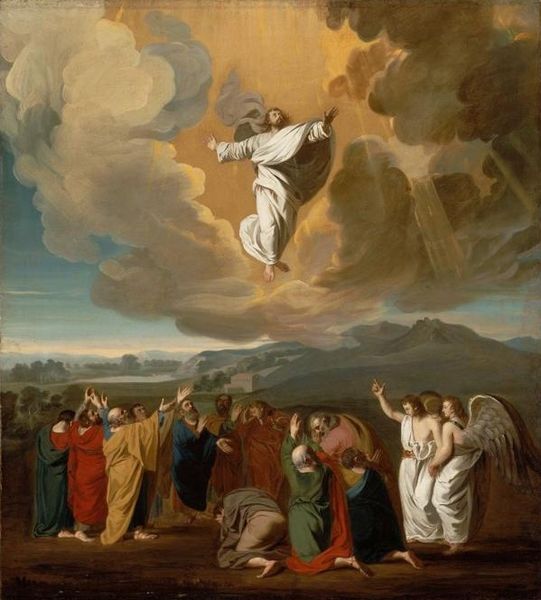
Ascension by John Singleton Copley (1775)

I’ve always been one to ask untidy questions, so of course I asked a lot of questions in confirmation class. God tells us half a dozen times in the Old Testament, for example, that he is a “jealous god.” How, I asked Rev. Press, can a jealous god be a loving god? What’s good about a jealous god? (A couple decades later, when I was studying the Aramaic Bible as translated by George M. Lamsa from the Pshitta manuscripts, I learned that the correct word is “zealous.” That was no help. I still don’t see much good in either jealousy or zealotry.) A week or two later, I asked Rev. Press, “What’s good about Good Friday?” Shortly thereafter, my mother advised me to stop asking questions in confirmation class. (Can we assume she’d received a pastoral phone call?) Continue reading “What’s Good About Good Friday? by Barbara Ardinger”

Persephone by Barbara Ardinger

Here we are, creeping up on the vernal equinox (March 21), which astronomers and weathermen on TV tell us is the start of spring. I see Imbolc (as described by Deanne Quarrie) as the true beginning of spring, however. It’s when we see the first little crocuses popping up through the snow…..oh, yeah…..well, maybe not this year, when more than half the U.S. is buried under mountains of snow. Let’s just agree that in ordinary years crocuses pop up and bloom and trees start showing us their tiny green leaves in February. The equinox is really the turning point of spring, the hinge of time when the rising energy tips over into falling energy that is flowing toward summertime, which will arrive at Beltane (May 1 or 2).

Persephone
Demeter and Persephone

We’re probably all familiar with the story of Persephone, who under her childhood name, Kore, was out picking flowers in the meadow one day when her Uncle Hades roared up out of the earth in his mighty chariot and kidnapped her. This led her mother, Demeter, the grain goddess, to search for her and finally go on strike and let the world turn back into winter. This went on until Aunt Hecate told Demeter where her daughter was. When Persephone, now queen of the underworld, came back up with her mother—voilà! It was springtime. That’s how the vegetation myth goes. Continue reading “Persephone by Barbara Ardinger”