

During the past week I have been thinking about Greek spring fountains while designing a water fountain for my new apartment in Heraklion, Crete. When the architect sent photos showing that the tiles had been removed from my balconies, I noticed an enclosed niche that could be used for stacking wood, turned into a closet, or as I began to imagine, would be the perfect place for a fountain to bring the soothing sound of running water to my balcony. Continue reading “Designing with the Goddess in Mind: A Meditation on Greek Spring Fountains by Carol P. Christ”
Tag: Carol P. Christ
Safe Hands in the Moria Refugee Camp in Lesbos: A Starfish Project
 Imagine that you are a young mother of three from Syria, and that after fleeing your home with your husband and family, you arrived in Lesbos and have been waiting for months to have your asylum papers processed. You don’t know when that will happen, it could take more than a year, you have been told. You are staying in a tent with other families because the containers are full. You have no privacy. When it is cold you are cold, and when it rains you get wet. You try to keep your family clean and healthy, but there are not enough toilets and showers for everyone. In addition, you are afraid to leave the tent at night because some of the men without families drink too much and harass you and the other women.
You have heard that a strange new disease is killing people all over the world. It has a name but you cannot remember it. You don’t know what the symptoms are, and you don’t know what to do to protect yourself and your family. What you do know is that the camp is on lockdown, which means that no one can leave. This is especially hard on the men, including your husband. They have been used to feeling at least a little bit free when they walked outside the camp. Now they feel like they are in prison. They get angry easily, and this makes life harder for you and the other women. Continue reading “Safe Hands in the Moria Refugee Camp in Lesbos: A Starfish Project”
I Am a Progressive because of Not in spite of My Feminist Spirituality by Carol P. Christ
 Feminist spirituality is often disparaged in academic feminist and progressive communities. Many of the strongest critics are Marxists, but there is a general agreement that religion is the opiate of the people, a false belief system that diverts energy from the difficult work of creating justice in this world. This view is rooted in the habit of thought known as classical dualism in which spirit and nature, spirit and body, and this world and the next are viewed as antithetical. From this, it would seem to follow, feminist spirituality focuses attention on an imagined spiritual world as opposed to the material world in which real people live and interact with each other. Nothing could be farther from the truth.
Feminist spirituality is rooted in a strong critique of classical dualism, which sets mind above body, spirit above nature, and male above female. Feminist Goddess spirituality asserts that the female body has been especially disparaged in traditional theologies rooted in classical dualism. This can be seen in the image of the naked Eve as the source of evil, sin, and temptation. In contrast, Goddess spirituality is inspired by images of the female body of the Goddess as a symbol of the Source of Life. Goddess spirituality understands nature (or the world) to be the body of the Goddess and affirms this world as our true home. This world is understood to be an interconnected web of life shared by humans and other than human beings. Continue reading “I Am a Progressive because of Not in spite of My Feminist Spirituality by Carol P. Christ”
Coronavirus: The Villain Is Not Mother Nature: It Is Ourselves by Carol P. Christ
 Over the past few weeks of lockdown in Greece, I have asked myself numerous times: if we can shut down the world economy because of a virus, why don’t we shut everything down until we end war or find real solutions to global climate change? In my mind the horrors of war are much worse than the horrors of disease and dying and the threat and reality of global extinctions pose a much greater threat to humanity (not to mention nature) than the Coronavirus.
Why is it that we are willing to take extreme measures to defeat the Coronavirus but we are not willing to take extreme measures to end war or to stop global climate change? A thought keeps creeping into the back of my mind: the fight against disease and death is (understood to be) a fight against Mother Nature and (sadly) we are well used to fighting against Her. If we recognized that human beings have brought the Coronavirus upon ourselves, we would have to face up to our responsibility for it. Continue reading “Coronavirus: The Villain Is Not Mother Nature: It Is Ourselves by Carol P. Christ”
Last Will and Testament by Carol P. Christ
 Just over a month ago and shortly before Greece went into Coronavirus lockdown, I signed the contract on my new apartment in Crete (after waiting 6 months for the owner to submit his paperwork). Though I did not realize it until I had been sitting in the notary’s office for several hours, the date of the signing was February 25, my father’s birthday. My father and I had a troubled relationship, due to the fact that he could not accept that I did not “know my place” in a world where women were expected to be submissive to men.
My father and I did not see each other during the last thirteen years of his life. After having received “the silent treatment” for two of the four months when I was teaching in California and living less than a mile away from him and his third wife, I had gradually come to the conclusion that I did not want to put either of us in the position where he could be cruel to me again. When he developed a heart problem a few years before he died, I decided not to visit. Nor did he ask me to do so. Continue reading “Last Will and Testament by Carol P. Christ”
Dignity of Women Across the World’s Wisdom: Parliament of World Religions Webinar by Carol P. Christ
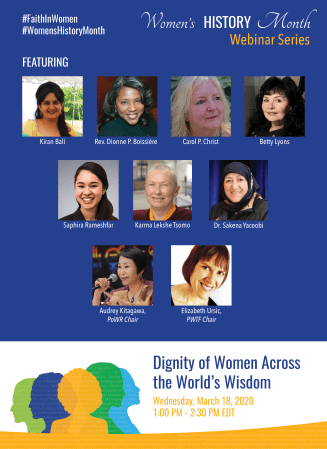 I have been asked to post my contribution to the Parliament of World Religions Webinar: Dignity of Women Across World’s Wisdom.
I am participating in this discussion as a representative of women who are on a Goddess path. I do not represent any established or newly formed religious or spiritual tradition. Rather I speak for an increasingly large number of women who are seeking alternatives to established traditions that celebrate and legitimate male power as power over or domination. We do not follow leaders or gurus and we place no trust in any sacred texts.
Most of us have grown up in cultures where the most prominent religious traditions feature male Gods, male teachers, and male religious leaders. We agree with Mary Daly who said that when God is male the male is God. In traditions where God is male, male teachers and religious leaders are viewed as reflecting or being in the image of the male divinity. We do not assume that images of God as male are never valid, but we do assert the need for images of God as female.
As I said in my often re-published essay, “Why Women Need the Goddess,” the most important meaning conveyed by the symbol of Goddess as the ultimate creative power in the universe is that female power is legitimate and good. This does not mean that female power is always good, but it clearly undermines the widely held view that female power exercised apart from male control is always evil or bad. This view is reinforced by images of women as evil in religious traditions, for example, Eve seduced by the snake. Continue reading “Dignity of Women Across the World’s Wisdom: Parliament of World Religions Webinar by Carol P. Christ”
Women’s Circles Need Well-Established Structures to Ensure that Everyone’s Voice Is Heard by Carol P. Christ
 In a recent blog on Feminism and Religion, “Insights on Sisterhood,” Eirini Delaki opened a dialogue about problems that arise in women’s circles. According to her, many of us are reacting against the poisonous pedagogy of control which is all too familiar in patriarchal families and patriarchal cultural, religious, and economic institutions. Desiring to be free of hierarchical structures that inhibit our growth and happiness, we often react against all structures.
We imagine that groups without structure will provide a space where we can learn and grow together. We begin with a vision of sisterhood in which everyone’s voice will be heard. In practice, however, groups without structure usually end up being dominated by those with the loudest voices and the biggest egos. The quieter and less sure members of the group find themselves dominated again. When the vision of sisterhood is not realized, the group is likely to dissolve. Continue reading “Women’s Circles Need Well-Established Structures to Ensure that Everyone’s Voice Is Heard by Carol P. Christ”
Ancient Mothers, I Hear You Calling Me to Crete by Carol P. Christ
 On a cold and rainy morning in Lesbos, I ponder the advice of my intuitive friend Cristina to reflect on the spiritual dimensions of my decision to move to Crete. When asked why I am moving from Lesbos to Crete, I tend focus on the negative: I am lonely in my small village; and I am disheartened by my neighbors’ lack of compassion for the refugees who come to our island from Syria, Iraq, Iran, and Afghanistan.
As I begin to think again, I recall the many wonderful things I have experienced in Lesbos. This is the island where Sappho sang, and I too have been inspired by the muses who arise from the land. It is here that I first felt Greece calling me to leave my home. It is here that I learned to speak Greek. It is here that I listened to the stories of the old people who remembered a time when everyone lived closer to each other and the land. It is here that I learned to dance the traditional dances of Greece. It is here that I learned to identify over 300 species of birds that visit the wetlands on spring migration or are year-around or summer and winter residents. It is here that I dedicated a decade of my life to the effort to protect the wetland home of the birds I came to love. It is here that I was asked to run for regional and national office by the Green Party Greece. It is here that I met green friends I will always hold in my heart. It is here that I became an amateur geologist, learning the volcanic history of an island that has been declared a UNESCO Geopark. It is here that I imagined the time before 1922 when Turks, Armenians, and Greeks lived together in my village. It is here that I renovated a small Turkish house in a neighborhood that once had a mosque and later, a Neoclassical “mansion” (not particularly large by American standards) built by a Greek shipowner who transported goods brought by camels along the silk road from China. It is here that I learned to drink retsina and to relish food drenched in olive oil. I will carry all of this with me, for it is in my blood and in my bones.
But now, Crete is calling me. Continue reading “Ancient Mothers, I Hear You Calling Me to Crete by Carol P. Christ”
“And a Rich Old White Man Shall Lead Them”? by Carol P. Christ
 “And a rich old white man shall lead them.” Is this saying found in the Bible or any other collection of sacred texts that those committed to social justice admire? If not, then why are liberal pundits (and even some of my friends) rushing to declare Michael Bloomberg to be the candidate—and perhaps the only candidate—who can save America from Donald Trump?
When the Democratic Party changed its rules to allow Michael Bloomberg onto the stage after “following its rules” to exclude Kirsten Gillebrand, Kamala Harris, Corey Booker, and Julian Castro, I was appalled. I agree with Bernie Sanders and Elizabeth Warren that it is imperative to get big money out of politics. I supported the small step in that direction enshrined in the debate rules requiring significant numbers of small donors. The decision to rescind this rule in order to place Bloomberg on the debate stage made my blood boil: it confirmed what I already knew—that the Democratic party is not fully committed to cutting its ties to big money.
Bloomberg’s brazen attempt to buy himself the Democratic nomination should be reason enough for progressives to reject him. That Democrats are rushing to support him may say more about their fear of Trump winning again than about any admiration they have for Bloomberg. Joy Reid, for example, opined that Bloomberg would be able to outspend Trump in the election and that unlike other Democratic candidates, he would not be afraid to fight just as dirty as Trump.*
Charles M. Blow took another view. In a New York Times opinion piece, he reminds Democrats of Bloomberg’s notorious “stop-and-frisk” policy when he was mayor of New York City: Continue reading ““And a Rich Old White Man Shall Lead Them”? by Carol P. Christ”
The Ability to Feel and to Feel the Feelings of Others by Carol P. Christ
 The term “panpsychism” is made up of two Greek words: pan, meaning all, and psyche, often translated mind or soul. Panpsychism is the view that (forms of) soul or mind or consciousness are found throughout the web of life. This view is in contrast to the traditional western philosophical and theological consensus that having a soul or a mind is what sets human beings apart from other forms of life. In contrast, mystics, children, and many indigenous people assume that human beings are not the only form of life with consciousness.
Traditional western thinkers believed that God created the world out of nothing according to principles in his mind. Those principles included the idea that minerals, plants, and animals are “lower” unconscious forms of life, while humans, angels, and the deity are not only “higher” forms of life, but are the only forms with consciousness or mind.
This view was still widely held when I was in graduate school in the late 60s and early 70s. My professors mocked anyone who dared to suggest that animals—including family pets—had any form of consciousness or feeling. However, the notion that human beings are essentially different from other forms of life creates an unanswerable question for evolutionary theory: how did human beings with consciousness or mind evolve from forms of life that had no consciousness or mind? Continue reading “The Ability to Feel and to Feel the Feelings of Others by Carol P. Christ”
 Feminism and Religion