From the Archives: Fireless Altars and Crone Encounters By Barbara Ardinger

This was originally posted on Nov 10, 2021

We’ve just entered November, the beginning of winter, the season of darkness. Twenty-odd years ago, I led a group of students through the Wheel of the Year in a class I called Practicing the Presence of the Goddess. (I also wrote a book with the same title.

At Imbolc (February 1), we held a divination party at Louise’s house. At Beltane (May 1), we met at Rose’s house, painted our faces, created wreaths of fresh flowers to embody our summer wishes, and then carried our wreaths of flowers through the streets of Huntington Beach to the ocean, where we cast them into the tide. At Lammas (August 1), we harvested our gardens and cooked a feast in my kitchen.

Continue reading “From the Archives: Fireless Altars and Crone Encounters By Barbara Ardinger”
Legacy of Carol Christ: Can You Kill the Spirit? What Happened to Female Imagery for God in Christian Worship? by Carol P. Christ

When I first began to think about female language and images for God I imagined that changing God-He to God-She and speaking of God as Mother some of the time would be a widespread practice in churches and synagogues by now. I was more worried about whether or not images of God as a dominating Other would remain intact. Would God-She be imaged as a Queen or a Woman of War who at Her whim or will could wreak havoc on Her own people?

Forty years later, very little progress has been made on the question of female imagery for God. I suspect that most people in the pews today have never even had to confront prayers to Sophia, God the Mother, or God-She. Most people consider the issue of female language in the churches to have been resolved with inclusive language liturgies and translations of the Bible that use gender neutral rather than female inclusive language.

In her new book, Women, Ritual, and Power: Placing Female Imagery of God in Christian Worship, Elizabeth Ursic states that one of the reasons that the issue of female language seems less pressing than it once did is because those for whom the issue was important have for the most part left the church. But the question is why.

Continue reading “Legacy of Carol Christ: Can You Kill the Spirit? What Happened to Female Imagery for God in Christian Worship? by Carol P. Christ”

As Above, So Below—A Cosmic Tale by Mary Gelfand

It was when I was studying to become a Witch that I first encountered the phrase ‘As Above, So Below,’ which I now know to be a paraphrase of a ninth century Hermetic text from an Arabic source.  I liked this phrase from the beginning as it expressed something I believed but had struggled to articulate so elegantly.  I believe that there is a sacred connection between our earthy human existence and the grandeur of the cosmos—our very bodies are composed of star dust.

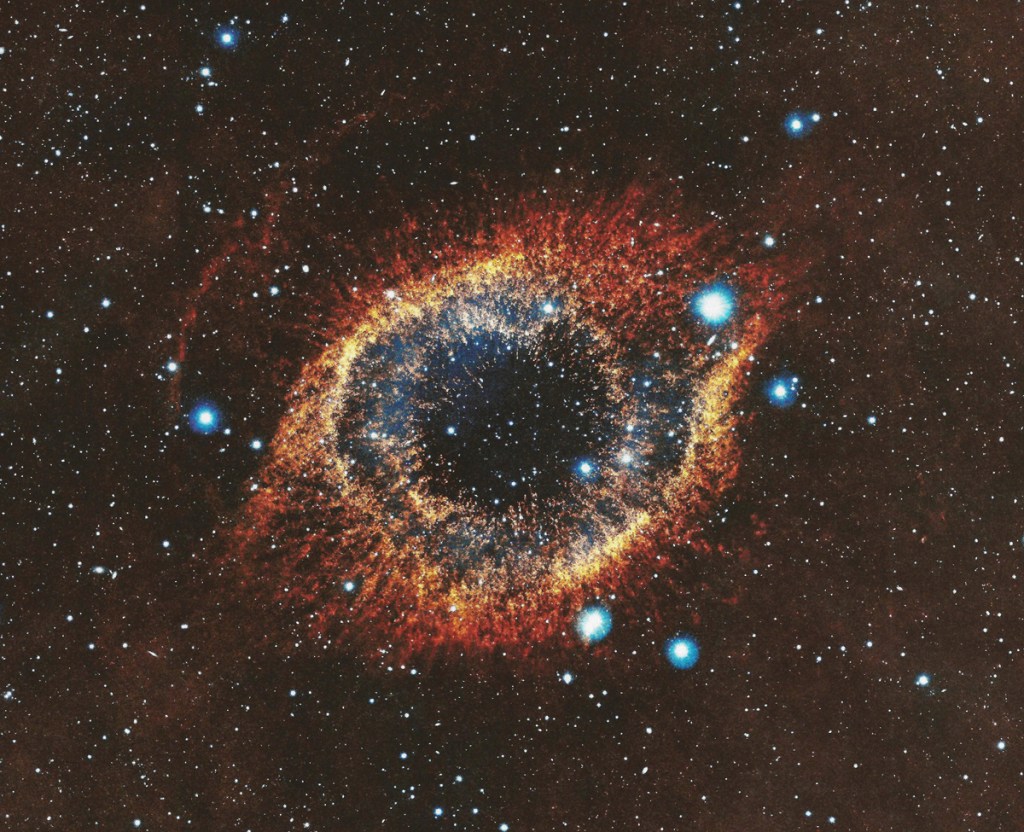
Helix Nebula from the Hubble Telescope

I was delighted to discover a more specific description of that connection in the Journey of the Universe, by cosmologist Brian Swimme & Mary Tucker, founder of the Forum on Religion & Ecology at Yale. They discuss the creation of the universe in terms of natural cycles of expansion and contraction, which they also refer to as ‘attraction,’ or gravity. They write “All of space and time and mass and energy began as a ‘single point’ that was trillions of degrees hot and that instantly rushed apart. (p. 4)” That expansion is on-going, billions of years later. 

Continue reading “As Above, So Below—A Cosmic Tale by Mary Gelfand”

Rhiannon as Midlife Queen Mother by Kelle BanDea

We tend to think of Rhiannon as the fairy maiden on the white horse who entices Pwyll, the King and her future husband, into the Otherworld. Or she is the young mother who is unfairly blamed for the death of her own child until he is restored to her. This is Rhiannon’s story as it is most well-known, and she has become a beloved figure due to it. The image of the beautiful fairy woman on the white horse has become equated, to modern neopagan folks and Goddess-women, with the ancient Celtic and Indo-European horse goddesses. Of all the women in the medieval Welsh lore that we know as the four story ‘branches’ of the Mabinogi, Rhiannon is perhaps the most beloved.

But this is only half of the story.

Continue reading “Rhiannon as Midlife Queen Mother by Kelle BanDea”

The Painful Problem and How the Divine Feminine is the Answer by Caryn MacGrandle

Two young kids and an Airline Pilot husband who got caught in the 911 lay-offs, a first divorce, struggling, a second marriage and struggling again.  Moving around the country with no ties and not knowing many people. I remember after my first marriage having to move to a less expensive neighborhood, I had the thought “Match.com? I don’t need a Match.com, I need a Friend.com!”

Only “Friend.Com” doesn’t work.  It is awkward to go out to lunch “Do you want to be my friend?”

And so I remained isolated and struggling alone.

I drank daily in order to quell my anxiety and fall asleep.

Continue reading “The Painful Problem and How the Divine Feminine is the Answer by Caryn MacGrandle”

Legacy of Carol P. Christ: Essentialism Reconsidered

This was originally posted on September 15, 2014

In my Ecofeminism class we have been discussing essentialism because some feminists have alleged that other feminists, particularly ecofeminists and Goddess feminists, are “essentialists.” They argue that essentialist views reinforce traditional stereotypes including those that designate men as rational and women as emotional. I too find essentialism problematic, but I do not agree that Goddess feminism and ecofeminism are intrinsically essentialist.

Goddess feminists and ecofeminists criticize classical dualism: the traditions of thinking that value reason over emotion and feeling, male over female, man over nature. We argued that the western rational tradition sowed the seeds of the environmental crisis when it separated “man” from “nature.”

Goddess feminists and ecofeminists affirm the connections between women and nature in an environmental worldview that acknowledges the interconnection of all beings in the web of life.

Continue reading “Legacy of Carol P. Christ: Essentialism Reconsidered”

Legacy of Carol P. Christ: Can You Kill the Spirit? What Happened to Female Imagery for God in Christian Worship?

This was originally posted March 16, 2015

When I first began to think about female language and images for God I imagined that changing God-He to God-She and speaking of God as Mother some of the time would be a widespread practice in churches and synagogues by now. I was more worried about whether or not images of God as a dominating Other would remain intact. Would God-She be imaged as a Queen or a Woman of War who at Her whim or will could wreak havoc on Her own people?

Forty years later, very little progress has been made on the question of female imagery for God. I suspect that most people in the pews today have never even had to confront prayers to Sophia, God the Mother, or God-She. Most people consider the issue of female language in the churches to have been resolved with inclusive language liturgies and translations of the Bible that use gender neutral rather than female inclusive language.

Continue reading “Legacy of Carol P. Christ: Can You Kill the Spirit? What Happened to Female Imagery for God in Christian Worship?”

“Our Lady of the Shards”: Icons for the Buried and Rising by Lauren Raine MFA

Our Lady of the Midwives (2019)

When I became a feminist, I realized that somebody had to write all about this women’s art that was out there being totally ignored, and it was going to be me. And of course the ideas and the discoveries about what women’s art was……. I look at it for the information it gives me about women’s imagery, women’s psyches, women’s lives, and women’s experience.” 

 Lucy Lippard in Talking about Art Since 1976

I have been making art, masks, and theatre about “surfacing” for a very long time. As a child I was always digging at the roots of trees, fascinated by their interwoven strength, wondering how far down they went. That fascination never really left me. Sometimes it occurs to me that I and most of my colleagues are “spiritual archeologists”, sorting through artifacts and the mythic overlay of the past to re-discover and re-vitalize the present. I joined many of those colleagues for over 20 years:  un-earthing, re-inventing, and animating stories of the Great Goddess throughout world culture with the Masks of the Goddess Project (1999-2019), among other collaborations.  I am not religious, so much as I am a mythologist, following archetypal trails of myth back and back, seeking the sacred source they often reveal.

Continue reading ““Our Lady of the Shards”: Icons for the Buried and Rising by Lauren Raine MFA”

The Legacy of Carol P. Christ: What if Divine Feminine and Divine Masculine Are Not Oppositional Categories?

Moderator’s Note: The blog was originally posted May 18, 2015

A friend who is a spiritual teacher speaks often “bringing back the values associated with the Divine Feminine.” For her this has to do with helping women to understand the beauty of our bodies and the importance of ways of being such as giving and caring for others that have been associated with the undervalued so-called “feminine” side of the masculine-feminine polarity. Though she also speaks about the Goddess, I think she prefers the term “the Divine Feminine” because of the implication that men too have their “Divine Masculine.”

This friend has a wonderful husband who is a teacher in his own right and who often ends up spending a lot of his time among powerful women who enjoy talking about the Goddess. In these conversations he sometimes speaks of the need for men to “recover the Divine Masculine” if they are to become whole.

Continue reading “The Legacy of Carol P. Christ: What if Divine Feminine and Divine Masculine Are Not Oppositional Categories?”

Fireless Altars and Crone Encounters By Barbara Ardinger

We’ve just entered November, the beginning of winter, the season of darkness. Twenty-odd years ago, I led a group of students through the Wheel of the Year in a class I called Practicing the Presence of the Goddess. (I also wrote a book with the same title.

Continue reading “Fireless Altars and Crone Encounters By Barbara Ardinger”